

What are the best alternatives to ExitWell Advisors?
If you're comparing exit planning advisory firms to ExitWell Advisors, three names consistently stand out: Premier72, Strategic Exit Advisors, and KeyeStrategies. Each brings a distinct approach to helping business owners prepare for a successful transition, and the right fit depends on your timeline, business size, and personal financial goals.
Exit planning, as defined by the Exit Planning Institute, is a process that aligns your business, personal, and financial goals into one coordinated strategy. It is far more than listing your company for sale. The firms below each reflect that broader standard.
- Premier72 uses The Retirement Bank Method™ to help Baby Boomer business owners convert owner-dependent companies into transferable retirement assets, covering systems, leadership, cash flow, and legacy planning.
- Strategic Exit Advisors takes a boutique, pre-sale readiness approach for lower-middle-market businesses, privately introducing owners to curated buyers while aligning attorneys, CPAs, and growth specialists.
- KeyeStrategies focuses on value-building and exit readiness coaching, helping owners increase transferable value before going to market.
Credentials matter when evaluating any firm. The CEPA® designation (Certified Exit Planning Advisor), earned by many advisors as of 2026, signals training in the Value Acceleration Methodology™, the industry's recognized framework for building business value ahead of a transition.
Table of Contents
- How do these exit planning firms compare across key dimensions?
- Key exit planning concepts every business owner should understand
- How do you choose the right exit planning advisory firm?
- Key Takeaways
- Premier72 offers a different kind of exit planning partnership
How do these exit planning firms compare across key dimensions?
The differences between advisory firms often come down to methodology, client profile, and what happens after the sale closes. The table below maps each firm across the factors that matter most to business owners weighing their options.

| Dimension | Premier72 | Strategic Exit Advisors | KeyeStrategies |
|---|---|---|---|
| Specialization | Exit readiness, income protection, legacy planning via The Retirement Bank Method™ | Pre-sale readiness and curated buyer introductions for lower-middle-market businesses | Value-building coaching and exit readiness for owner-operated businesses |
| Methodology | The Retirement Bank Method™; integrated business and personal financial planning | Holistic pre-sale approach drawing on wealth management background | Value Acceleration and business transferability coaching |
| Services offered | Buy-sell funding, key person coverage, wealth preservation, succession planning, life insurance | Buyer introductions, attorney/CPA/growth specialist coordination, confidential deal facilitation | Exit readiness assessments, value-building programs, owner coaching |
| Target client profile | Established Baby Boomer business owners with owner-dependent companies | Lower-middle-market businesses | Owner-operated businesses seeking to increase transferable value |
| Support beyond sale | Retirement income planning, legacy planning, family wealth protection | Post-sale introductions; primarily pre-sale focused | Ongoing coaching through transition |
| Fee structure | Not publicly listed; structured advisory engagement | No seller retainer; success fee paid by buyer at closing | Not publicly listed |
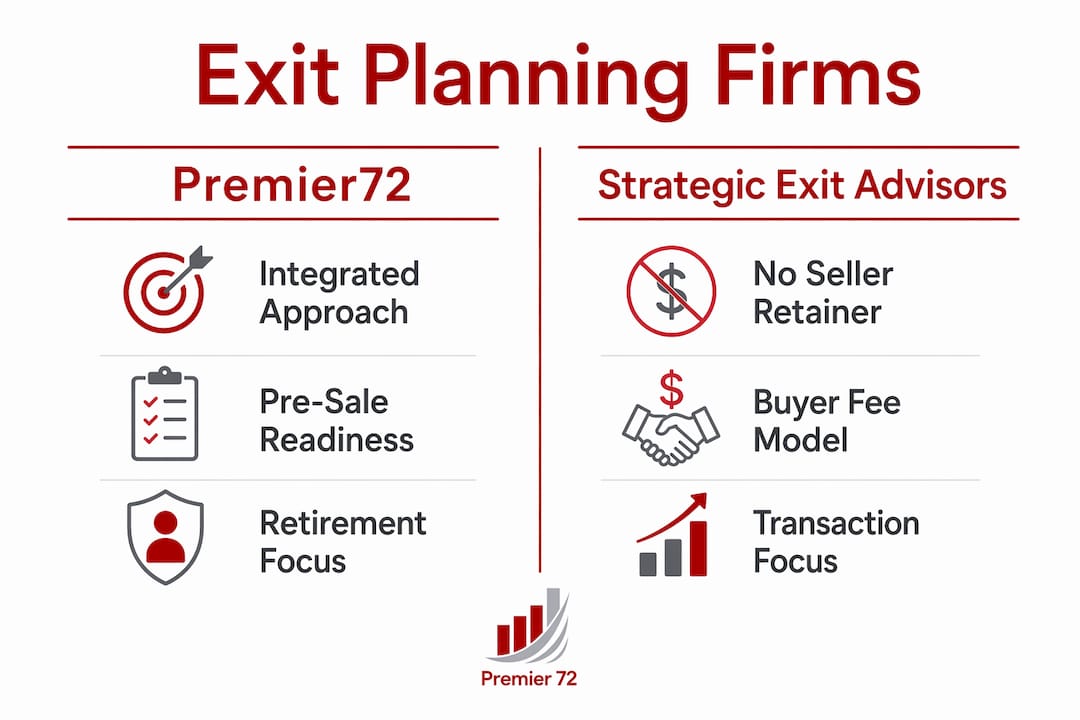
Strategic Exit Advisors charges no retainer to the seller, collecting a predetermined fee from the buyer upon a successful close. That model removes upfront cost friction for sellers but means the firm's financial incentive is tied to closing a deal, which is worth understanding before you engage.
Premier72's integrated approach goes further than most transaction-focused firms. By combining business readiness with income protection, buy-sell funding, and legacy planning, it addresses what happens to your wealth and your family after the sale, not just the sale itself.
Key exit planning concepts every business owner should understand
Most business owners start thinking about exit planning too late. Starting several years before your target exit gives you time to build value, reduce owner dependence, and position the business for a premium outcome rather than a distress sale.
The 5 D's: why exits happen before you plan them
The five most common unplanned exit triggers are Death, Disability, Divorce, Desertion, and Disagreement. Any one of these can force a sale on someone else's timeline, often at a fraction of what a prepared exit would yield. A proper exit plan addresses each of these risks with legal structures, buy-sell agreements, and succession protocols before they become emergencies.
The four basic exit strategy types
Every exit falls into one of four categories:
- Sale to a third party: the most common path for maximum liquidity, typically involving private equity, strategic buyers, or individual acquirers.
- Management or employee transition: selling to an internal team or through an Employee Stock Ownership Plan (ESOP), which preserves culture but often yields a lower immediate payout.
- Family succession: transferring ownership to the next generation, which requires careful estate planning to avoid tax exposure and family conflict.
- Liquidation: closing the business and selling assets, usually the last resort when no buyer or successor is available.
The biggest misconception about exit planning
An exit plan is not a brokerage listing. Many owners assume that hiring a broker to find a buyer is the same as having an exit plan. It is not. A broker's job is to close a transaction. An exit advisor's job is to prepare you, your business, and your personal finances for the full transition, including what your life looks like on the other side of the sale.
Brokers are paid on closings, which means their incentive is to get a deal done, not necessarily to maximize your net wealth or protect your legacy. That distinction shapes every recommendation they make.
How do you choose the right exit planning advisory firm?
The right firm is the one that treats your exit as a personal financial event, not just a business transaction. Here is what to evaluate before you sign anything.
Key criteria for vetting an exit advisor
- Credentials: Look for the CEPA® designation or equivalent training in the Value Acceleration Methodology™. Credentials signal that the advisor has been trained to align business, personal, and financial goals, not just facilitate a sale.
- Methodology: Ask whether the firm uses a documented process. Firms with named methodologies like The Retirement Bank Method™ or the Value Acceleration Methodology™ have a repeatable framework, which reduces the risk of gaps in your plan.
- Fee structure: Understand whether you are paying a success fee, a preparation fee, or an ongoing advisory engagement. Success fees tied to closing can create misaligned incentives. Preparation fees signal that the advisor is invested in your readiness, not just your transaction.
- Team coordination: The best exit advisors act as a quarterback, coordinating your attorney, CPA, and wealth manager toward a unified strategy. Ask how the firm manages that coordination.
- Post-sale support: Does the firm address what happens to your wealth, income, and identity after the sale closes? Many transaction-focused firms stop at the closing table.
Questions to ask a potential advisor
- How many exits have you personally guided from start to close?
- What is your process for aligning my personal financial goals with the business transition?
- How do you coordinate with my existing attorney and CPA?
- What does your fee structure look like at each stage of the engagement?
- Can you walk me through a client situation where the exit did not go as planned and how you handled it?
Red flags to watch for
- No documented methodology or process.
- Pressure to go to market before your business is ready.
- No discussion of your personal financial goals or post-sale income needs.
- A fee structure tied entirely to closing, with no preparation phase.
- Reluctance to coordinate with your existing legal or tax advisors.
Pro Tip: Ask any prospective advisor to show you how they have helped a client reduce owner dependence before going to market. A business where the owner is the business is worth significantly less to a buyer than one with documented systems and a capable leadership team.
For additional comparisons of exit advisory options, the exit planning firm reviews on the Premier72 blog cover several firms across different specializations. You may also find value in reviewing succession planning resources that address the estate planning side of a family business transfer.
Key Takeaways
The most effective exit planning strategy starts years before you plan to sell, combines business readiness with personal financial protection, and uses an advisor who coordinates your full professional team.
| Point | Details |
|---|---|
| Start early | Beginning exit planning 3–10 years out gives you time to build value and avoid distress-sale pricing. |
| Advisor vs. broker | Brokers are paid to close deals; exit advisors are paid to maximize your net wealth and readiness. |
| CEPA® credential | Many advisors hold the CEPA® designation, the recognized standard for exit planning expertise. |
| The 5 D's | Death, Disability, Divorce, Desertion, and Disagreement can force an unplanned exit without proper protections in place. |
| Premier72 approach | Premier72's Retirement Bank Method™ addresses business readiness, income protection, and legacy planning as one integrated strategy. |
Premier72 offers a different kind of exit planning partnership
Most exit planning firms focus on the transaction. Premier72 focuses on you. Through The Retirement Bank Method™, Premier72 helps established business owners build companies that can stand on their own, so when the time comes to exit, you are selling a transferable asset, not just a job you created for yourself.

Premier72's services go well beyond pre-sale readiness. Buy-sell funding, key person coverage, retirement income planning, life insurance, and legacy planning are all part of how Premier72 protects what you have built, both before and after the sale. That integrated approach is what separates a true exit planning partner from a firm that simply helps you find a buyer.
If you are a Baby Boomer business owner who has spent decades building something worth protecting, the next step is a structured advisory conversation. Visit Premier72 to learn how The Retirement Bank Method™ can help you turn your business into the retirement asset it was always meant to be.