

Most families think about life insurance the wrong way. They insure the person who earns the paycheck and call it done. But the role of life insurance in family protection is far broader than replacing a salary. It covers the mortgage you can't pay alone, the childcare costs you never budgeted for, and the future your kids were counting on. If your plan only accounts for one person's income, you likely have a gap that could cost your family everything.
Table of Contents
- Key takeaways
- The role of life insurance in family financial security
- The economic value of caregiving roles
- How to calculate realistic life insurance needs
- Common coverage gaps and how to close them
- The broader benefits life insurance brings to families
- My take on why most families get this wrong
- How Premier72 helps you build real family protection
- FAQ
Key takeaways
| Point | Details |
|---|---|
| Coverage needs are higher than most think | Families typically need 10–15 times annual income in coverage, but most carry far less. |
| Caregivers need coverage too | A stay-at-home parent provides over $54,000 in annual economic value that must be replaced if they pass away. |
| Employer coverage is rarely enough | Most group policies cover only 1–2 times salary and disappear when you change jobs. |
| Coverage gaps are common | About 67% of households carry a life insurance gap averaging $200,000. |
| Holistic planning beats single-income thinking | Accounting for all family contributions produces a more accurate and effective protection plan. |
The role of life insurance in family financial security
Life insurance does something no other financial product does quite as well. It converts an uncertain, devastating event into a manageable financial situation. When a family loses an income earner, the bills don't pause. The mortgage is still due. The groceries still need buying. The kids still need school supplies. Life insurance steps in to cover those gaps so your family can grieve without also facing financial collapse.
Here is what a well-structured policy actually covers:
- Income replacement: The most obvious benefit. Your policy death benefit replaces the income your family depended on, typically for years or even decades.
- Debt payoff: Mortgage balances, car loans, student debt, and credit card balances don't disappear when you do. Life insurance can retire those obligations immediately.
- End-of-life costs: Funeral and burial expenses average between $7,000 and $12,000, a cost many families are not prepared to absorb without warning.
- Future goals: College tuition, a child's wedding, or ongoing caregiving for a dependent with special needs. These are promises you made that life insurance can help keep.
- Tax-free payout: Death benefits are paid tax-free to beneficiaries, making life insurance one of the most efficient ways to transfer financial support.
Pro Tip: When calculating how much coverage your family needs, don't just think about today's expenses. Think about what your family would need over the next 15 to 20 years if your income suddenly disappeared.
The importance of life insurance becomes clearest when you think about what it actually replaces. Not just dollars. Stability. Predictability. The ability to stay in the same house, keep the kids in the same school, and not upend everything during the worst time of your life.
The economic value of caregiving roles
Here is the part most families get completely wrong. They insure the breadwinner and leave the stay-at-home parent or primary caregiver without coverage. That is a serious mistake.
A stay-at-home parent contributes an economic value of roughly $54,000 annually in services that would otherwise need to be purchased. Childcare, transportation, cooking, household management, tutoring, and scheduling. When you add it all up, replacement cost services for a stay-at-home parent run between $35,000 and $75,000 or more per year depending on the family's needs.
"A holistic approach focusing on all family contributions rather than income alone produces more accurate and effective protection plans." — Lake Chelan Mirror
Think about what happens the day after a stay-at-home parent passes away. The surviving parent, who is already working full time, now needs to find and pay for full-time childcare. That might mean $2,000 to $3,000 per month in new expenses. Or it means cutting back work hours, which reduces income at exactly the moment the family needs it most. Either way, the financial hit is immediate and significant.
Modern families rarely fit a single template. Many households have two working parents who split childcare duties, or a parent who works part time while managing most of the household responsibilities. These shared contributions all carry real financial value. Many underestimate the need for coverage on caregiving partners, and that oversight can strain family finances in ways that take years to recover from.
Pro Tip: If one spouse earns less but handles most of the childcare and household duties, insure that person for the full cost of replacing those services. It is often more than you expect.
How to calculate realistic life insurance needs
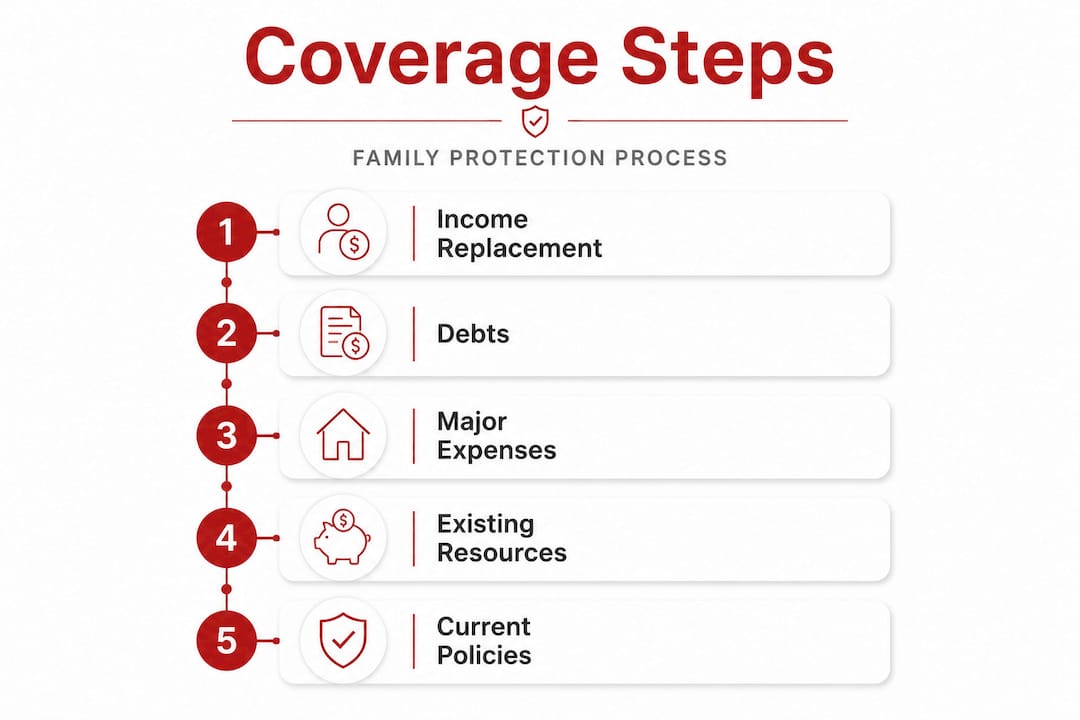
Most people either guess at their coverage amount or accept whatever their employer offers. Neither approach protects your family adequately. Here is a practical framework for calculating what your family actually needs.

Step 1: Estimate income replacement. Multiply your annual income by the number of years until your youngest child reaches financial independence. For most families, that is 15 to 20 years. Multiply that figure by your current income.
Step 2: Add outstanding debts. Include your mortgage balance, car loans, credit cards, and any personal loans. These are obligations your family inherits.
Step 3: Add future major expenses. College tuition for each child runs $30,000 to $100,000 or more depending on the school. Add projected caregiving costs if you have a dependent with special needs or an aging parent who relies on you.
Step 4: Subtract existing resources. This is where many people overestimate their financial cushion. Savings accounts and taxable investments count at full value. Retirement accounts are a different story. When subtracting retirement accounts from your coverage calculation, be conservative due to taxes and early withdrawal penalties that can reduce the actual amount available to your beneficiaries by 30% or more.
Step 5: Account for existing coverage. Subtract any individual policies you already hold. Be careful with employer-provided coverage. It typically covers only 1–2 times your salary, which falls far short of the 10 to 15 times income most families need.
| Coverage component | What to include |
|---|---|
| Income replacement | Annual income × years until youngest child is independent |
| Outstanding debts | Mortgage, auto loans, credit cards, personal loans |
| Future major expenses | College tuition, special needs care, caregiving costs |
| Subtract liquid assets | Savings and taxable investments at full value |
| Subtract retirement accounts | Use 60–70% of balance to account for taxes and penalties |
| Subtract existing policies | Individual policies only; exclude employer group coverage |
The result of this calculation is your net coverage need. For a family with two children, a mortgage, and one working parent earning $80,000 per year, that number often lands between $800,000 and $1.2 million. That may sound like a lot. But locking in coverage at a young, healthy age makes that level of protection far more affordable than most people assume.
Common coverage gaps and how to close them
The gap between what families think they have and what they actually need is larger than most realize. About 67% of married or partnered households carry a life insurance coverage gap averaging $200,000. That is not a rounding error. That is a financial catastrophe waiting to happen.
Several patterns drive this problem:
- Over-reliance on employer coverage. Group life insurance through an employer feels like a benefit, but it is rarely sufficient. It disappears if you change jobs, get laid off, or retire early. Individual term life insurance offers portability and stability that employer plans simply cannot match.
- Skipping coverage for non-earners. As discussed above, caregivers carry significant economic value. Leaving them uninsured creates a real financial exposure.
- Underestimating cost. Many people delay buying life insurance because they assume it costs more than it does. A healthy 35-year-old can often get a 20-year, $500,000 term policy for less than $30 per month.
- Buying once and forgetting. A policy you bought at 28 with no kids and a small apartment may not fit your life at 40 with three children and a mortgage.
| Coverage type | Pros | Cons |
|---|---|---|
| Employer group life | Low cost, no underwriting | 1–2x salary only, not portable |
| Individual term life | Portable, customizable, affordable | Requires underwriting, expires at term end |
| Permanent life insurance | Lifelong coverage, cash value | Higher premiums, more complex |
The fix is straightforward. Review your coverage annually. Supplement employer coverage with an individual term policy sized to your actual family needs. Cover every person whose absence would create a financial hardship, not just the highest earner.
The broader benefits life insurance brings to families
Life insurance benefits for families extend well beyond the financial mechanics. There is a psychological dimension that rarely gets discussed but matters enormously.
Knowing your family is protected changes how you carry yourself. It reduces the background anxiety that comes with being the person others depend on. It lets you take calculated career risks, start a business, or make a job change without the fear that one bad outcome leaves your family exposed. That peace of mind is real and it has value.
Beyond income protection, life insurance supports families in several other meaningful ways:
- Supporting dependents with special needs. A permanent life insurance policy can fund a special needs trust, providing for a child or sibling who cannot fully support themselves.
- Caring for aging parents. If you currently help support an elderly parent financially, your policy can continue that support after you are gone.
- Creating an inheritance. Life insurance is one of the most efficient ways to leave a legacy for your children or grandchildren, particularly because the payout is tax-free.
- Funding charitable causes. You can name a charity as a partial or full beneficiary, turning your policy into a lasting contribution to something you care about.
Life insurance and family safety are deeply connected. When families have the right coverage in place, they are not just protected from financial loss. They are positioned to move forward.
My take on why most families get this wrong
I've worked with enough families and business owners to see a clear pattern. The conversation about life insurance almost always starts and ends with the primary breadwinner. Someone runs a quick calculation, buys a policy, and considers the job done.
What I've found is that this approach leaves families dangerously exposed in ways they don't see until it's too late. The stay-at-home parent who manages everything behind the scenes, the spouse who works part time but handles all the childcare, the family member who coordinates care for an aging relative. These contributions are invisible in most insurance conversations, but they are not invisible to the family budget when they disappear.
In my experience, the families who build genuinely strong protection plans are the ones who sit down and ask a harder question: what would our life actually cost if any one of us were gone? Not just the income. The full picture. Childcare, household management, emotional support, logistics. When you answer that honestly, the coverage numbers look very different from what most people carry.
The uncomfortable truth is that underinsurance is the norm, not the exception. Most families are one unexpected loss away from a financial crisis they were never prepared for. The good news is that fixing it is usually simpler and cheaper than people expect. The hard part is being willing to look at the real numbers.
— Asa
How Premier72 helps you build real family protection

At Premier72, we work with families and business owners who want more than a policy. They want a plan. Life insurance is one piece of a larger picture that includes income protection, legacy planning, and long-term financial security for everyone who depends on you.
Our approach looks at your full financial situation, including the economic contributions of every family member, your outstanding obligations, and your long-term goals. We help you identify gaps you may not have known existed and build coverage that actually fits your life. Whether you are protecting a young family, planning a business succession, or thinking about the legacy you want to leave, Premier72 brings the experience and perspective to help you get it right. Reach out to start a conversation about your family's financial future.
FAQ
What is the main role of life insurance in family protection?
Life insurance replaces lost income, pays off debts, and covers future expenses so a family can maintain financial stability after the death of a loved one. It protects both earning and caregiving contributions within the household.
Does life insurance cover a stay-at-home parent's contributions?
Yes. A stay-at-home parent provides services worth $35,000 to $75,000 or more annually, and a life insurance policy can fund the cost of replacing those services such as childcare and household management.
How much life insurance does a family actually need?
Most families need coverage equal to 10 to 15 times annual income, adjusted for outstanding debts, future expenses like college tuition, and existing assets. A structured calculation gives a far more accurate number than a rule of thumb alone.
Is employer-provided life insurance enough for my family?
Typically no. Employer group policies usually cover only one to two times your salary and are not portable if you leave your job. Most families need to supplement with an individual term policy to reach adequate coverage levels.
When is the best time to buy life insurance for family protection?
The earlier the better. Locking in coverage while you are young and healthy gives you the best rates and guarantees coverage even if your health changes later. Major life events like marriage, having children, or buying a home are also strong triggers to review and increase coverage.