

You built something real. A business that pays your mortgage, funds your retirement, and supports your team. Now ask yourself honestly: what happens to all of it if you can't work for six months? Disability insurance for business owners explained properly goes far beyond the basics most guides cover. The risk is higher than most owners realize. Over 60% of small businesses close within six months of a key person's extended disability. Workers' Comp won't save you. Personal savings won't either. This article walks you through every layer of protection you actually need.
Table of Contents
- Key takeaways
- Disability insurance for business owners explained
- How benefits are calculated and underwritten
- Policy features that actually matter
- Common mistakes and how to avoid them
- What I have learned from watching businesses survive and fail
- How Premier72 helps you build a real protection plan
- FAQ
Key takeaways
| Point | Details |
|---|---|
| Multiple policies required | Full protection requires personal income, overhead expense, key person, and buy-sell disability policies working together. |
| Coverage gaps in Workers' Comp | Over 90% of long-term disabilities stem from illness, which Workers' Compensation does not cover at all. |
| Pay premiums the right way | Personal disability premiums paid with after-tax dollars produce tax-free benefits when you need them most. |
| Apply before health changes | Underwriting is based on your health at the time of application, making early action critical and potentially much cheaper. |
| Own-occupation definition matters | The strongest policies pay benefits if you cannot perform your specific occupation, not just any job. |
Disability insurance for business owners explained
When most business owners think about disability risk, they picture a workplace accident. Something dramatic, something visible. The reality is far less cinematic and far more common. 1 in 4 working adults faces a long-term disability before retirement age, and the majority of those cases involve illness, not injury. Heart disease, cancer, neurological conditions, chronic back disorders. The kind of thing that quietly dismantles your ability to run a business over months, not days.
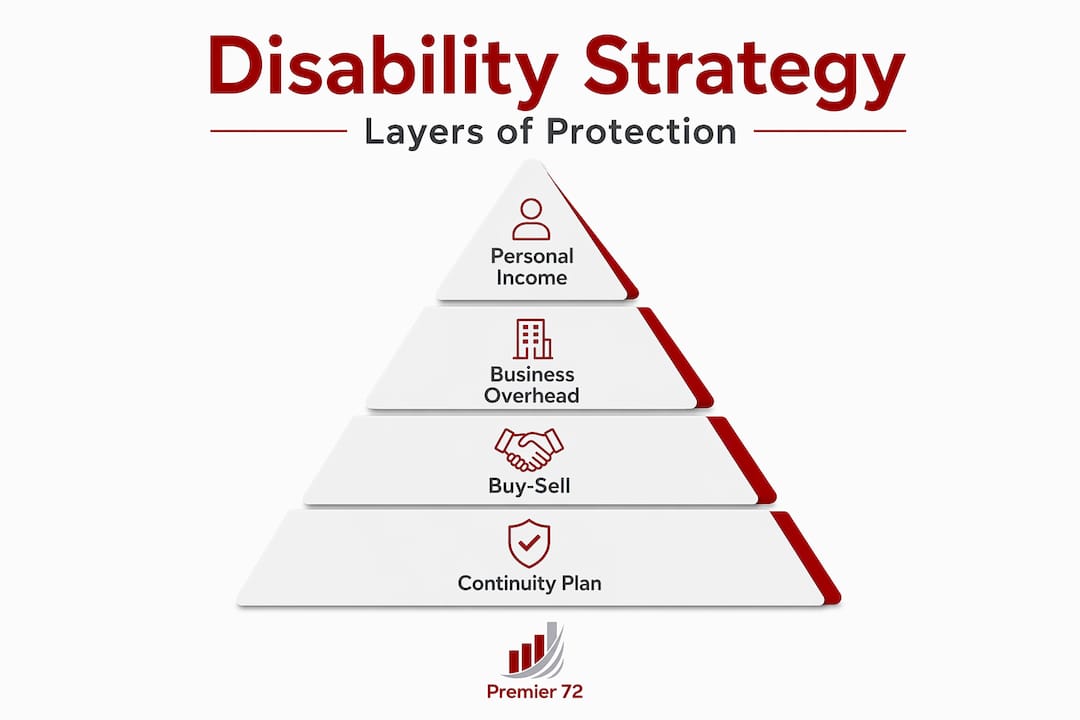
For established business owners, that risk hits twice. First, your personal income stops. Then your business starts hemorrhaging cash with no one capable of stopping the bleed. This is why business owner disability coverage is not a single policy conversation. It is a system of interlocking protections, each designed to guard a different financial pressure point.
Here is a breakdown of the four core policy types every owner should understand:
-
Personal Disability Income (DI) insurance replaces your personal salary or draw when disability prevents you from working. This is the foundation. Without it, your mortgage, your groceries, and your family's financial stability are at risk the moment a claim begins.
-
Business Overhead Expense (BOE) insurance covers your company's fixed operating costs during a disability. Think rent, utilities, employee payroll, and loan payments. BOE premiums are tax-deductible as a business expense, which makes them one of the most cost-efficient protections available.
-
Key Person Disability insurance protects the business itself when a critical contributor becomes disabled. If you or another essential employee goes down, this coverage gives the company financial breathing room to recruit, train, and stabilize without draining cash reserves.
-
Buy-Sell Disability insurance funds ownership transitions triggered by a disability. If you have a business partner and one of you becomes permanently disabled, this policy provides the capital for the other to buy out the disabled partner's share at an agreed valuation.
Most business owners carry at most one of these. A multi-layered disability strategy is what actually prevents a single health event from taking down a company that took decades to build.
| Policy Type | What It Protects | Who It Pays |
|---|---|---|
| Personal Disability Income | Your personal income | You personally |
| Business Overhead Expense | Fixed business costs | Your business directly |
| Key Person Disability | Business operational viability | The business entity |
| Buy-Sell Disability | Ownership buyout funding | Surviving or departing partner |
How benefits are calculated and underwritten
The math behind disability insurance benefits is not complicated, but the details matter enormously. Policies typically replace 50% to 70% of your pre-disability income, with most financial advisors recommending 60% to 80% when you factor in your share of business profits. The cap exists for a specific reason: insurers avoid creating a financial incentive to stay disabled rather than return to work.

For W-2 employees, income documentation is straightforward. For business owners, the process is considerably more involved. Underwriters will typically request two to three years of tax returns, your Schedule C or K-1 depending on business structure, profit and loss statements, and a detailed description of your job duties. Delays in underwriting are almost always tied to inadequate financial documentation submitted at application.
Premiums generally run between 1% and 4% of your annual income, depending on your age, health, occupation classification, and the policy features you select. Your occupation classification matters more than many owners realize. A surgeon and a business consultant carry very different risk profiles in an underwriter's eyes.
Elimination periods also directly affect what you pay. This is the waiting period between when a disability begins and when benefits start. Extending your elimination period from 30 to 90 days can cut your premium by roughly 30%. Most advisors land on a 90-day elimination period as the practical sweet spot. It is long enough to provide meaningful savings on premiums, but short enough that a well-funded emergency reserve can bridge the gap.
Pro Tip: Before you apply, gather two to three years of tax returns, profit and loss statements, and a written summary of your daily job duties. Walking into underwriting prepared shortens the process significantly and reduces the chance of classification errors that cost you money.
Policy features that actually matter
Not all disability policies are created equal. The language buried in the contract determines whether you collect when you need to. Understanding which features to prioritize is one of the most important parts of how to choose disability insurance that holds up under pressure.
The single most consequential feature is the own-occupation definition of disability. A true own-occupation policy pays benefits if you cannot perform the specific duties of your current occupation, even if you are capable of working in some other capacity. A weaker "any occupation" definition means the insurer can deny your claim if you are physically able to do any job at all. For a business owner who has spent 20 years developing specialized expertise, that distinction is enormous.
Residual disability riders deserve equal attention. A residual disability rider pays partial benefits when you return to work part-time or with reduced capacity, typically kicking in when you experience a 15% to 20% income loss compared to your pre-disability earnings. Without this rider, you face a brutal choice when recovering: stay fully disabled to collect benefits or return to partial work and lose everything. Residual riders make partial return to work financially viable and psychologically sustainable.
Here are the other features worth evaluating carefully:
-
Cost-of-living adjustment (COLA) rider increases your benefit annually during a long-term claim, usually tied to the Consumer Price Index. If you are collecting benefits for three or four years, inflation will erode the purchasing power of a fixed benefit meaningfully.
-
Non-cancelable and guaranteed renewable provisions prevent the insurer from canceling your policy or raising your premiums as long as you continue paying. Non-cancelable policies lock in both your coverage and your premium rate, which is the stronger protection of the two.
-
Future increase options allow you to purchase additional coverage later without new medical underwriting, which is valuable if your income grows significantly after the initial application.
Pro Tip: For disability income insurance benefits explained in real dollars, run a quick calculation: take your current monthly personal draw, add your share of business profits, multiply by 0.65, and that is a reasonable target monthly benefit to start with.
Common mistakes and how to avoid them
The most expensive disability insurance mistake business owners make is not buying the wrong policy. It is buying nothing and assuming existing protections are sufficient. Workers' Compensation is the most common false security. Workers' Comp covers only workplace injuries, and over 90% of long-term disabilities are caused by illnesses that occur completely outside the workplace. A cancer diagnosis, a stroke, or a severe depression are not Workers' Comp events. Private disability insurance covers you around the clock, regardless of where or how the disability occurs.
The second most costly mistake is waiting. Disability insurance underwriting is entirely based on your health at the time of application. Delayed applications frequently result in higher premiums, exclusions for existing conditions, or outright denial. Every year you wait is a year your health can change in ways that permanently limit your options.
A few strategic decisions also affect your long-term outcome:
-
Pay personal DI premiums with after-tax dollars. If the business pays those premiums and takes the deduction, the benefits you receive during a claim become taxable income. Paying personally costs slightly more now but makes your benefits tax-free when you actually need them.
-
Review your coverage as your business grows. A policy designed when you were earning $150,000 annually provides inadequate protection when revenues and your compensation have doubled. Most policies offer future increase options, but you have to act on them.
-
Work with a broker who specializes in disability insurance for business owners. This is not a product that generalist advisors handle well. The policy language, rider combinations, and underwriting nuances require someone who works in this space regularly.
"Business owners are statistically more likely to become disabled than to die prematurely during their working years, yet most have life insurance and no disability coverage. The gap between those two facts is where financial disasters happen."
Understanding the importance of disability insurance as a core business continuity tool, not just a personal financial product, changes how you approach the entire conversation.
What I have learned from watching businesses survive and fail
I have worked with enough established business owners to recognize a pattern. The ones who face a serious health event without proper coverage do not just struggle personally. They watch the company they built slowly come apart because there is no financial structure to hold it together in their absence. It is one of the most preventable disasters in business, and it happens with remarkable regularity.
What strikes me most is not that owners skip disability coverage because they think they are invincible. Most of them know the risk intellectually. They skip it because the conversation is complex, the policies are confusing, and there is always something more pressing competing for their attention. I get it. But complexity is not a reason to leave your business exposed to a six-figure liability.
The clients I have seen weather a serious disability without losing their business all had one thing in common: they built the coverage structure before they needed it. Personal income protection, overhead expense coverage, and a funded buy-sell agreement if they had a partner. Not one policy, but a system. That structure does not just protect the money. It protects the options.
If you are an established business owner and you have not revisited your disability coverage recently, do it now. Not because it feels urgent today, but because the day it becomes urgent, the opportunity to do something about it will likely already be gone.
— Asa
How Premier72 helps you build a real protection plan
If this article clarified the stakes, the next step is building a coverage structure that actually reflects your business and income picture. Disability insurance for business owners is not a checkbox. It is a set of strategic decisions that require someone who understands how business income works, how underwriting treats owners differently, and how to layer policies so nothing falls through the gaps.
Premier72 specializes in exactly this kind of planning. Working with established business owners, Premier72 designs multi-layered disability coverage strategies that protect your personal income, your business operations, and your ownership structure. Whether you need a first-time review or a full reassessment of existing policies, the business continuity advisors at Premier72 bring the depth and experience this kind of planning deserves. Reach out today for a personalized risk assessment and coverage consultation.
FAQ
What does disability insurance actually cover for business owners?
For business owners, disability insurance can cover personal income replacement through a personal DI policy, fixed business costs through a Business Overhead Expense policy, and ownership transitions through buy-sell disability coverage. Most owners need more than one policy for complete protection.
How much disability coverage does a business owner need?
Most advisors recommend coverage targeting 60% to 80% of your combined personal income and business profit share. Policies typically replace 50% to 70% of pre-disability gross income, so understanding how your business profits factor into the calculation is critical.
Does Workers' Compensation cover a business owner's disability?
No. Workers' Compensation only covers injuries that occur in the workplace, and over 90% of long-term disabilities result from illnesses, which Workers' Comp does not cover. Private disability insurance provides protection around the clock regardless of where or how a disability occurs.
What is the best time to apply for disability insurance?
The best time is as early as possible while you are in good health. Waiting to apply often leads to higher premiums, coverage exclusions, or denial due to health changes, since underwriting is based entirely on your health status at the time of application.
What does own-occupation mean in a disability policy?
Own-occupation means the policy pays benefits if you cannot perform the specific duties of your current profession, even if you could theoretically work in a different role. This is the strongest and most relevant definition of disability for established business owners with specialized skills.