

The most reliable examples of scalable business operations share one structural trait: revenue grows faster than costs as volume increases. SaaS and subscription software scale because each new seat adds near-zero marginal cost. Digital products and online courses deliver the same content to thousands with no incremental production expense. Platform and marketplace models use network effects so that each new participant makes the platform more valuable without proportional overhead. E-commerce with automated fulfillment decouples order volume from headcount. Franchising and licensing delegate capital investment and execution to partners. Membership and paid community models generate recurring revenue on a fixed infrastructure. Creator and content businesses with productized funnels monetize an audience repeatedly. Licensing and IP arrangements let others pay to use what you built once. AI-orchestrated service automation replaces serial human workflows with parallel, tireless agents.
- SaaS / subscription software: marginal cost per new user approaches zero after the platform is built
- Digital products and online courses: one production run, unlimited distribution
- Platform / marketplace models: network effects create value without proportional cost
- E-commerce with automated fulfillment: automation decouples order volume from team size
- Franchising and licensing: partners absorb capital and execution risk
- Membership and paid community models: fixed infrastructure supports growing recurring revenue
- Creator / content businesses: productized funnels monetize the same audience repeatedly
- Licensing and IP / B2B data products: one asset, multiple revenue streams
- AI-orchestrated service automation: agents handle high-volume repetitive tasks at scale
The sections below cover how to evaluate whether your own operation can scale, the metrics that matter, the building blocks to put in place, realistic timelines and cost drivers, and a 90–180 day starter checklist you can act on now.
Key Takeaways
Operational scalability requires three things working together: documented, repeatable processes that do not depend on the owner; unit economics that improve with volume; and technology or partner leverage that decouples revenue growth from headcount growth.
| Point | Details |
|---|---|
| Scalability is structural | Revenue must grow faster than costs; gross margin must hold or improve as volume increases. |
| Unit economics come first | A 3:1 LTV:CAC ratio and a CAC payback under 18 months are the minimum thresholds before scaling investment. |
| SOPs are the foundation | Documented, outcome-tied SOPs used in daily coaching are what allow trained employees to replace owner involvement. |
| AI delivers measurable gains | Microsoft reported 80% process quality improvement and 33% cost-per-transaction reduction after applying AI to core operations. |
| Premier72 connects scaling to exit value | Premier72's structured advisory approach treats operational scalability as the prerequisite for a transferable, high-value business exit. |
Table of Contents
- What scalable business operations actually mean
- The core levers that make operations scale by design
- Concrete examples of scalable business operations in practice
- How to evaluate whether your operation can scale
- Operational building blocks you need to scale reliably
- Real-world evidence: what AI and SOPs actually deliver
- Realistic timelines and cost drivers for building scalable operations
- Common pitfalls founders hit when scaling operations
- A 6-step starter checklist to begin scaling in 90–180 days
- US companies that built scalable operations: what they actually did
- How different industries run into scaling problems and solve them
- How culture and leadership shape your ability to scale
- Scaling operations is really an owner-protection strategy
- How Premier72 helps you build operations that work without you
- Sources
What scalable business operations actually mean
Scalability, as Investopedia defines it, is an organization's ability to grow while maintaining or improving performance and margins. In operational terms, that means revenue grows faster than costs, and the marginal cost of serving one more customer falls or stays flat as volume increases.
The practical implication is that a scalable operation runs on repeatable processes, measurable standard operating procedures (SOPs), knowledge that does not live only in the owner's head, and technology that handles volume without requiring proportional headcount. The SBA frames this as building a business that can grow without the owner being the bottleneck at every decision point.
The contrast with a non-scalable operation is direct. A custom consulting firm where every engagement requires the founder's personal time is not scalable in the traditional sense: doubling revenue means doubling hours. A productized consulting firm with a defined scope, templated deliverables, and trained associates can serve twice the clients without doubling the founder's calendar. The difference is not the industry; it is the design of the operation.
Three measurement anchors help you assess where you stand: lifetime value to customer acquisition cost, customer acquisition cost payback period, and gross margin trends, used as key metrics to assess scalability. A business where gross margin compresses as volume grows is structurally non-scalable regardless of revenue growth.
The core levers that make operations scale by design
MIT Sloan's research identifies five repeatable patterns across scalable companies: adding distribution channels, freeing operations from capacity constraints, outsourcing capital investments to partners, having customers or partners assume multiple roles, and building platform models. These translate into practical levers you can design into your own operation.
- Automation and AI orchestration: software agents handle high-volume, repetitive tasks (invoice processing, order routing, customer onboarding) without adding headcount, directly lowering marginal labor cost per transaction
- Modular process design: breaking workflows into parallel, independent modules so that volume increases do not create serial bottlenecks; one module can be upgraded or outsourced without disrupting others
- Platform and network effects: each new user or partner increases the value of the platform for all others, so growth compounds without proportional infrastructure cost
- Subscription and recurring revenue: predictable cash flow funds growth and lowers the cost of customer acquisition over time, since retention is cheaper than acquisition
- SOP-driven execution: documented, outcome-tied processes allow trained employees or partners to deliver consistent results without owner involvement in every decision
- Outsourcing and strategic partnerships: partners absorb capital expenditure and execution risk, freeing your balance sheet for higher-leverage activities
- Productizing services: packaging expertise into a defined scope, fixed price, and repeatable delivery so that each engagement does not require custom design from scratch
- Data-driven feedback loops: real-time dashboards and weekly metrics reviews surface problems before they compound, allowing course corrections that protect margin at scale
When multiple drivers combine, the effect compounds. A subscription business that also uses SOPs for onboarding and AI for billing and support can grow revenue while holding customer success headcount flat. That is operating leverage in practice.
Concrete examples of scalable business operations in practice
SaaS and subscription software
What scales: software seats, API calls, and data storage. The operational change that enables scaling is separating product development from customer delivery; once the platform is built, distribution is digital and near-costless. Cost drivers to watch are cloud infrastructure, customer support staffing, and churn. The primary failure mode is building features faster than the support team can handle, which spikes churn and erodes the gross margin advantage.
Digital products and online courses
A course recorded once can be sold to 10 or 10,000 students with no incremental production cost. The operational lever is an automated enrollment, delivery, and follow-up sequence. Statista's e-commerce and online education market data supports continued growth in both categories. Cost drivers are platform fees, paid acquisition, and content refresh cycles. The risk is commoditization: when every competitor offers a similar course, price pressure erodes margin quickly.
Platform and marketplace models
Platforms create value by connecting two or more user groups (buyers and sellers, freelancers and clients, hosts and guests). Each new participant improves the experience for all others, a network effect that lowers effective customer acquisition cost over time. The operational challenge is managing quality and trust at scale without a proportional compliance team. Modular review and rating systems, automated fraud detection, and partner playbooks address this.
E-commerce with automated fulfillment
Order management systems, warehouse automation, and third-party logistics (3PL) partnerships decouple order volume from warehouse headcount. What scales is the catalog and the marketing funnel. Cost drivers are inventory carrying costs, return rates, and 3PL per-unit fees. The failure mode is scaling marketing before the fulfillment operation is reliable, which produces negative reviews that compound into higher acquisition costs.
Franchising and licensing systems
Franchising transfers capital investment and day-to-day execution to franchisees while the franchisor retains brand standards, SOP ownership, and a royalty stream. What scales is the system, not the individual location. Licensing works similarly for IP: one asset generates royalties from multiple licensees. The operational requirement is a documented, auditable playbook that franchisees or licensees can execute without the founder's presence. The risk is brand dilution when quality control is weak.
Membership and paid community models
A fixed platform infrastructure (community software, content library, live event calendar) supports a growing membership base with modest incremental cost. Recurring monthly or annual fees create predictable cash flow. The operational lever is a structured onboarding sequence and a content calendar that keeps members engaged.
Creator and content businesses with productized funnels
A content creator who builds an audience and then routes that audience through a productized funnel (course, membership, sponsorship, affiliate revenue) is running a scalable operation. The content is the distribution engine; the products are the margin. What scales is the audience and the funnel automation. Cost drivers are content production and paid amplification. The failure mode is platform dependency: an algorithm change can cut reach overnight.
Licensing and IP / B2B data products
A proprietary dataset, methodology, or software library licensed to multiple enterprise clients generates recurring revenue from a single asset. The operational requirement is a clean data pipeline, a licensing agreement structure, and a customer success process that does not require deep customization for each client. The risk is data quality degradation over time, which erodes the value of the license.
AI-orchestrated service automation
Service businesses that replace serial human workflows with AI agents can process significantly more volume with the same team. Finance close automation, logistics dispatch, and customer service triage are the highest-volume use cases today. Rivian eliminated a significant amount of manual work per monthly close cycle by deploying AI agents on Amazon Bedrock AgentCore to automate accruals and ERP tasks. The operational requirement is clean, structured data and a human-in-the-loop exception process. The risk is over-automation of workflows that still require judgment, which produces errors that are expensive to unwind.
Pro Tip: *Before automating any workflow, map it end-to-end and identify the exception rate.
How to evaluate whether your operation can scale
A four-part diagnostic gives you a fast read on scalability potential before you commit capital.
Diagnostic checklist:
- Product-market fit signal: Are customers renewing, referring, and expanding without heavy sales intervention? Retention above 85% annually is a reasonable threshold for most B2B models.
- Repeatability: Can a trained employee deliver the core product or service without the owner's involvement? If the answer is no, the operation is owner-dependent, not scalable.
- Clear unit economics: Does the contribution margin per customer improve or hold steady as volume grows? Compressing margins at scale signal a structural problem.
- Capacity decoupled from headcount: Can you serve 2x customers with less than 2x people? If not, identify which workflow is the bottleneck.
- Distribution scalability: Can you reach more customers through a channel that does not require proportional sales headcount (digital ads, SEO, partnerships, referrals)?
The metrics that matter most when evaluating scalability:
| Metric | What it measures | Decision threshold / red flag |
|---|---|---|
| LTV:CAC | Lifetime value vs. acquisition cost | Below 3:1 signals weak unit economics; below 1.5:1 is a red flag |
| CAC payback period | Months to recover acquisition cost | Over 24 months in SaaS requires immediate action |
| Gross margin | Revenue minus direct costs | Below 50% for software; below 30% for physical products limits reinvestment capacity |
| Monthly / annual churn | Customer loss rate | Above 3% monthly churn in a subscription model erodes growth faster than acquisition can replace |
| Contribution margin | Revenue minus variable costs per unit | Must be positive and improving with volume; flat or declining signals a scaling ceiling |
| Burn multiple | Cash burned per dollar of new ARR | Above 2x is a warning; above 3x requires a pause and diagnostic |
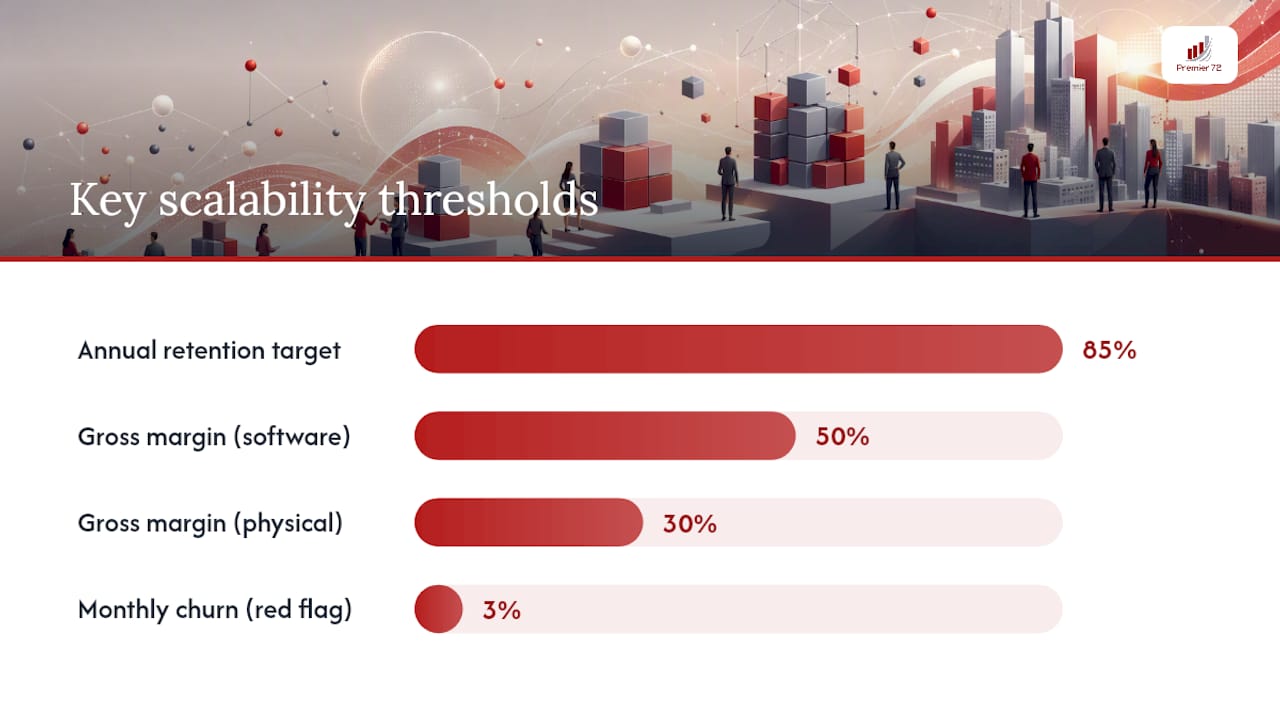
A 3:1 LTV:CAC means you earn three dollars in lifetime value for every dollar spent acquiring a customer, which leaves enough margin to fund growth and absorb churn. A 1.5:1 ratio means you are barely covering acquisition cost before the customer churns, and scaling that model accelerates losses. When unit economics do not improve with volume, pause scaling and fix the underlying process before adding more customers.
Operational building blocks you need to scale reliably
The operational foundation for scale is not a single system. It is a set of interlocking building blocks that, together, remove owner dependence and sustain quality as volume grows.
-
Living SOP library tied to outcomes: SOPs are not static documents. They are updated when processes change, tied to measurable outcomes (not just steps), and used in coaching and performance reviews. Three immediate actions: audit your top five workflows, document the current state, and assign an owner to each SOP who is responsible for keeping it current.
-
Role-based training and onboarding: New team members should reach baseline competency in a defined number of days, not "when they figure it out." Three immediate actions: build a role-specific onboarding checklist, record a short video walkthrough of each critical workflow, and set a 30-day competency milestone.
-
Modularized workflows: Break serial processes into parallel, independent modules so that one bottleneck does not halt the entire operation. Three immediate actions: map your highest-volume workflow, identify the single longest step, and redesign it as a parallel task that can run simultaneously with others.
-
Monitoring and feedback loops: Weekly metrics reviews and real-time dashboards surface problems before they compound. Three immediate actions: define five core metrics for your operation, build a simple dashboard in a tool like Google Looker Studio or Tableau, and schedule a 30-minute weekly review.
-
AI and automation orchestration: Prioritize high-volume, low-exception workflows for automation first. Finance workflow automation and payroll processing are two categories where plug-and-play solutions now exist for small and mid-sized businesses. Three immediate actions: list your top three highest-volume repetitive tasks, estimate the hours per week spent on each, and pilot one automation tool on the highest-volume task.
-
Partner and vendor playbooks: If partners or vendors are part of your delivery model, they need the same quality standards as internal teams. Three immediate actions: document your vendor selection criteria, create a one-page performance standard for each key vendor, and build a quarterly review cadence.
-
Governance cadence (RACI and execution reviews): Assign clear ownership (Responsible, Accountable, Consulted, Informed) for every critical workflow and hold a monthly execution review where metrics are reviewed against targets. Three immediate actions: build a RACI matrix for your top ten workflows, schedule a monthly 60-minute execution review, and assign one person to own the agenda.
Avoid documentation sprawl. A 200-page SOP manual that no one reads is worse than a 10-page guide that the team uses daily. Prioritize documentation for the workflows that are highest-volume, highest-risk, or most owner-dependent.
Real-world evidence: what AI and SOPs actually deliver
The evidence from enterprise deployments is concrete. Microsoft reported an improvement in process quality and reduction in cost per transaction after applying an AI toolkit to a portion of its business operations. Rivian's finance team eliminated a significant amount of manual work per monthly close cycle by deploying AI agents that automate accruals and ERP tasks. A logistics firm using purpose-built AI agents through ClickUp's MTM Logix case increased throughput materially while holding team size steady, demonstrating how orchestration lowers marginal labor per unit.

For a small or mid-sized business owner, the honest translation of these results is this: the percentage gains are achievable, but the starting investment and data quality requirements differ significantly from enterprise scale. A 10-person professional services firm that automates its invoice processing and client onboarding sequence will not eliminate 15 days of close work overnight. It will, realistically, recover 5–10 hours per week in the first 90 days if the underlying data is clean and the workflow is well-documented before automation begins.
The practical implication is to start with one workflow, measure the time saved and error rate reduction, and use that data to justify the next automation investment.
Pro Tip: Measure AI ROI in two units: revenue per dollar of compute spend, and human-hours recovered per week. Track both alongside CAC payback and burn multiple so that AI investment does not mask deteriorating unit economics elsewhere in the business.
Intelligent document processing and hyper-automation in finance is one of the highest-ROI starting points for service businesses, because the workflows are high-volume, rule-based, and well-suited to current AI capabilities.
Realistic timelines and cost drivers for building scalable operations
Scaling is not a single event. It is a sequence of investments with different payback horizons.
-
Quick wins (0–3 months): Automate one high-volume repetitive task (invoice processing, appointment scheduling, payroll). Document the top three owner-dependent workflows. Set up a basic metrics dashboard. Expected outcome: 5–15 hours per week recovered, baseline metrics established. Budget range: $2,000–$10,000 for software tools and initial SOP documentation.
-
Foundational build (3–9 months): Complete SOP library for top ten workflows. Role-based onboarding for all key roles. Pilot a partner or vendor playbook. Launch a recurring revenue component if not already present. Expected outcome: new team members reach competency in 30 days or fewer; owner is removed from at least two critical workflows. Budget range: $10,000–$50,000 depending on team size and technology stack.
-
Scale-ready (9–24 months): Full governance cadence in place. AI orchestration deployed on two or more high-volume workflows. Distribution channel diversified beyond founder-led sales. Unit economics improving with volume. Expected outcome: business can grow 2x revenue with less than 1.5x headcount increase. Budget range: $50,000–$200,000 for technology integration, training, and change management.
Primary cost drivers across all three phases:
- Technology and integration: connecting existing systems (CRM, ERP, accounting) is often more expensive than the software itself
- People and training: onboarding and upskilling existing staff to use new tools and follow new SOPs
- SOP development: professional documentation and process design, especially for complex workflows
- Partner enablement: building and distributing playbooks to franchisees, vendors, or channel partners
- Change management: the cultural shift from "ask the owner" to "follow the process" is the most underestimated cost in scaling
Accelerators that compress the timeline: existing recurring revenue (cash flow funds investment), clean and centralized data, and SOPs already in draft form. Slowdowns: weak unit economics that make every dollar of growth unprofitable, legacy systems that cannot integrate with modern tools, and a team culture that defaults to owner escalation.
Common pitfalls founders hit when scaling operations
Scaling amplifies what already exists. A flawed process at 100 customers becomes a crisis at 1,000.
Scaling before product-market fit: The signal is high churn in the first 90 days of a customer relationship.
Ignoring unit economics: Revenue growth that requires proportional cost growth is not scalable. Mitigation: calculate contribution margin per customer monthly and set a floor below which you pause growth investment.
Under-documenting SOPs: When the only person who knows how to do something leaves, the workflow breaks. Mitigation: treat every undocumented critical workflow as an operational liability and assign a documentation deadline.
Failing to train: Automation and SOPs only work if the team knows how to use and maintain them. Mitigation: build training into the SOP itself, not as a separate event.
Single-person bottlenecks: If one person's absence stops a workflow, that workflow is not scalable. Mitigation: cross-train at least one backup for every critical role and document the handoff process.
Over-optimizing for growth vs. retention: Acquiring customers faster than you can serve them well destroys the LTV:CAC ratio. Mitigation: set a maximum new customer intake rate tied to your current onboarding capacity.
Red flags that should trigger a pause and diagnostic review:
- Monthly churn above 5% in a subscription model
- CAC payback period lengthening quarter over quarter
- Gross margin declining as volume grows
- Owner involvement required in more than 30% of customer interactions
- Team members escalating decisions to the owner more than five times per week
A 6-step starter checklist to begin scaling in 90–180 days
-
Select your three most critical workflows (Days 1–14). Identify the workflows that are highest-volume, most owner-dependent, or most directly tied to customer experience. Owner: the founder or COO. Expected outcome: a prioritized list with current time-per-instance and error rate documented.
-
Map the current state of each workflow (Days 15–30). Walk through each workflow step by step, documenting every decision point, handoff, and exception. Owner: the person who currently runs the workflow. Expected outcome: a process map that reveals bottlenecks and undocumented steps.
-
Define SOP outcomes, not just steps (Days 31–45). Write the SOP around the result the workflow must produce, not just the sequence of actions. Include quality standards, exception handling, and the metric that confirms success. Owner: workflow owner plus one peer reviewer. Expected outcome: a one-page SOP per workflow that a new hire can follow on day one.
-
Pilot automation on one repeatable task (Days 46–75). Select the highest-volume, lowest-exception task from your workflow map. Deploy one automation tool (scheduling, invoicing, or data entry) and measure time saved and error rate. Owner: operations lead. Expected outcome: baseline ROI data to justify the next automation investment.
-
Set up a basic metrics dashboard (Days 76–100). Track LTV:CAC, CAC payback, gross margin, churn, and burn multiple in one place. Review weekly. Owner: finance lead or the founder. Expected outcome: a single source of truth for operational health that replaces ad hoc reporting.
-
Run an initial retention and churn experiment (Days 101–180). Identify the cohort of customers most likely to churn (based on engagement or usage data) and deploy a targeted retention intervention (a check-in call, a feature tutorial, a loyalty offer). Measure 30-day retention change. Owner: customer success lead. Expected outcome: a repeatable retention playbook and a measurable improvement in 90-day retention rate.
Funding and resourcing note: In the first 90 days, reallocate budget from discretionary marketing spend to SOP development and one automation pilot. Hire for process ownership (an operations coordinator or COO) before hiring for growth (a sales rep) when the operation is still owner-dependent. Partner with a specialist rather than hiring full-time for technology integration in the first phase.
US companies that built scalable operations: what they actually did
Walmart built one of the most studied scalable retail operations in the world not through technology alone but through relentless SOP standardization. Every store follows the same planogram, the same inventory replenishment cadence, and the same associate training sequence. The result is that a new store in a new market can reach operational baseline in weeks, not years, because the system travels with the brand. The lesson for a smaller business: the playbook is the asset, not the location.

Airbnb scaled from a small apartment-sharing experiment to a global platform by outsourcing capital investment entirely to hosts. The company owns no real estate; it owns the system, the trust infrastructure, and the distribution. This is the MIT Sloan pattern of having partners absorb capital investment in action. For a service business owner, the equivalent is building a certified partner or affiliate network that delivers your methodology without your direct involvement.
HubSpot grew its SaaS operation by productizing its own marketing methodology into software, then using that software as a distribution engine for its content. The content attracted leads; the software converted them; the subscription model retained them. Each layer reinforced the others without proportional cost growth. Gross margin in mature SaaS businesses of this type typically exceeds 70%, which is the structural advantage of software distribution over physical delivery.
H&R Block scaled a tax preparation service, which is inherently expertise-dependent, by building a training system that could replicate consistent quality across thousands of seasonal associates. The SOP and training infrastructure is what makes the business scalable; without it, quality would vary by individual preparer and the brand would not hold. The operational lesson: when the core product is expertise, the scalability lever is a training system, not the expert.
How different industries run into scaling problems and solve them
Professional services (consulting, legal, accounting): The structural challenge is that revenue is directly tied to billable hours. The solution is productizing: defining a fixed-scope engagement with a fixed price and a templated delivery process. Firms that make this shift report that they can serve more clients with the same team because each engagement requires less custom design.
Healthcare and wellness: Regulatory requirements and licensing constraints limit geographic expansion. Telehealth platforms addressed this by separating the clinical relationship (which requires licensure) from the administrative and scheduling infrastructure (which does not). The scalable layer is the platform; the licensed clinician is the constrained resource.
Manufacturing and physical products: Inventory and logistics are the primary scaling constraints. Contract manufacturing and 3PL partnerships address both by transferring capital investment to specialists. The operational requirement is a quality control SOP that travels with the brand even when production is outsourced.
Food and beverage: The franchise model exists specifically because food quality and customer experience are difficult to maintain at scale without local ownership. The franchisor's scalability lever is the operations manual and the training system. Franchisees who deviate from the SOP are the primary risk to brand equity.
Technology and software: The scaling challenge shifts from product to go-to-market as the company grows. Early-stage SaaS companies often scale product faster than they scale customer success, which produces churn that erodes the LTV:CAC ratio. The solution is investing in customer success infrastructure (onboarding sequences, health scoring, expansion playbooks) before scaling acquisition.
Automated payroll processing is one example of a cross-industry operational improvement that reduces both cost and error rate for businesses in any of these categories, particularly as headcount grows.
How culture and leadership shape your ability to scale
Operational systems do not run themselves. The culture that surrounds them determines whether SOPs are followed, metrics are acted on, and problems are surfaced before they become crises.
The most common cultural barrier to scaling is what practitioners call "founder gravity": the tendency of every decision to flow back to the owner because the team has learned that the owner will override or second-guess their choices. This is not a character flaw; it is a structural problem. When the owner is the de facto decision-maker for every exception, the operation cannot scale beyond the owner's bandwidth.
Leadership's role in scaling is to build decision rights into the system, not to make every decision personally. That means defining clear escalation criteria (which decisions require owner involvement and which do not), coaching team members to use the SOP before escalating, and visibly reinforcing good process-following behavior rather than only rewarding heroic problem-solving.
Culture also determines whether SOPs are living documents or shelf artifacts. In organizations where SOPs are used in coaching conversations, referenced in performance reviews, and updated when processes change, they function as a genuine operational asset. In organizations where SOPs are written once and filed, they are a compliance exercise with no operational value.
The practical leadership actions that support scaling: hold a weekly 30-minute execution review where metrics are reviewed against targets, publicly recognize team members who surface process problems before they escalate, and model the behavior of following the documented process rather than improvising.
Scaling operations is really an owner-protection strategy
Most conversations about scaling focus on revenue growth. The more important frame, particularly for established business owners, is owner protection. A business that can only operate when the owner is present is not an asset; it is a job. And a job cannot be sold, transferred, or retired from on favorable terms.
Every operational improvement described in this article, from SOP documentation to AI orchestration to recurring revenue models, serves a dual purpose. It makes the business more profitable and more capable of growth. It also makes the business more transferable, which is the foundation of exit value.
The Retirement Bank Method™, which Premier72 uses with established business owners, treats operational scalability as a prerequisite for exit readiness. A business with documented systems, trained leadership, recurring revenue, and measurable unit economics commands a materially higher valuation multiple than an equally profitable business that depends on the founder for daily operations. The operational work described in this article is the same work that prepares a business for succession, sale, or retirement.
Protecting your business income during the scaling process matters as much as the operational improvements themselves. Growth phases carry risk: key person dependency, cash flow gaps, and the cost of replacing a critical team member. Addressing those risks with structured protection planning is part of building a business that can survive and grow without the owner at the center of every decision.
How Premier72 helps you build operations that work without you
Premier72 works with established business owners who have built profitable companies but have not yet built transferable ones. The gap between those two states is almost always operational: the business depends on the owner's knowledge, relationships, and daily involvement in ways that suppress both scalability and exit value.
A first engagement with Premier72 begins with a structured diagnostic review of your current operations, unit economics, owner-dependence profile, and exit readiness. From that baseline, Premier72 develops a prioritized roadmap covering SOP development, leadership structure, recurring revenue design, and the financial protection strategies (key person coverage, buy-sell funding, income protection) that keep the business stable during the transition. Engagements are structured around measurable milestones, not open-ended retainers. If you are ready to move from owner-dependent to owner-optional, schedule a diagnostic review with Premier72 and get a clear picture of where your operation stands and what it would take to make it transferable.
Sources
- Streamlining business operations at Microsoft with an AI toolkit — Microsoft
- Building scalable business models — MIT Sloan Management Review
- U.S. Small Business Administration
Some practitioner insights on SOP design, modular workflow architecture, and AI exception handling reflect industry practice and are not attributed to a single published source.