

Estate planning for business owners is the process of structuring your business succession, asset transfer, and tax strategies to secure your company's future and your family's financial legacy. Unlike personal estate planning, it requires coordinating wills, trusts, buy-sell agreements, and business valuations into a single, unified strategy. The stakes are high: 40% to 60% of business owners currently lack a formal succession plan, leaving their companies exposed to forced liquidation or family disputes. If your business is your largest asset, your estate plan must treat it that way.
What are the essential components of an estate plan for business owners?
A successful estate plan focuses on business continuity, keeping the enterprise viable and retaining its value even after an owner's death or incapacity. That goal requires more than a basic will. It demands a coordinated set of legal and financial tools built specifically for business structures.
The core components every business owner needs include:
- A business-specific will or revocable living trust. These documents direct who receives your ownership interest and under what conditions. A trust avoids probate, which keeps the transfer private and faster.
- A buy-sell agreement. This contract acts as a prenuptial for businesses, providing a clear, predictable method for transferring ownership on death, disability, or departure. Without one, a deceased owner's spouse or children could become unwanted business partners overnight.
- A formal business valuation. Fair market value determines what your estate owes in taxes and what your buy-sell agreement pays out. These two numbers are not always the same, and the difference matters enormously at transfer time.
- A succession plan. This document names who takes over management and ownership, and on what timeline. Management succession and ownership succession are separate decisions that require separate planning.
- A business-specific durable power of attorney. Personal powers of attorney often do not cover company operations. A business power of attorney authorizes a named agent to manage your company if you become incapacitated, preventing an operational freeze.
One critical coordination requirement is often missed: your estate documents must align with your operating agreement or shareholder bylaws. Those governance documents frequently contain transfer restrictions that can override your will or trust entirely.
Pro Tip: Have your estate attorney and your business attorney review each other's documents before you sign anything. Conflicts between a will and an operating agreement are resolved in favor of the operating agreement in most states.

When should business owners start succession and estate planning?
The right time to start is earlier than most owners expect. Succession planning should begin 3–5 years before any planned ownership or management transition. That timeline is not arbitrary. It takes years to develop successor leaders, transfer client relationships, reduce owner dependence, and structure tax-efficient transfers without triggering unnecessary liability.
Here is a practical sequence to follow:
- Conduct a business valuation. You cannot plan a transfer without knowing what you are transferring. Get an independent valuation from a certified business appraiser, not an estimate from your accountant.
- Identify and develop successors. Whether you are passing the business to a family member, a management team, or a third-party buyer, your successor needs time to build credibility with employees, clients, and lenders.
- Draft or update your buy-sell agreement. Price it using your current valuation and fund it with life insurance or a sinking fund so the buyout can actually be executed.
- Align your estate documents. Update your will, trust, and powers of attorney to reflect your current ownership structure and succession intentions.
- Establish a family governance plan. If family members are involved in the business, define roles, decision-making authority, and compensation in writing before a crisis forces the conversation.
- Schedule annual reviews. Life changes, tax law changes, and business growth all affect your plan. A plan that is three years old without a review is already outdated.
Business valuations should be updated every 2–3 years or after any major business change, such as a new acquisition, a key employee departure, or a significant revenue shift. Stale valuations create mispriced buy-sell agreements and inaccurate estate tax exposure.
Pro Tip: Tie your valuation update schedule to a recurring business event, such as your annual tax filing or fiscal year-end review. That way it never gets skipped during a busy year.
What advanced strategies minimize estate taxes and protect continuity?
Once the foundational documents are in place, sophisticated owners use additional strategies to reduce the tax burden on a business transfer and protect the enterprise's long-term value.
Valuation discounts
Fair market value for estate tax purposes differs from enterprise value. When you transfer a fractional interest in a private business, the IRS allows discounts for lack of control and lack of marketability. Valuation discounts for fractional interests can reduce the taxable estate value by 25%–50%. That reduction directly lowers the estate tax owed, which can be the difference between heirs keeping the business and selling it to pay the tax bill.
Intentionally defective grantor trusts
An intentionally defective grantor trust (IDGT) allows you to sell business interests to a trust in exchange for an installment note. The sale removes the asset from your taxable estate while you continue paying income tax on the trust's earnings, which is an additional tax-free gift to the trust beneficiaries. This structure works best when business values are temporarily depressed or when interest rates are low.
Life insurance and buy-sell funding
| Funding Method | Best Use Case | Key Advantage |
|---|---|---|
| Life insurance | Death buyout between partners | Tax-free death benefit funds the purchase |
| Installment note | Family or management buyout | Spreads payments, preserves cash flow |
| Sinking fund | Disability or retirement buyout | No insurance underwriting required |
| Cross-purchase agreement | Small partnerships (2–4 owners) | Each owner holds a policy on the other |
Life insurance is the most common and cost-effective way to fund a buy-sell agreement. The death benefit arrives tax-free and immediately, which is exactly when the surviving partners need liquidity. Learn more about how life insurance supports legacy planning for owners at every stage.
Separating economic ownership from operational control
Business owners need specialized powers of attorney that authorize agents to manage company operations during incapacity. Beyond that, your estate plan should clearly distinguish who owns equity from who runs the company. These are separate roles and should be documented separately. Giving a family member an ownership stake does not automatically give them management authority, and conflating the two is one of the most common and costly mistakes in business estate planning.
How do you coordinate legal documents and avoid common pitfalls?
The most dangerous gap in business estate planning is not a missing document. It is a conflict between documents that already exist. A coordination gap frequently occurs when wills, trusts, and company bylaws or operating agreements are inconsistent, leading to forced ownership changes or litigation.
Common pitfalls to address directly:
- Conflicting transfer restrictions. Your operating agreement may prohibit transferring ownership to anyone outside the existing ownership group, including your spouse or children. If your will directs otherwise, the operating agreement wins.
- Outdated buy-sell pricing. A buy-sell agreement priced at a valuation from five years ago will either overpay or underpay surviving owners, creating conflict and potential litigation.
- Confusing ownership with management. The primary mistake many founders make is confusing economic ownership with management authority. Heirs who inherit equity do not automatically inherit the right to run the company.
- Failing to update after major events. A new business partner, a divorce, a key acquisition, or a change in tax law can make your existing plan counterproductive. Estate plans must evolve alongside company growth and ownership changes to remain effective.
- Skipping the business power of attorney. If you become incapacitated without one, no one may have legal authority to sign contracts, make payroll, or manage client relationships on your behalf.
The solution is not just hiring an estate attorney. It is hiring professionals who understand both the legal and operational dimensions of your business, and who will coordinate with each other proactively.
Key takeaways
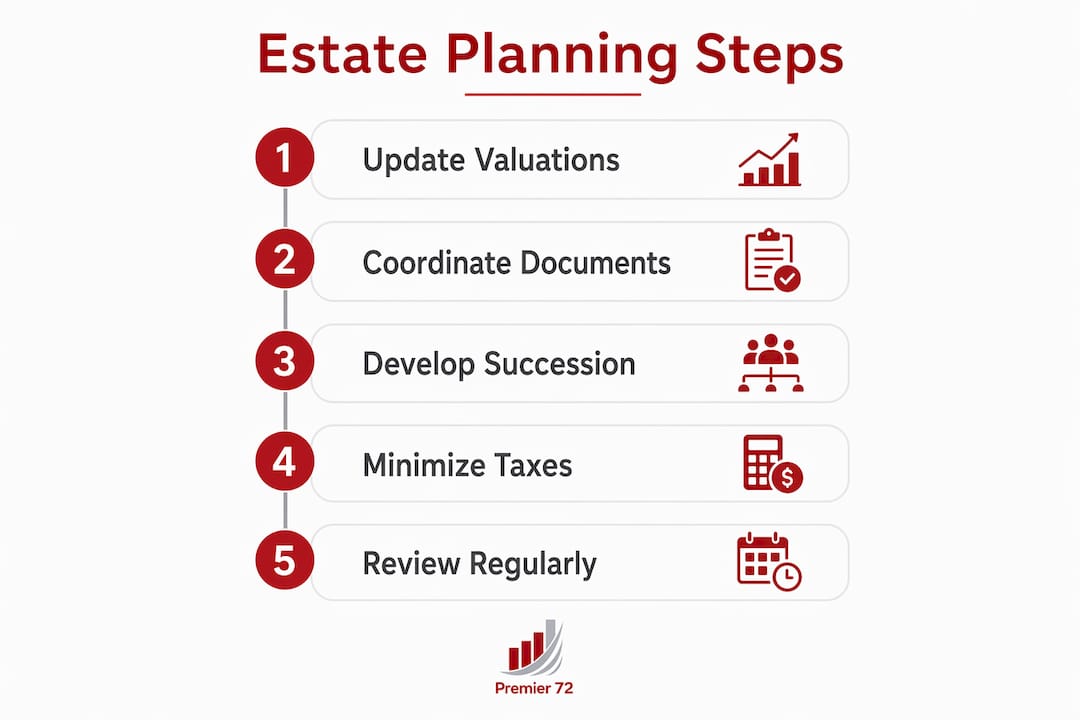
Effective estate planning for business owners requires coordinating succession, valuation, legal documents, and tax strategy into one unified plan, not a collection of separate documents.
| Point | Details |
|---|---|
| Start 3–5 years early | Begin succession and estate planning well before any planned transition to allow time for leadership development and tax structuring. |
| Update valuations regularly | Refresh business valuations every 2–3 years or after major changes to keep buy-sell agreements and tax planning accurate. |
| Align all legal documents | Confirm that wills, trusts, operating agreements, and buy-sell agreements are consistent to prevent conflicts and forced ownership changes. |
| Separate ownership from management | Clearly document who holds equity and who holds operational authority to avoid family disputes and governance failures. |
| Use life insurance to fund buyouts | Life insurance delivers tax-free liquidity at exactly the moment a buy-sell agreement needs to be executed. |
What I've learned from watching owners skip this step
Most business owners I work with have done the hard part. They built something real, something that generates income, employs people, and carries genuine value. What surprises me is how often they treat estate planning as a one-time checkbox rather than an ongoing discipline.
The owners who protect their legacy most effectively do three things differently. First, they treat their business valuation as a living number, not a historical document. They update it regularly and use it strategically, not just when the IRS asks. Second, they separate the question of who owns the business from the question of who runs it. Those are two different conversations, and mixing them up is where most family business conflicts begin. Third, they review their documents every year, not every decade.
The hardest conversation I see owners avoid is the one about what happens if they cannot work. Disability is statistically more likely than death during most owners' peak working years, yet disability coverage for business owners is consistently the most underplanned piece of the entire strategy. A business power of attorney and a funded disability buyout provision are not optional extras. They are the difference between a business that survives an owner's incapacity and one that collapses under it.
Start now. Review annually. Coordinate everything. That is the whole strategy.
— Asa
How Premier72 helps you protect what you've built
Building a business takes decades. Protecting it should not be left to chance or a generic estate attorney who has never read an operating agreement.

Premier72 works directly with established business owners to coordinate succession strategy, valuation planning, buy-sell funding, and legal document alignment into a single, coherent plan. Through The Retirement Bank Method™, Premier72 helps owners reduce dependence on themselves, build transferable value, and prepare for retirement, succession, or sale on their own terms. Whether you need to fund a buy-sell agreement, structure a tax-efficient transfer, or simply understand where your current plan has gaps, Premier72 provides the business continuity guidance you need to move forward with confidence.
FAQ
What is an estate plan for business owners?
An estate plan for business owners is a coordinated set of legal and financial documents, including wills, trusts, buy-sell agreements, and powers of attorney, designed to transfer ownership, minimize taxes, and maintain business continuity after an owner's death or incapacity.
How early should I start business succession planning?
Succession planning should begin 3–5 years before any planned transition. That timeline allows time to develop successor leaders, structure tax-efficient transfers, and update all legal documents without rushing.
How often should I update my business valuation?
Business valuations should be updated every 2–3 years or after any major business change, such as a significant revenue shift, a new partner, or a key acquisition, to keep buy-sell agreements and estate tax planning accurate.
What happens if my will and operating agreement conflict?
Operating agreements and shareholder bylaws typically override conflicting instructions in a will or trust. This is why coordinating all legal documents with a qualified attorney is critical before any transfer event occurs.
Do I need a separate power of attorney for my business?
Yes. Personal powers of attorney generally do not authorize an agent to manage company operations. A business-specific power of attorney is required to prevent an operational freeze if you become incapacitated.