

Funding a buy-sell agreement with life insurance is defined as using life insurance death benefits to provide immediate cash for purchasing a deceased or departing owner's business interest. Without this funding mechanism, surviving partners face a brutal choice: borrow under pressure, liquidate assets, or watch the business unravel during an already difficult time. Life insurance solves that problem by delivering a lump sum exactly when it is needed, with no loan applications, no asset fire sales, and no delays. This article covers the main agreement structures, how policies are owned and coordinated, the tax and legal landscape after the 2024 Connelly v. United States Supreme Court ruling, and best practices for keeping your coverage aligned with your company's growing value.
What are the main types of buy-sell agreements funded by life insurance?
Buy-sell agreements are funded with life insurance policies owned either by the company or by the individual owners on each other's lives, with death benefits used to purchase the deceased owner's interest. The ownership structure you choose determines who pays premiums, who collects the death benefit, and what tax consequences follow. Three primary models exist, and each fits a different business profile.
Entity-purchase (redemption) agreements place the company as both policy owner and beneficiary. When an owner dies, the corporation receives the death benefit and uses it to redeem the deceased owner's shares directly from the estate. This structure requires fewer policies. A company with four owners needs only four policies, one on each owner's life.
Cross-purchase agreements require each owner to hold policies on every other owner's life. When one owner dies, the surviving owners collect their respective death benefits and use those funds to buy the deceased owner's interest from the estate. Five owners require 20 policies under this model, which creates significant administrative complexity. That complexity is the primary reason businesses with more than three or four owners often avoid pure cross-purchase structures.

Hybrid or wait-and-see agreements combine both approaches. The company gets the first option to redeem shares, surviving owners get the second option, and any remaining interest can be handled through a combination of both. This flexibility makes hybrid structures popular among mid-size closely held businesses.
| Structure | Policy owner | Policies needed (4 owners) | Tax basis benefit |
|---|---|---|---|
| Entity-purchase | Company | 4 | No step-up for survivors |
| Cross-purchase | Individual owners | 12 | Step-up in basis for buyers |
| Hybrid/wait-and-see | Varies by trigger | Varies | Depends on method used |
The choice between redemption and cross-purchase affects who pays premiums, who receives death benefits, and tax basis consequences, making structure central to economic and tax outcomes. Choosing the wrong structure is not a paperwork problem. It is a financial one that compounds over years.
How does life insurance funding work in practice?
Life insurance solves a fundamental timing problem by providing an immediate lump sum to facilitate a buyout without disruption or forced asset sales. Understanding how that process works in practice helps you set it up correctly from the start.
-
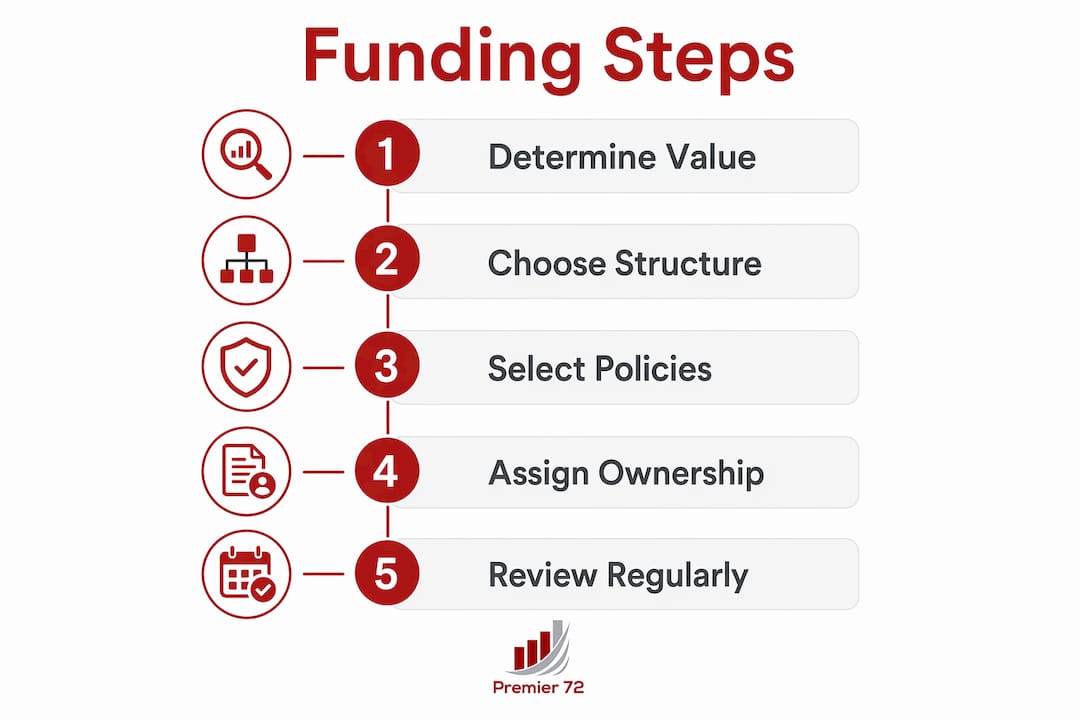
Determine the coverage amount. The right coverage amount matches the buyout price in the agreement. Your business valuation method, whether formula-based, fixed price, or independent appraisal, sets the target. Coverage should be reviewed whenever the valuation method or business value changes materially.
-
Assign policy ownership and beneficiary designations. Ownership and beneficiary designations must mirror the agreement structure exactly. In a redemption plan, the company owns the policy and is named beneficiary. In a cross-purchase plan, each owner owns policies on co-owners and is named beneficiary on those policies. Mismatches between the agreement and the policy documents create legal and tax problems at the worst possible moment.
-
Coordinate premium payments. In entity-purchase plans, the company pays premiums directly. In cross-purchase plans, each owner pays premiums on the policies they own. Some businesses compensate owners for premium costs through salary adjustments or bonus arrangements to maintain fairness.
-
Identify triggering events. Death is the most common trigger, but well-drafted agreements also address disability, retirement, and voluntary departure. Life insurance covers death triggers. Disability buyout insurance covers disability triggers. Knowing which events are covered and which require alternative funding prevents gaps.
-
Plan for funding gaps. Many agreements layer insurance proceeds with promissory notes to manage cash flow when coverage falls short of the full buyout price. This is especially relevant when business value grows faster than policy coverage is updated.
Pro Tip: Review your coverage amount every two to three years or after any major business event such as a new contract, acquisition, or significant revenue increase. A policy that covered your buyout obligation five years ago may now fund only a fraction of your actual business value.
What are the tax and legal considerations?
Tax treatment is one of the strongest arguments for using life insurance to fund a buy-sell agreement. Life insurance death benefits are generally received tax-free, while premiums are not deductible for tax purposes in buy-sell contexts. That combination, tax-free proceeds with nondeductible premiums, is still favorable because the death benefit arrives without income tax, regardless of how large it is.
The tax picture differs between structures in one critical way: basis. In a cross-purchase plan, surviving owners purchase shares directly and receive a stepped-up cost basis equal to what they paid. That higher basis reduces capital gains taxes if they later sell the business. In a redemption plan, the company buys back shares, and surviving owners' basis in their existing shares does not change. Over time, that difference can mean a significant tax bill at exit.
The 2024 Connelly v. United States Supreme Court decision changed the estate tax calculus for corporate-owned life insurance. Following the Connelly decision, closely held businesses with corporate-owned life insurance face estate tax valuation risks where insurance proceeds may increase the deceased owner's estate value. In plain terms, the IRS can now include the insurance proceeds in the company's value when calculating the estate, which inflates the taxable estate and potentially triggers a larger estate tax bill.
"After the Connelly ruling, careful drafting is essential to ensure insurance ownership and buy-sell mechanics avoid unwanted estate tax valuations and protect shareholder equity." — Bowditch & Dewey
Key legal and tax points to address with your advisors:
- Confirm that policy ownership and beneficiary designations match the agreement structure precisely.
- Evaluate whether a cross-purchase structure or an insurance LLC better protects your owners from Connelly-related estate tax exposure.
- Estate taxes are generally due within 9 months of death, so funding must be liquid and accessible on that timeline.
- Installment payments or promissory notes as the sole funding source create cash shortfall risk for the deceased owner's family at the tax due date.
What are the advantages and challenges of this funding approach?
The case for using life insurance as your primary buy-sell funding tool is strong, but it is not without trade-offs. Understanding both sides helps you build a plan that holds up under real-world pressure.
Advantages:
- Immediate liquidity at death, with no borrowing required and no disruption to business operations.
- Death benefits arrive income-tax-free, preserving the full buyout amount for the estate.
- Cross-purchase structures provide a stepped-up basis for surviving owners, reducing future capital gains exposure.
- Insurance LLCs can reduce administrative complexity in cross-purchase agreements while preserving tax benefits, by holding policies owned by shareholders as partners with partnership tax treatment.
Challenges:
- Premium costs increase with age and health changes. A partner who develops a serious health condition may become uninsurable, creating a funding gap.
- Cross-purchase agreements with many owners require a large number of policies. For policy types suited to buy-sell funding, the cost difference between term and permanent coverage becomes significant at scale.
- Corporate-owned policies now carry Connelly-related estate tax risk that did not exist before 2024.
- Coverage amounts that are not updated regularly fall behind business growth, leaving the buyout partially unfunded.
Pro Tip: Monitor the financial strength ratings of your insurer annually using AM Best or Standard & Poor's ratings. A policy from a financially weakened insurer is a liability, not an asset, when a triggering event occurs.
How to maintain and review your life insurance funding
A buy-sell agreement funded by life insurance is not a set-it-and-forget-it arrangement. Business values change, ownership percentages shift, and tax laws evolve. Ongoing maintenance is what keeps the agreement enforceable and the funding adequate.
-
Update valuations regularly. Conduct a formal business valuation every two to three years and after major financial events. Mismatches between coverage and business value lead to partial funding that risks buyout completion or requires supplemental payments from other sources.
-
Confirm premium payments are current. A lapsed policy provides no death benefit. Assign responsibility for confirming annual premium payments to a specific person, whether that is your CFO, your attorney, or your financial advisor.
-
Review agreement provisions. Valuation formulas written five years ago may no longer reflect market conditions. Revisit the agreement's valuation method, payout terms, and triggering event definitions with your attorney on the same schedule as your valuation updates.
-
Evaluate supplemental funding strategies. If life insurance alone becomes insufficient due to cost or insurability issues, consider supplementing with a sinking fund, line of credit, or installment note structure. Life settlement options may also be relevant if an existing policy no longer fits the agreement's needs.
-
Coordinate among all co-owners. Every owner should understand the agreement, know which policies exist, and confirm that beneficiary designations are current. Lack of coordination among co-owners is the most common reason a well-drafted agreement fails at execution.
Pro Tip: Schedule an annual "buy-sell review" meeting with all owners, your attorney, and your financial advisor. Treat it like a board meeting. Decisions made in that meeting protect everyone's family and the business simultaneously.
Key takeaways
Life insurance is the most effective tool for funding a buy-sell agreement because it delivers immediate, income-tax-free cash precisely when a buyout obligation arises, without borrowing or asset liquidation.
| Point | Details |
|---|---|
| Structure determines outcomes | Choose between entity-purchase, cross-purchase, or hybrid based on tax basis needs and owner count. |
| Coverage must match valuation | Align policy amounts with your current business valuation and update them every two to three years. |
| Connelly ruling changes the calculus | Corporate-owned policies now carry estate tax valuation risk; cross-purchase or insurance LLC structures may reduce exposure. |
| Liquidity timing is critical | Estate taxes are due within 9 months of death, so insurance proceeds must be accessible on that timeline. |
| Ongoing maintenance is required | Annual premium confirmation, valuation updates, and owner coordination keep the agreement enforceable and fully funded. |
Why early alignment is the only strategy that actually works
Most business owners I work with come to this conversation after a close call. A partner gets sick. A co-owner announces retirement. Suddenly the buy-sell agreement they signed years ago is being read carefully for the first time, and the gaps are obvious. The policy amounts are outdated. The ownership structure was never updated after the Connelly ruling. One owner's policy lapsed because nobody was tracking premium payments.
The owners who avoid that scenario share one habit: they treat the buy-sell agreement and its insurance funding as a living document, not a legal formality. They review it on a schedule. They involve their attorney and their financial advisor in the same conversation, not in separate silos. And they make decisions about ownership structure before a triggering event forces the issue.
My strongest recommendation after working through these plans with business owners is this: do not let the structure be an afterthought. The difference between a redemption plan and a cross-purchase plan is not just administrative. It is the difference between a stepped-up basis that saves your surviving partners hundreds of thousands in future taxes and a flat basis that costs them. Post-Connelly, that structural decision also determines whether the deceased owner's estate faces an inflated tax bill.
Start with the end in mind. Build the insurance funding to match the agreement. Review both together, every year, without exception.
— Asa
How Premier72 helps you fund your buy-sell agreement
Premier72 works directly with business owners to structure life insurance funding for buy-sell agreements that actually hold up when a triggering event occurs. That means aligning policy ownership with your agreement structure, addressing Connelly-related estate tax risks, and keeping coverage amounts current with your business value.

Whether you are setting up a new agreement or reviewing one that has not been updated in years, Premier72 brings together business advisory expertise and insurance planning under one roof. You get a plan that protects your co-owners, your family, and the business you have built. Explore business continuity planning with Premier72 and find out how a properly funded buy-sell agreement fits into your broader exit and legacy strategy.
FAQ
What is a funded buy-sell agreement?
A funded buy-sell agreement is a legal contract between business owners that includes a designated funding source, typically life insurance, to finance the purchase of a deceased or departing owner's interest. Without funding, the agreement is an obligation with no mechanism to fulfill it.
Why fund a buy-sell agreement with life insurance?
Life insurance provides immediate, income-tax-free cash at death, eliminating the need to borrow or sell business assets under pressure. It is the most reliable way to meet a buyout obligation on the timeline that estate tax deadlines and business continuity require.
How much life insurance do I need for a buy-sell agreement?
Coverage should equal each owner's proportional share of the business's current fair market value, based on the valuation method specified in the agreement. Review and update coverage every two to three years or after any major change in business value.
What did the Connelly ruling change for buy-sell insurance?
The 2024 Connelly v. United States Supreme Court decision established that corporate-owned life insurance proceeds can be included in a company's estate tax valuation, potentially increasing the deceased owner's taxable estate. Businesses with entity-purchase structures should review their agreements with an attorney to assess exposure and consider restructuring.
Can a buy-sell agreement be funded without life insurance?
Yes. Alternatives include installment notes, sinking funds, and lines of credit. However, these methods do not provide immediate liquidity and may leave the deceased owner's family waiting for payment while estate tax obligations come due within nine months of death.