

Life insurance for business owners is a strategic financial tool that protects business continuity, covers personal and business debts, and secures family wealth when the owner dies. Most business owners carry coverage between $1.5 million and $3 million to address multiple financial layers simultaneously. That range reflects a reality most personal policies ignore entirely: your business creates financial obligations that follow your family long after you are gone. Understanding why business owners need life insurance means recognizing that your coverage must address three distinct problems at once. It must replace your personal income, protect your business from collapse, and fund the legal agreements that determine who controls your company after your death.
Why business owners need life insurance for family and personal finances
Your family's financial exposure does not stop at your personal income. When you sign an SBA loan, a commercial lease, or a business line of credit, you typically sign a personal guarantee. That guarantee survives your death. Business debt obligations often range from $250,000 to $750,000, and without life insurance proceeds to cover them, creditors can pursue your estate directly. That means the family home, personal savings accounts, and other assets your spouse and children depend on become fair targets.
The importance of life insurance for business goes well beyond replacing a paycheck. Consider a manufacturing company owner carrying $400,000 in personally guaranteed equipment loans and a $150,000 business line of credit. Without a policy sized to cover those obligations, the surviving spouse faces a creditor claim against the estate while simultaneously losing the household's primary income. That is two financial crises arriving at the same time.
Here is what a well-structured policy covers for your family:
- Personal income replacement to maintain household expenses and education costs
- Personally guaranteed business debts including SBA loans, equipment financing, and commercial leases
- Estate liquidity so heirs are not forced to sell assets at distressed prices to satisfy creditors
- Mortgage and consumer debt that may have been serviced from business income
Pro Tip: Review every loan document you have signed in the past five years. If your signature appears on a personal guarantee line, that debt belongs on your life insurance coverage calculation.
Owners often underestimate the personally guaranteed debt exposure they carry, treating it as a business problem rather than a family one. It is both.
What is key person insurance and why does it matter for business continuity?
Key person insurance is a life insurance policy owned by the business, naming the company as the beneficiary, that pays out when a critical employee or owner dies. The proceeds go directly to the business, not the family, giving the company immediate capital to stabilize operations. Industry guidance recommends coverage of 5 to 10 times the key employee's annual salary, which reflects the true cost of replacing that person's revenue contribution, client relationships, and institutional knowledge.

The business case for this coverage is stark. More than 50% of small businesses close within a year of losing a key owner or employee, yet only 20% carry key person insurance. That gap represents thousands of businesses that could have survived with a policy that costs far less than the revenue it protects.
Here is how key person insurance proceeds are typically deployed after a loss:
- Cover lost revenue during the transition period while the business adjusts its operations
- Fund recruitment and onboarding for a replacement executive or specialist
- Maintain operating expenses for the recommended 6 to 12 months of cash flow runway needed during leadership transitions
- Reassure clients and lenders that the company has the financial resources to honor its commitments
- Retain key staff who might otherwise leave during a period of uncertainty
The reassurance function is underappreciated. When a bank or major client learns that a business carries key person coverage, it signals that the company has planned for leadership risk. That signal alone can preserve credit lines and client contracts that would otherwise be at risk during a transition.
Pro Tip: If your business depends on one or two people for more than 30% of its revenue, those individuals represent a key person risk. Price a policy on each of them before your next renewal cycle.
How do buy-sell agreements funded by life insurance protect ownership?
A buy-sell agreement is a legally binding contract between business partners that determines what happens to an owner's share of the company when that owner dies, becomes disabled, or exits. Life insurance is the most common funding mechanism because it delivers a tax-free lump sum at exactly the moment the agreement needs to be executed. Buy-sell agreements funded by life insurance prevent estate conflicts and unwanted partnerships by providing the liquidity needed for ownership transfers at pre-set terms.
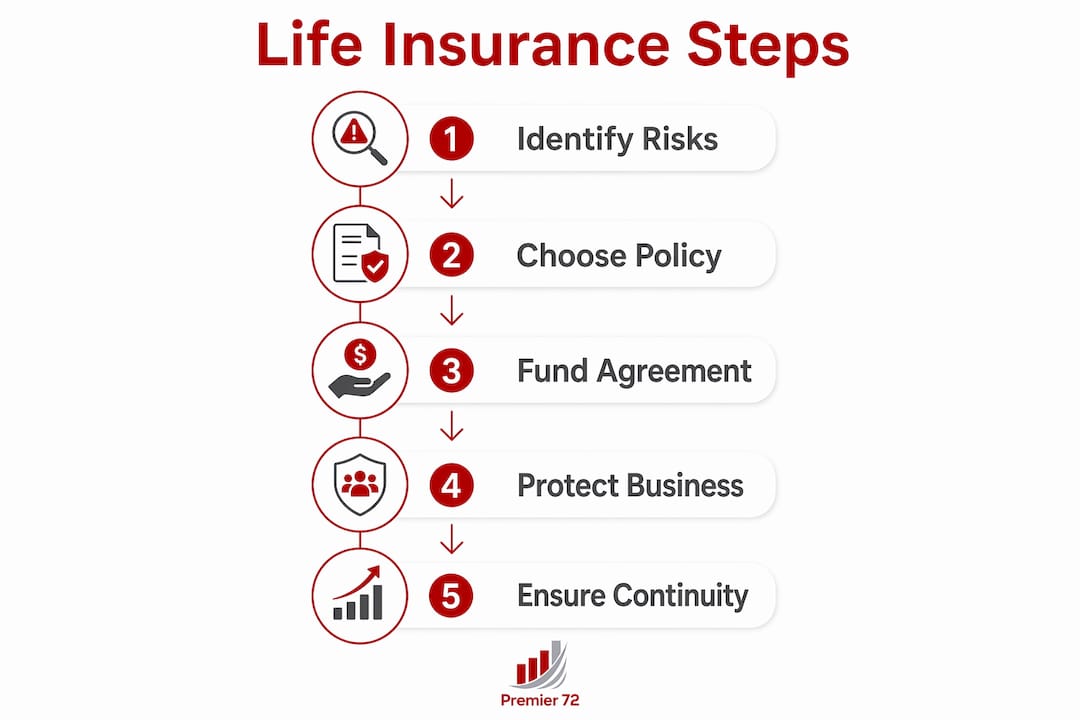
Without that funding, surviving owners may become involuntary partners with the deceased owner's heirs. A spouse or adult child who inherits a 40% stake in a business they do not understand can block decisions, demand distributions, and ultimately force litigation or dissolution. That outcome destroys value for everyone involved.
There are two primary structures for funding buy-sell agreements with life insurance:
| Structure | How it works | Best suited for |
|---|---|---|
| Cross-purchase | Each partner owns a policy on the other partners | Businesses with 2 to 3 partners and relatively equal ownership stakes |
| Entity purchase | The business owns policies on each partner and buys back the shares | Businesses with multiple partners or complex ownership structures |
The cross-purchase arrangement gives surviving partners a stepped-up cost basis in the acquired shares, which reduces capital gains taxes if they later sell the business. The entity purchase arrangement is simpler to administer when there are more than three partners, because each additional partner in a cross-purchase plan multiplies the number of policies required. A business with four partners using cross-purchase needs twelve separate policies. The same business using entity purchase needs four.
Learn more about funding buy-sell agreements to understand which structure fits your ownership arrangement.
Which life insurance policies best serve business owners?
Business owners have two primary policy categories to work with: term life insurance and permanent life insurance. Each serves a different function, and most well-structured plans use both.
Term life insurance provides coverage for a defined period, typically 10, 20, or 30 years, at the lowest possible premium. It is the right tool for covering time-limited liabilities like SBA loans with fixed payoff schedules, buy-sell agreements tied to a specific business phase, or income replacement during the years when children are financially dependent. Term policies do not build cash value, but they deliver maximum coverage per dollar during the years when financial risk is highest.
Permanent life insurance covers the owner for life and builds cash value over time. Permanent policies build cash value that owners can borrow against for business capital needs while the policy continues to grow. Policy loans require no credit check and do not appear on a business credit report. That makes permanent life insurance a secondary liquidity source that operates completely outside the banking system.
The tax advantages compound the financial case. Permanent life insurance provides tax-advantaged growth and cash value accumulation, making it an efficient financial asset beyond basic death benefit protection. For business owners approaching retirement who have maxed out 401(k) and SEP-IRA contributions, a permanent policy becomes a third retirement savings vehicle with no contribution limits tied to earned income.
Here is a practical comparison of how each policy type fits different business needs:
- Term: Covers SBA loan balances, buy-sell funding during growth phase, income replacement for young families
- Permanent: Funds retirement income, provides business liquidity, supports estate planning and legacy transfers
- Combined strategy: Term covers the high-liability years; permanent builds the long-term asset base
Explore how life insurance supports retirement for owners who want to understand the full financial picture beyond basic protection.
Key takeaways
Life insurance for business owners must cover three distinct financial layers: personal income replacement, business debt obligations, and ownership transfer funding through buy-sell agreements.
| Point | Details |
|---|---|
| Cover personally guaranteed debts | Business debts you have personally guaranteed become family liabilities without life insurance proceeds to pay them off. |
| Size key person coverage correctly | Key person policies should cover 5 to 10 times annual salary plus 6 to 12 months of operating expenses. |
| Fund buy-sell agreements before you need them | An unfunded buy-sell agreement can force involuntary partnerships with heirs and trigger business dissolution. |
| Use permanent policies as financial assets | Cash value in permanent policies can be borrowed against without credit checks, creating off-balance-sheet liquidity. |
| Combine term and permanent coverage | Term handles time-limited liabilities; permanent builds long-term retirement and legacy assets. |
What most business owners get wrong about life insurance
I have worked with enough business owners to recognize a consistent pattern: they insure their personal life but not their business life. They buy a $500,000 term policy to replace their income for their family, and they stop there. They never account for the $350,000 SBA loan they personally guaranteed, the buy-sell agreement sitting in a drawer with no funding mechanism attached to it, or the fact that their business would likely close within 12 months if they were gone.
The coverage gap is not about cost. A well-structured policy combination covering all three layers is often less expensive than business owners expect, particularly when permanent policies are started before age 55. The gap exists because most people treat life insurance as a personal finance decision rather than a business continuity decision. Those are two completely different calculations.
What I find most underappreciated is the strategic asset function of life insurance. A properly funded buy-sell agreement means your family sells your business interest on their own terms, at a fair price, to a known buyer, on a pre-agreed timeline. Without it, they are negotiating from a position of grief and financial pressure against partners who have every incentive to pay as little as possible.
Review your coverage every time your business changes materially. A new loan, a new partner, a significant revenue increase, or a key hire all change your coverage requirements. The policy you bought five years ago almost certainly does not reflect the business you are running today.
— Asa
How Premier72 helps you build the right coverage strategy

Premier72 works directly with established business owners to design life insurance strategies that address all three coverage layers: family protection, business continuity, and ownership transfer. Whether you need key person coverage to protect against the loss of a critical employee, a funded buy-sell agreement to protect your partners and heirs, or a permanent policy structured to support retirement income, Premier72 builds solutions that align with your business stage and financial goals. The Retirement Bank Method™ connects life insurance planning to your broader exit readiness strategy, so your coverage grows with your business and supports the transition you are working toward.
FAQ
Do all business owners need life insurance?
Any business owner with employees, business debt, partners, or a family dependent on business income needs life insurance. The coverage amount and structure will vary, but the need is consistent across business types and sizes.
How much life insurance does a business owner need?
Coverage typically ranges from $1.5 million to $3 million when accounting for personal income replacement, personally guaranteed business debts, and buy-sell funding. Owners with significant debt or multiple partners often need more.
What is the difference between key person insurance and a buy-sell agreement?
Key person insurance pays the business when a critical employee or owner dies, covering operational costs and recruitment. A buy-sell agreement funded by life insurance pays surviving partners the capital needed to purchase the deceased owner's equity stake.
Can life insurance be used as a retirement asset for business owners?
Permanent life insurance policies build cash value that owners can access tax-advantaged in retirement. This makes them a useful supplement to 401(k) and SEP-IRA accounts, particularly for owners who have maximized those contribution limits.
What happens to a buy-sell agreement without life insurance funding?
Without funding, surviving partners may be forced into an involuntary partnership with the deceased owner's heirs, which frequently leads to disputes, litigation, and in many cases, business dissolution.