

Employee benefits are one of the most reliable levers for reducing turnover, and the evidence is specific: 60% of employees would consider leaving for better health insurance, and 59% would leave for a stronger retirement plan or match. The role of employee benefits in retention operates through three distinct mechanisms: perceived organizational support (employees who feel cared for stay longer), financial switching costs (robust life, disability, and retirement coverage is expensive to replicate on the open market), and reduced cognitive load (benefits that remove daily friction prevent the silent burnout that quietly drives departures). Get these right, and you are not just offering a competitive package. You are building structural reasons for people to stay.
The five benefit categories with the largest, most consistent impact on retention are:
- Core medical coverage (health, dental, vision)
- Retirement savings with employer match (401(k) or equivalent)
- Paid time off and flexible work arrangements
- Mental health and financial wellness programs
- Family and caregiving support (parental leave, elder care assistance)
Pro Tip: Before adding any new benefit, audit which existing benefits your employees actually use. Low-utilization benefits signal either poor communication or poor fit — both of which erode the retention value of your entire package.
Key Takeaways
The most important finding across all the evidence: benefits reduce turnover most reliably when they create financial switching costs, signal genuine organizational support, and remove daily friction — not when they simply add perks.
| Point | Details |
|---|---|
| Health and retirement lead | 60% of employees would leave for better health coverage; 59% for a stronger retirement match. |
| Switching costs matter | Employer-sponsored life, disability, and retirement benefits are expensive to replace, creating real financial reasons to stay. |
| Personalization outperforms uniformity | Flexible, customizable benefits signal organizational support and consistently produce better retention outcomes than one-size-fits-all packages. |
| Measure cohorts, not averages | Track retention by benefit-utilization cohort to identify which benefits are actually driving people to stay. |
| Premier72 advisory approach | Premier72 helps business owners audit, fund, and communicate benefits that reduce turnover and strengthen succession readiness. |
Table of Contents
- Why employee benefits matter for retention
- Which benefits most reduce turnover?
- How to design a benefits package that actually keeps people
- Measuring the impact and ROI of your benefits investment
- Common mistakes that undermine benefits as a retention tool
- What recent research adds for HR leaders
- What business leaders should prioritize this year
- How Premier72 can help you design and fund retention-focused benefits
- Sources
Why employee benefits matter for retention
Benefits convert into staying behavior through three causal pathways, each worth understanding before you allocate budget.
Perceived organizational support (POS) is the psychological mechanism that matters most. When employees believe their employer genuinely invests in their well-being, they reciprocate with commitment and discretionary effort. Flexible benefits that let employees choose what fits their life stage tend to produce stronger POS signals than uniform packages, because choice itself communicates respect. A 2026 systematic literature review confirms that customizable benefit systems improve retention specifically by signaling organizational support and matching offerings to individual needs.
Financial switching costs are the economic mechanism. Employer-sponsored life insurance, long-term disability, and critical-illness coverage are genuinely difficult and expensive to replace independently. That calculation keeps people in place even when compensation alone might not.
Cognitive load reduction is the mechanism most employers underestimate. Benefits that remove daily friction — concierge services, flexible scheduling, caregiving coordination, employee assistance programs — directly address the accumulation of small daily stressors that produce silent burnout. Mid-career employees and those with caregiving responsibilities are especially vulnerable to this pattern, and they are often among your highest-value, hardest-to-replace people.

The SHRM 2025 Employee Benefits Survey shows that employers themselves rate health-related benefits (88%), retirement savings (81%), and leave benefits (81%) as extremely or very important to workforce stability. These ratings reflect employer recognition that benefits are not a cost center but a structural retention tool.
Which benefits most reduce turnover?
Not all benefits carry equal weight. Here is where the evidence points, organized by impact and mechanism.
| Benefit Category | Primary Retention Mechanism | Employer Cost Shape |
|---|---|---|
| Core medical (health, dental, vision) | POS signal + financial protection | Primarily employer-funded premiums |
| 401(k) with employer match | Switching cost + financial security | Employer match + admin cost |
| Paid time off / flexible work | Cognitive load reduction + autonomy | Primarily time/policy cost |
| Mental health & EAP | Burnout prevention + POS signal | Low per-employee cost |
| Family/caregiving benefits | Cognitive load reduction + loyalty | Variable; often partially subsidized |
| Financial wellness programs | Reduced financial stress + engagement | Low to moderate; often vendor-priced |
| Voluntary/supplemental benefits | Switching cost + perceived breadth | Largely employee-funded premiums |
Core medical coverage remains the single highest-stakes benefit category. Losing health coverage is a concrete, immediate risk that employees weigh heavily. The BenefitNews analysis finding that 60% of employees would consider leaving for better health insurance is not a soft preference. It is a departure trigger.
Retirement savings with employer match has moved sharply higher in importance. The ADP 2026 Benefits Survey finds retirement readiness is now a core concern for employees across age groups, not just those nearing exit. A well-structured 401(k) match creates a vesting schedule that functions as a financial handcuff — employees who leave before full vesting forfeit real money. Pair that with sound retirement income planning and you give employees a concrete financial reason to stay.
Paid time off and flexible work differentiates employers even when access to PTO is common. BLS data shows that 79% of private industry workers had access to paid vacation in 2021, but perceived quality and schedule flexibility still separate employers. Employees who can control when and how they work report higher engagement and lower intent to leave.
Voluntary and supplemental benefits (dental, vision, life, disability, critical illness) deserve more credit than they typically receive. Voluntary benefits expand perceived package breadth for mid-size employers without proportionally larger premium spending, because employees fund most of the cost through payroll deduction. The retention value comes from the switching cost: group rates and employer-facilitated enrollment are advantages employees cannot easily replicate on their own. For executives and key personnel, employer-paid life insurance structured as part of a compensation plan adds another layer. The executive bonus plan approach is one structure worth examining for high-value retention targets.
Fast wins with low incremental cost:
- Add an Employee Assistance Program (EAP) if you do not have one. Per-employee costs are low, and utilization directly reduces burnout-driven attrition.
- Offer voluntary benefits through a Section 125 cafeteria plan so employees pay with pre-tax dollars, increasing perceived value at no additional employer cost.
- Introduce flexible scheduling or remote-work options for roles where the work permits it. The cost is policy, not budget.
- Provide a financial wellness resource (budgeting tools, debt counseling access) as a low-cost add-on that addresses a top stressor for employees across income levels.
How to design a benefits package that actually keeps people
A benefits package built without a structured process tends to accumulate offerings that look generous on paper but miss what employees actually value. Here is a practical sequence.
- Audit your current state. Pull utilization data for every benefit you currently offer. Low-utilization benefits are either poorly communicated or poorly matched to your workforce. Both problems are fixable, but you need the data first.
- Segment your workforce. Group employees by life stage, role type, and tenure. A 28-year-old individual contributor values different benefits than a 52-year-old manager with dependents. Segmentation lets you prioritize without overspending.
- Survey and listen. A short annual benefits survey (8–10 questions) surfaces gaps faster than any benchmark study. Ask employees which benefits they use, which they wish existed, and which they would trade away. HR teams that free time from manual admin to conduct these conversations consistently report better benefit-to-need alignment.
- Prioritize by retention impact and cost. Use the mechanism framework from Section 2: prioritize benefits that create switching costs or reduce cognitive load for your highest-turnover segments first.
- Cost-model and pilot. Before a full rollout, pilot a new benefit with one department or cohort. Track utilization and gather qualitative feedback over 90 days. This limits financial exposure and generates real data for the business case.
- Communicate and enroll. Enrollment periods are not enough. Benefits need year-round communication through multiple channels: manager briefings, digital guides, and one-on-one support for complex decisions. The ADP 2026 survey finds employees increasingly expect their employer to provide personalized guidance, not just a benefits portal.
- Iterate using usage data. Set a quarterly review cadence. Utilization rates, enrollment changes, and exit interview themes are your leading indicators.
Pro Tip: When piloting a new benefit, assign a specific cohort (e.g., employees in their first two years of tenure) and track their 12-month retention rate against a comparable cohort that did not receive the benefit. That comparison gives you a defensible ROI number for leadership.
Section 125 flexible pre-tax enrollment is worth calling out specifically. It allows employees to pay for qualifying benefits with pre-tax dollars, which increases take-home pay and perceived benefit value simultaneously. For employers, it can reduce payroll tax liability. It is one of the most underused structural tools available to mid-size employers.
Measuring the impact and ROI of your benefits investment
Measurement is where most HR teams fall short. Without a defined framework, benefits spending is difficult to defend and impossible to improve.
| Metric | Definition | Review Cadence |
|---|---|---|
| Turnover rate by cohort | Separations ÷ average headcount, segmented by role, tenure, and benefit-utilization status | Quarterly |
| Cost per replacement | Recruiting + onboarding + lost productivity, typically 50%–200% of annual salary | Annual or per-event |
| Benefit utilization rate | Enrolled employees actively using a benefit ÷ total eligible | Quarterly |
| Retention by utilization cohort | 12-month retention rate for high-utilizers vs. low-utilizers of a specific benefit | Annual |
| eNPS / engagement score | Employee Net Promoter Score or equivalent engagement index | Semi-annual |
| Time to productivity | Days from hire to full performance for new hires, as a proxy for replacement cost | Per cohort |
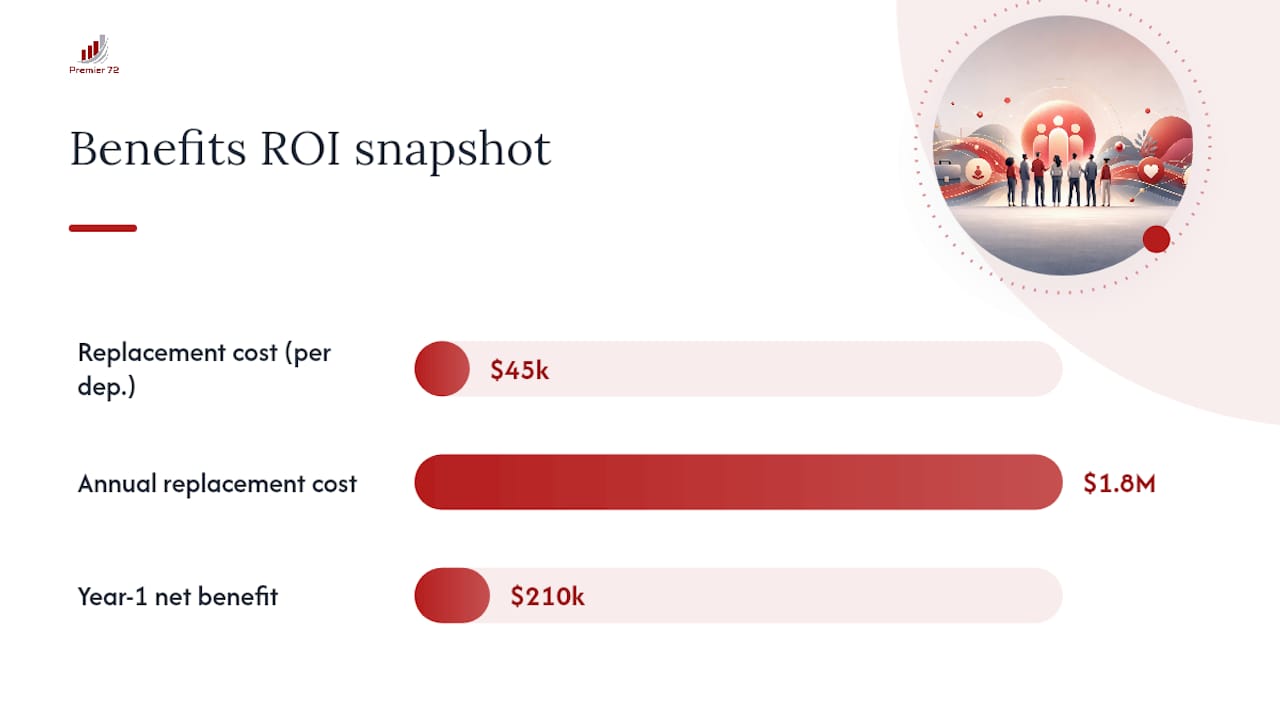
Sample ROI calculation (conservative assumptions):
That puts replacement cost at $45,000 per departure, or $1.8 million annually.
Net benefit: $210,000 in year one, before accounting for productivity and engagement gains.
The 6–12 month window is realistic for utilization-driven benefits to show measurable retention impact. Cultural signaling effects (POS-driven retention) can appear faster, particularly after a visible, well-communicated benefits expansion.
Common mistakes that undermine benefits as a retention tool
Even well-funded benefits packages fail when implementation breaks down. These are the patterns that consistently erode retention value:
- Poor communication and low awareness. Employees cannot value what they do not know they have. Annual open enrollment is not a communication strategy. Benefits that go unused generate no retention value and no ROI.
- One-size-fits-all design. A uniform package signals that the employer has not thought about individual needs. It also means you are spending on benefits that large segments of your workforce do not want, while leaving gaps that matter to others.
- Complex enrollment friction. If enrolling in a benefit requires more than a few steps, participation drops. Lower participation means lower utilization, which means lower retention impact and a weaker business case for the investment.
- Failing to measure utilization. Without utilization data, you cannot distinguish between a benefit that is working and one that is simply costing money. Measurement is not optional if you want to defend the budget.
- Misaligned funding strategy. Spending heavily on benefits that create no switching cost or POS signal (free snacks, generic wellness apps) while underfunding health coverage or retirement match is a common and costly error. Prioritize the benefits that create structural reasons to stay.
Legacy HR systems and manual admin processes often block progress here. If your team spends most of its time on paperwork rather than employee listening and benefits design, the administrative burden itself becomes a retention risk.
What recent research adds for HR leaders
The most actionable recent findings point in a consistent direction: personalization, guidance, and friction reduction outperform generic benefit additions.
The SHRM 2025 survey confirms that employer prioritization of health, retirement, and leave benefits aligns with what employees report as departure triggers. The ADP 2026 survey adds a layer: employees do not just want benefits. They want their employer to help them understand and use those benefits. A benefits portal without guidance is not enough.
The IJRISS 2026 systematic review provides the strongest academic support for personalization: flexible, customizable benefit systems consistently outperform uniform packages on retention outcomes, with the POS mechanism as the primary driver.
The Circles research on cognitive load makes a point that most benefits analyses miss: the benefits that prevent silent burnout are often not the most visible ones. Concierge services, caregiving coordination, and flexible scheduling address the daily accumulation of small stressors that erode engagement long before an employee updates their resume. These benefits are high-impact precisely because they operate below the threshold of what employees consciously attribute to their decision to stay.
Two experiments HR teams can run now based on this evidence:
- Personalization pilot: Offer one cohort of employees a structured benefits consultation (30 minutes with an HR advisor or benefits guide) during open enrollment. Track their utilization rates and 12-month retention against the control group.
- Friction audit: Map every step required to enroll in your three lowest-utilization benefits. Reduce the step count by half. Measure enrollment change over the next quarter.
What business leaders should prioritize this year
The evidence points to three priorities that produce the clearest return on benefits investment: audit and segmentation, voluntary benefit expansion, and benefits guidance.
Auditing your current package against actual utilization data is the foundation. Without it, you are guessing about what is working. Segmentation by life stage and tenure lets you direct spending where it creates the most retention value, rather than spreading it uniformly across a workforce with divergent needs.
Expanding voluntary benefits through a Section 125 structure is one of the highest-leverage moves available to mid-size employers. It broadens perceived package value, creates real switching costs through group-rate access, and does so largely at employee expense. The employer's cost is administration and communication, not premium.
Benefits guidance is the piece most organizations skip. Employees who understand their benefits use them more, value them more, and stay longer. Investing in clear communication, personalized enrollment support, and year-round education converts a benefits budget into a retention asset. For business owners specifically, this connects directly to succession readiness: a workforce that feels financially protected and organizationally supported is more stable, less owner-dependent, and more transferable as a business asset.
How Premier72 can help you design and fund retention-focused benefits
Premier72 works with established business owners and their leadership teams to build benefits structures that serve both retention and long-term business goals.
The advisory process covers benefits audits, ROI modeling, voluntary-benefits sourcing, communication strategy, and measurement support. For business owners who also need protection planning, Premier72 integrates key person coverage, buy-sell funding, and executive compensation structures into a unified strategy. Engagements are structured as fee-based advisory with optional product placement for insurance and annuity solutions, and most clients move from initial review to a prioritized action plan within 60 days.
If your benefits package is costing you people, the right next step is a structured advisory review. Visit Premier72 to schedule a conversation and get a clear picture of where your benefits investment is and is not working for retention.
Sources
The statistics and measurement examples in this article draw from the following sources:
- SHRM 2025 annual benefits survey executive summary
- Why benefits will make or break employee retention in 2026 | Employee Benefit News
- 79 percent of private industry workers had access to paid vacation in 2021 (BLS)
- Flexible Benefits and Employee Retention: A Systematic Literature Review and Thematic Synthesis (IJRISS)
- Voluntary benefits & employee retention | Benefitra