

Most people spend decades building a nest egg and assume the hard part is over once they retire. It isn't. Knowing what is a retirement income plan separates those who run out of money at 82 from those who spend confidently at 90. A retirement income plan, formally called a retirement income strategy, is a coordinated system for generating steady, lasting income from all your available sources, not just a withdrawal schedule from one account. It combines guaranteed income, growth investments, and the flexibility to adapt when life doesn't go as expected.
Table of Contents
- Key takeaways
- What a retirement income plan actually is
- Guaranteed income and essential expenses
- Growth, flexibility, and keeping pace with inflation
- How to create a personalized plan
- Common pitfalls that derail retirement income plans
- My honest take on retirement income planning
- Build your retirement income plan with Premier72
- FAQ
Key takeaways
| Point | Details |
|---|---|
| More than just savings | A retirement income plan coordinates multiple sources to create sustainable lifetime income. |
| Guaranteed income anchors the plan | Social Security, pensions, and annuities should cover your non-negotiable monthly expenses. |
| Growth assets fight inflation | Keeping some money invested preserves purchasing power across a 20 to 30-year retirement. |
| Withdrawal order matters for taxes | Sequencing withdrawals from taxable, tax-deferred, and Roth accounts reduces your lifetime tax bill. |
| Regular reviews are non-negotiable | Life changes, markets shift, and your plan should adapt accordingly every year or two. |
What a retirement income plan actually is
A retirement income plan is a coordinated strategy for generating and withdrawing income to cover retirement spending. It isn't a single account or a single product. Think of it as a three-legged stool: predictable guaranteed income, growth potential from invested assets, and the flexibility to adjust as circumstances change.
The reason this distinction matters is real and measurable. Someone who retires with $800,000 in a 401(k) and no income plan may follow a standard 4% withdrawal rule and feel fine for a decade. Then a bad market sequence hits early in retirement, withdrawals continue, and the account balance craters faster than expected. A coordinated plan prevents that scenario by making sure not every dollar depends on portfolio performance.
Here's a quick comparison of the main retirement income sources most people have access to:
| Income source | Predictability | Growth potential | Flexibility |
|---|---|---|---|
| Social Security | Very high | Low (COLA adjustments only) | Low (timing affects amount) |
| Pension | Very high | None | Very low |
| Income annuity | High | None to low | Low to medium |
| 401(k) / IRA | Low (market-dependent) | High | High |
| Roth IRA | Low (market-dependent) | High | Very high (no RMDs) |
| Part-time income | Medium | Low | High |
Combining these sources protects you against three major threats: outliving your money (longevity risk), rising prices (inflation risk), and a bad run in the stock market (sequence-of-returns risk).
Pro Tip: Think of your retirement income plan in two buckets. Bucket one covers essential monthly expenses with guaranteed income. Bucket two holds growth investments that handle discretionary spending, travel, and legacy goals.
Guaranteed income and essential expenses
Understanding retirement income starts with separating what you must pay from what you choose to pay. Essential expenses are the non-negotiables: housing, food, utilities, healthcare, and insurance premiums. These should not depend on how the stock market performed last quarter.
Essential expenses should be covered by lifetime guaranteed income sources. The three primary ones most retirees work with are:
- Social Security. Your monthly benefit is inflation-adjusted and lasts your lifetime. Delaying from age 62 to 70 can increase your monthly benefit by as much as 76%, making timing one of the highest-leverage decisions in your entire retirement plan.
- Pensions. Defined benefit plans from employers pay a fixed monthly amount for life. If you have one, it is one of the most valuable assets you own. The survivorship option for a spouse is worth careful consideration before you elect your payout.
- Income annuities. These convert a lump sum from your savings into guaranteed lifetime payments. Options include immediate annuities (payments start right away), deferred income annuities (payments start at a future age), and variable or fixed annuities with a guaranteed lifetime withdrawal benefit (GLWB) rider that provides income floors even if the account value drops.
The trade-off with annuities is real. You give up liquidity and control in exchange for certainty. Using an annuity income floor strategy means you will not be forced to sell investments at a loss during a downturn just to pay the electric bill.
Pro Tip: Fidelity advises against putting more than half of your assets into income annuities. Keeping the other half in liquid, invested accounts preserves your ability to handle emergencies, big purchases, and changing needs.
Growth, flexibility, and keeping pace with inflation
Guaranteed income handles the floor. Your invested assets handle everything above it, and that job does not end when you retire.
A 65-year-old today has a meaningful probability of living into their late 80s or early 90s. According to life expectancy research, individual longevity assumptions significantly affect how much growth your portfolio needs to generate. If inflation runs at 3% annually, $5,000 in monthly expenses today costs roughly $9,000 in 20 years. Bonds and cash alone cannot protect against that. Some portion of your portfolio must remain invested in equities.
Flexibility in how you draw from your accounts is just as important as what you invest in. The tax-smart approach is called a withdrawal waterfall, and it sequences your income sources deliberately. Sequencing income from guaranteed benefits to taxable accounts, then tax-deferred accounts, then tax-free accounts optimizes taxes and prolongs income sustainability. Here is how that typically looks in practice:
- Start with guaranteed income. Collect Social Security, pension, and annuity payments to cover the income floor before touching invested accounts.
- Draw from taxable accounts next. Brokerage accounts and taxable investments often receive favorable long-term capital gains rates, making them efficient to tap in early retirement.
- Then pull from tax-deferred accounts. Traditional IRA and 401(k) withdrawals are taxed as ordinary income. Drawing these after taxable accounts can keep you in a lower bracket longer.
- Preserve Roth accounts for last. Roth IRAs have no required minimum distributions (RMDs) during your lifetime and withdrawals are tax-free. Letting them grow while you draw from other sources maximizes their value.
One thing that surprises most people: there is no universal withdrawal order. Your age, tax bracket, Social Security taxation thresholds, and Medicare premium income limits all affect which sequence actually saves you the most money. Tax-bracket blending, where you pull from multiple account types in the same year to stay within a target bracket, often outperforms a rigid sequential approach.
Revisit your withdrawal plan annually. A big medical expense, an inheritance, or a change in your spouse's income can shift which strategy works best.
How to create a personalized plan
Building your own retirement income plan follows a logical sequence, but the variables are personal enough that the details matter enormously. Here's a practical framework:
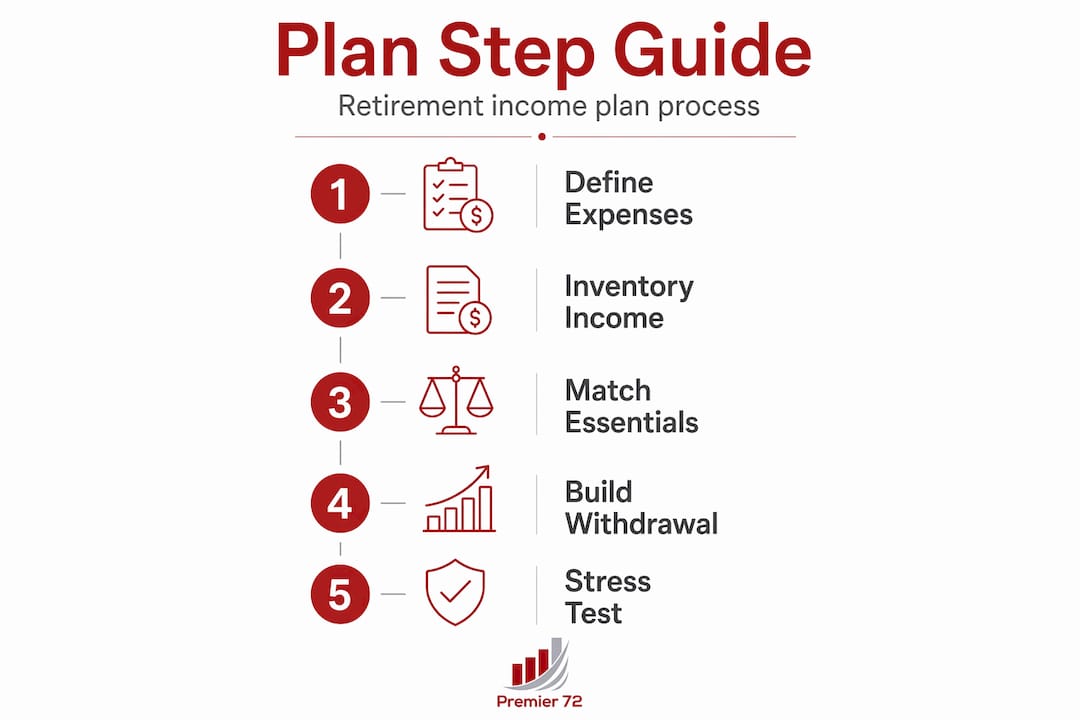
Step 1: Define your expenses. Separate essential from discretionary spending. Be specific. People consistently underestimate healthcare costs and overestimate how much they will cut back on lifestyle.
Step 2: Inventory your income sources. List every potential retirement income source: Social Security estimates (available at SSA.gov), any pension benefits, existing annuities, 401(k) and IRA balances, taxable investment accounts, rental income, and any business sale proceeds. A retirement income calculator can help quantify gaps between projected income and projected expenses.
Step 3: Match guaranteed income to essential expenses. If Social Security and a pension cover your non-negotiable costs, your investments can be managed more aggressively for growth. If there is a gap, an income annuity may close it efficiently.

Step 4: Build your withdrawal sequence. Based on your account types and tax situation, map out which accounts you draw from first, second, and third. Model the tax impact before you finalize it.
Step 5: Stress test the plan. Run scenarios for early market downturns, higher-than-expected healthcare costs, and living to age 95. If the plan holds in the bad scenarios, it will perform well in the average ones.
| Planning step | Key action | Why it matters |
|---|---|---|
| Define expenses | Split essential vs. discretionary | Determines guaranteed income need |
| Inventory sources | List all accounts and benefits | Reveals gaps early |
| Match income to needs | Align guaranteed sources to essentials | Reduces portfolio dependence |
| Sequence withdrawals | Build a tax-efficient withdrawal order | Extends portfolio longevity |
| Stress test | Model worst-case scenarios | Builds confidence and resilience |
Pro Tip: Review your plan every two years at minimum, and always after a major life change: a health diagnosis, a death in the family, a significant market shift, or a change in your tax situation.
Common pitfalls that derail retirement income plans
Even well-intentioned savers make mistakes that become expensive only years into retirement. The most common ones are worth naming directly.
- Over-relying on portfolio withdrawals. Drawing solely from investments without guaranteed income leaves you fully exposed to sequence-of-returns risk. A 30% market drop in year two of retirement is devastating if every expense depends on that portfolio.
- Ignoring inflation. A plan that works at 65 can fail at 80 if it was designed around today's prices. Build in annual inflation assumptions of 3% or more for healthcare specifically.
- Planning too late. The strategies that save the most money, like delaying Social Security, doing Roth conversions, or using life insurance as a supplemental retirement asset, require time and runway. Waiting until two years before retirement closes most of those doors. Exploring how life insurance can function as a retirement asset is a conversation worth having a decade before you need it.
- Ignoring taxes on withdrawals. Every dollar from a traditional 401(k) or IRA is taxable as ordinary income. Failing to plan for that can push you into a higher bracket and trigger Medicare premium surcharges.
- Assuming the plan is static. In-plan lifetime income options through employer plans are evolving. Checking whether your current 401(k) plan includes lifetime income fund options is worth doing before you retire.
- Neglecting family protection. A surviving spouse's income can drop sharply after the higher earner dies. Pension elections, Social Security survivor benefits, and family financial protection strategies should all be part of the conversation.
My honest take on retirement income planning
I've worked with enough clients approaching retirement to know that the ones who struggle are rarely the ones who saved the least. They are the ones who never built a system around what they saved.
What I've seen repeatedly is this: people arrive at retirement with a solid portfolio and no income plan. They treat their investments like a checking account they hope doesn't run dry. That is not a plan. It is a countdown.
The clients who sleep well at 80 are the ones who covered their non-negotiable expenses with guaranteed income first, then let their invested assets work for growth without the pressure of funding groceries. That separation is everything. It sounds simple. Most people never actually do it.
I've also learned that starting the planning conversation later than ideal is not a reason to skip it. Even starting at 60 with a clear-eyed assessment of income sources, tax exposure, and withdrawal sequencing makes a material difference. The perfect plan done late still beats no plan done never.
— Asa
Build your retirement income plan with Premier72

Building a retirement income plan that actually holds up over a 25-year retirement requires more than a spreadsheet and a calculator. At Premier72, we work with business owners, professionals, and families to structure income plans that balance guaranteed coverage, investment growth, and long-term flexibility. Whether you are five years from retirement or already there, we help you map income sources, model tax-efficient withdrawal sequences, and put protections in place that keep your plan working no matter what the markets do. If you have built something worth protecting, the next step is building a plan to make it last.
FAQ
What is the main purpose of a retirement income plan?
A retirement income plan coordinates all your income sources, guaranteed benefits, investments, and other assets, to generate sustainable income throughout retirement. The goal is to cover essential expenses reliably while preserving flexibility for unexpected costs.
How is a retirement income plan different from a retirement savings plan?
A retirement savings plan focuses on accumulating assets before retirement. A retirement income plan addresses how you turn those assets into reliable income during retirement, including which sources to draw from, in what order, and when.
What counts as guaranteed income in retirement?
Guaranteed income includes Social Security benefits, employer pensions, and income annuities. These sources cover essential expenses reliably, regardless of market conditions.
When should I start creating a retirement income plan?
The earlier the better. Starting at least 10 years before retirement allows time for strategies like Roth conversions, Social Security optimization, and insurance-based income tools to work most effectively.
Do I need a financial advisor to build a retirement income plan?
You do not strictly need one, but the complexity of tax sequencing, Social Security timing, and insurance options makes professional guidance genuinely valuable. A tax-smart withdrawal strategy alone can be worth more than its cost in saved taxes over a 20-year retirement.