

An annuity ladder staggers multiple annuity purchases across different terms and carriers so you get rolling liquidity, rate-averaging, and partial protection from being locked into a single low rate. It works by spreading money across contracts that mature at different times instead of committing everything to one product. The approach suits retirees and near-retirees who want conservative, predictable income without surrendering all flexibility at once.
TL;DR:
- Interest rate environment fluctuations impact ladder performance, with rising rates improving reinvestment outcomes and falling rates reducing overall yields.
- Proper management, including regular reviews and decision points at each maturity, is crucial to maximize benefits and avoid automatic renewals at suboptimal rates.
- Constructing a ladder typically involves 2 to 4 rungs with specific spacing, and larger balances above $200,000 are better suited for income ladder structures.
- Balancing inflation protection requires pairing fixed annuities with optional riders and maintaining a diversified portfolio for long-term purchasing power.
- Diversification across multiple carriers, combined with annual reviews and professional guidance, helps mitigate credit and reinvestment risks in an annuity ladder strategy.
Table of Contents
- How an Annuity Ladder Strategy Works: Terms, Mechanics, and a Quick Example
- Ladder Structures That Match Different Retirement Goals
- How to Build an Annuity Ladder You Can Actually Manage
- Taxes, Fees, and Trade-Offs Worth Weighing Before You Ladder
- Managing Maturities: What to Do Every Time a Rung Comes Due
- Who Should Ladder, and How Many Rungs Make Sense
- Premier72's Take: Laddering Inside the Retirement Bank Method™
- How Interest Rates Shape Ladder Performance
- Annuity Ladders Versus Other Retirement Income Strategies
- What an Annuity Ladder Actually Looks Like in Practice
- Building Inflation Protection Into a Ladder
- Fitting an Annuity Ladder Into Your Broader Retirement Portfolio
- A Straight Answer on What Actually Matters Here
- Premier72 Helps You Build and Manage an Annuity Ladder With Guidance
- Sources
How an Annuity Ladder Strategy Works: Terms, Mechanics, and a Quick Example
Every ladder is built from rungs, individual annuity contracts purchased at the same time but set to mature or begin payouts on different schedules. The maturity date on a fixed contract is when the surrender period ends and you regain full access to your money. The annuitization date is when you convert accumulated value into a guaranteed income stream, and that decision doesn't have to happen the moment a contract matures.
Three product types typically fill the rungs:
- MYGA (multi-year guaranteed annuity): works like a CD with a locked rate for a fixed term, usually two to ten years.
- SPIA (single premium immediate annuity): converts a lump sum into income payments that start almost immediately.
- DIA (deferred income annuity): also converts a lump sum into future income, but payments start years later, which raises the payout because of mortality credits.
Annuity laddering spreads capital across multiple contracts with staggered maturities specifically to reduce interest rate risk and diversify which insurer holds your money. At each rung's maturity, you choose to withdraw the cash, roll it into a new MYGA at current rates, or use a 1035 exchange to move it tax-free into another annuity, including a DIA. A simple example: split $150,000 evenly across a 3-year, 5-year, and 7-year MYGA. Instead of guessing where rates will be in five years, you get a rung maturing every couple of years, giving you a blended average rate and repeated chances to reassess.
Ladder Structures That Match Different Retirement Goals
Not every ladder is built the same way, and the right structure depends on whether you're chasing safety, income, or both.
- MYGA ladder. This is the most common structure, pairing terms like 3/5/7 years or 2/4/6/8 years so a portion of principal becomes available every couple of years. It suits retirees who want CD-like predictability with better rates and tax deferral, and who aren't ready to commit to lifetime income yet.
- Income ladder. Here you stagger the start dates of SPIAs or DIAs instead of maturity dates on MYGAs. Because laddering works with MYGAs, SPIAs, DIAs, or hybrid approaches, an income ladder lets you begin smaller payments earlier and larger ones later, when mortality credits push the payout rate higher. This fits someone worried about outliving their savings more than someone worried about liquidity.
- Hybrid ladder. This blends the two: early rungs stay in MYGAs for flexibility, while later rungs get exchanged into income annuities as retirement progresses. A 65 year old might keep the first two rungs liquid and convert the third into lifetime income at 75, once health and spending needs are clearer.
Matching structure to goal matters more than matching structure to what a neighbor did. A retiree with a pension already covering fixed expenses might lean toward a MYGA ladder purely for growth, while someone without a pension may need the income ladder's later-life boost.
How to Build an Annuity Ladder You Can Actually Manage
Building a ladder is straightforward on paper. Managing it well over a decade is where most people fall short.
- Set your total allocation first. Keep three to six months of expenses in cash before committing anything to annuities, since these contracts penalize early withdrawals.
- Choose your rung count and spacing. Two to four rungs is the practical range for most retirees, with 3/5/7-year or 2/4/6-year spacing being the most common patterns.
- Shop rates across carriers, not just terms. Check each insurer's AM Best rating before committing, since a slightly higher rate from a weaker carrier isn't worth the credit risk.
- Decide equal or weighted funding. Some retirees split evenly across rungs; others weight later rungs heavier if they expect higher future income needs. Respect each carrier's minimum, often between $5,000 and $25,000 per contract, according to MoneyRates.
- Fund the contracts and verify the paperwork. Confirm beneficiary designations on every contract and keep copies in one folder or a shared drive your spouse can access.
- Calendar every maturity date. Set a reminder 60 to 90 days before each rung matures so you're not defaulted into an automatic renewal at a rate you never agreed to.
Pro Tip: Build a one-page spreadsheet listing carrier name, contract number, premium, start date, maturity date, and current interest rate for every rung. Update it once a year. It takes ten minutes and saves you from ever missing a decision window.
Taxes, Fees, and Trade-Offs Worth Weighing Before You Ladder
Annuities inside a nonqualified account grow tax-deferred, and withdrawals of gains are taxed as ordinary income, not capital gains. Annuities inside an IRA follow the IRA's own tax rules instead. A 1035 exchange lets you move value from one nonqualified annuity into another without triggering a taxable event, which is exactly how you roll a maturing MYGA into a new contract or convert one into a DIA.
Costs and risks to weigh:
- Surrender charges typically decline over a set schedule, often starting between 7% and 10% in year one and phasing out by year seven or later, though most contracts allow a free withdrawal of 10% per year without penalty.
- Carrier credit risk is real. Annuities are backed by the issuing insurer, not the FDIC, so Investopedia notes that laddering across carriers, and knowing your state guaranty association's coverage limit, matters more than it would with insured deposits.
- Reinvestment risk cuts the other way too. If rates fall by the time a rung matures, your renewal rate drops with it, which is the trade-off for the flexibility a ladder provides.
State guaranty limits vary, so check your own state's coverage cap before assuming a large contract is fully protected.
Managing Maturities: What to Do Every Time a Rung Comes Due
Each maturity date is a decision point, not a formality. Ignore it, and most contracts auto-renew into a new term at whatever rate the carrier currently offers, which is rarely the best rate on the market.
- Start the review 60 to 90 days out. Compare current MYGA and income annuity rates against what you'd get by simply renewing, and check whether your cash needs have changed.
- Use a 1035 exchange when moving between annuity contracts. This preserves tax deferral instead of triggering a taxable withdrawal, an important distinction advisors flag repeatedly, per Annuity.com.
- Log the decision in your ladder spreadsheet. Note the old contract's end date, the new contract's carrier and rate, and why you chose it.
- Bring in an advisor for the income decision. If you're converting a maturing rung into a SPIA or DIA, the payout math varies by age, gender, and carrier enough that a side-by-side comparison run by a professional is worth the conversation.
Who Should Ladder, and How Many Rungs Make Sense
Laddering isn't for every balance size. MYGA ladders become practical with a sufficient principal amount, as splitting smaller sums across multiple contracts may run into carrier minimum restrictions. Income ladders using SPIAs or DIAs generally work better above $200,000, simply because smaller income annuity purchases produce payments too modest to matter much against monthly expenses.
- Two rungs suits smaller balances or a first attempt at laddering.
- Three to four rungs is the sweet spot most advisors recommend, balancing diversification against the administrative work of tracking multiple contracts.
- A CD or TIPS ladder may fit better if you want FDIC or Treasury backing over insurer credit risk, though you give up tax deferral in the process.
- Laddering works best as a supplement to Social Security and any pension income, not a replacement for either.
Premier72's Take: Laddering Inside the Retirement Bank Method™
Within the Retirement Bank Method™, Premier72 treats annuity ladders as one tool among several for converting a lifetime of savings into a dependable income floor. Clients who benefit most tend to be business owners nearing an exit, sitting on liquidity they don't want fully committed to one carrier or one rate. Premier72's approach enforces carrier diversification, documented contract records, and a scheduled annual review, the same discipline outlined above, applied with professional oversight. For readers wanting the full picture on how different annuities function, that guide fills in the product-level detail this article assumes.
How Interest Rates Shape Ladder Performance
Rate environment changes what a ladder actually delivers, and pretending otherwise leads to disappointment. When rates are rising, a ladder performs close to its ideal design: each rung that matures gets reinvested at a higher rate than the last, so your blended yield climbs year over year without you having to predict the peak. When rates are falling, the opposite happens. A rung maturing during a rate trough gets reinvested lower, dragging down your average even though the earlier rungs locked in better numbers.
This is precisely why laddering exists instead of simply buying one long-term contract or waiting for the "right" moment. A single 10-year MYGA purchased at a rate trough locks you into a mediocre return for a decade. A single 10-year MYGA purchased at a rate peak looks brilliant in hindsight but requires a guess most retirees can't reliably make. Laddering trades the chance of hitting the peak for the certainty of never being fully wrong. You'll never capture the single best rate available in any given year, and you'll never be stuck entirely at the worst one either.
The practical takeaway for 2026 conditions: if you believe rates are near a cyclical high, weighting slightly more capital toward longer rungs locks in today's numbers for longer. If you believe rates still have room to climb, shorter rungs let you reinvest sooner and capture the improvement. Neither bet needs to be perfect, because the ladder structure absorbs the error either way.
Annuity Ladders Versus Other Retirement Income Strategies
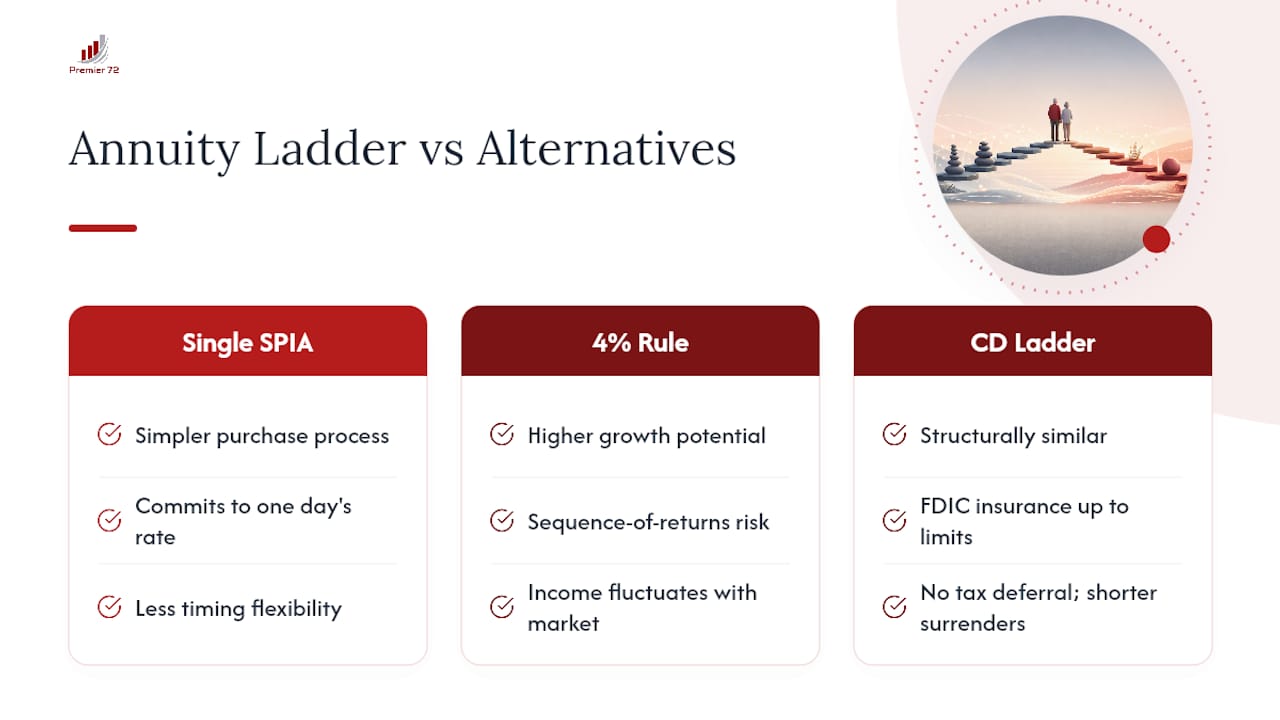
Compared with a single lump-sum annuity purchase, a ladder trades some simplicity for meaningfully better flexibility and reduced timing risk. Buying one large SPIA at a single point commits you to whatever rate and payout table exist that day. A ladder spreads that bet across several purchase dates.
Compared with a systematic withdrawal strategy from a stock and bond portfolio (often called the "4% rule" approach), a ladder trades growth potential for certainty. Market-based withdrawal strategies can outperform in strong years but carry sequence-of-returns risk, the danger of a market downturn early in retirement permanently damaging the portfolio's ability to sustain withdrawals. A ladder's income doesn't fluctuate with the market at all.
Compared with a CD ladder, the two strategies look structurally similar but diverge on tax treatment and protection. Annuity ladders offer tax deferral that CD ladders don't, but CDs carry FDIC insurance up to federal limits, while annuities rely on state guaranty associations with lower and more variable caps. Annuities also typically carry longer surrender periods and steeper early-withdrawal penalties than CDs.
None of these strategies is universally superior. A retiree with a pension and paid-off house might prefer market-based withdrawals for growth. A retiree without other guaranteed income sources often values the predictability a ladder provides more than the upside a portfolio might offer. Most comprehensive retirement plans, including the diversification-focused approach many advisors recommend, use a combination rather than betting everything on one method.
What an Annuity Ladder Actually Looks Like in Practice
Consider a 63 year old retiring with $300,000 set aside for guaranteed income, separate from her investment portfolio. Instead of buying one 7-year MYGA, she splits the money into three rungs: $100,000 in a 3-year MYGA, $100,000 in a 5-year MYGA, and $100,000 in a 7-year MYGA. When the 3-year rung matures, rates have moved higher, so she rolls it into a new 5-year MYGA at the improved rate. Two years later, her original 5-year rung matures, and she decides she wants guaranteed lifetime income instead, so she uses a 1035 exchange to convert that rung into a DIA that begins paying at age 72, capturing higher mortality-credit pricing along the way.
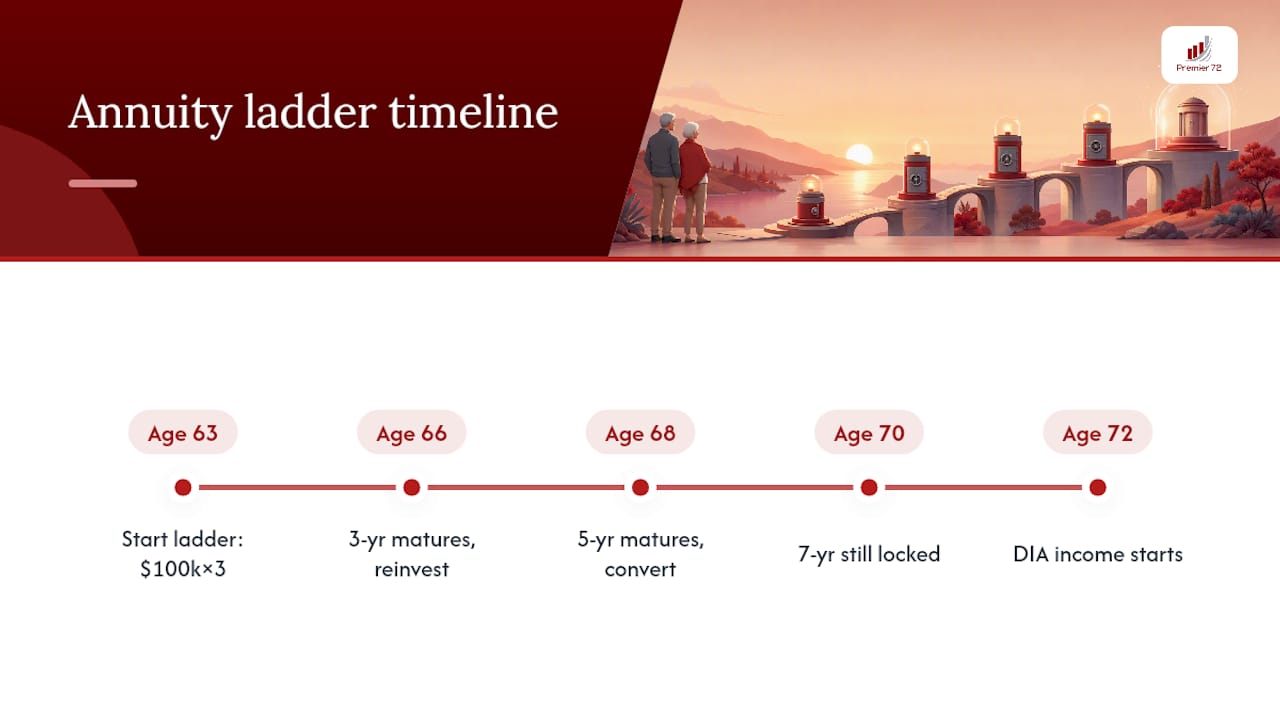
By year seven, she has one rung still locked into its original term, one converted into an income stream, and one reinvested at a newer, higher rate. No single decision defined her outcome. Compare that to a retiree who put the full $300,000 into one 7-year MYGA in a low-rate year: he's stuck at that rate for the entire term, with no ability to react to the market or his changing income needs.
A second, smaller example: a couple with $120,000 chooses a simpler two-rung structure, splitting evenly between a 4-year and 8-year MYGA specifically because they wanted fewer moving parts to track. Fewer rungs meant less rate-averaging benefit, but it also meant less paperwork and fewer decision points, a fair trade for a couple who wanted simplicity over optimization.
Building Inflation Protection Into a Ladder
Fixed annuities, MYGAs included, don't adjust for inflation on their own. The interest rate locked in at purchase stays fixed for the term regardless of what prices do afterward, which is the single biggest structural weakness of an otherwise conservative strategy.
Laddering itself offers a partial, indirect hedge. Because rungs mature and get reinvested every two to three years, each renewal is a chance to capture whatever rate environment exists at that moment, including one shaped by higher inflation and correspondingly higher interest rates. A retiree locked into one 10-year contract has no such opportunity until the full term ends.
Some income annuities offer an explicit cost-of-living adjustment rider, which increases payments annually by a fixed percentage or by a measure tied to inflation. These riders reduce the starting payout in exchange for growth over time, so they need to be weighed against a level payment that starts higher but never increases. For a ladder that includes income rungs, adding an inflation rider to just one or two of the later rungs, rather than all of them, is a common way to hedge some purchasing power risk without giving up meaningful starting income across the whole structure.
The practical design choice: don't rely on the ladder alone to solve inflation. Pair it with growth-oriented assets elsewhere in the portfolio, and consider an inflation rider selectively on income rungs meant to cover later, less predictable years of retirement.
Fitting an Annuity Ladder Into Your Broader Retirement Portfolio
A ladder isn't a full retirement plan by itself. It's the conservative, guaranteed-income layer that sits alongside Social Security, any pension, and a separate investment portfolio built for growth and long-term liquidity.
The right allocation to a ladder depends on how much guaranteed income you already have. Someone with a pension covering most fixed expenses might allocate a smaller share of savings to laddering, using it mainly for tax-deferred growth rather than income replacement. Someone without a pension, relying primarily on savings and Social Security, often benefits from a larger allocation, since the ladder's later income rungs can fill the gap that a pension would otherwise cover.
Liquidity planning matters just as much as allocation size. Because surrender periods restrict access to funds for several years per contract, money committed to a ladder should be money you're confident you won't need on short notice. That's why the emergency-cash step in the construction process isn't optional. It's what keeps a market downturn or an unexpected expense from forcing you into an early, penalized withdrawal from a rung that hasn't matured yet.
Finally, review the ladder alongside the rest of the portfolio at least once a year, not in isolation. Rate environment changes, health changes, and shifts in spending needs all affect whether the current rung structure still makes sense or whether the next maturity is the moment to adjust course.
A Straight Answer on What Actually Matters Here
Most of the writing on annuity laddering treats it like a set it and forget it product, and that's the part that misses the point. The strategy's entire value comes from the decisions you make at each maturity, not from the initial purchase. Skip the 60 to 90 day review window even once, and you've likely surrendered the rate-averaging benefit that justified building a ladder in the first place.
If there's one habit worth adopting, it's the spreadsheet. Retirees who track carrier, rate, and maturity date for every rung make better renewal decisions simply because they're not scrambling to remember contract details under time pressure. A couple I've seen described in advisory case discussions built a three-rung MYGA ladder, then let the second rung auto-renew at a mediocre rate because nobody flagged the date. That single missed window cost them more over the term than a modest advisory fee would have.
Talk to a licensed advisor before committing real money to a multi-rung structure. The mechanics are simple enough to understand from an article. The judgment calls at each maturity rarely are.
— Asa
Premier72 Helps You Build and Manage an Annuity Ladder With Guidance
Structured advisory reviews built around The Retirement Bank Method™ can provide access to professionals who check carrier strength, track maturity dates, and run payout comparisons as described in this article. This approach suits retirees and near-retirees seeking the rate-averaging and liquidity benefits of a ladder without managing all the administration alone, and business owners approaching an exit who want to manage liquidity without depending on a single carrier or rate.

If the mechanics in this guide made sense but the ongoing management feels like more than you want to track solo, that's exactly the gap a structured advisory relationship closes. You bring the goals and the balance sheet; Premier72 brings the carrier research, the documentation discipline, and the maturity calendar. Visit Premier72 to schedule a review of your retirement income options and find out whether an annuity ladder fits your specific numbers.
This article is general information, not a substitute for advice from a qualified financial advisor. Consult a qualified financial professional about your own circumstances before acting on anything here.
Sources
- Annuity
- Annuity ladder: Secure your retirement income — Investopedia
- FINRA: Annuities — investor resource