

For retirees who need a guaranteed income floor they cannot outlive, a fixed annuity or single-premium immediate annuity (SPIA) is generally the stronger choice. For those who prioritize liquidity, legacy, and control over their principal, a bond ladder built from U.S. Treasuries or municipal bonds fits better. The honest answer for most people: you probably need both.
Here is the short version of how to think about it:
- If your essential monthly expenses exceed Social Security and pension income, a partial annuitization covers that gap with a guaranteed payment you cannot outlive.
- If you have adequate baseline income and want flexibility for emergencies or heirs, a bond ladder preserves principal, returns cash on schedule, and keeps you in control.
- If you are unsure, read the $100,000 example in Section 8 and the checklist in Section 9, then get a side-by-side advisory quote before committing to either.
The core trade-off in the annuity vs bonds decision is simple: certainty versus control. Annuities give up principal access in exchange for a payment that cannot run out. Bonds keep your principal intact but require you to manage reinvestment risk and the possibility of outliving the ladder.
Key Takeaways
For most retirees, the strongest retirement income plan uses a fixed annuity or SPIA to cover the essential income gap and a bond ladder to preserve liquidity, legacy value, and flexibility above that floor.
| Point | Details |
|---|---|
| Annuity for the income floor | A SPIA or fixed annuity covers essential expenses you cannot outlive; mortality credits make payouts higher than a self-managed bond ladder. |
| Bond ladder for liquidity and legacy | Staggered maturities return principal on schedule, preserve assets for heirs, and keep you in control of reinvestment decisions. |
| Fees and insurer strength matter | Check AM Best ratings (A or better) and get full fee disclosure in writing; state guaranty associations cover up to $250,000 per insurer in most states. |
| Combine both for the best outcome | Partial annuitization plus a bond ladder outperforms either strategy alone for most retirees with a real income gap above Social Security. |
| Premier72 advisory next step | Premier72 models both strategies side by side, compares annuity quotes, and builds a bond-ladder scenario matched to your income gap and legacy goals. |
Table of Contents
- How annuities work and why they create reliable retirement income
- Annuity types you will encounter and when each typically fits
- What bonds are and how a bond ladder produces income
- Annuity vs bonds: a side-by-side comparison of what matters most
- Fees, insurer solvency, and the real cost of each strategy
- Mortality credits: the mechanism that makes annuities pay more
- What a $100,000 purchase might pay: annuity vs bond ladder
- How to choose: a checklist and the right questions to ask your advisor
- Combining annuities and bonds: three practical approaches
- A practical perspective on the annuity vs bonds decision
- How Premier72 can help you model both strategies
- Sources
How annuities work and why they create reliable retirement income
An annuity is an insurance contract, not an investment account. You transfer a lump sum to an insurance company, and in return the insurer promises a stream of payments, either immediately or at a future date. That distinction matters because the insurer, not you, bears the longevity risk.
The mechanics behind the payout involve three elements working together:
- Pooling: The insurer collects premiums from thousands of policyholders. Those who die early effectively subsidize the payments of those who live longer, a dynamic called mortality credits.
- Insurer investments: The company invests pooled assets, primarily in high-grade bonds and other fixed-income instruments, to generate the returns that fund payouts.
- Mortality credits: The portion of each payment that comes from the redistribution of assets from shorter-lived policyholders to longer-lived ones. This is what allows annuities to pay more per dollar than a bond ladder you manage alone.
A few terms you will see repeatedly:
- Accumulation phase: The period before payouts begin, during which your premium grows (in deferred annuities).
- Distribution phase: When the insurer makes regular payments to you, the annuitant.
- Annuitize: The act of converting your contract value into a guaranteed income stream, typically irrevocable.
Key mechanics to keep in mind when comparing annuities to bonds:
- Payouts are contractually guaranteed by the insurer, not by the federal government.
- Once annuitized, you generally cannot reclaim the lump sum.
- Payments can be structured for a single life, joint life, or a fixed period.
- Tax treatment depends on whether the annuity was funded with pre-tax or after-tax dollars.
Annuity types you will encounter and when each typically fits
Not all annuities behave the same way. Conflating a variable annuity with a SPIA is like comparing a savings account to a pension. Here is a quick breakdown of the products you are most likely to encounter:
- Fixed annuity: Pays a guaranteed interest rate during accumulation, then converts to a predictable income stream. Low risk, low complexity. Best for retirees who want certainty without market exposure.
- Variable annuity: Ties your account value to underlying investment subaccounts. Returns and income can fluctuate. Carries higher fees and market risk; generally less suitable for retirees who need a stable floor.
- Indexed annuity (fixed indexed annuity or FIA): Credits interest based on a market index like the S&P 500, subject to a cap and floor. Offers some upside with principal protection, but the caps and participation rates limit gains.
- Single-premium immediate annuity (SPIA): You pay a lump sum and income begins within 30 days to 12 months. The clearest, most direct tool for creating a guaranteed income floor. No accumulation phase, no market exposure, no ongoing decisions.
- Deferred annuity: Payments begin at a future date. Useful for building a guaranteed income stream you will not need for several years.
- Qualified Longevity Annuity Contract (QLAC): A deferred income annuity funded from a qualified retirement account (IRA or 401(k)) that delays required minimum distributions (RMDs) and begins payments as late as age 85. Designed specifically to hedge against living well into your 80s and 90s.
For a deeper look at how each product type fits into a retirement income plan, the types of annuities guide on the Premier72 blog walks through each in detail.
Always ask for the total cost of the contract with and without each rider before signing.
What bonds are and how a bond ladder produces income
Bonds are debt instruments issued by governments, municipalities, and corporations. When you buy a bond, you are lending money to the issuer. In return, the issuer pays you periodic interest (the coupon) and returns your principal at maturity. The three most common types for retirees:
- U.S. Treasury bonds: Backed by the full faith and credit of the federal government. The safest fixed-income instrument available. Interest is subject to federal income tax but exempt from state and local taxes.
- Municipal bonds: Issued by state and local governments. Interest is typically exempt from federal income tax and often from state taxes if you live in the issuing state, making them especially useful for retirees in higher tax brackets.
- Corporate bonds: Issued by companies. Higher yields than Treasuries, but carry credit risk. Investment-grade corporates are relatively safe; high-yield bonds carry meaningful default risk.
Zero-coupon bonds, which pay no periodic interest but are purchased at a discount and mature at face value, can be useful in ladder construction when you want precise cash flow timing without reinvestment decisions.
How a bond ladder works
A bond ladder staggers maturities so that a portion of your principal returns every year, giving you predictable cash flow and reducing reinvestment risk. Here is a simplified 5-year ladder using $100,000:
Each year, you either spend the returned principal or reinvest it into a new rung at the far end of the ladder. A 10-year ladder works the same way with longer rungs and typically higher yields on the longer maturities.
Key advantages of bonds for retirees:
- Liquidity: You can sell bonds on the secondary market before maturity if you need cash (though price may vary with interest rates).
- Legacy: Principal passes to heirs at maturity or through your estate.
- Control: You decide how to reinvest, when to spend, and how to adjust the ladder.
- Transparency: Coupon rates and maturity dates are fixed and known upfront.
Annuity vs bonds: a side-by-side comparison of what matters most
Both strategies create retirement income but serve fundamentally different roles. The table below compares them on the dimensions that actually drive retiree decisions.
| Dimension | Annuity (SPIA / Fixed) | Bond Ladder |
|---|---|---|
| Income certainty / lifetime guarantee | Guaranteed for life regardless of how long you live | Ends when the ladder matures; no longevity protection |
| Liquidity / access to principal | Principal is surrendered; no access after annuitization | Principal returns on schedule; bonds can be sold early |
| Fees & commissions | Agent commissions (typically 1%–7%), M&E charges, rider fees, surrender charges | Bid/ask spreads on secondary market; brokerage commissions (often minimal for Treasuries) |
| Tax treatment | Exclusion ratio applies to after-tax premiums; earnings taxed as ordinary income | Coupon interest taxed as ordinary income; muni interest often tax-exempt; principal return is not taxed |
| Inflation protection | Fixed annuities lose purchasing power over time; inflation riders available but costly | Reinvested principal can capture rising rates; TIPS ladders offer direct inflation adjustment |
| Credit / counterparty risk | Insurer solvency risk; state guaranty associations cover up to $250,000 per insurer in most states | Treasury bonds carry no credit risk; corporate bonds carry issuer default risk |
| Legacy value to heirs | Typically none after annuitization (unless a period-certain or death benefit rider is added) | Full remaining principal passes to heirs |
| Minimum investment | Often $10,000 for a SPIA | Treasury Direct allows purchases of $100 |
| Complexity / ongoing management | Low after purchase; insurer manages everything | Moderate; requires reinvestment decisions and monitoring |
Quick scan:
- Annuity: Best when you need income you cannot outlive and are willing to give up principal access.
- Bond ladder: Best when you want liquidity, legacy, and the flexibility to adjust your plan over time.
Fees, insurer solvency, and the real cost of each strategy
Fees are where many retirees get surprised, and the difference between annuities and bonds on this dimension is significant.
Annuity costs
- Agent commissions: Typically 1%–7% of the premium, paid by the insurer but embedded in the product's pricing. A SPIA generally carries lower commissions than a variable or indexed annuity.
- Mortality and expense (M&E) charges: Common in variable annuities, often 1.0%–1.5% annually.
- Rider fees: Each optional rider (income, death benefit, long-term care) typically adds 0.5%–1.0% per year.
- Surrender charges: Most deferred annuities impose a surrender schedule, often 7–10 years, with penalties of 7%–10% in year one declining to zero. SPIAs have no surrender period because the contract is immediate.
Bond transaction costs
Bond costs are generally lower and more transparent. Treasury bonds purchased at auction through TreasuryDirect carry no commission. Secondary market purchases involve a bid/ask spread, which for investment-grade bonds is typically a fraction of a percent. Brokerage commissions, where they apply, are usually modest.
Insurer solvency and state guaranty associations
Unlike Treasury bonds, annuities are not backed by the federal government. If an insurer becomes insolvent, state guaranty associations step in, but coverage is limited. Most states cover up to $250,000 in annuity present value per insurer, though limits vary by state. Before purchasing, check the insurer's financial strength rating from AM Best (look for A or better), Moody's, or S&P.
Statistic callout: State guaranty association limits vary, but the most common threshold is $250,000 per insurer per policyholder. If you are placing more than that with a single insurer, spreading the purchase across two highly rated carriers is a straightforward way to stay within protected limits.
Red flags to watch for:
- Surrender periods longer than 7 years without a clear waiver for hardship or terminal illness.
- Rider fees not disclosed in writing before signing.
- Payout guarantees that seem materially higher than competing quotes (often a sign of a weaker insurer or hidden trade-offs).
- An agent who cannot or will not show you the insurer's AM Best rating.
Mortality credits: the mechanism that makes annuities pay more
The single most important concept in the annuity vs bonds comparison is mortality credits, and most retirees have never heard of them.
When an insurer pools thousands of policyholders, some will die earlier than average and some will live longer. The assets of those who die early do not go to their heirs; they stay in the pool and are redistributed as additional income to survivors. This redistribution is the mortality credit. It is the reason a lifetime annuity can pay materially more per dollar than a bond ladder you manage on your own, even when both are invested at the same interest rate.
Statistic callout: Analysis from Kitces and Financial Planning shows that mortality credits can allow a SPIA to generate meaningfully higher annual income than a comparable bond-amortization strategy under the same assumed interest rates, with the differential widening as the annuitant ages. The older you are at purchase, the larger the mortality credit component of each payment.
The assumptions behind any payout comparison matter. Age is the biggest driver: a 65-year-old and a 75-year-old buying the same $100,000 SPIA will receive very different monthly payments because the 75-year-old's shorter expected lifespan means the insurer can pay more per year. Single-life contracts pay more than joint-life contracts because the insurer's liability ends at one death rather than two.
Pro Tip: If you are married, always get quotes for both single-life and joint-life options before deciding. A single-life payout is higher, but if your spouse depends on that income and you die first, the payments stop. A joint-life or survivor option reduces the monthly amount but protects your spouse's income floor. The right choice depends on your spouse's other income sources and health.

For a detailed explanation of how annuities provide guaranteed income through this pooling mechanism, the Premier72 blog covers the mechanics in plain language.
What a $100,000 purchase might pay: annuity vs bond ladder
Numbers make this concrete. The following example uses clear assumptions so you can see exactly where the differences come from.
Assumptions:
- Purchaser age: 65, single life
- Purchase amount: $100,000
- Interest rate environment: approximately 4.5% (prevailing 10-year Treasury yield as a reference)
- SPIA: no riders, no inflation adjustment, single-life payout
- Bond ladder: 10-year ladder, equal rungs of $10,000, average coupon 4.5%, held to maturity
- Taxes: not included in the table (see notes below)
Reading the numbers: The SPIA's monthly payment looks lower than the bond ladder's total annual cash flow in early years because the bond ladder includes returned principal alongside coupon income. By year 11, the SPIA is still paying; the bond ladder is not. A retiree who lives to 85 or 90 collects far more total income from the SPIA than from a 10-year ladder that exhausted itself at 75.
Limitations of this example: Actual SPIA payouts vary by insurer, the exact rate environment at purchase, and the specific contract terms. A 70-year-old would receive a higher monthly payment than a 65-year-old for the same premium. Rising rates increase both bond yields and annuity payouts. These figures are illustrative; always get a current quote from a licensed advisor before making a decision.
How to choose: a checklist and the right questions to ask your advisor
Work through this before you commit to either strategy.
Decision checklist
- Calculate your income gap. Add up Social Security, pension, and any other guaranteed income. Subtract your essential monthly expenses. If there is a gap, that gap is the case for annuitization.
- Assess your emergency liquidity needs. Do you have 6–12 months of liquid reserves outside of this decision? If not, a bond ladder preserves access to cash that an annuity does not.
- Clarify your legacy goals. Do you want to leave principal to heirs or a charity? Bonds pass principal; annuities generally do not without a rider.
- Review your tax situation. Are you in a high bracket where muni bond income would be tax-advantaged? Is your annuity funded with pre-tax or after-tax dollars?
- Be honest about your health and longevity expectations. Mortality credits favor those who live longer. If your family history suggests a shorter lifespan, a bond ladder may return more total value.
- Verify insurer financial strength. Check AM Best ratings before purchasing any annuity. Stick with carriers rated A or better.
- Get full fee disclosure in writing. Ask for the total annual cost of the contract, including all rider fees, before signing.
Questions to ask your advisor
- What is the exact surrender schedule, and are there hardship or terminal illness waivers?
- How does the payout change if I add a joint-life or survivor option for my spouse?
- What is the insurer's AM Best rating, and how long have they maintained it?
- How is your compensation structured on this product?
- Can you show me a bond ladder alternative at the same dollar amount for comparison?
- What happens to my income if the insurer is downgraded or becomes insolvent?
Red flags
- Seller does not disclose their compensation structure upfront.
- Payout guarantee is materially higher than three competing quotes.
- No liquidity waiver for medical emergencies or terminal illness.
- Advisor recommends annuitizing your entire liquid net worth.
- Contract language on the income rider is vague about what triggers the guarantee.
Combining annuities and bonds: three practical approaches
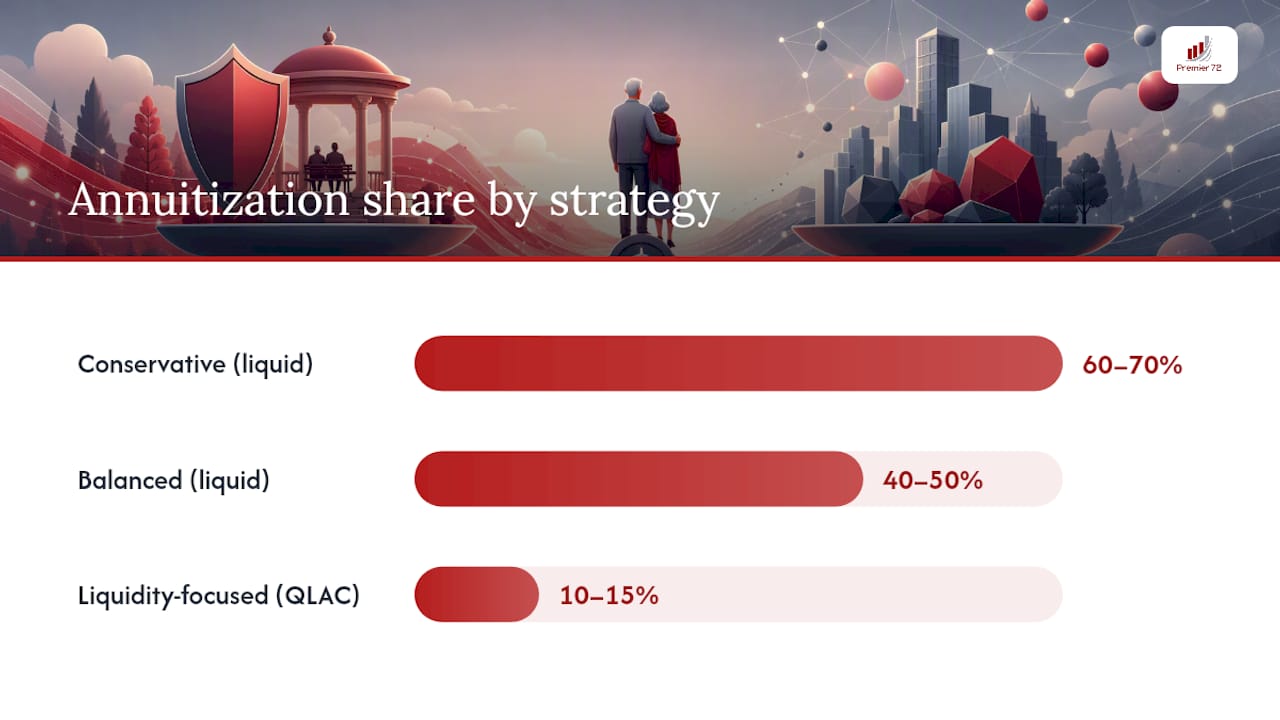
The either/or framing of annuity vs bonds misses how most well-structured retirement income plans actually work. Advisors widely recommend a floor-and-upside approach: annuitize enough to cover essential expenses, then use bonds and other assets for discretionary spending and legacy. Here are three sample structures.
-
Conservative (annuity floor + short ladder): Annuitize 60%–70% of liquid assets to cover all essential expenses. Use the remaining 30%–40% to build a 5-year bond ladder for discretionary spending, travel, and emergencies. This approach prioritizes income certainty and simplicity. Best for retirees with no pension, limited Social Security, and modest legacy goals.
-
Balanced (partial annuitization + medium ladder): Annuitize 40%–50% to cover the income gap above Social Security. Build a 7–10 year bond ladder with the rest. The ladder handles near-term flexibility and provides principal for heirs. Best for retirees with moderate legacy goals and some tolerance for managing the ladder's reinvestment decisions.
-
Liquidity-focused (short ladder + reserve + deferred annuity/QLAC): Keep most assets in a 5-year rolling bond ladder. Maintain a separate cash reserve of 12–18 months of expenses. Purchase a QLAC with 10%–15% of IRA assets to begin payments at age 80 or 85, hedging against extreme longevity without locking up the bulk of your portfolio now. Best for retirees with strong Social Security income, significant legacy goals, or health uncertainty that makes immediate annuitization feel premature.
For a broader view of how these strategies fit into a complete income plan, the retirement income streams guide on the Premier72 blog covers the full picture.
Pro Tip: If you decide to annuitize, consider spreading purchases over two or three years rather than committing everything at once. Staggering purchases averages out interest-rate timing, reduces the risk of locking in at a rate trough, and gives you time to compare quotes from multiple insurers as your situation becomes clearer.
A practical perspective on the annuity vs bonds decision
Most of the debate around annuities versus bonds gets framed as a product competition, and that framing leads retirees to the wrong question. The right question is not "which is better?" It is "what does my income plan actually need to do?"
At Premier72, the advisory process starts with a simple income gap analysis: what do you need every month to cover non-negotiable expenses, and how much of that is already covered by Social Security or a pension? If the gap is real and persistent, the case for at least partial annuitization is strong, not because annuities are universally superior, but because no bond ladder can guarantee income you cannot outlive without eventually running out of principal.
What gets underestimated consistently is the value of certainty itself. Retirees who know their essential expenses are covered tend to spend more freely from their discretionary assets, take fewer panicked decisions during market downturns, and report higher satisfaction with their retirement. A bond ladder that requires annual reinvestment decisions and carries the quiet anxiety of "what if I live to 95?" is not a neutral alternative. It carries its own psychological cost.
That said, annuities are not right for everyone, and they are certainly not right for every dollar. Annuitizing assets you may need for a medical emergency, a home repair, or a family obligation is a mistake. The income floor concept matters precisely because it is a floor, not a ceiling. The assets above that floor belong in structures that preserve flexibility, and a bond ladder is often the right tool for that job.
Premier72 typically recommends partial annuitization for clients whose essential expenses exceed guaranteed income sources, and a bond ladder or other liquid strategy for the discretionary layer. The combination is not a compromise; it is a structure that lets each tool do what it does best.
How Premier72 can help you model both strategies
Choosing between an annuity and a bond ladder involves more than comparing monthly payment estimates. It requires a clear picture of your income gap, your tax situation, your legacy goals, and the specific contract terms of any annuity you are considering.

Premier72 offers structured advisory reviews that walk you through exactly this process: a side-by-side income gap analysis, annuity quote comparisons from multiple carriers, and a bond-ladder scenario modeled against your actual expenses and timeline. Before reaching out, it helps to have a rough sense of your current liquid assets, your essential monthly expenses, and your age and health situation. That information lets the advisory conversation move quickly from general education to a plan that fits your specific numbers.
Premier72's advisory services cover annuity placement, retirement income planning, and legacy strategy. To start a conversation about your income floor and how annuities or bonds might fit into your plan, visit premier72.com.
Sources
Before purchasing an annuity or building a bond ladder, verify the key facts from primary sources. Here is where to look:
- Kitces
- Investor
- Bankrate — Annuities vs. Bonds
- Investopedia — Annuities vs Bonds
- Retirement
- Financial Planning — Kitces: Bond ladder vs immediate annuity
For insurer ratings, use AM Best as your primary source and cross-check with Moody's or S&P for any carrier you are seriously considering. For bond auction pricing and Treasury Direct purchases, use TreasuryDirect.gov directly rather than a secondary source.
This article is for general informational purposes only and does not constitute financial, tax, or legal advice. Annuity and bond strategies involve complex trade-offs that depend on your individual circumstances. Consult a licensed financial advisor and verify current product terms, insurer ratings, and tax rules before making any decisions.
This article is general information, not a substitute for advice from a qualified financial advisor. Consult a qualified financial professional about your own circumstances before acting on anything here.