

A retirement income floor is defined as the guaranteed monthly income that covers your essential living expenses without depending on market performance. For Baby Boomer business owners, the role of insurance in retirement income floor planning is to fill the gap between Social Security and what you actually need to live comfortably. Annuities and life insurance are the two primary tools that make this floor real. Without them, even a well-funded portfolio leaves you exposed to sequence-of-returns risk, longevity risk, and the behavioral trap of either spending too freely or living too cautiously. Premier72 works with business owners who face exactly this challenge.
What is the role of insurance in retirement income floor planning?
The retirement income floor is a planning concept, not an official regulatory term. Financial planners and researchers use it to describe the layer of guaranteed income that covers your non-negotiable monthly expenses: housing, food, healthcare, utilities, and debt service. Essential retirement expenses typically represent 60–80% of total retirement spending. That range tells you how much of your monthly budget must be covered before you touch a single dollar of your investment portfolio.
Business owners face a specific version of this problem. Your income during your working years often came from your company, not a paycheck. That means you may have fewer pension credits, irregular Social Security contributions, and a retirement plan built around a future business sale rather than decades of 401(k) contributions. The income floor concept gives you a framework to replace that business income with something contractual and permanent.

Failing to define the income floor causes retirees to either overspend in early retirement or underspend and sacrifice quality of life. Both outcomes are avoidable. The floor removes the guesswork by separating essential expenses from discretionary spending.
Pro Tip: Map your monthly essential expenses before you choose any insurance product. That number is your target floor, and every product decision should be measured against it.
The income floor strategy decouples essential expenses from portfolio volatility by securing them through contractual income. Once your floor is funded, your investment portfolio can take more risk because a market drop no longer threatens your ability to pay rent or cover a medical bill.
How do annuities create and sustain guaranteed retirement income?
Annuities are the most direct insurance tool for building a retirement income floor. They convert a lump sum into a stream of guaranteed payments, and that guarantee comes from an insurance company's contractual obligation, not market performance. The four types most relevant to income floor planning are fixed immediate annuities, deferred income annuities, fixed indexed annuities, and variable annuities with guaranteed lifetime withdrawal benefits.
A fixed immediate annuity starts paying within 30 days of purchase. A deferred income annuity, sometimes called a longevity annuity, starts at a future date you choose, often age 80 or 85. That delayed start makes it far cheaper per dollar of future income, and it protects against the risk of living longer than your savings last. Annuities pool longevity risk across thousands of policyholders, using actuarial credits from those who die early to fund payments to those who live longer. That mechanism is what makes lifetime income guarantees financially sustainable.
Allocation matters. Allocating roughly 25% of a portfolio to deferred income annuities improves late-life income security while preserving growth potential in the remaining assets. Putting too much into annuities reduces flexibility; too little leaves a gap in the floor.
| Annuity type | Best use in income floor | Key trade-off |
|---|---|---|
| Fixed immediate annuity | Cover current essential expenses now | No liquidity after purchase |
| Deferred income annuity | Fund late-life expenses starting at 80+ | Payments delayed; lower cost per dollar |
| Fixed indexed annuity | Grow floor assets with downside protection | Caps on upside growth |
| Variable annuity with GLWB | Combine growth potential with income guarantee | Higher fees; complexity |
Inflation is the silent threat to any fixed income floor. At a 3% annual inflation rate, purchasing power is cut roughly in half over 25 years. A fixed annuity paying $4,000 per month today covers far less in 2051. The solution is to pair fixed annuities with inflation-adjusted Social Security income, a growth portfolio, or annuities that include a cost-of-living adjustment rider.
Safety is non-negotiable when you commit a large lump sum to an insurance company. State guaranty associations cover annuity losses up to $250,000–$300,000 per owner per company. Spread purchases across multiple carriers to stay within those limits. Stick to insurers with A.M. Best ratings of A or higher.
Pro Tip: Check the types of annuities available for retirement income before committing to any single product. The right type depends on when you need income, not just how much.
What role does life insurance play in the retirement income floor?
Life insurance does not generate monthly income the way an annuity does. Its role in the income floor is different and equally important: it provides tax-free liquidity that protects the floor from unexpected shocks. Life insurance delivers tax-free benefits that cover estate costs, unexpected healthcare expenses, and legacy goals without forcing you to liquidate income-producing assets.
For Baby Boomer business owners, this matters in several specific ways:
- Business continuity: A life insurance death benefit funds a buy-sell agreement, keeping your business transfer on track and protecting your estate from a forced sale at a discount.
- Estate liquidity: Large estates often face illiquid assets. Life insurance provides immediate cash to cover estate taxes or equalize inheritances among heirs without selling the business or real estate.
- Healthcare cost buffer: Long-term care riders on whole life or indexed universal life policies can cover nursing home or home care costs without touching your annuity income.
- Legacy planning: The death benefit passes income-tax-free to beneficiaries, making life insurance one of the most efficient wealth transfer tools available.
- Floor protection: When an unexpected expense hits, you draw from the life insurance cash value rather than surrendering an annuity or selling portfolio assets at a bad time.
Whole life insurance builds guaranteed cash value at a fixed rate. Indexed universal life ties cash value growth to a market index with a floor of zero, giving you upside without downside. Both serve the income floor by acting as a reserve that does not fluctuate with markets. The life insurance retirement income strategy for business owners combines these protection and liquidity functions in a way that pure investment accounts cannot replicate.
Combining annuities and life insurance shifts the focus from accumulating assets to managing retirement outcomes. That shift is exactly what business owners need when transitioning from a company that generated income to a retirement plan that must replace it.
How do you integrate insurance into a practical income floor plan?
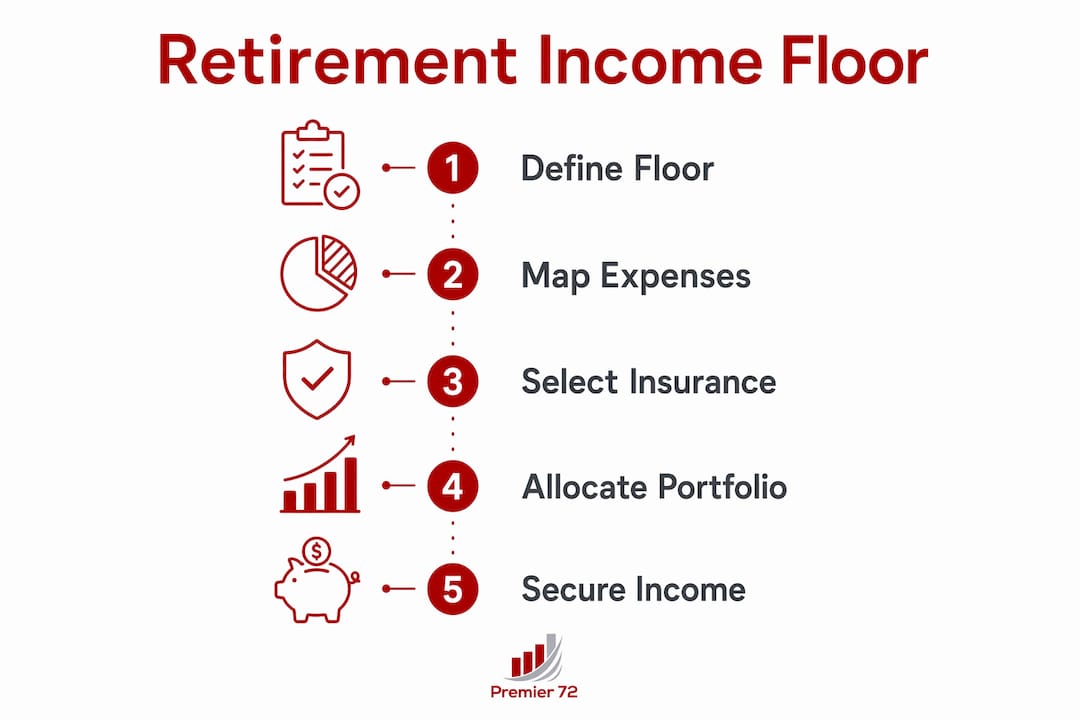
Building the floor is a sequenced process, not a single product decision. Follow these steps to put the pieces together correctly.
- Delay Social Security as long as possible. Delaying from age 62 to 70 raises your guaranteed monthly benefit by 76%. That increase is permanent, inflation-adjusted, and backed by the federal government. It is the cheapest guaranteed income you will ever get.
- Coordinate spousal benefits. Coordinating spousal Social Security claims can significantly increase the household income floor. The higher earner delays; the lower earner claims earlier to provide income during the delay period.
- Calculate your floor gap. Subtract your projected Social Security income from your essential monthly expenses. The remaining gap is what annuities must cover.
- Purchase annuities to close the gap. Use fixed immediate annuities for current income needs and deferred income annuities for late-life coverage. Keep total annuity allocation near 25% of your portfolio.
- Layer in life insurance for protection and liquidity. Choose a policy type based on your estate size, health, and legacy goals. Fund it while you are still insurable.
- Keep the remaining portfolio for discretionary spending and inflation. Growth assets cover travel, gifts, and lifestyle upgrades. They also offset inflation erosion on fixed annuity payments.
- Diversify across insurance carriers. Spreading purchases across insurers reduces the risk of any single company's insolvency affecting your floor. Stay within state guaranty association limits per carrier.
The role of insurance in retirement planning is not to replace your portfolio. It is to protect the portion of your income that cannot afford to fluctuate. Once the floor is secured, your portfolio can pursue growth without the pressure of funding your grocery bill.
Key takeaways
Insurance converts retirement savings into guaranteed income, making it the most reliable tool for funding the essential expenses that define your income floor.
| Point | Details |
|---|---|
| Define your floor first | Calculate essential monthly expenses before choosing any insurance product. |
| Annuities close the income gap | Allocate roughly 25% of your portfolio to annuities to fund guaranteed lifetime income. |
| Delay Social Security | Waiting until age 70 raises your monthly benefit by 76%, the largest risk-free return available. |
| Life insurance protects the floor | Tax-free cash value and death benefits prevent unexpected costs from disrupting guaranteed income. |
| Diversify across carriers | Stay within state guaranty limits of $250,000–$300,000 per company to reduce insolvency risk. |
Why business owners need a different income floor conversation
I have worked with enough Baby Boomer business owners to know that the standard retirement income conversation does not fit them. Most retirement planning advice assumes decades of W-2 income, a 401(k), and a predictable Social Security record. Business owners rarely have all three in clean form.
What I see most often is a business owner who has significant net worth tied up in their company, a modest Social Security benefit because they paid themselves through distributions rather than salary, and no defined benefit pension. When they sell the business, they receive a lump sum. That lump sum has to become their income floor, their growth portfolio, and their legacy plan all at once.
The mistake I see repeatedly is treating that lump sum as a portfolio and ignoring the income floor entirely. The owner invests it, draws from it, and then panics when markets drop 20% in year three of retirement. The floor was never built. The portfolio was never meant to carry that weight alone.
Advisors who integrate income and protection strategies help clients manage retirement outcomes beyond asset returns. That is the real value of combining annuities and life insurance. It is not about the products. It is about separating what must be guaranteed from what can afford to fluctuate.
The other misconception I encounter is that annuities are inflexible and expensive. Some are. But a well-chosen deferred income annuity purchased at 65 for income starting at 80 is one of the most cost-effective ways to fund late-life expenses. The cost per dollar of future income is low precisely because you are not paying for immediate access. Business owners who understand this stop seeing annuities as a trap and start seeing them as a tool.
Build the floor first. Then invest the rest. That sequence changes everything.
— Asa
How Premier72 helps you build a guaranteed income floor
Premier72 works specifically with Baby Boomer business owners who are transitioning from company income to retirement income. The gap between selling a business and building a reliable monthly income floor is where most owners are most vulnerable.

Through The Retirement Bank Method™, Premier72 helps you map your essential expenses, identify your income gap, and select the right combination of annuities and life insurance to close it. The process accounts for your business sale proceeds, your Social Security timing, your estate goals, and your legacy priorities. Every plan is built around your specific numbers, not a generic template. Visit Premier72 to connect with an advisor who understands both the business exit and the retirement income challenge that follows it.
FAQ
What is a retirement income floor?
A retirement income floor is guaranteed monthly income that covers essential living expenses without depending on investment returns. It typically needs to cover 60–80% of total retirement spending.
How does insurance create guaranteed retirement income?
Annuities convert a lump sum into lifetime income payments backed by an insurance company's contractual obligation. Life insurance adds tax-free liquidity to cover unexpected costs without disrupting that income.
How much of my portfolio should go into annuities?
Allocating roughly 25% of your portfolio to deferred income annuities improves late-life income security while preserving flexibility and growth potential in the remaining assets.
What happens if my insurance company fails?
State guaranty associations cover annuity losses up to $250,000–$300,000 per owner per company. Spreading purchases across multiple highly rated carriers reduces your exposure to any single insurer's insolvency.
When should I start building my income floor?
The earlier you plan, the more options you have. Delaying Social Security to age 70 and purchasing deferred income annuities in your early 60s locks in the most favorable terms for late-life guaranteed income.