

The cash conversion cycle (CCC) measures how many days pass between paying cash out for inventory and collecting cash in from customers, using the formula CCC = DIO + DSO − DPO. A shorter cycle generally means stronger liquidity and less dependence on outside financing, but "shorter" only counts as healthy when it does not strain suppliers or customers. CCC is often treated as a core diagnostic in exit-readiness work, alongside frameworks from FDIC and OpenStax.
TL;DR:
- A CCC of 76 days means a business needs about three months of working capital to fund operations before cash from sales is collected.
- For manufacturers and wholesalers with longer production cycles, a CCC between 60 and 100 days is common, while retail and grocery businesses often run near zero or negative cycles.
- Shortening CCC typically involves reducing inventory days, accelerating receivables collection, and extending supplier payment terms, prioritized in that order.
- Rapid changes in CCC can signal operational issues or supplier/vendor shifts and should be monitored against seasonal or economic trends for accuracy.
- Improving CCC can significantly increase business valuation by demonstrating disciplined cash management to potential buyers.
Table of Contents
- What the Cash Conversion Cycle Measures and Why It Matters
- How Do You Calculate the Cash Conversion Cycle?
- What Counts as a Good Cash Conversion Cycle?
- How to Shorten Your Cash Conversion Cycle
- When Does a Short Cash Conversion Cycle Become a Red Flag?
- Turning CCC Into a 30 to 90 Day Cash Action Plan
- How Supply Chain and Vendor Relationships Shape Your CCC
- How Seasonality and Economic Cycles Move Your CCC
- Why CCC can serve as a valuation lever, not just a ratio
- How Premier72 Turns CCC Improvements Into Exit Readiness
- Sources
What the Cash Conversion Cycle Measures and Why It Matters
The cash conversion cycle answers one operational question: how long does your cash sit tied up in inventory and unpaid invoices before it comes back to you as usable money? It is a direct measure of working capital efficiency, expressed in days rather than dollars. A business with a 90 day CCC is financing three months of operations out of its own pocket, or a lender's, before a single sale turns into spendable cash.
This matters most for businesses that hold physical inventory and extend credit to customers. A distributor buying raw materials, warehousing finished goods, and invoicing retailers on 60 day terms lives and dies by this number. A subscription software company billing monthly by credit card barely needs to think about it, because there is no inventory and receivables clear in days, not months.
CCC becomes critical in these situations:
- Manufacturers and wholesalers carrying multi-week production and storage cycles
- Retailers and distributors extending trade credit to business customers
- Seasonal businesses that must fund inventory buildup months before peak sales
- Any company preparing for a sale, where buyers scrutinize working capital efficiency closely
It matters less for pure service firms billing on retainer, cash-only retail operations, or businesses with minimal inventory and instant payment collection.
Get CCC under control and two things happen. First, you reduce how much you need to borrow or draw from a line of credit just to keep operating, which lowers interest expense and financial risk. Second, the cash you free up becomes available for growth: new equipment, additional hires, or a marketing push, instead of sitting locked in a warehouse or an unpaid invoice. Working capital management is not an abstract finance exercise. It is the difference between a business that funds its own growth and one that is perpetually asking a bank for permission.
How Do You Calculate the Cash Conversion Cycle?
CCC breaks into three components, each measured in days, then combined with one formula: CCC = DIO + DSO − DPO.
- Days Inventory Outstanding (DIO) measures how long inventory sits before it sells. The formula is DIO = (Average Inventory ÷ Cost of Goods Sold) × 365.
- Days Sales Outstanding (DSO) measures how long it takes to collect cash after a sale. The formula is DSO = (Average Accounts Receivable ÷ Total Credit Sales) × 365.
- Days Payables Outstanding (DPO) measures how long you take to pay your own suppliers. The formula is DPO = (Average Accounts Payable ÷ Cost of Goods Sold) × 365.
Pull the average inventory, receivables, and payables balances from your balance sheet, averaging the beginning and ending figures for the period. Pull cost of goods sold and credit sales from the income statement. This is a key reason CCC is a management accounting construct rather than something you can read straight off a cash flow statement; it has to be derived by combining two different financial statements.
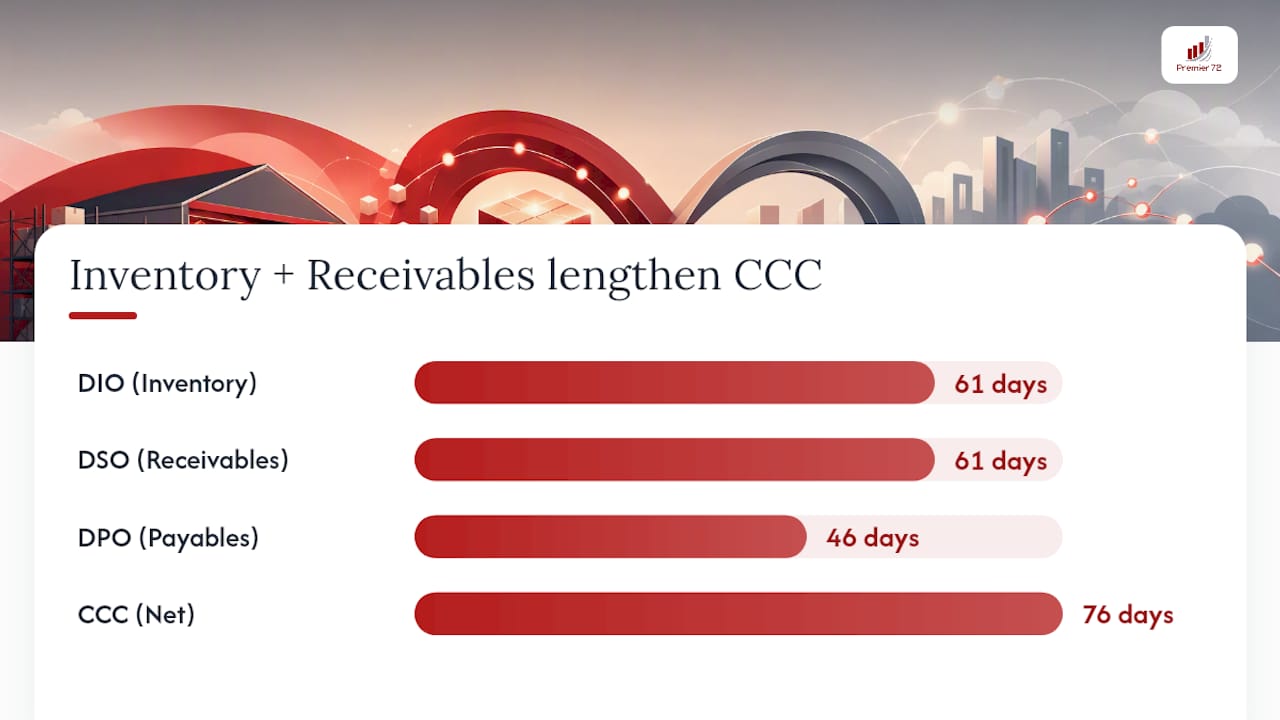
Worked example: Say a mid-size distributor reports average inventory of $400,000, COGS of $2,400,000, average receivables of $500,000, credit sales of $3,000,000, average payables of $300,000, and uses COGS of $2,400,000 again for the DPO calculation.
- DIO = (400,000 ÷ 2,400,000) × 365 = 61 days
- DSO = (500,000 ÷ 3,000,000) × 365 = 61 days
- DPO = (300,000 ÷ 2,400,000) × 365 = 46 days
- CCC = 61 + 61 − 46 = 76 days
Pro Tip: Run this calculation on a rolling 12 month basis rather than a single quarter. A one-time bulk inventory purchase or a slow holiday collection period can distort a single quarter's numbers badly enough to send you chasing a problem that does not really exist.
Three pitfalls trip up almost every business running this math for the first time. Seasonality skews single-period snapshots, since a retailer calculating CCC right after a holiday inventory buildup will show an inflated DIO that has nothing to do with normal operations, a distortion FDIC's cash flow module flags directly. Mismatched periods create false comparisons, so never mix a trailing 12 month COGS figure with a single quarter's average inventory. And one-off timing events, like a large customer paying 90 days late for reasons unrelated to your credit policy, can make DSO look worse than your actual collections process really is.
What Counts as a Good Cash Conversion Cycle?
There is no universal "good" CCC number, because the components that drive it vary enormously by business model. A grocery chain turns inventory in days. A furniture manufacturer might legitimately need weeks of production and storage time before a single unit ships.
Industry structure explains most of the variation you will see when benchmarking your own number against a competitor's or an industry report's:
- Retail and grocery businesses often run CCC near zero or negative, since inventory turns fast and much of it sells for cash or near-instant card settlement.
- Manufacturing businesses typically run CCC in the 60 to 100 day range, driven by production lead times and supplier payment terms.
- E-commerce and direct-to-consumer brands vary widely, but many land somewhere between 30 and 60 days depending on how much inventory they hold versus drop-shipping.
- Professional and business services firms often see CCC dominated entirely by DSO, since there is no inventory component at all.
Watch for sudden shifts more than the absolute number itself. A CCC that jumps from 70 to 100 days in one quarter usually signals something specific: a collections process breaking down, a supplier tightening terms, or inventory building up because sales forecasts missed. A CCC that suddenly drops to near zero deserves just as much scrutiny, since it can mean customers are being pushed to prepay in ways that will eventually cost you business, or suppliers are about to cut your credit line.
How to Shorten Your Cash Conversion Cycle
Three levers move CCC, and J.P. Morgan's treasury guidance frames them the same way most enterprise finance teams do: reduce inventory holding time, accelerate receivables collection, and extend payables terms where the relationship allows it. The practical question is which lever to pull first.
Inventory. Start with SKU rationalization: identify the slow-moving 20% of your catalog that is quietly tying up the majority of your inventory cash, and either discount it out or stop reordering it. Set reorder points based on actual sales velocity rather than gut instinct, and consider a just-in-time approach for your highest-volume items if your suppliers can support tighter delivery windows. Regular cycle counting also catches shrinkage and dead stock before they distort your numbers for months.
Receivables. This is usually the fastest lever to pull because it does not require renegotiating anything with a third party. Shorten standard payment terms where your market allows it, and move to electronic invoicing so invoices go out the day work is complete instead of sitting in a batch. Early-payment incentives, even a small 1 to 2% discount for payment within 10 days, pull cash forward measurably. An automated collections workflow that flags overdue accounts on day one, rather than day 45, changes DSO faster than almost any other single change.
Payables. Negotiate longer terms with suppliers, but treat this carefully. Use early-payment discounts strategically rather than automatically, paying early only when the discount rate beats your cost of capital. Dynamic discounting arrangements, where you offer to pay faster in exchange for a small price break, can work in your favor when you have surplus cash. Align your payment schedule with your actual cash inflow timing instead of paying everything on the invoice due date by default.
Here is what ties these levers together operationally:
- Integrate your accounting system with inventory and invoicing tools so DIO, DSO, and DPO update automatically rather than requiring a manual quarterly pull.
- Build a real-time dashboard tracking these three metrics alongside cash runway.
- Monitor inventory turnover ratio and DSO trend weekly, not just at quarter close, since early warning beats after-the-fact correction every time.
A practical sequencing heuristic works well for most small and mid-size businesses: fix receivables and invoicing automation first for the fastest impact, address inventory structure next, and only then approach suppliers about extending payables, since that conversation goes better once your own cash position is already stronger.
When Does a Short Cash Conversion Cycle Become a Red Flag?
Negative CCC happens when your combined inventory and receivables days are shorter than your payables days, meaning you collect cash from customers before you have to pay your own suppliers. Some retailers and subscription businesses run negative CCC as a structural feature, and it can be a genuine competitive advantage.
The risk shows up when negative CCC comes from aggressive tactics rather than a sound business model. Squeezing suppliers into unreasonably long payment terms or pressuring customers into prepayment can produce the same negative number on paper, but HBS Online's analysis warns this version is often unsustainable, since it depends on supplier goodwill or customer tolerance that can evaporate quickly, particularly during a supply disruption or a competitive shift.
CCC also has real measurement blind spots worth knowing before you lean on it too heavily:
- It does not distinguish good inventory from obsolete inventory sitting on the books at full value.
- It ignores bad debt, so receivables that will never actually be collected still count as "outstanding," not written off.
- It cannot tell you whether a change came from operational improvement or simply from a financing arrangement shifting the timing.
Pair CCC with the current ratio, days working capital, and free cash flow to get the fuller liquidity picture before drawing conclusions from CCC alone.
Turning CCC Into a 30 to 90 Day Cash Action Plan
CCC earns its value in forecasting, not just in retrospective reporting. Knowing your cycle runs 76 days lets you build a rolling cash forecast that predicts, weeks in advance, exactly when a funding gap will hit rather than discovering it the week payroll is due. Practitioners who fold CCC into forecasting move from reactive scrambling to proactive planning, since the number tells you precisely how much working capital your growth plans will actually require.
Build your plan across three horizons:
- Days 1 to 30: Audit your DSO by aging bucket, launch electronic invoicing for any customers still on paper, and identify your three slowest-turning inventory SKUs.
- Days 30 to 60: Implement an automated collections workflow, renegotiate terms with your top two suppliers, and set formal reorder points for your core inventory items.
- Days 60 to 90: Review results against your baseline CCC, adjust payment scheduling to match confirmed cash inflow timing, and assign a specific owner to weekly monitoring of DSO trend and inventory turns going forward.
Pro Tip: Track weekly cash runway alongside your CCC trend, not just the day count. A business can have an improving CCC and still hit a cash crunch if a single large customer payment slips by two weeks.
For a more detailed breakdown of this kind of structured timeline, a guide on cash flow gains in four to six weeks walks through the advisor-supported version of this plan.
How Supply Chain and Vendor Relationships Shape Your CCC
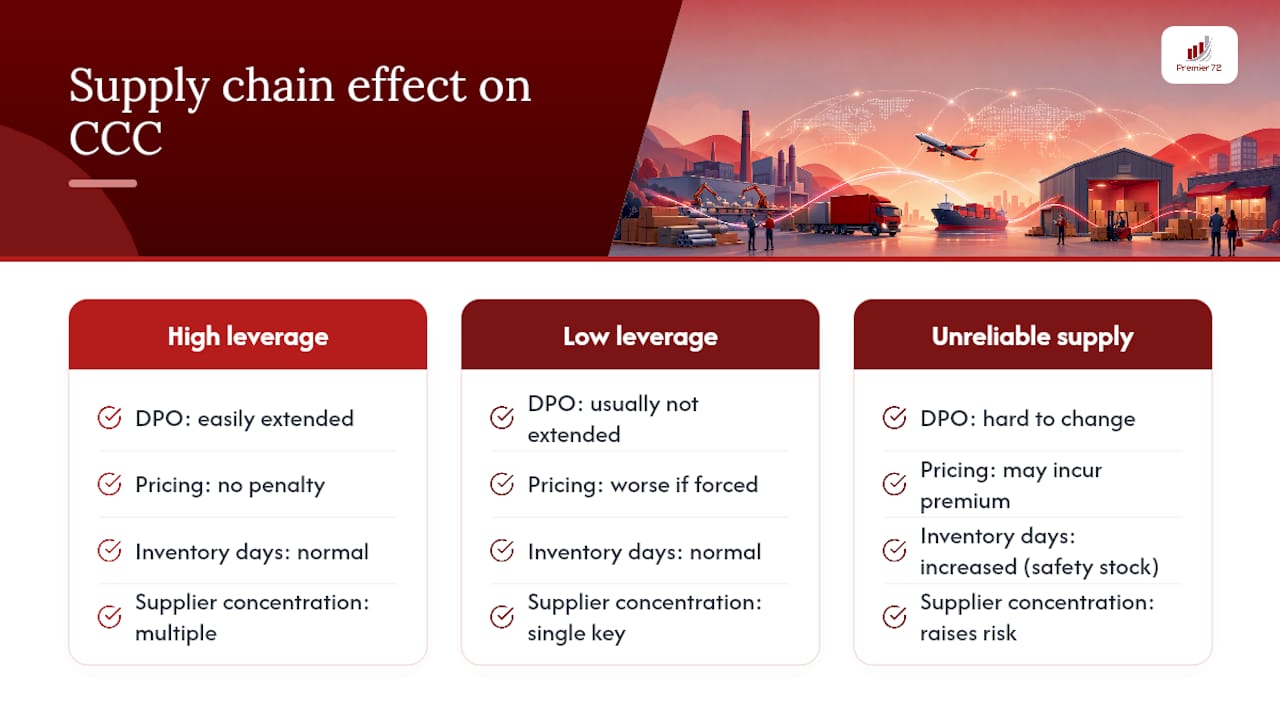
Your CCC is only partly under your own control. DPO, the payables side of the formula, depends on what your suppliers will actually agree to, and ACCA's working capital guidance makes clear that industry norms and supplier power limit how far you can push those terms unilaterally.
A small distributor trying to extend payment terms from 30 to 60 days with a dominant supplier will usually fail, or succeed only by accepting worse pricing elsewhere. A larger buyer with real purchasing leverage can negotiate that same extension without damaging the relationship at all. Supplier concentration matters just as much as size: a business relying on a single key vendor has far less room to negotiate than one with three or four comparable suppliers competing for the business.
The DIO side of the cycle depends on supply chain reliability just as much as negotiation leverage. A supplier with unpredictable lead times forces you to hold more safety stock, which directly inflates inventory days regardless of how efficiently your warehouse runs. Strengthening supplier collaboration, sharing demand forecasts, setting clear reorder triggers, and building in delivery reliability commitments, often does more for CCC than any internal inventory system upgrade. The businesses with the tightest cycles tend to be the ones treating their supplier relationships as an active part of financial management, not a purely operational afterthought handled by procurement in isolation.
How Seasonality and Economic Cycles Move Your CCC
Seasonal businesses see their CCC swing widely across the calendar year, and a single-quarter snapshot taken at the wrong moment will mislead you badly. A retailer building inventory ahead of the holiday season shows an inflated DIO in October that has nothing to do with a genuine operational problem; it simply reflects the natural buildup before peak selling. OpenStax's working capital guidance recommends computing CCC on rolling 12 month figures or matching comparable seasonal periods year over year, rather than comparing Q4 this year against Q2 last year.
Broader economic cycles affect CCC through a different channel entirely: customer and supplier behavior. During a downturn, customers stretch payment terms informally, quietly paying invoices a few days later than usual, which pushes DSO upward even when your collections process has not changed at all. Suppliers, feeling their own cash pressure, sometimes tighten credit terms in response, which compresses your DPO from the other direction. Both effects push CCC in the same unfavorable direction simultaneously during tight economic periods, which is exactly when a longer cycle hurts the most.
The practical response is to track CCC trend against a same-period-last-year comparison rather than a flat month-over-month view, and to build extra cash reserve cushion heading into any period your business has historically seen as seasonally tight.
Why CCC can serve as a valuation lever, not just a ratio
Business owners preparing to sell often discover their cash conversion cycle is quietly suppressing their valuation, because buyers read a long CCC as owner-dependent, undisciplined cash management. Improving it is core to The Retirement Bank Method™, where tightening receivables and inventory discipline both frees cash now and strengthens the working capital position a buyer will scrutinize at close. A business owner comfortable with spreadsheets can absolutely calculate and monitor CCC alone. What usually calls for advisory help is the negotiation layer, deciding which supplier or customer terms can safely move without damaging relationships you will need through a transition.
— Asa
How Premier72 Turns CCC Improvements Into Exit Readiness
A structured approach to working capital improvement offers a review of actual DIO, DSO, and DPO numbers, followed by a 90 day plan with owners and deadlines attached to each lever.

An initial engagement typically starts with pulling your cash conversion cycle components straight from your financial statements, benchmarking them against your specific industry rather than a generic average, and identifying which one or two levers will free the most cash fastest for your business. From there, Premier72 builds a prioritized action plan targeting measurable outcomes: a specific DSO reduction, a defined inventory turnover improvement, or a payables restructuring that does not damage supplier trust. For owners already thinking about a future sale, this same working capital work doubles as exit preparation, since a tighter cash cycle strengthens the numbers a buyer will diligence closely. If you want a clear picture of where your cash is actually tied up and a concrete plan to free it, start a conversation with Premier72 about a structured working capital review.
Sources
- HBS Online — Word of the Week: Cash Conversion Cycle
- FDIC — Module 10 Managing Cash Flows (participant guide)
- OpenStax — Principles of Finance (cash cycle section)
- J.P. Morgan — Understanding & optimizing your cash conversion cycle