

The working capital peg is the target level of operating net working capital that a seller must deliver at closing, and it drives a dollar-for-dollar adjustment to the purchase price. If actual working capital lands below the peg, the seller pays the buyer back; if it lands above, the buyer pays the seller more.
Before you sign anything, take three steps: confirm exactly how the purchase agreement defines net working capital, verify how cash is treated separately from that definition, and push for a peg supported by real historical data rather than a number someone picked to make the math work.
- Check the SPA's NWC definition line by line, not just the peg number
- Confirm whether cash is swept separately or embedded in the peg
- Negotiate a collar or dispute-resolution mechanism before signing the letter of intent
Pro Tip: A vague peg is one of the most common causes of post-closing disputes, and it can quietly erode proceeds for sellers who never modeled the cash treatment before closing.
Key Takeaways
The working capital peg sets the operating cash cushion a seller must deliver at closing, and every dollar above or below it shifts the purchase price directly.
| Point | Details |
|---|---|
| Peg drives price dollar-for-dollar | Closing NWC minus the peg equals the exact adjustment to the purchase price, no multiple applied. |
| Definition matters more than the number | Explicit account-level schedules in the SPA prevent more disputes than negotiating the peg figure itself. |
| True-up typically lands in 60 to 90 days | Most deals finalize the post-closing adjustment within that window, with a median near 75 days. |
| Cash treatment causes silent value loss | Misaligned DFCF sweep and NWC clauses can result in cash being counted, or paid, twice. |
| Prepare before you market the business | Premier72 helps sellers build defensible NWC schedules and model peg scenarios ahead of the LOI. |
Table of Contents
- What Is a Working Capital Peg in an M&A Deal?
- What Counts as Net Working Capital in a Deal?
- How Do Buyers and Sellers Set the Working Capital Peg?
- How Do You Calculate the Working Capital Adjustment?
- When Does the Working Capital True-Up Happen?
- What Do Buyers and Sellers Fight About Most?
- What Should Sellers Do Before Closing to Protect Proceeds?
- How Premier72 Helps Sellers Get the Peg Right
- Frequently Asked Questions
- Sources
What Is a Working Capital Peg in an M&A Deal?
A working capital peg, sometimes called an NWC peg, target working capital, or reference working capital, is the number both parties agree the business should carry into closing. Net working capital itself is simple in concept: operating current assets minus operating current liabilities, calculated using the accounts each side has agreed to include.
The formula in most purchase agreements reads: Adjustment = Closing NWC − Peg. If the number is positive, the buyer owes the seller more than the base purchase price. If it's negative, the seller owes the buyer back.
This mechanism interacts directly with debt-free, cash-free (DFCF) deal structures. In a DFCF transaction, the enterprise value assumes the business arrives with no debt and no excess cash, so any cash sitting on the balance sheet at closing typically flows to the seller separately from the NWC calculation. That separation sounds clean in theory. In practice, cash treatment is one of the most common sources of unintentional value leakage when the peg definition and the cash sweep language aren't written to match each other.
- NWC peg = agreed target level of working capital at closing
- Adjustment = Closing NWC minus the peg, paid dollar-for-dollar
- DFCF assumes zero debt, zero excess cash, separate from the peg calculation
What Counts as Net Working Capital in a Deal?
Most purchase agreements start from a familiar base and then customize it deal by deal. Getting this list wrong, or leaving it vague, is where a huge share of post-closing arguments originate.
Standard inclusions usually cover:
- Accounts receivable, net of allowances for doubtful accounts
- Inventory, net of obsolescence or slow-moving reserves
- Unbilled receivables or work-in-progress balances
- Operating prepaid expenses (insurance, rent, subscriptions)
- Accounts payable and accrued operating expenses
Cash gets special treatment almost universally. Operating cash needed to run the business day-to-day may stay inside the NWC calculation in some deals, while excess cash is swept to the seller under the DFCF mechanic. Debt and debt-like items (capital leases, unpaid transaction fees, deferred purchase obligations) sit outside NWC entirely and get settled through the debt payoff at closing.
The genuinely contentious items are the ones that don't fit neatly into either bucket. Deferred revenue can swing a peg calculation by hundreds of thousands of dollars depending on how a SaaS or services business recognizes it. Accrued bonuses and warranty reserves often get argued over because they're estimates, not hard numbers. Cutoff accounting, meaning which transactions fall on which side of the closing date, and restricted cash tied to customer deposits or regulatory requirements both need explicit treatment in the agreement. Poor drafting on these items is a leading cause of pro-buyer adjustments after closing.
How Do Buyers and Sellers Set the Working Capital Peg?
Setting a defensible peg blends quantitative analysis with judgment. Three methodologies dominate real deals:
- Trailing 12-month average: smooths seasonal swings and is the most common approach in practice
- Snapshot at the latest period: simpler, but risky if that month doesn't represent normal operations
- 12-month average with explicit adjustments: strips out one-time items and documents why
The look-back period matters more than most first-time sellers realize. Seasonal businesses face the sharpest version of this problem: a landscaping company selling in March, at the bottom of its working capital cycle, can get badly hurt by a peg calculated off a 12-month average that includes its peak summer months.
Sellers preparing for this conversation should run through a short list before engaging a buyer:
- Pull monthly working-capital schedules for the prior 12 to 24 months
- Flag outliers: one-time write-offs, unusual collections, discount campaigns
- Document any recurring seasonality with supporting operational data
- Reconcile the schedule against audited or reviewed financials
Pro Tip: If your business has a predictable seasonal pattern, build a rolling 24-month schedule before you ever talk to a buyer. It's the single easiest way to defend against a peg set at your worst possible month.
How Do You Calculate the Working Capital Adjustment?
The formula itself is straightforward: Adjustment = Closing NWC (per the SPA definition) − Agreed Peg. A positive result increases the purchase price paid to the seller. A negative result reduces it, dollar-for-dollar, no multiples applied.
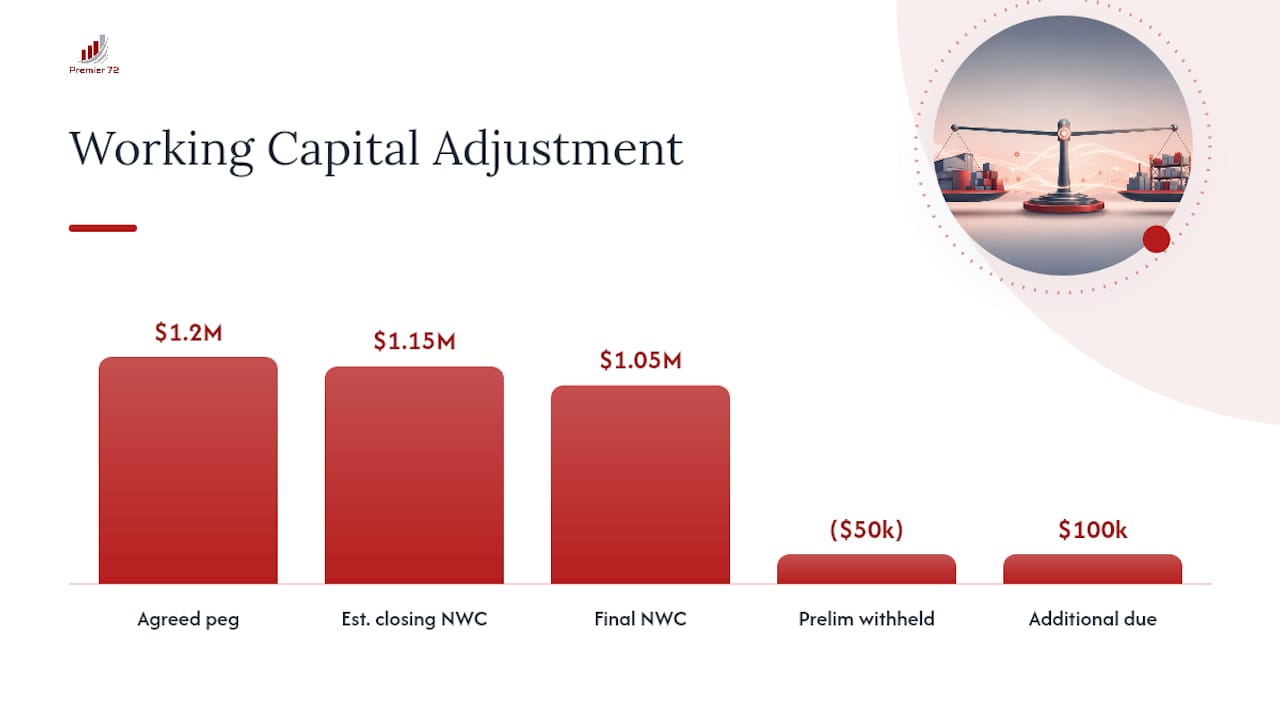
Here's how it plays out in a real transaction. Say a business sells for a $10 million base purchase price with a peg of $1.2 million. At signing, the seller estimates closing NWC at $1.15 million, so the buyer withholds $50,000 from the closing payment as a preliminary adjustment. Once the books close and the final NWC calculation is completed, actual NWC comes in at $1.05 million, $150,000 below the peg.
| Line Item | Amount |
|---|---|
| Base purchase price | $10 million |
| Agreed peg | $1.2 million |
| Estimated closing NWC | $1.15 million |
| Preliminary adjustment (at close) | ($50,000) |
| Final NWC (post-closing true-up) | $1.05 million |
| Total adjustment owed to buyer | ($150,000) |
| Additional payment due from seller | $100,000 |
The seller already gave up $50,000 at closing, so the post-closing true-up requires an additional $100,000 payment to reach the full $150,000 shortfall. This kind of two-step process, an estimated closing statement followed by a final reconciliation, is standard, and it's exactly why escrow or holdback provisions exist. Without one, a buyer chasing $150,000 from a seller who's already spent the proceeds becomes a collections problem, not a contract term.
When Does the Working Capital True-Up Happen?
The true-up follows a predictable three-step timeline in most deals.
- Estimated closing statement: the seller prepares this roughly 3 to 5 business days before closing, based on the most recent available financials
- Preliminary adjustment at close: the purchase price is adjusted using that estimate, often with a portion held back in escrow
- Final true-up: typically finalized 60 to 90 days after closing, once final books are closed and reviewed; industry data puts the median delivery timeline at around 75 days
Escrow and holdback amounts exist specifically to fund this second payment without requiring a fresh collections effort. Collars, meaning a dead band around the peg within which no adjustment applies, reduce the number of disputes triggered by immaterial variances. Caps limit the maximum adjustment either party can be forced to absorb.
- Buyer delivers final closing statement with supporting schedules
- Seller has a defined window (commonly 30 days) to review and object
- Unresolved disputes escalate to a pre-named Independent Accountant for binding resolution
What Do Buyers and Sellers Fight About Most?
Buyers generally push for a higher peg and a broader definition of included accounts, since both moves reduce their post-closing payment risk and increase the odds a seller owes money back. Sellers push the opposite direction: a lower peg, narrower inclusions, and a collar wide enough to absorb normal month-to-month noise without triggering an adjustment at all.
A few red flags reliably predict a fight after closing:
- A NWC definition that references "GAAP" without listing specific accounts
- Cash treatment that contradicts itself between the purchase price section and the NWC schedule
- No supporting exhibit showing exactly how the peg was calculated
- A look-back period that doesn't account for known seasonality or a recent acquisition
The fix is almost entirely a drafting exercise. Explicit account-level schedules attached as exhibits beat broad formulas nearly every time, since the definition of what counts often matters more than the peg number itself. Naming the Independent Accountant in the agreement, rather than leaving it to be negotiated after a dispute has already started, removes one entire round of conflict. And aligning the DFCF cash sweep language with the NWC definition closes the single most damaging gap sellers tend to miss: paying out cash twice, once through the sweep and once buried inside a working capital calculation that assumed it was still there.
Pro Tip: If your management buyout or sale structure involves an earnout or deferred payment, review how that mechanism interacts with the NWC true-up. Overlapping adjustment periods are a common drafting blind spot.
What Should Sellers Do Before Closing to Protect Proceeds?
A sell-side working capital review, done before you ever talk to a buyer, changes the entire negotiation dynamic. Reconcile AR aging, inventory obsolescence reserves, and accrual balances now, while you control the timeline. Baker Tilly's guidance on this process makes clear that sellers who show up with clean, documented schedules negotiate from a stronger position than those who wait for the buyer's diligence team to find the problems first.
- Build a 12 to 24 month monthly NWC schedule and reconcile it to your financials
- Document every one-time item with backup, not just a note in a spreadsheet
- Avoid unusual AR collection pushes or inventory drawdowns in the weeks before closing
- Attach a sample working-capital schedule as an SPA exhibit and pre-name your Independent Accountant
Pro Tip: Some businesses, particularly customer-funded models with heavy deferred revenue, operate with a negative NWC peg entirely. That's not automatically a red flag, but it needs documentation, not just an explanation offered after a buyer questions it.
A note on the mistake we see most often
The most common seller mistake isn't a bad number. It's agreeing to a peg methodology before modeling what it does to actual cash proceeds under a realistic range of outcomes, including how a cash sweep clause might interact with it. Run the math under two or three scenarios before you sign the letter of intent, not after. If you're mapping out your exit timeline alongside this decision, aligning your working capital strategy with your broader retirement planning now avoids a scramble later.
How Premier72 Helps Sellers Get the Peg Right
Premier72 gives established business owners something most sellers never get: a working capital model built months before a buyer ever sees your financials, not scrambled together during diligence.

That's the practical difference. Sellers who walk into a deal with a documented 24-month NWC schedule, clearly flagged one-time items, and a pre-modeled range of peg and cash-sweep scenarios negotiate from strength instead of playing defense against a buyer's first draft. Premier72's exit readiness work, including The Retirement Bank Method™, builds this preparation directly into your broader succession planning, so the working capital conversation is one more solved problem on your way to closing, not a surprise that erodes your proceeds in the final 90 days. If you're weighing an exit in the next few years, start a readiness review with Premier72 now, while you still have time to shape the numbers instead of reacting to them.
Frequently Asked Questions
What is a working capital peg in simple terms? It's the target amount of operating working capital, mainly receivables and inventory minus payables, that the seller agrees to deliver at closing. The final purchase price gets adjusted up or down based on how actual working capital compares to that target.
Is a working capital peg negotiable? Yes, and it should be negotiated well before the letter of intent stage. Buyers typically favor a higher peg and broader inclusions; sellers benefit from a lower peg, narrower exclusions, and a collar that absorbs minor fluctuations without triggering an adjustment.
What happens if actual net working capital is below the peg? The seller owes the buyer the shortfall, dollar-for-dollar, usually settled through an escrow or holdback established at closing.
How long does the final working capital true-up take? Most deals finalize the adjustment 60 to 90 days after closing, once final financial statements are prepared and reviewed by both parties.
Can a working capital peg be negative? Yes, particularly for businesses with significant deferred revenue or customer deposits. A negative peg isn't inherently a warning sign, but it requires clear documentation to withstand buyer scrutiny.

This article is general information, not a substitute for advice from a qualified financial advisor. Consult a qualified financial professional about your own circumstances before acting on anything here.
Sources
- The importance of net working capital (NWC) in M&A | BDO
- Practical Law: Working capital adjustments (Thomson Reuters Practical Law)
- Net working capital purchase price adjustments in M&A deals | Whiteford, Taylor & Preston
- Cash in the net working capital calculation and adjustment | RIW
- Net working capital adjustment: peg calculation, true-up process, and dispute avoidance | CT Acquisitions