

The five primary types of management buyout structures are the leveraged MBO (LMBO), the phased or partial buyout, the management buy-in (MBI) and its hybrid variant the BIMBO, the ESOP or employee ownership structure, and the owner buy-down (OBO). Each is a distinct approach to ownership transfer, and the right fit depends on your company's cash flow, the depth of your management team, and how quickly you need liquidity. As a first step, most owners benefit from a quick feasibility check: test whether your business generates enough free cash flow to service acquisition debt, confirm that your management team is committed and capable, and get a high-level read on the financing gap between what lenders will provide and what the deal requires. Management buyouts are typically financed with a mix of senior bank debt, private equity, and seller financing, and understanding which combination fits your situation is what separates a deal that closes from one that stalls.
The core MBO structures at a glance:
- Leveraged MBO (LMBO): High debt, management equity, often private equity co-investment; suited to cash-flow-stable businesses.
- Phased/partial buyout: Staged purchase over time using seller notes and cash-flow lending; reduces upfront leverage.
- MBI and BIMBO: Outside managers lead or co-lead; higher execution risk but useful when internal depth is thin.
- ESOP: Employees acquire ownership through a trust; tax-advantaged but structurally complex.
- Owner buy-down (OBO): Seller retains a minority stake while management buys the majority; bridges valuation gaps.
Key Takeaways
The most effective MBO outcome depends on matching your structure to your cash-flow profile, management depth, and liquidity timeline before you approach lenders or investors.
| Point | Details |
|---|---|
| Five core structures | LMBO, phased buyout, MBI/BIMBO, ESOP, and OBO each suit a different cash-flow and ownership profile. |
| Financing mix drives deal viability | Senior debt, mezzanine, seller notes, and management equity must be sized to your EBITDA and covenant capacity. |
| Warranty gap is a real risk | MBO sellers provide fewer reps; budget for escrow, RWI, or earnouts to protect both sides post-close. |
| Start preparation 18–24 months early | Reducing owner dependence and customer concentration before going to market improves terms and bankability. |
| Premier72 exit-readiness advisory | Premier72's Retirement Bank Method™ prepares owner-dependent businesses for a structured, financeable ownership transfer. |
Table of Contents
- What are the main types of management buyout structures?
- How MBOs are typically financed
- Who's involved in an MBO and what each party wants
- What does the MBO transaction process actually look like?
- Key risks in MBOs and how to manage them
- Which MBO structure fits your business?
- How experienced advisors improve your MBO outcome
- What most owners get wrong about MBOs
- Premier72 helps you structure a cleaner, more bankable MBO
- Sources
What are the main types of management buyout structures?
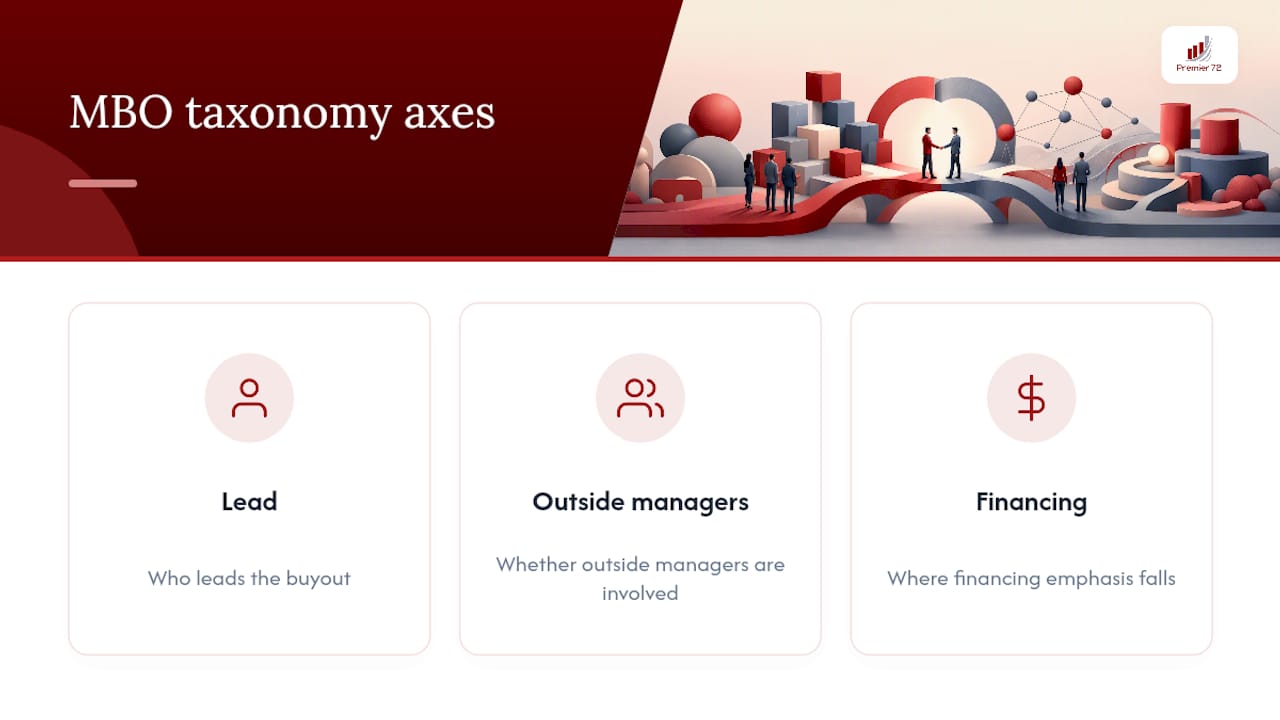
Authoritative educational primers distinguish MBO variants by three factors: who leads the buyout, whether outside managers are involved, and where the financing emphasis falls. The taxonomy below maps each structure to a practical use case.
1. Leveraged MBO (LMBO)
The LMBO is the most common structure for mid-market U.S. businesses. Management, often backed by a private equity sponsor, creates a NewCo or HoldCo that takes on acquisition debt and uses the target's future cash flows to repay it. This HoldCo/NewCo wrapper is central to buyer economics: it receives equity contributions from managers and investors, takes the acquisition debt, and acquires the target as a clean legal entity.
Best for: Businesses with predictable, recurring revenue and strong EBITDA margins.
Control outcome: Management holds meaningful equity, but a PE sponsor often holds a majority or board-control position until debt is repaid.
Pros:
- Maximizes purchase price relative to management's out-of-pocket equity
- PE sponsors bring operational expertise and follow-on capital
- Seller receives a clean, full-price exit at close
Cons:
- High debt load creates covenant risk and limits operating flexibility
- Management equity is subordinated to debt repayment
- PE sponsors typically require a defined exit horizon (often 4–7 years)
Scenario: A manufacturing company with $8 million EBITDA is acquired by its CEO and CFO with a PE co-investor.
2. Phased or partial buyout
A phased buyout transfers ownership in stages rather than all at once. The seller finances part of the purchase price through a seller note, and management buys additional tranches at pre-agreed prices or valuation formulas over several years. This staged approach reduces immediate leverage and eases management's cash requirement, making it a practical compromise when owners want gradual liquidity.
Best for: Smaller businesses (often under $10 million in revenue) where management lacks the personal capital for a full buyout and the seller values continuity over speed.
Control outcome: Seller retains partial ownership and often a board seat during the transition period.
Pros:
- Lower upfront debt burden
- Seller stays engaged, reducing transition risk
- Valuation disputes are easier to resolve with step-up formulas
Cons:
- Seller remains exposed to business risk during the transition
- Governance can become complicated with two principals
- Financing terms for later tranches may shift with market conditions
Over three years, management buys the remaining stake using the firm's cash flow.
3. Management buy-in (MBI) and BIMBO
An MBI brings in an external management team to acquire and run the business, replacing or supplementing existing leadership. The BIMBO (buy-in management buyout) blends both: external managers join the existing team to lead the acquisition together. The key distinction is that an MBI introduces new managers who lack the insider knowledge of an MBO team, which increases execution risk and typically requires stronger investor oversight and more rigorous lender underwriting.
Best for: Businesses where internal management is thin, retiring, or unwilling to participate, but the business itself is sound.
Control outcome: External managers hold the majority; existing staff may retain minority stakes or employment roles.
Pros:
- Brings fresh strategic perspective and skills
- Viable when no internal succession candidate exists
- BIMBO preserves institutional knowledge while adding new capability
Cons:
- Higher execution risk due to the learning curve
- Lenders and PE sponsors demand more due diligence
- Cultural friction between incoming and existing teams is common
Scenario: A distribution company's owner retires with no internal successor.
4. ESOP and employee ownership structures
An Employee Stock Ownership Plan (ESOP) transfers ownership to a trust that holds shares on behalf of employees. The trust typically borrows to buy the seller's shares, and the company repays the loan through tax-deductible contributions. ESOPs carry significant tax advantages under U.S. law.
Best for: Owners who prioritize employee legacy and long-term continuity over maximum sale price; companies with stable, predictable earnings and a broad employee base.
Control outcome: A trustee votes the shares on behalf of employees; a board of directors continues to manage operations.
Pros:
- Significant tax benefits for seller and company
- Strong employee retention and motivation
- Seller can exit gradually while preserving company culture
Cons:
- Structurally complex and expensive to establish (legal, valuation, and trustee fees)
- Valuation must be set by an independent appraiser
- Repayment obligations can strain cash flow in lean years
5. Owner buy-down (OBO)
The seller's retained equity participates in future value creation, which helps bridge a valuation gap when management cannot finance a full purchase price. The seller effectively "rolls" equity into the new structure.
Best for: Situations where the seller believes in the company's growth trajectory and is willing to accept a partial exit now in exchange for upside later.
Control outcome: Management holds majority control; seller retains a minority board seat and economic rights.
Pros:
- Reduces the financing gap management must close
- Aligns seller and management incentives post-close
- Seller participates in future appreciation
Cons:
- Seller remains exposed to downside risk
- Exit timing for the seller's retained stake must be negotiated upfront
- Governance documents must clearly define minority rights
6. Management rollover and minority-management deals
In a rollover, management contributes a portion of their sale proceeds back into the acquiring entity as equity, rather than taking full cash at close.
LBO vs. MBO distinction: An LBO (leveraged buyout) is the broader category; any highly leveraged acquisition of a company qualifies. An MBO is a specific type of LBO where the acquiring party is the incumbent management team. All LMBOs are LBOs, but not all LBOs are MBOs.
How MBOs are typically financed
Practical MBO financing commonly draws from five sources: buyers' personal funds, asset-based financing, cash-flow lending, mezzanine tranches, and seller financing. The exact mix depends on deal size, the company's profitability, and available collateral. Banks may require a substantial management equity contribution before committing senior debt, and lenders in more aggressive financings have modeled leverage at 4x cash flow or higher, though actual leverage depends heavily on earnings stability and collateral quality.

The table below shows illustrative financing mixes by structure type. These are examples only; actual terms depend on your company's specific cash flow, collateral, industry, and lender appetite.
Pro Tip: Match your amortization schedule to your business's cash-flow cycle. A seasonal business that front-loads debt repayment in its slow quarter will trip covenants even when the annual numbers look fine. Ask lenders for a cash-flow sweep structure or a flexible amortization profile tied to EBITDA milestones rather than a fixed monthly payment.
Mezzanine financing often includes equity kickers such as warrants or payment-in-kind (PIK) components that increase the effective cost of capital over time. If you negotiate a mezzanine tranche, model the fully diluted cap table at exit, not just at close, to understand how warrants affect management's net proceeds. Similarly, revenue-based financing is an emerging alternative for cash-flow-positive businesses that want to avoid fixed-payment bank debt; repayments flex with revenue, which can reduce covenant risk in cyclical businesses.
Key financing considerations:
- Seller notes typically carry interest rates of 5–8% and maturities of 3–7 years; they are subordinated to senior debt and often require a standstill agreement.
- Asset-based lending (ABL) uses receivables and inventory as collateral; useful for product businesses with strong working capital.
- SBA 7(a) loans can finance MBOs up to $5 million and are accessible to smaller deals that fall below conventional bank thresholds.
- Cash-flow lending underwrites against EBITDA rather than hard assets; common in service businesses with limited collateral.
Who's involved in an MBO and what each party wants
Every MBO involves at least four parties, and each one enters the transaction with a distinct objective. Understanding those objectives helps you anticipate where negotiations will stall and where concessions are available.
Core parties and their primary objectives:
- Management team: Acquire ownership at a price that leaves meaningful equity upside after debt service; retain operational control and minimize dilution.
- Seller: Maximize net proceeds, minimize post-close liability (representations, warranties, indemnities), and achieve a clean exit on a defined timeline.
- Senior lender (bank or ABL provider): Protect principal through covenants, collateral, and amortization; require management equity contribution as a commitment signal.
- Mezzanine or PE investor: Achieve target returns (often 20%+ IRR for PE) through a combination of current yield, equity appreciation, and a defined exit; require board representation and veto rights on major decisions.
- Legal and tax advisors: Structure the transaction to minimize tax leakage, protect their client's interests in representations and warranties, and close the deal efficiently.
- Accountants and financial advisors: Prepare quality-of-earnings analyses, financial models, and lender packages that support the financing narrative.
Negotiation checklist — key leverage points:
- Purchase price and valuation methodology (EBITDA multiple, asset vs. stock sale, working capital peg)
- Seller representations and warranties (scope, survival period, indemnity caps)
- Escrow amount and release schedule (typically 10–15% of purchase price held for 12–18 months)
- Earnout structure (metrics, measurement period, accounting definitions, dispute resolution)
- Equity rollover percentage (how much of the seller's proceeds re-invest alongside management)
- Management retention and incentive packages (equity grants, stay bonuses, non-compete terms)
Post-close governance: The shareholder agreement should define board composition, voting thresholds for major decisions (asset sales, new debt, acquisitions), drag-along and tag-along rights, and the process for resolving deadlocks. PE sponsors typically require at least one board seat and veto rights over decisions above a defined dollar threshold. Sellers who retain a minority stake need clearly defined minority protections, including information rights and a defined liquidity path.
Structuring partner life insurance on key management members is a practical governance tool: it funds the buy-sell agreement if a key manager dies or becomes disabled post-close, protecting both the lender's collateral and the remaining owners' equity.

What does the MBO transaction process actually look like?
A U.S. MBO typically takes 4–9 months from initial planning to closing, though complex deals with multiple financing sources or regulatory considerations can run longer. The phases below reflect a realistic sequence.
Phase 1: Planning and feasibility (weeks 1–6)
- Management conducts an internal feasibility assessment: free cash flow test, financing gap analysis, and management commitment confirmation.
- Engage a financial advisor or M&A attorney to validate valuation range and identify likely financing sources.
- Seller and management sign a confidentiality agreement and begin preliminary valuation discussions.
Phase 2: Valuation and negotiation (weeks 4–12)
- Engage an independent valuation firm or investment bank to produce a quality-of-earnings (QoE) report.
- Management submits a letter of intent (LOI) with proposed price, structure, and key terms.
- Negotiate exclusivity period (typically 45–90 days) to allow financing syndication and due diligence.
Phase 3: Financing syndication (weeks 8–18)
- Prepare the lender information memorandum (IM): historical financials (3 years), management projections (3–5 years), customer and revenue analysis, and management bios.
- Approach senior lenders, mezzanine funds, and PE sponsors; collect term sheets.
- Negotiate financing terms: leverage multiples, covenants, amortization schedule, equity requirements.
Phase 4: Due diligence and definitive agreements (weeks 12–24)
- Legal due diligence: corporate records, contracts, IP, litigation, regulatory compliance.
- Financial due diligence: tax returns (3 years), audited or reviewed financials, working capital analysis.
- Draft and negotiate the purchase agreement, disclosure schedules, shareholder agreement, and management employment agreements.
Phase 5: Closing and post-close transition (weeks 20–36+)
- Satisfy closing conditions: financing commitments, regulatory approvals, third-party consents.
- Fund the HoldCo/NewCo, execute the purchase agreement, and transfer ownership.
- Implement the 100-day post-close plan: lender reporting setup, governance documentation, and management communication to employees and customers.
Pre-close checklist for management teams:
- CFO-prepared 3-year financial model with monthly cash-flow projections
- Customer concentration analysis (flag any customer above 15–20% of revenue)
- Key-person retention plan with signed agreements or term sheets
- Documented management org chart and succession depth below the top team
- Summary of material contracts, change-of-control provisions, and consent requirements
Key risks in MBOs and how to manage them
MBOs carry a specific risk profile that differs from a third-party sale. The risks below are the most common deal-killers and value-destroyers in U.S. transactions.
| Risk | Mitigation |
|---|---|
| Over-leverage and covenant strain | Conservative amortization schedule; cash-flow sweep rather than fixed payments; covenant headroom of at least 20% above projected EBITDA |
| Management capability gap | Retain key managers with equity grants and stay bonuses; bring in a BIMBO partner if depth is thin |
| Warranty gap (seller provides fewer reps) | Escrow (10–15% of price, 12–18 months); representations and warranties insurance (RWI); time-limited indemnities |
| Valuation mismatch | Earnout tied to post-close EBITDA; seller note with contingent payment features |
| Customer or supplier concentration | Diversify before close; lender haircuts on concentrated revenue; earnout metrics tied to retention |
| Tax structuring pitfalls | Asset vs. stock election analysis; Section 338(h)(10) elections for tax step-up; Section 1042 for ESOP sellers |
| Key-person loss post-close | Life insurance-backed buy-sell funding on each key manager; disability buyout coverage |
Because incumbent managers already know the business, due diligence is often streamlined, but sellers in MBOs typically provide fewer representations and warranties than in third-party sales. This warranty gap is a real exposure. Deal teams commonly address it through layered protections: escrows, time-limited indemnities, representations and warranties insurance (RWI) where available, and earnouts that split post-close performance risk between buyer and seller.
Pro Tip: Earnouts and retention bonuses serve double duty. A well-structured earnout aligns the seller's interest in a smooth transition with management's interest in hitting growth targets, while a retention bonus pool keeps the key managers who make those targets achievable. Tie the earnout metric to a number management can actually influence, such as EBITDA or gross profit, not revenue, which can be gamed.
Business income protection strategies for the management team should be reviewed before close. A key manager's disability or death in the first 18 months post-close can trigger a covenant default if the lender has a key-person condition in the credit agreement.
Which MBO structure fits your business?
The right structure follows from four criteria: your company's cash-flow profile, its size and collateral base, how quickly you need liquidity, and how much leverage or dilution you can tolerate. The decision matrix below maps those criteria to a recommended structure.
| Your situation | Recommended structure |
|---|---|
| Strong, predictable EBITDA; willing to accept PE partner | Leveraged MBO (LMBO) |
| Limited management capital; seller wants gradual exit | Phased/partial buyout with seller note |
| No internal successor; sound business | MBI or BIMBO with PE backing |
| Owner values employee legacy; stable earnings | ESOP |
| Valuation gap; seller believes in future growth | OBO with seller equity rollover |
| PE-backed deal; management wants skin in the game | Management rollover / minority-management deal |
Questions to bring to your advisors and lenders:
- What is the supportable leverage multiple for our industry and EBITDA profile, and how does that translate to a maximum purchase price?
- Does our customer concentration or key-person dependency require mitigation before we approach lenders?
- What is the tax impact of an asset sale vs. a stock sale for both the seller and the acquiring entity?
- If we use a seller note, what standstill and subordination terms will the senior lender require?
- Does our cash-flow cycle support a fixed amortization schedule, or do we need a flexible repayment structure?
Tax and timing considerations: The choice between an asset sale and a stock sale has significant tax consequences for both parties. Sellers generally prefer stock sales (capital gains treatment); buyers prefer asset sales (step-up in basis and depreciation benefits). Structures like Section 338(h)(10) elections can give buyers an asset-sale tax treatment on a stock purchase when both parties agree. For ESOP transactions, the Section 1042 rollover deferral is only available to sellers of C-corporation stock, not S-corporation stock. These decisions require U.S. tax counsel; the right structure can materially change the after-tax proceeds for both sides.
How experienced advisors improve your MBO outcome
The difference between a bankable MBO and a deal that dies in underwriting often comes down to preparation, not the business itself. Advisors who specialize in ownership transitions contribute in four concrete ways.

Financial model preparation: Lenders underwrite against management's projections, not historical financials alone. A CFO-quality model with monthly cash-flow detail, covenant compliance projections, and sensitivity analysis gives lenders the confidence to commit. An advisor who has built these models for lenders knows exactly what questions the credit committee will ask.
Covenant-friendly structuring: Amortization schedules, EBITDA add-backs, and working capital pegs are all negotiable. An experienced advisor knows which concessions lenders will accept and which ones will kill the deal. Getting the covenant headroom right at the term-sheet stage is far easier than renegotiating a waiver six months post-close.
Operational KPI remediation: Lenders and PE sponsors look for owner dependence, customer concentration, and undocumented processes as red flags. Reducing those risks before you go to market, not during due diligence, improves your terms and your valuation. This is precisely where Premier72's exit-readiness work under The Retirement Bank Method™ adds measurable value: improving systems, leadership depth, and cash-flow documentation so your business presents as a transferable asset, not an owner-dependent operation.
Governance design: The shareholder agreement, board composition, and management incentive plan need to be designed together, not assembled piecemeal. A governance structure that misaligns management and investor incentives will surface as a problem within 18 months of close.
Timing guidance:
- Bring in a valuation advisor 12–18 months before your target close date to establish a defensible value and identify gaps.
- Engage tax counsel at the same time to model asset vs. stock sale scenarios and any ESOP or Section 1042 elections.
- Engage a financing advisor 6–9 months before close to begin lender conversations and collect preliminary term sheets.
- Retain M&A legal counsel when you enter the LOI stage.
Pro Tip: An effective MBO narrative to lenders focuses on three things: predictable cash flow, management continuity, and mitigation of customer concentration. Those fixes materially improve your bankability and your pricing.
Private equity due diligence is a specialized process; if your deal involves a PE sponsor, understanding what their commercial diligence team will scrutinize helps you prepare a stronger management presentation.
This article is for educational purposes only and does not constitute legal, tax, or financial advice. Consult qualified U.S. legal and tax counsel for structuring specifics applicable to your transaction.
What most owners get wrong about MBOs
Two mistakes show up in MBO transactions more consistently than any others, and both are avoidable with early planning.
The first is underestimating covenant strain in the first 12 months post-close. Owners often model their projections on a strong trailing year, then close the deal just as a seasonal dip or a customer departure hits. The debt is already on the books, the covenants are already set, and suddenly management is in a waiver conversation with the bank before the ink is dry.
The second mistake is leaving key managers without retention incentives during the transaction. The 6–9 months of an MBO process are exactly when your best people start getting calls from recruiters. They know something is happening, they are uncertain about their future, and they have no financial reason to stay. A retention bonus pool, funded at close and paid out over 18–24 months, costs far less than replacing a key operations or sales leader mid-integration.
Common mistakes and corrective steps:
- Waiting too long to engage advisors: Start the feasibility process 18–24 months before your target exit date, not 6 months.
- Ignoring the warranty gap: Assume the seller will provide limited reps; budget for RWI or a larger escrow from the start.
- Treating the seller note as free money: Seller notes are subordinated debt with real covenants; model them as a cash-flow obligation, not a favor.
- Skipping the governance conversation: Shareholder agreements negotiated under time pressure at closing are the ones that generate disputes two years later.
- Underestimating ESOP complexity: An ESOP is a powerful tool, but the setup costs, trustee fees, and annual valuation requirements are real; model them before committing to the structure.
Premier72 helps you structure a cleaner, more bankable MBO
Preparing your business for an MBO is not just a financing exercise. It is an operational transformation that makes your company worth more and easier to finance. Premier72 works with established business owners to reduce owner dependence, improve cash-flow documentation, and build the leadership depth that lenders and PE sponsors want to see before they commit capital.

Through The Retirement Bank Method™, Premier72 helps you turn a successful but owner-dependent company into a transferable asset, one that commands better terms, attracts stronger financing partners, and closes faster. Premier72 also structures insurance-backed buy-sell funding and key-person coverage to protect the transaction and the people who make it work. Whether you are 18 months from a target close date or just beginning to evaluate your options, a structured advisory review with Premier72 gives you a clear picture of where your business stands and what it takes to get deal-ready.
Visit Premier72 to schedule a consultation and start your exit-readiness assessment.
This content is for educational purposes only and does not constitute legal, tax, or financial advice. Consult qualified U.S. legal and tax counsel before making structuring decisions.
Sources
- Understanding Management Buyouts (MBO): Process, Benefits, and Risks
- MBO Explained: Inside the Buyout Driven by a Company's Own Leaders - ScaleX Invest
- Management buyout
- A Guide to Management Buyouts (MBO) | WGU
This article is general information, not a substitute for advice from a qualified financial advisor. Consult a qualified financial professional about your own circumstances before acting on anything here.