

Normalizing your owner salary before a sale converts your personal compensation into the market cost a buyer would pay to replace you, giving buyers, lenders, and valuation experts a clean, defensible earnings number to price your business. Without that adjustment, your reported financials misrepresent the company's true profitability, and every dollar of distortion gets multiplied by your deal multiple into a larger error in enterprise value.
The mechanics are straightforward. Buyers and lenders underwrite to normalized EBITDA or Seller's Discretionary Earnings (SDE), not to your reported bottom line. When your compensation sits above or below what a third-party manager would cost, your reported earnings are wrong by that gap.
The primary reasons to normalize now, before you go to market:
- Valuation accuracy: Buyers price on normalized earnings; an unnormalized P&L produces an artificially low or high asking price that collapses under scrutiny.
- Lender acceptance: SBA and conventional lenders underwrite debt capacity to normalized cash flow; weak normalization shrinks the buyer pool to cash-only offers.
- Smoother due diligence: Add-backs documented before marketing survive a quality-of-earnings (QoE) review; add-backs introduced during negotiation invite skepticism and price cuts.
"Buyers normalize owner compensation to reflect what a replacement manager would be paid. Owner pay that differs from market rates must be corrected so financial statements show sustainable profitability." — Hanson CPA
Key Takeaways
Owner salary normalization is the single most controllable lever in your pre-sale valuation, and every dollar of documented add-back compounds into enterprise value at your deal multiple.
| Point | Details |
|---|---|
| Normalize to market rate | Replace your actual pay with a benchmarked replacement salary 12–24 months before marketing. |
| Document every add-back | W-2s, payroll registers, named compensation surveys, and role descriptions are the minimum survival kit for QoE review. |
| The multiplier effect is real | A $100,000 documented add-back at a 4x multiple adds $400,000 to enterprise value. |
| Start early | Embedding the replacement salary in your historical run-rate improves the credibility of the add-back to buyers and lenders. |
| Premier72 supports the full process | Premier72's exit readiness advisory, including The Retirement Bank Method™, helps owners normalize compensation, reduce owner dependence, and prepare financials for a defensible sale. |
A seller's perspective on executing normalization
The owners who come through this process most cleanly are the ones who treated the salary reset as a financial planning decision, not a sale preparation tactic. One pattern that comes up often: an owner had been drawing $300,000 for years in a market where the replacement cost was closer to $160,000. When they reset to $165,000 eighteen months before going to market, the normalized EBITDA was already embedded in two full years of financials by the time the QoE team arrived. The add-back was small, the documentation was clean, and the buyer's lender accepted the normalized earnings without a single question. The sale closed at the asking price. The owners who wait until the letter of intent stage to surface a $140,000 add-back rarely have that experience.
Table of Contents
- What does owner salary normalization mean in a sale context?
- Why does normalization matter for your valuation, buyers, and lenders?
- What add-backs do buyers accept, and which ones do they reject?
- How do you calculate owner salary normalization step by step?
- How do you document and defend owner salary add-backs during due diligence?
- What happens if you skip normalization before marketing?
- When should you engage a valuation expert, CPA, or broker?
- Premier72's practical checklist for owner compensation readiness
- Premier72 helps you build a sale-ready financial foundation
- Sources
What does owner salary normalization mean in a sale context?
Normalization, in the technical sense valuation professionals use, means replacing owner-specific compensation and personal perks with the market cost to hire a qualified third-party manager for the same role. The result is a financial statement that reflects what the business would earn under arm's-length management, which is the only earnings picture a buyer can rely on.
Owner pay distortions come in two directions, and each requires a different adjustment:
- Overpaying yourself: An owner drawing $350,000 in a market where a replacement CEO costs $180,000 inflates expenses and suppresses EBITDA. The normalization adds back the $170,000 excess, increasing reported earnings.
- Underpaying yourself: An owner drawing $60,000 while doing a job that would cost $150,000 on the open market understates expenses and overstates EBITDA. The normalization deducts the $90,000 gap, reducing reported earnings to a sustainable level.
The earnings base used depends on deal size. For smaller businesses, typically under $1–2 million in revenue, SDE adds back the full owner compensation because a buyer-operator would replace the owner entirely. For mid-market companies using EBITDA, only the portion of owner pay that exceeds a market replacement rate is added back. Confusing the two is one of the most common errors sellers make when preparing their own normalization schedules.
Common owner-pay distortions buyers expect to see normalized:
- Above-market or below-market base salary
- Compensation paid to family members for roles they do not fully perform
- Personal health insurance premiums run through the business
- Personal vehicle expenses or auto allowances
- Discretionary bonuses tied to ownership rather than performance
- Personal travel, meals, or entertainment coded as business expenses
Why does normalization matter for your valuation, buyers, and lenders?
The math is unforgiving in both directions. Normalized EBITDA is the earnings base buyers and lenders use to calculate enterprise value: enterprise value equals normalized EBITDA multiplied by an industry multiple. Every dollar added back to EBITDA through a defensible owner-salary adjustment compounds into the purchase price at that multiple.
Lenders apply the same logic. An SBA 7(a) lender or conventional acquisition lender underwrites debt capacity against normalized cash flow. If your normalization is weak or undocumented, the lender reduces the loan amount, which forces the buyer to bring more equity. Fewer buyers can do that, so your effective buyer pool shrinks, and competitive tension in your sale drops with it.
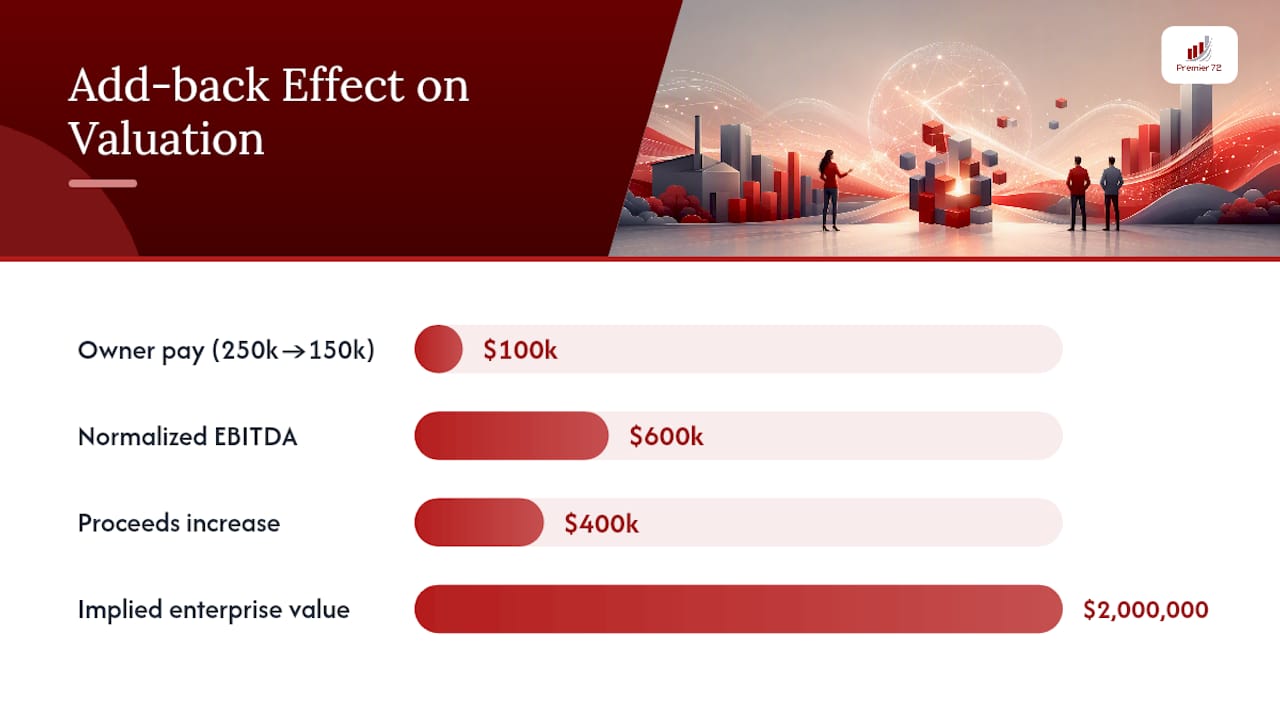
Your implied enterprise value is $2,000,000. Now suppose you have been paying yourself $250,000 when a qualified replacement manager would cost $150,000. That $100,000 add-back, documented with a compensation benchmark, pushes normalized EBITDA to $600,000. A single salary adjustment, properly documented, added $400,000 to your proceeds.
In closely held firms, owner-compensation adjustments commonly increase reported EBITDA significantly. That range reflects how widely owner pay varies from market rates in practice, and it underscores why buyers and their advisors treat this line item as the first place they look.
What add-backs do buyers accept, and which ones do they reject?
Buyers and their QoE providers approach owner add-backs with a simple test: is this expense truly owner-specific, and would it disappear under third-party management? Items that pass that test survive diligence. Items that fail it get struck, often with a multiplied price reduction.
Add-backs buyers typically accept:
- Above-market owner salary, supported by a named compensation survey
- Compensation paid to a spouse or family member for a role that would not be filled at the same cost under new ownership
- Owner's personal health, dental, and life insurance premiums
- Personal vehicle lease or depreciation run through the business P&L
- One-time legal or accounting fees unrelated to ongoing operations
- Non-recurring expenses such as a one-time equipment repair or a lawsuit settlement
Add-backs that commonly get rejected or reduced:
- Family payroll with no documentation of hours worked or role performed
- Inconsistent payroll history where the owner's draw fluctuates dramatically year to year
- Add-backs claimed without a third-party benchmark to establish the replacement cost
- Owner-dependent revenue streams where key client relationships are personal, not institutional
Framing matters as much as the number itself. Each add-back should be presented as a line item with a brief narrative: what the expense was, why it is owner-specific, and what the market replacement cost is. A buyer's QoE team will ask for that narrative anyway. Providing it upfront signals that your financials are prepared and trustworthy, which reduces friction during negotiation.
How do you calculate owner salary normalization step by step?
Follow this sequence to produce a defensible normalized earnings figure before you engage a broker or begin marketing.
- Select your baseline period. Use trailing twelve months (TTM) as your primary period, then prepare a three-year weighted average as a secondary check. Buyers want to see trend, not just a snapshot.
- Pull your reported EBITDA or SDE. Start from your most recent income statement. EBITDA is earnings before interest, taxes, depreciation, and amortization. SDE adds back the full owner compensation on top of EBITDA.
- Isolate all owner-related compensation. Pull every line that flows to the owner: base salary, bonuses, distributions coded as compensation, benefits, and personal expenses run through the business.
- Establish a market replacement salary. Use at least two named sources: the Bureau of Labor Statistics Occupational Employment and Wage Statistics (OEWS), the ERI Salary Assessor, or a Robert Half compensation guide for your industry and geography. Average the two figures and document the sources. The IRS requires that officer compensation be reasonable and commensurate with the duties performed, so your replacement benchmark should be defensible under that standard as well.
- Calculate the add-back. Subtract the market replacement salary from total owner compensation. A positive result is an add-back (you were overpaying yourself). A negative result is a deduction (you were underpaying yourself).
- Add back personal perks separately. Each personal expense line gets its own add-back with its own documentation.
- Produce normalized EBITDA or SDE. Apply all adjustments to reported earnings and state the result clearly.
Worked example: from reported EBITDA to enterprise value
The three documented add-backs added $810,000 to enterprise value. That is not a rounding error; it is the difference between a comfortable retirement and a shortfall.

Pro Tip: Use two independent compensation benchmarks, such as BLS OEWS and Robert Half, and average them. Document whether you applied a local cost-of-labor adjustment, and note the date you pulled each survey. A buyer's QoE team will ask for your source; having two named, dated references makes the add-back nearly impossible to dispute.
How do you document and defend owner salary add-backs during due diligence?
Documentation is what separates an add-back that survives a QoE review from one that gets struck and repriced. Undocumented add-backs are typically eliminated during diligence; documented ones hold. Build this file before you engage a broker.
Pre-sale documentation checklist:
- W-2s and payroll registers for the owner and any family members on payroll, covering at least three years
- A written role description for the owner's position, including time allocation across functions
- An organizational chart showing which functions would be managed by a replacement hire
- Named compensation survey citations with dates and geographic scope
- Receipts or statements for personal expenses claimed as add-backs (vehicle, insurance, travel)
- Any related-party contracts (office lease from a family LLC, for example) with market-rate comparisons
- Three years of consistent payroll records showing a stable compensation structure
On timing: the single most protective step you can take is to reset your compensation to market rate 12–24 months before you begin marketing the business. When the replacement salary is already embedded in your historical run-rate, the add-back becomes a smaller adjustment and the normalized earnings look more stable. A large, sudden add-back introduced at the time of sale raises questions about whether the earnings are real.
Pro Tip: Combine your salary reset with a parallel review of all related-party transactions. A buyer's QoE team will examine every contract between the business and entities you or your family control. Cleaning those up at the same time as the compensation reset means one documentation project covers both exposures.
What happens if you skip normalization before marketing?
Sellers who go to market with unnormalized financials face a predictable sequence of problems, and each one costs money or time.
- Buyers reprice at LOI or during diligence. A buyer who discovers an undisclosed add-back after signing a letter of intent will use it as leverage to reduce the purchase price, often by more than the add-back itself because the discovery erodes trust.
- Lenders reduce debt capacity. If the buyer's lender recalculates normalized cash flow downward, the loan amount drops, the buyer may not be able to close, and the deal falls apart.
- The sale process extends. Normalization disputes add weeks or months to diligence. Longer processes increase the chance of deal fatigue, market changes, or a competitor emerging.
- Buyers withdraw entirely. Sophisticated buyers walk away from sellers whose financials require extensive reconstruction, especially when the seller cannot produce supporting documentation.
There is a second risk that compounds the first. If your business is heavily owner-dependent, a buyer may apply an owner-dependency discount on top of any add-back gains. You can normalize your salary perfectly and still lose value if the business cannot operate without you. That is why valuation practitioners recommend preparing a normalization schedule 12–36 months ahead of sale, using that window to both embed the replacement salary in the run-rate and reduce operational dependence on the owner simultaneously.
When should you engage a valuation expert, CPA, or broker?
Each advisor plays a distinct role in the normalization process, and the timing of each engagement matters.
- CPA: Handles payroll compliance, W-2 structuring, and tax treatment of officer compensation. The IRS standard for reasonable officer compensation is the governing benchmark; your CPA should confirm your replacement salary is consistent with it before you finalize the add-back.
- Valuation expert or appraiser: Provides an independent opinion of value and validates the normalization methodology. Particularly useful when owner compensation is complex, when there are multiple family members on payroll, or when the business has related-party transactions.
- Business broker or investment banker: Positions the normalized earnings to the buyer market, sets price expectations, and manages buyer questions about add-backs during marketing. A good broker will tell you which add-backs buyers in your industry typically accept and which ones they push back on.
- Sell-side QoE provider: A CPA firm engaged by the seller to produce a quality-of-earnings report before listing. This is the most powerful pre-sale tool available because it surfaces problems before a buyer's team does, and it gives buyers a credible third-party validation of your normalized earnings.
Recommended timeline:
- 18–24 months before sale: Reset owner compensation to market rate; begin building the documentation file; engage your CPA to confirm tax and payroll compliance.
- 12 months before sale: Commission a preliminary valuation or advisory review to confirm normalized earnings and identify gaps.
- 3–6 months before listing: Engage a sell-side QoE provider to validate the normalization schedule and produce a report you can share with buyers.
Signals that warrant immediate advisor engagement, regardless of timeline:
- Complex related-party transactions (leases, loans, management fees between the business and owner-controlled entities)
- Inconsistent or fluctuating owner payroll history over the past three years
- Multiple family members on payroll with unclear role documentation
- Revenue that is heavily concentrated in relationships the owner controls personally
Premier72's practical checklist for owner compensation readiness
The Retirement Bank Method™ that Premier72 uses with established business owners treats owner-salary normalization as one of the first structural steps in exit readiness, not a last-minute accounting adjustment. The goal is to embed a defensible, market-rate compensation structure into the business's financial history well before a sale, so the normalized earnings are real, not reconstructed.
Practical checklist for the 12–24 months before sale:
- Set your salary to a documented market replacement rate using at least two named benchmarks
- Remove all personal expenses from the business P&L and route them through personal accounts
- Write a formal role description for your position and update the organizational chart to show which functions a replacement manager would cover
- Build three years of consistent payroll records at the new rate
- Document all related-party contracts and confirm they reflect market terms
- Commission a sell-side QoE when the normalized run-rate is stable, typically 3–6 months before listing
For income replacement planning alongside the salary reset, Premier72 also works with owners on insurance-based strategies, including life insurance and buy-sell funding structures, so the transition from owner compensation to exit proceeds is planned, not improvised.
Pro Tip: Run the salary normalization and the operational redundancy work in parallel. Reducing owner-dependency at the same time you reset compensation means you capture the add-back value without giving it back through an owner-dependency discount. Premier72 advisors address both in the same engagement.
Premier72 helps you build a sale-ready financial foundation
When your exit is years away, the compensation decisions you make today are already shaping your sale price. Premier72 works with established business owners through The Retirement Bank Method™ to reset owner compensation to defensible market rates, remove personal expenses from the P&L, and build the documentation structure that survives a buyer's QoE review. The firm coordinates advisory, interim CFO support, and insurance-based strategies including buy-sell funding and life insurance so your exit is structured, not reactive. For owners who want independent valuation context alongside the compensation work, Premier72 also draws on property and business valuation guidance to benchmark replacement costs against market standards.

If you are 12–24 months from a potential sale, or simply want to know where your financials stand today, schedule a structured advisory review with Premier72 at Premier72 and get a clear picture of what your business is worth, and what it could be worth with the right preparation.
This article is general information, not a substitute for advice from a qualified financial advisor. Consult a qualified financial professional about your own circumstances before acting on anything here.
Sources
Build your normalization file using primary, authoritative sources. Buyers and their QoE teams will ask where your replacement salary came from; a named, dated source is the only answer that holds.
- Paying yourself | Internal Revenue Service
- Importance of Owner's Compensation in Middle Market Sales
When using multiple benchmarks, document whether you applied a local cost-of-labor adjustment and note the date each survey was accessed. Two sources averaged and dated are far more defensible than one source cited without context.