

Life insurance needs analysis is the process of calculating exactly how much coverage you need to protect your income, your business, and your legacy. For business owners and professionals approaching retirement or succession, this process is not optional. It is the foundation of every sound exit plan. The life insurance needs analysis steps covered here follow the industry's standard "needs approach," which calculates required coverage based on current and future liabilities. Methods like the DIME framework (Debt, Income, Mortgage, Education) and the 10–12x income rule give you a structured starting point before you ever speak to an underwriter.
What are the life insurance needs analysis steps?
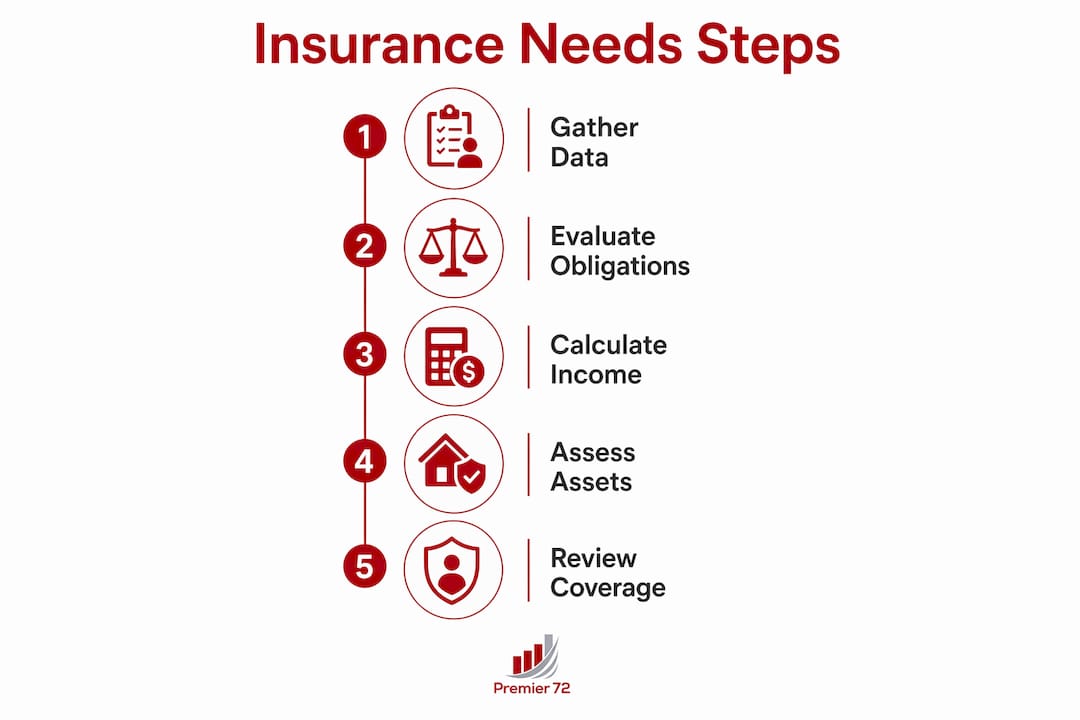
A complete needs analysis follows five core steps: gather financial data, evaluate immediate obligations, calculate long-term goals, subtract existing assets, then identify the coverage gap. Each step builds on the last. Skipping one produces a number that either leaves your family exposed or wastes money on coverage you do not need.
Business owners face a layer of complexity that salaried professionals do not. Your personal finances and your business finances are often intertwined. A buy-sell agreement, a key person policy, or a business loan guarantee can each add six figures to your coverage requirement overnight.

What financial data and obligations must you gather first?
The first step is building a complete picture of every financial obligation that would fall on your estate or your business if you died today. This is not a rough estimate. It is a documented inventory.
Start with these categories:
- Immediate costs: Funeral and final expenses range from $5,000 to $25,000 depending on location and arrangements. Add estate settlement fees and any emergency fund your family would need in the first 90 days.
- Personal debt: Mortgage balance, car loans, credit card balances, and personal lines of credit.
- Business debt: SBA loans, equipment financing, commercial real estate loans, and any personal guarantees you have signed on behalf of the business.
- Income support: The monthly amount your household depends on from your salary, distributions, or owner draws.
Gather actual statements, not estimates. Pull your most recent mortgage statement, business loan summary, and personal tax return. Vague numbers produce vague coverage, and vague coverage fails at the worst possible moment.
Pro Tip: Create a single financial inventory document and update it every january. Store it with your estate planning files so your advisor, attorney, and family can access it quickly.
The business insurance needs of an owner are fundamentally different from those of an employee. Your death could trigger a forced sale, a loan default, or a leadership vacuum. All three belong in your financial inventory.
How do you estimate future financial needs for income replacement?
Once you have your immediate obligations documented, you calculate the long-term income and financial support your dependents will need. Two methods dominate this step.
The 10–12x income rule
Multiplying annual income by 10 to 12 times gives you a fast baseline. If your business pays you $250,000 per year, your starting estimate is $2,500,000 to $3,000,000. This rule is a starting point, not a final answer. It does not account for debt, education costs, or your specific retirement timeline.
The DIME method
The DIME method produces a more precise result by adding four components:
- Debt: Total outstanding personal and business debt (from Step 1).
- Income: Annual income multiplied by the number of years your dependents need support.
- Mortgage: Full remaining balance on your home.
- Education: Estimated college costs for each dependent child.
The table below shows a sample calculation for a business owner earning $300,000 annually with two children and 15 years until retirement.
| DIME Component | Sample Amount |
|---|---|
| Debt (personal + business) | $450,000 |
| Income ($300,000 x 15 years) | $4,500,000 |
| Mortgage balance | $380,000 |
| Education (2 children) | $300,000 |
| Total gross need | $5,630,000 |
The needs approach favors slight overestimation to build a financial cushion for unpredictable expenses. That cushion matters most for business owners whose income is variable and whose liabilities can shift with a single contract or market change.
Factor in inflation and lifestyle changes as well. A retirement that begins in 10 years will cost more than one that begins today. A business succession that triggers a taxable event may require additional liquidity. Both belong in your long-term estimate.
How do existing assets and coverage affect your total insurance needs?
Your gross coverage need is not your final number. You subtract what you already have.
Assets and benefits that reduce your coverage gap include:
- Liquid savings and investments: Brokerage accounts, money market funds, and CDs that your estate could access immediately.
- Retirement accounts: 401(k), IRA, and SEP-IRA balances, adjusted for taxes on withdrawal.
- Existing life insurance: Group coverage through your business, any personally owned policies, and key person policies already in force.
- Business value: If your business is a transferable asset, its estimated sale value reduces the income replacement gap. This only applies if the business can actually be sold without you, which is a separate planning challenge entirely.
- Social Security survivor benefits: Relevant for spouses and minor children, though amounts vary significantly by earnings history.
Insurance is part of a larger financial portfolio, not a standalone product. The goal is to cover gaps, not to duplicate protection you already have. Over-insuring is a real cost. A business owner paying premiums on $3,000,000 of coverage when $1,800,000 is the actual gap is wasting money that could fund retirement or business reinvestment.
Pro Tip: Review your existing coverage every time your business valuation changes materially. A company worth $500,000 more than it was three years ago changes your gap calculation in both directions.
The policy review process for business owners should include both personal and business-owned policies in the same session. Reviewing them separately creates blind spots.
What should you consider when choosing a life insurance type?
Your coverage gap number tells you how much insurance you need. Your financial situation and goals tell you what kind to buy.
The table below compares the two primary categories.
| Factor | Term life insurance | Permanent life insurance |
|---|---|---|
| Cost | Lower premiums for same death benefit | Higher premiums; includes cash value component |
| Best use | Income replacement, debt coverage, business loans | Estate planning, legacy transfer, long-term wealth |
| Complexity | Simple structure | Complex; fees, growth assumptions, and access rules vary |
| Duration | Fixed term (10, 20, or 30 years) | Lifetime coverage |
Term life insurance is the most cost-effective option for most income replacement needs. A 20-year term policy covers the period when your obligations are highest and your business is most dependent on your presence. For a detailed breakdown of term versus permanent options, the differences in cost and structure are significant enough to change your total planning strategy.
Permanent insurance suits business owners who need lifetime coverage for estate liquidity, buy-sell funding, or legacy transfer. The cash value component adds flexibility but also adds cost and complexity. Insurer financial strength ratings from agencies like A.M. Best, S&P, and Moody's matter here. A rating of A or higher signals that the insurer can pay a claim decades from now, which is exactly when a permanent policy is most likely to be used.
One underwriting detail that many business owners overlook: completing a medical exam can reduce premiums by 20–50% for healthy applicants. That savings compounds over a 20-year policy term into a material difference in total cost.
How and when should you review and adjust your coverage?
A needs analysis is not a one-time event. Your obligations change. Your assets grow. Your business evolves.
Review your coverage every 3 to 5 years or immediately after any of these events:
- Marriage, divorce, or the birth of a child
- A significant change in business valuation or ownership structure
- Completion of a buy-sell agreement or succession plan
- Retirement of a key employee whose departure changes your risk profile
- A major shift in personal debt, such as paying off a mortgage or taking on a new business loan
Beneficiary designations deserve a separate review. Naming minor children directly as beneficiaries can create legal complications. A trust or guardian arrangement prevents the court from controlling the payout until the child reaches adulthood. Coordinate this with your estate attorney, not just your insurance advisor.
Set up automatic premium payments to prevent lapses. A lapsed policy on a business owner with health changes since the original underwriting can mean re-underwriting at significantly higher rates, or no coverage at all.
Key Takeaways
A complete life insurance needs analysis requires five steps: inventory obligations, calculate long-term income needs, subtract existing assets, select the right policy type, and review coverage regularly as your business and personal finances evolve.
| Point | Details |
|---|---|
| Start with a full financial inventory | Document all personal and business debts before calculating any coverage number. |
| Use DIME for precision | The DIME method produces a more accurate coverage estimate than the 10–12x income rule alone. |
| Subtract what you already have | Existing assets, employer coverage, and business value reduce your actual coverage gap. |
| Match policy type to purpose | Term insurance covers income replacement; permanent insurance suits estate and legacy planning. |
| Review every 3–5 years | Business valuation changes, succession milestones, and major life events all require a coverage update. |
Why most business owners get this wrong
The most common mistake I see is treating life insurance as a personal finance decision rather than a business planning decision. A business owner who calculates coverage based only on household income misses the business loan guarantees, the buy-sell obligations, and the key person risk entirely. That gap does not show up until a claim is filed, and by then it is too late to fix.
The second mistake is buying coverage once and never revisiting it. A policy sized for a $2,000,000 business is wrong for a $6,000,000 business. The math changes. The coverage has to change with it.
The third mistake is letting cost drive the decision before the need is fully understood. I have seen business owners buy the cheapest term policy available without running a proper DIME calculation first. They end up underinsured by millions, paying premiums on a policy that will not actually protect their family or their business.
The right sequence is always: calculate the need first, then shop for coverage. Not the other way around.
— Asa
How Premier72 approaches life insurance planning for business owners
Business owners preparing for retirement or succession need more than a standard insurance quote. They need a coverage strategy that accounts for business value, ownership transitions, and legacy goals together.

Premier72 works with established business owners to build insurance strategies that align with their exit readiness and retirement income plans. Through The Retirement Bank Method™, Premier72 connects life insurance and succession planning into a single coordinated strategy. Whether you need key person coverage, buy-sell funding, or a personal legacy plan, Premier72 builds the analysis before recommending the coverage. The result is a protection plan that fits your actual financial picture, not a generic policy sized for someone else's life.
FAQ
What is a life insurance needs analysis?
A life insurance needs analysis is a structured process for calculating exactly how much coverage you need based on your debts, income, future obligations, and existing assets. The standard industry method is the needs approach, which favors slight overestimation to account for unpredictable expenses.
What is the DIME method for calculating life insurance?
DIME stands for Debt, Income, Mortgage, and Education. You add the totals from each category to arrive at a precise coverage estimate that accounts for all major financial obligations.
How often should business owners review their life insurance?
Business owners should review coverage every 3 to 5 years or after any major event such as a change in business valuation, a new buy-sell agreement, or a significant shift in personal debt.
Is term or permanent life insurance better for business owners?
Term life insurance is the most cost-effective option for income replacement and debt coverage. Permanent insurance is better suited for estate planning, legacy transfer, and long-term buy-sell funding where lifetime coverage is required.
Can a medical exam lower my life insurance premiums?
Yes. Completing a medical exam can reduce premiums by 20–50% for healthy applicants compared to no-exam policies, making it a worthwhile step for most business owners in good health.