

Key person life insurance setup is the process by which a business secures a company-owned life insurance policy on an employee whose loss would cause serious financial harm to the company. The business owns the policy, pays the premiums, and receives the death benefit directly. This structure makes it a business asset, not a personal one, and that distinction matters enormously for tax treatment, legal compliance, and succession planning. Providers like MassMutual, Principal Financial Group, and Pacific Life all offer policies designed specifically for this purpose. Getting the setup right from the start protects your company's financial stability and keeps your exit or succession plan intact.
What does key person life insurance setup require first?
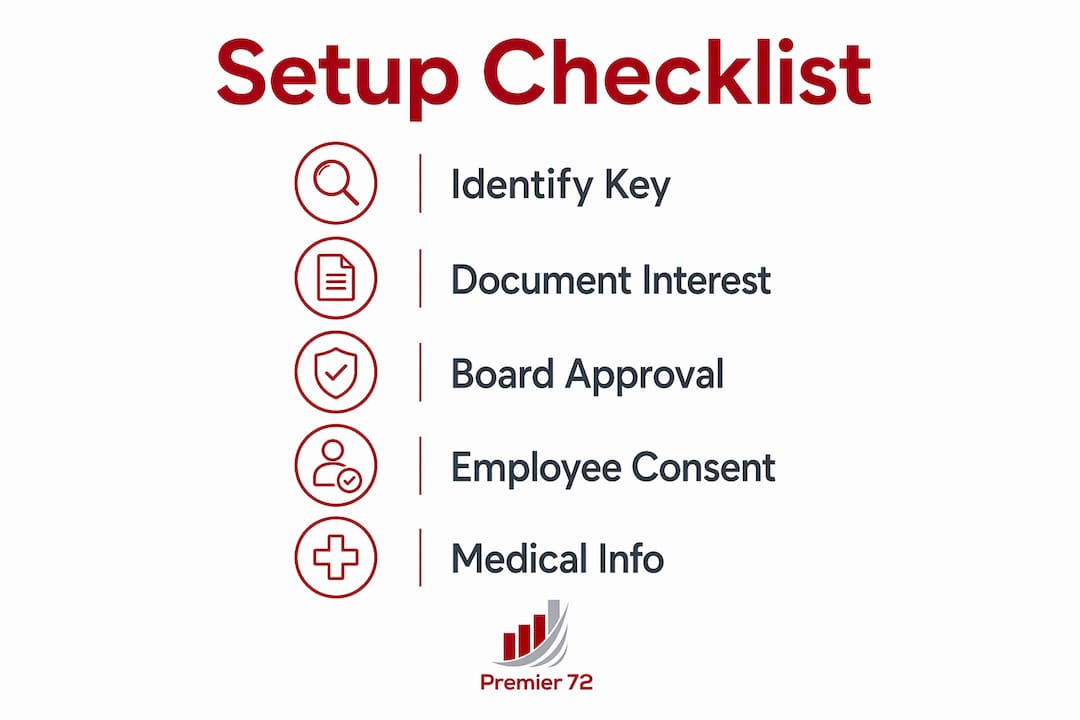
Before you contact a carrier or broker, you need to complete several preparatory steps. Skipping them causes underwriting delays, compliance failures, and in the worst cases, taxable death benefits.
Identify the right employees. A key person is someone whose absence would directly reduce revenue, disrupt operations, or trigger a financial crisis. Think of your top salesperson who controls 40% of your client relationships, your lead engineer who holds proprietary knowledge, or a co-founder whose personal guarantees secure your credit lines. The test is financial impact, not job title.

Document insurable interest. Carriers require financial justification. You need to show the key person's revenue contribution, the estimated cost to recruit and train a replacement, and the projected revenue loss during the transition period. Detailed financial impact documentation describing the key person's revenue contribution and replacement cost speeds up underwriting approval significantly. Prepare this document before you apply.
Secure board or partnership approval. If your business is a corporation or partnership, you need a formal resolution authorizing the policy. This protects you legally and satisfies carrier requirements.
Obtain written employee consent. This is not optional. Under IRC Section 101(j), the employee must receive written notice before the policy is issued. The notice must disclose the maximum coverage amount, the fact that the business is the beneficiary, and the employee's right to consent or decline. Failure to complete this step before policy issuance means the death benefit may be taxed as ordinary income.
Gather medical and underwriting information. Carriers typically require age, health history, and sometimes a medical exam. Applicants under 40 with clean health histories often qualify for accelerated no-exam underwriting.
Key person insurance setup requirements checklist
| Requirement | Details |
|---|---|
| Key person identification | Document financial impact, revenue contribution, and replacement cost |
| Board or partnership resolution | Formal approval authorizing the policy on behalf of the business |
| Employee written consent | Signed before policy issuance per IRC §101(j) standards |
| Insurable interest documentation | Revenue impact analysis and replacement cost estimate |
| Medical and underwriting data | Health history, age, and exam results if required by carrier |
| Legal business name | Exact registered name for use as policy owner and beneficiary |
Pro Tip: Have your CPA or business attorney prepare the financial justification document and board resolution before you approach a carrier. Arriving with these ready cuts weeks off the underwriting timeline.
How do you apply for a key person insurance policy?
The application process follows a predictable sequence, but each step has details that can trip you up if you are not prepared.
-
Choose your policy type. Term and permanent life insurance each serve different business needs. Term is the most popular choice for cost-effective coverage during critical growth years. Permanent policies carry higher premiums but build cash value and provide long-term protection.
-
Select a broker with business insurance experience. A broker who specializes in business life insurance understands carrier underwriting standards, knows which carriers favor certain health profiles, and can help you structure the policy correctly from day one.
-
Submit the application with financial documentation. Include your insurable interest documentation, the board resolution, and the signed employee consent form. Submit these together to avoid back-and-forth with the underwriter.
-
Complete the medical underwriting process. Standard applications take 2–4 weeks from submission to policy issuance. Accelerated no-exam options exist for younger, healthier applicants and can shorten that timeline considerably.
-
Confirm beneficiary designation. The business entity must be named as the sole beneficiary. The name on the policy must exactly match your legal business name as registered with your state. Even a minor deviation, such as "LLC" versus "L.L.C.," can stall a claim payout and create liquidity problems at the worst possible time.
-
Finalize IRC §101(j) compliance. Confirm that the employee's signed notice and consent are dated before the policy issue date. Your broker and CPA should both verify this timing.
-
File the policy with your corporate records. Store the policy alongside your operating agreement, buy-sell agreement, and board resolutions. This makes it accessible during a claim and during any future business sale or audit.
Term vs. permanent key person insurance: a comparison
| Factor | Term Life Insurance | Permanent Life Insurance |
|---|---|---|
| Cost | Lower premiums | Higher premiums |
| Coverage period | Fixed term (10, 20, or 30 years) | Lifetime coverage |
| Cash value | None | Accumulates over time |
| Best for | Cost-conscious coverage during key growth years | Long-term protection and cash value strategy |
| Flexibility | Simple and straightforward | More complex, more options |
Pro Tip: Ask your broker about disability riders at the application stage. Disability riders in key person policies typically cover 40%–70% of the key employee's salary during disability-related absences, extending your financial protection beyond death coverage.
How does key person insurance fit into business continuity planning?
A key person insurance policy is not a standalone purchase. It is a component of a larger financial and operational strategy. Treating it as a commodity purchase rather than a strategic business asset is the single most common mistake established business owners make.
Here is how to integrate it properly.
-
Tie the policy to your buy-sell agreement. If a key person is also a co-owner, the death benefit can fund a buyout of their ownership interest. This prevents unwanted ownership transfers to heirs and keeps control of the business where it belongs. You can learn more about structuring this through partner life insurance planning.
-
Designate specific uses for the death benefit. Successful policies are tied to documented business plans that specify how proceeds will be used. Common uses include revenue replacement during the transition period, recruiting and training a successor, paying down business debt, and funding a partner buyout.
-
Schedule annual policy reviews. Your business changes. Revenue grows, key roles shift, and the financial impact of losing a specific person changes over time. Review coverage amounts annually and after any major business event such as a new contract, acquisition, or ownership change.
-
Keep key person coverage separate from personal life insurance. The business must own and benefit from the policy. Mixing personal family protection into a key person policy creates tax and legal complications. Personal coverage belongs in a separate policy owned by the individual.
-
Coordinate with your succession plan. If you are preparing your business for sale or transition, key person coverage demonstrates to buyers and lenders that the business is not entirely dependent on one individual. That reduces perceived risk and can improve your valuation. Premier72's Retirement Bank Method™ specifically addresses how to reduce owner dependence as part of exit readiness.
What are the biggest compliance pitfalls in key person insurance?
Most claim disputes and tax problems in key person insurance trace back to a small number of avoidable errors.
-
Missing the IRC §101(j) consent deadline. Notice and consent must be finalized before policy issuance. There is no grace period. If the policy is issued before the employee signs, the death benefit loses its tax-free status and becomes taxable as ordinary income. This is a permanent consequence, not a correctable error.
-
Beneficiary name mismatch. The policy beneficiary must match your exact legal business name. A mismatch does not just slow the claim. It can trigger legal disputes over who is entitled to the proceeds.
-
Confusing key person coverage with personal life insurance. Only the business should be owner and beneficiary. If the policy is structured to benefit an employee's family, it loses its business insurance character and creates tax exposure for both the business and the employee.
-
Failing to tie the policy to corporate documents. Policies not connected to corporate resolutions or buy-sell agreements leave proceeds without a defined purpose. That creates internal disputes and potential misuse of funds during an already difficult time.
-
Ignoring underwriting challenges. If the key person has health issues, certain carriers will decline or rate the policy. Work with a broker who can shop multiple carriers and present the application in the most favorable light.
The most expensive mistake in key person insurance is not buying the wrong policy. It is buying the right policy incorrectly structured. One missed signature or one wrong name on the beneficiary line can convert a tax-free benefit into a taxable one.
Key takeaways
A properly structured key person life insurance setup protects your business financially, satisfies legal compliance requirements, and functions as a strategic asset tied directly to your continuity and succession plan.
| Point | Details |
|---|---|
| Prepare before you apply | Gather financial justification, board resolutions, and employee consent before contacting a carrier. |
| IRC §101(j) timing is strict | Employee notice and consent must be signed before policy issuance or the death benefit becomes taxable. |
| Beneficiary naming is critical | The exact legal business name must appear on the policy to avoid claim delays and legal disputes. |
| Integrate with corporate documents | Tie the policy to your buy-sell agreement and operating agreement to define how proceeds will be used. |
| Review coverage annually | Business revenue and key roles change; your coverage amounts should reflect current financial reality. |
The part most business owners get wrong
I have worked with enough established business owners to know that most of them treat key person insurance as a checkbox. They buy a policy, file it away, and never look at it again. That approach is a mistake, and it often becomes an expensive one.
The owners who get the most value from these policies treat them the way they treat their best employees: with attention, regular review, and a clear sense of purpose. They know exactly what the policy is supposed to do, who it protects, and how the proceeds will be used. They have that spelled out in their operating agreement or buy-sell agreement, not just in their heads.
The compliance piece is where I see the most damage. IRC §101(j) is not complicated, but it is unforgiving. I have seen situations where a policy was issued before the consent form was signed, and the entire death benefit became taxable. That is not a technicality. That is a six-figure tax bill at the worst possible moment for a grieving business.
Work with a broker who specializes in business life insurance, not a generalist. Bring your CPA and your business attorney into the conversation before the application goes in. And set a calendar reminder to review the policy every year. The business you are protecting today will look different in three years, and your coverage should reflect that.
— Asa
How Premier72 helps you protect what you've built
Key person coverage is one of the most powerful tools in a business owner's financial protection plan. Getting it right requires more than filling out an application. It requires coordinating insurance structure, legal documentation, tax compliance, and succession strategy into a single coherent plan.

Premier72 specializes in exactly that. As business continuity and legacy advisors, Premier72 works with established business owners to design, implement, and manage key person insurance policies that are fully integrated with their exit readiness and succession plans. From identifying the right coverage amounts to coordinating with your legal and tax advisors, Premier72 handles the details that most generalist advisors overlook. If you are ready to protect your business and the people who make it run, reach out to Premier72 for a consultation.
FAQ
What is key person life insurance?
Key person life insurance is a company-owned policy on an employee whose loss would cause significant financial harm to the business. The business pays the premiums and receives the death benefit directly.
How long does key person insurance setup take?
The standard application process takes 2–4 weeks from submission to policy issuance. Accelerated no-exam underwriting is available for younger, healthier applicants and can shorten that timeline.
Are key person life insurance death benefits tax-free?
Death benefits are tax-free only if the business complies with IRC §101(j), which requires written employee notice and consent before the policy is issued. Missing this step makes the benefit taxable as ordinary income.
Can a key person policy fund a buy-sell agreement?
Yes. Death benefit proceeds can be designated to fund a buyout of a deceased owner's interest, provided the policy is tied to a documented buy-sell agreement and the business is the named beneficiary.
What is the difference between term and permanent key person insurance?
Term insurance provides affordable, fixed-period coverage and is the most common choice for business protection. Permanent insurance builds cash value and offers lifetime coverage at a higher premium cost.