

Losing your top salesperson, your lead engineer, or the founder who holds every major client relationship could put your business in serious financial trouble within weeks. Key person insurance is the policy that stands between that crisis and a controlled recovery. It is a business-owned life or disability policy that pays directly to the company when a critical individual dies or becomes disabled. Not to the employee's family. Not to a retirement account. Straight to the business, so operations can continue while leadership stabilizes.
Table of Contents
- Key takeaways
- What is key person insurance and how it works
- Why key person insurance matters strategically
- Policy types, coverage amounts, and riders
- When and how to implement key person coverage
- Common questions and ownership considerations
- My honest take on what most businesses get wrong
- How Premier72 can protect your business
- FAQ
Key takeaways
| Point | Details |
|---|---|
| Business owns the policy | The company is both the owner and beneficiary, not the insured employee or their family. |
| Coverage is sized to business risk | Policies are commonly structured at 5 to 10 times the key person's annual salary. |
| Premiums are generally not deductible | The business pays premiums with after-tax dollars, but death benefit proceeds are tax-free. |
| Lenders and investors often require it | Key person coverage is frequently a condition for loan approval or funding agreements. |
| It buys time, not just money | The primary purpose is operational stability during the transition period after a loss. |
What is key person insurance and how it works
The key person insurance definition is straightforward once you separate it from personal life insurance. The business purchases a life or disability policy on a specific individual whose loss would materially harm company operations. The business pays the premiums, owns the policy, and collects the benefit. The insured employee has no rights to the policy, no say in how proceeds are used, and their family receives no benefit from the payout.
That distinction matters more than most business owners realize. This is a financial risk management tool, not an employee benefit. When you frame it correctly, the purchase decision becomes much easier to justify.
Here is how the money flows when a claim is paid:
- Lost revenue coverage. The proceeds can replace lost revenue from accounts tied to the key individual or fund operations while a replacement is recruited.
- Recruitment and training costs. Finding and onboarding a qualified replacement at the executive or specialist level can cost six figures. The payout covers that.
- Debt obligations. If the company carries loans that creditors may call due upon the loss of a key individual, the proceeds provide liquidity to manage those obligations.
- Business stabilization. Investors, employees, and clients need to see that the company can absorb the loss. Having cash reserves signals exactly that.
On policy types, you have three main structures to consider. Term life is the most affordable and keeps things clean. It covers a defined period, typically 10 to 20 years, which often aligns with a growth phase or a key employee's planned tenure. Whole life and universal life policies are permanent and build cash value, which some businesses use as a secondary asset on the balance sheet. The right structure depends on how long the risk exists and whether you want a policy that can also serve other financial purposes over time.
Pro Tip: If you are considering permanent key person coverage, consult an advisor about whether the cash value component could eventually support a buy-sell agreement or executive retention strategy, since these policies can serve multiple functions simultaneously.
Why key person insurance matters strategically
Most business owners think about key person insurance as a death benefit. That is only part of the picture. The deeper value is what the coverage signals to the outside world and how it functions as a stabilizing force before and after a loss occurs.

Lenders and investors pay close attention to concentration risk. When a single individual drives a disproportionate share of revenue or holds critical technical expertise, that person represents a financial vulnerability. Coverage is frequently required by creditors and investors as a condition for loan approval or funding rounds. If you are pursuing a business loan or preparing for a capital raise, not having key person coverage in place can kill the deal before it starts.
Beyond financing, the strategic benefits of key person insurance for businesses include:
- Protecting company valuation. A business that can demonstrate continuity planning, including insurance on critical personnel, will carry a higher valuation during a sale or acquisition process.
- Maintaining creditworthiness. The cash infusion from a claim allows the business to meet debt payments and keep its credit profile intact during a period of leadership disruption.
- Funding the search for a replacement. At the executive or specialized skill level, recruitment and onboarding timelines stretch to six months or more. The insurance proceeds fund that gap without pulling from operating cash.
- Preserving client and vendor relationships. The financial stability the payout provides buys the leadership team time to manage key relationships instead of scrambling to cut costs.
"The primary purpose of key person insurance is to buy time and stability after a loss, not simply replace the individual."
That framing changes how you evaluate coverage amounts. You are not trying to price the person. You are trying to price the disruption.
Policy types, coverage amounts, and riders
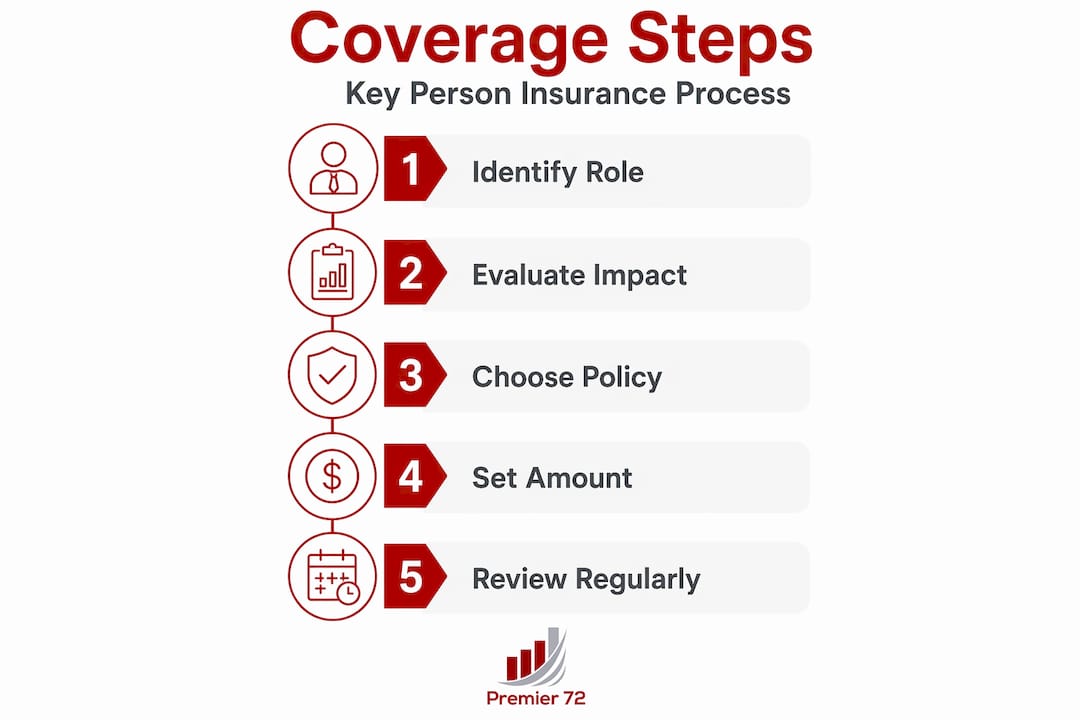
Sizing a key person policy requires an honest assessment of how much revenue, profit, or operational capacity the individual controls. The standard benchmark is 5 to 10 times annual salary, but that number should reflect the total business risk, not just compensation.
Here is a comparison of the three primary policy structures businesses use for key person coverage:
| Policy type | Cost | Cash value | Best for |
|---|---|---|---|
| Term life | Lowest | None | Defined risk periods, budget-conscious businesses |
| Whole life | Highest | Guaranteed growth | Long-term key persons, dual-use planning |
| Universal life | Moderate | Flexible growth | Businesses wanting premium flexibility |
Disability coverage deserves equal attention. A key person does not have to die to create a crisis. A serious illness or accident that keeps them out of the business for six to twelve months can be just as damaging. Disability riders cover accident and illness-related incapacity, and some specialized policies carry premiums starting at $20 per month depending on the structure. Adding a disability rider to a life policy is almost always worth the additional cost.
On taxes, the rules are straightforward. Premiums are generally not deductible because the business is the direct beneficiary. However, the death benefit is received tax-free by the company. Many owners assume deductibility because they think of it like a business expense. It is not. Understanding that upfront prevents surprises when you file.
Pro Tip: Review your coverage amounts every two to three years. If a key person's role has grown, their salary has increased, or they have taken on more client relationships, your policy may be significantly underinsured relative to the actual business risk they represent.
When and how to implement key person coverage
Knowing you need coverage and knowing how to structure it are two different problems. Start by identifying who actually qualifies as a key person in your business. Not every high performer meets the threshold. The right criteria focus on three factors.
- Revenue dependency. If this person left tomorrow, how much revenue would be at immediate risk? If the answer is more than 15 to 20 percent of your total, they qualify.
- Irreplaceable expertise or relationships. Technical founders, lead engineers, top salespeople with deep client loyalty, and specialized practitioners all create concentration risk that insurance should address.
- Leadership and decision-making authority. Individuals whose absence would create an operational vacuum or a leadership gap that takes months to fill belong on this list.
Once you have identified your key persons, timing matters. The best time to buy is before the risk materializes, which means before a lender requires it, before a health event makes someone uninsurable, and before the business enters a growth phase that increases the stakes. A specialized commercial insurance broker will walk you through term versus permanent options and help you structure riders appropriately.
Be aware of one creative use case that often surprises business owners. Some companies use key person policies to support executive bonus and retention programs. The cash value in a permanent policy can be used to fund deferred compensation or structured bonuses, making the policy do double duty as a retention tool.
Finally, watch for contractual triggers. Loan agreements and investor term sheets often include covenants requiring key person coverage at specific benefit amounts. Missing a renewal or letting a policy lapse could put you in technical default on financing agreements. Set a calendar reminder to review every policy annually.
Common questions and ownership considerations
Business owners who are new to key person coverage often run into the same points of confusion. Here is a clear breakdown of the most frequent ones.
- Who owns the policy? The business owns it completely. The insured employee has no rights, cannot borrow against it, and has no claim to the cash value.
- Can this be structured as an employee benefit? No. Key person insurance is financial risk management for the business, not a benefit for the employee. The employee's family receives nothing from the claim.
- How are the proceeds used? The business decides entirely. Common uses include covering operating losses, funding recruitment, paying off loans, or distributing to shareholders during a wind-down.
- What if we want the employee to benefit too? A separate executive bonus plan can accomplish that goal. Some businesses use life insurance held in an executive bonus arrangement alongside key person coverage, but these are distinct policies with different structures. You can learn more about how life insurance serves owners differently depending on the purpose.
Pro Tip: If a key employee leaves the company, the business can surrender the policy, sell it, or in some structures, transfer ownership to the departing employee as part of a separation agreement. Know your exit options before you buy.
My honest take on what most businesses get wrong
I have worked with enough business owners to know that key person insurance is one of those things that gets pushed to the back of the priority list until something goes wrong. Then it is too late.
The mistake I see most often is not skipping coverage entirely. It is buying too little, too late, and without a clear connection to the actual business risk. A policy that covers two times salary on your top revenue driver is not protection. It is a false sense of security.
What I have learned is that the best time to have this conversation is during a business growth phase, when a sale is being considered, or when a new hire significantly increases your exposure. Those moments create clarity about what the business would actually lose if that person walked out tomorrow. That number is usually much larger than what the insurance covers.
The other thing I tell every business owner I work with is this: key person insurance is not pessimism. It is the same logic that makes you carry property insurance on your building. The building has not burned down, and your key person is not gone today. But the value of being covered is not measured when nothing happens. It shows up in the loan you close, the investor who commits, and the business that keeps running while everyone else figures out what to do next.
— Asa
How Premier72 can protect your business
If you have read this far, you understand what is at stake. Key person coverage is not a simple product you pick off a shelf. The structure, the coverage amount, the policy type, and the riders all need to reflect your specific business risks, ownership structure, and long-term goals.

At Premier72, we work with established business owners to build protection strategies that align with how their businesses actually operate. That includes key person coverage, buy-sell funding, executive retention structures, and succession planning. Whether you are preparing for a capital raise, protecting against concentration risk, or planning an eventual exit, we help you put the right coverage in place before you need it. Visit Premier72 to schedule a consultation and start building a business protection plan that reflects the true value of what you have built.
FAQ
What is key person insurance in simple terms?
Key person insurance is a life or disability policy that a business owns on a critical employee. The company pays the premiums and collects the benefit if that person dies or becomes disabled.
Who is considered a key person for insurance purposes?
A key person is typically someone whose absence would significantly harm business revenue, client relationships, or operational continuity. This includes founders, top salespeople, lead executives, and specialized technical experts.
Are key person insurance premiums tax deductible?
No. Because the business is the direct beneficiary of the policy, premiums are generally not tax deductible. However, the death benefit proceeds are typically received by the company tax-free.
Does the insured employee's family receive any money from the policy?
No. The business is both the policy owner and the sole beneficiary. The insured employee and their family have no claim to the policy proceeds.
How much key person insurance coverage does a business need?
Coverage is typically sized at 5 to 10 times the key person's annual salary, though the actual amount should reflect the total revenue or operational risk the individual represents, not just their compensation.