

Start your exit-focused business retirement timeline planning 3–5 years before you need proceeds. With a focused 24–36 month run, you can materially increase your company's transferability and the net proceeds that fund your retirement. The industry term for this process is exit planning, and it covers far more than finding a buyer. It means building a company that can operate, be valued, and be financed without you at the center.
Three actions to take in the next few months:
- Get a formal baseline valuation. You cannot close a retirement income gap you have not measured. A defensible valuation tells you exactly how far your business value is from your retirement funding target.
- Audit your accounting method. If your books are on cash-basis, begin the transition to accrual. Buyers and SBA lenders require GAAP-compliant financials, and cleaning up your books early prevents costly delays later.
- Identify your successor or management depth. Owner dependence is the single largest value detractor buyers discount. Start naming and developing the people who will run the business without you.
Key Takeaways
A successful business retirement timeline requires starting 3–5 years out, building transferable systems and clean financials, and integrating sale proceeds directly into a structured retirement income plan.
| Point | Details |
|---|---|
| Start 3–5 years out | Owner dependence, clean books, and management depth each require years to build, not months. |
| Valuation drives the plan | A formal baseline valuation defines your income gap and prioritizes every action on the timeline. |
| SDE improvement compounds | A modest SDE improvement illustrates the leverage clearly. That $225,000 difference is retirement capital. |
| Financeability is the gate | Defensible SDE and clean add-backs keep SBA buyers in your deal; without them, most deals fail in underwriting. |
| Premier72 maps the method | The Retirement Bank Method™ ties every operational improvement to a retirement income outcome across each stage. |
Table of Contents
- What does a business retirement timeline look like at each stage?
- How do you build transferable value 5+ years out?
- What should you change 3–5 years before your exit?
- How do you make your business buyer-ready on paper 2–3 years out?
- What do you execute in the final year before selling?
- How does valuation connect to your retirement income target?
- What systems, people, and documents does every buyer expect?
- What does exit planning typically cost, and what slows it down?
- Which advisors do you need, and when should you hire them?
- How Premier72 and The Retirement Bank Method™ support your timeline
- What most owners get wrong about exit timing
- Premier72's exit readiness diagnostic: your first structured step
- Sources
What does a business retirement timeline look like at each stage?
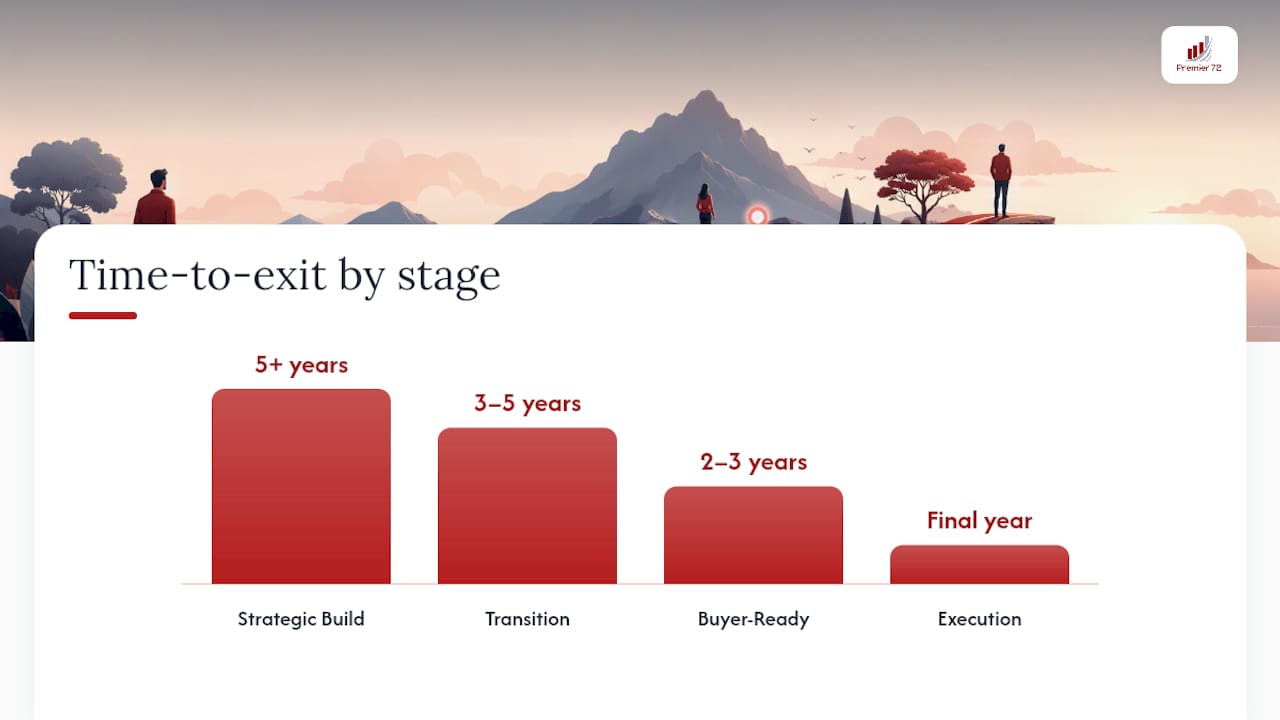
BizBuySell's exit planning framework structures the process into four actionable horizons. Here is how each stage maps to your priorities:
| Stage | Time to Exit | Primary Focus | Stage Gate (What "Done" Looks Like) |
|---|---|---|---|
| Strategic Build | 5+ years | Systems, recurring revenue, owner-dependence reduction | SDE growing, no single customer above 20% of revenue |
| Transition | 3–5 years | Accrual accounting, SOP library, management team | Clean 3-year financials, documented processes, second-tier leadership in place |
| Buyer-Ready | 2–3 years | Data room, recast financials, legal cleanup | Due-diligence package complete, QoE commissioned |
| Execution | Final year | CIM, buyer screening, negotiation, close | Signed LOI, diligence complete, proceeds to retirement plan |
Pro Tip: Anchor your exit date to a retirement income number, not a calendar preference. Calculate the monthly income you need in retirement, work backward to the sale price required, then set the exit date that gives you enough runway to reach that valuation.
How do you build transferable value 5+ years out?
The further you are from your exit, the more every dollar invested in transferability compounds. A five-year exit roadmap is the single strongest predictor of a successful sale, and owner dependence is the primary reason buyers discount or walk away.
Priority investments at this stage:
- Recurring revenue. Subscription contracts, retainers, and service agreements raise your multiple and reduce buyer risk perception.
- Customer diversification. No single customer should represent more than 15–20% of revenue. Concentration above that threshold triggers lender and buyer scrutiny.
- Documented SOPs. Core functions need written processes that a new owner or manager can follow without calling you.
- Contract assignability. Review vendor agreements, leases, and customer contracts now. Non-assignable contracts become deal-killers in diligence.
- IP clarity. Trademarks, software, and proprietary processes should be owned by the entity, not you personally.
Pro Tip: The lowest-cost early win is documenting your top five revenue-generating processes before you hire anyone new. It costs nothing but time and immediately signals to buyers that the business runs on systems, not on you.
What should you change 3–5 years before your exit?
This stage is where you shift from owner-as-operator to owner-as-strategic sponsor. The governance changes you make here are what buyers will see in your financials and management structure when they evaluate the business.
| Action | Owner | Timing |
|---|---|---|
| Shift to GAAP accrual accounting | CPA | Start immediately |
| Build SOP library for all core functions | Operations lead or owner | 12–18 months |
| Recruit and compensate a second-tier management team | Owner + HR | 18–36 months |
| Establish monthly normalized SDE/EBITDA tracking | CPA | Immediately |
| Review all contracts for assignability | M&A attorney | 24 months out |
When selecting an exit advisor or broker at this stage, ask three questions: How many deals in your industry and size range have you closed in the last three years? What is your typical buyer pool and outreach method? How do you handle confidentiality during the marketing process? Their answers reveal whether they have the network and process your deal actually needs.
How do you make your business buyer-ready on paper 2–3 years out?
This is the stage where financial recasting and documentation work pays off most directly. Sellers who skip a formal valuation commonly overprice by roughly 20–40%, and businesses that prepare 12 or more months ahead can achieve materially better sale outcomes than those that do not.
Financial checklist for this stage:
- Recast financials to Seller's Discretionary Earnings (SDE), documenting every legitimate add-back
- Reconcile P&L statements to tax returns for the prior three years
- Optimize working capital to reduce the cash tied up in the business at closing
- Commission a sell-side Quality of Earnings (QoE) report 12–18 months before listing
Data room documents to collect now:
- Three years of reviewed or audited financial statements
- Federal tax returns (business and personal, where relevant)
- All vendor and customer contracts, with assignability status noted
- Leases (real estate, equipment) with remaining terms and transfer provisions
- Employee files, offer letters, and non-compete agreements
- IP assignments and registrations
- Corporate formation documents, operating agreements, and any buy-sell agreements
Operationally, finalize your SOPs, put retention incentives in place for key staff, and confirm that your top vendor relationships can transfer to a new owner. These steps protect value during the diligence process.
What do you execute in the final year before selling?
The final year is about precision, not preparation. Your preparation is done. Now you are packaging, marketing, and negotiating.
Pre-listing deliverables:
- Final valuation update reflecting the most recent 12 months of normalized performance
- Confidential Information Memorandum (CIM) drafted with your advisor
- Seller teaser or blind profile for initial buyer outreach
- Confidentiality plan covering who knows what and when
Buyer screening best practices:
- Require a signed NDA before sharing any financials
- Qualify buyers on financial capacity before sharing the CIM
- Screen for cultural and operational fit, not just price
Pro Tip: Roughly 70–80% of listed businesses never sell, and most failures happen in buyer underwriting, not marketing. Being SBA-financeable, with defensible SDE and clean add-backs, keeps the largest pool of qualified buyers in your deal.
Negotiation levers that protect net proceeds include deal structure (asset vs. stock sale), escrow and holdback amounts, earnout terms and triggers, and tax treatment of the purchase price allocation. Each of these affects what you actually deposit into your retirement accounts.
How does valuation connect to your retirement income target?
SDE is the most relevant metric for owner-operated businesses with revenues under roughly $5 million. It represents the total economic benefit flowing to a single owner-operator: net income plus owner compensation, benefits, and one-time add-backs. EBITDA is more common for larger businesses with professional management teams already in place.
A modest SDE improvement illustrates the leverage clearly. That $225,000 difference is retirement capital.
A formal valuation early in your planning defines your income gap: the difference between what your business is worth today and what you need it to be worth to fund your retirement. That gap drives every prioritization decision across your timeline. Recommended valuation cadence: baseline at 3–5 years out, mid-run measurement at 2–3 years, and a formal pre-listing valuation with QoE in the final year.
What systems, people, and documents does every buyer expect?
Finance
- Three years of GAAP-compliant accrual financials
- Monthly P&L with normalized SDE or EBITDA tracked
- Recast financials with documented add-backs
- Working capital analysis
Operations
- SOPs for all revenue-generating and critical support functions
- Org chart showing management depth below the owner
- Key-person risk mitigation plan
Legal
- Assignable leases and contracts
- Non-compete agreements for key employees
- Buy-sell agreement (if applicable) and corporate governance documents
HR
- Employee files, compensation schedules, and benefit summaries
- Retention agreements for key staff
IT and IP
- Software licenses, domain ownership, and data security documentation
- Trademark and patent registrations in the entity's name
Pro Tip: Present legacy or imperfect items transparently with a remediation note rather than hiding them. Buyers who discover undisclosed issues in diligence discount aggressively or walk. Buyers who see a disclosed issue with a documented fix often proceed without a price reduction.
What does exit planning typically cost, and what slows it down?
Common delays and how to address them:
- Owner dependence: Start management development 3+ years out. A business that cannot operate without you will not close.
- Poor or cash-basis books: Begin the accrual transition immediately. Retroactive cleanup is expensive and slow.
- Customer concentration: Diversify revenue before listing. A single customer above 20% of revenue is a lender red flag. Lender underwriting of business debt is where many deals quietly fail.
- Legal encumbrances: Non-assignable leases and contracts require renegotiation that can take 6–12 months.
Budget for holdbacks and earnouts if your timeline slips. Earnouts can bridge a valuation gap but introduce post-close risk. Structure them with clear, measurable triggers tied to metrics you control.
Which advisors do you need, and when should you hire them?
| Stage | Advisor | Key Deliverables |
|---|---|---|
| 5+ years out | CPA | Accrual conversion, monthly SDE tracking, tax structure review |
| 3–5 years out | Exit advisor / CExP | Valuation baseline, exit-readiness scorecard, owner dependence plan |
| 2–3 years out | M&A attorney | Contract assignability review, buy-sell agreements, NDA templates |
| 18–24 months out | M&A broker or investment banker | CIM, buyer outreach, deal management |
| 12–18 months out | QoE provider | Sell-side quality of earnings report |
| Throughout | Retirement income planner | Retirement income gap analysis, post-close proceeds integration |

For deals above $500,000 in value, broker engagements have historically delivered higher sale prices than unrepresented sales. Interview at least three advisors, compare their buyer networks and fee structures, and select representation that matches your deal's size and complexity. A retirement income planner should be involved from the beginning, not just after closing, so that post-sale income planning is integrated into your valuation target from day one.
How Premier72 and The Retirement Bank Method™ support your timeline
Premier72's advisory services are built around The Retirement Bank Method™, a structured engagement that converts owner-dependent companies into transferable retirement assets. The method addresses the five dimensions buyers and lenders evaluate: systems, leadership, cash flow, documentation, and long-term exit readiness.
What a Premier72 engagement delivers across the timeline:
- Diagnostic phase: A structured advisory review that produces a valuation baseline, an exit-readiness scorecard, and a prioritized action plan tied to your retirement income target
- Build phase (3–5 years out): Owner-dependence reduction, SOP development, management team structure, and recurring revenue strategy
- Preparation phase (2–3 years out): Financial cleanup coordination, recast financials review, data-room preparation, and business income protection through key-person coverage and buy-sell funding
- Execution phase (final year): Pre-listing valuation support, CIM review, and post-close retirement income integration using insurance-based strategies, annuities, and legacy planning
The Retirement Bank Method™ is specifically designed for Baby Boomer business owners whose retirement depends on the sale or transfer of their company. It ties every operational improvement directly to a retirement income outcome, so you are not just building a more sellable business. You are building your retirement.
What most owners get wrong about exit timing
Most business owners treat exit planning as a transaction event rather than a multi-year construction project. That framing costs them money in three predictable ways.
Waiting too long is the most common mistake. An owner who starts planning 12 months before a desired exit date cannot meaningfully reduce owner dependence, clean three years of financials, or build a management team in that window. The result is a discounted sale or no sale at all.
Overreliance on one client is the second. It is a lender disqualifier. SBA lenders and most institutional buyers will not finance or acquire a business with that exposure, which eliminates the largest pool of buyers before marketing even begins.
Skipping a formal valuation is the third. That gap does not just slow the sale. It attracts unqualified buyers, wastes months of negotiation, and often ends in a failed deal.
The practical dos: start your valuation baseline now, build a management cadence that runs without your daily involvement, and document every critical process before you need to hand it off. These three actions, done early, are what separate owners who close at their target price from those who settle or stay.
Premier72's exit readiness diagnostic: your first structured step
Turning your business into a funded retirement requires a clear starting point. Premier72's initial diagnostic gives you exactly that: a valuation baseline, an exit-readiness scorecard, and a prioritized action plan built around your personal retirement income target.

The diagnostic covers your current SDE and defensible valuation range, owner-dependence risk factors, financial and documentation gaps, and a staged action plan mapped to your target exit date. It typically takes two to three structured sessions. The output is a concrete roadmap, not a general recommendation.
If your business is your retirement plan, the diagnostic is where the plan actually starts. Schedule your Premier72 advisory review and get the clarity your exit deserves.
Sources
- Exit Planning Timeline: A Roadmap to Selling Your Business
- Business Exit Checklist: 25 Steps Across 5 Phases (Interactive 2026)
- Exit SBA-Ready — Will an SBA Buyer's Lender Fund Your Sale? | FUNDED Series - SBA Lending Guides
- Exit Strategy Planning: How to Prepare for a Sale | John Galt
This article is general information, not a substitute for advice from a qualified financial advisor. Consult a qualified financial professional about your own circumstances before acting on anything here.