

To maximize value and close smoothly, follow this ordered preparation plan: clarify goals and timing → clean and normalize finances → resolve tax and legal housekeeping → build a deal team → reduce owner dependence → shore up customers, contracts, and operations → protect confidentiality → market and run diligence → negotiate, close, and execute a 100-day transition.
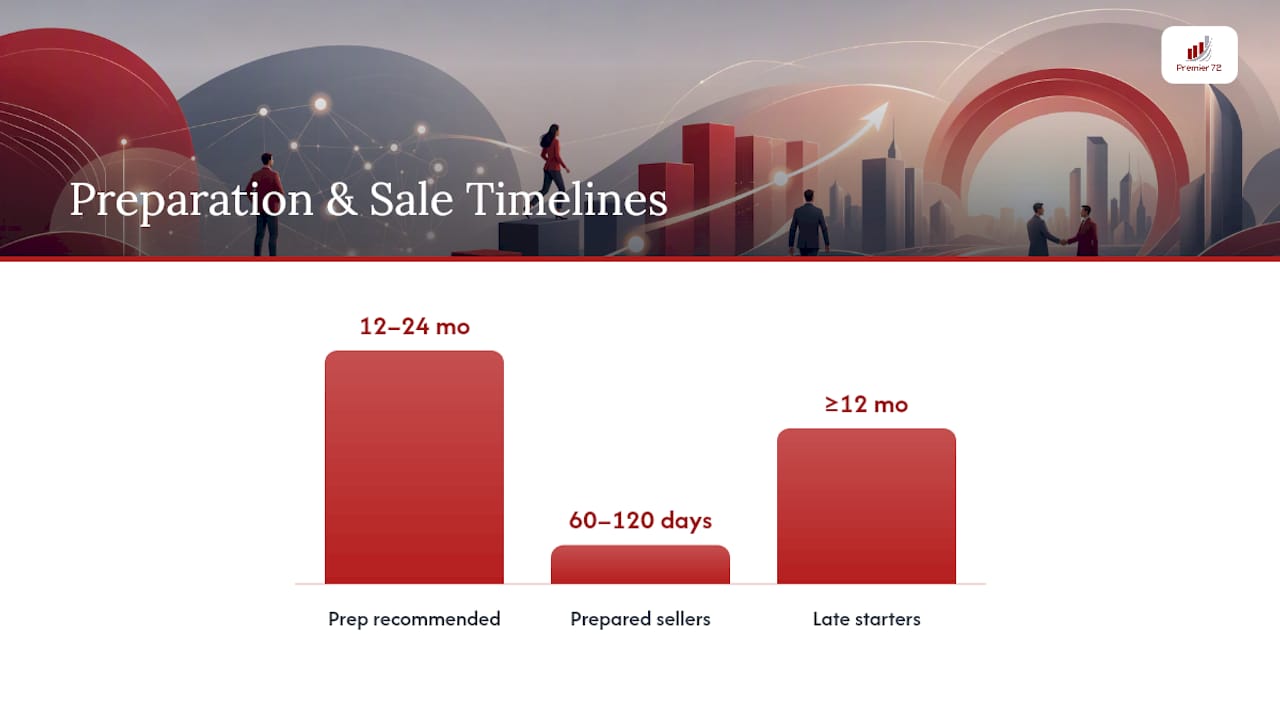
Most established business owners underestimate how much runway that sequence requires. Structured preparation typically begins 12–24 months before going to market, and sellers who compress that window often pay for it in price concessions. Sellers who arrive prepared, with clean financials and documented operations, routinely see 60–120 days from process launch to close — compared to 12 months or more for those who start late.
Here is where to focus your energy at each stage:
- First 30 days: Define your personal exit goals, set a target timeline, and pull three years of financial statements and tax returns. Identify obvious gaps immediately.
- First 90 days: Commission a professional valuation or preliminary Quality of Earnings (QoE) review, begin normalizing EBITDA, and engage a transaction-experienced CPA. Start documenting your top five operational processes.
- First 12 months: Complete legal and contract housekeeping, reduce owner dependence, build your full deal team, and prepare your Confidential Information Memorandum (CIM) and virtual data room.
The US Chamber of Commerce's preparation checklist confirms this sequence as the framework most owners rely on, and the sections below expand each step with the specifics that protect your leverage and your price.
Key Takeaways
Sellers who begin structured preparation 12–24 months before going to market, with clean financials and documented operations, consistently achieve better valuations and faster closings than those who start late.
| Point | Details |
|---|---|
| Start 12–24 months early | Structured preparation begun a year or more out avoids price concessions and gives time to fix what buyers will find. |
| Clean financials are highest-leverage | Three years of reconciled P&L, tax returns, and a documented add-back schedule are the foundation buyers build their offer on. |
| Owner dependence lowers multiples | Delegate key relationships, document SOPs, and install second-line management before going to market. |
| Confidentiality protects value | Use staged disclosure (teaser → CIM under NDA → data room) and a virtual data room to control information flow throughout the process. |
| Premier72 supports exit readiness | Premier72's structured advisory process addresses financials, owner dependence, and post-sale income planning 12–24 months before your target close date. |
Table of Contents
- What do your exit goals and timing actually look like?
- How do you get a defensible valuation and clean up your financials?
- What tax and legal issues can derail your deal?
- Who should be on your deal team, and when do you hire them?
- How do you reduce owner dependence before a buyer sees it?
- What customer and supplier metrics do buyers scrutinize most?
- How do you protect confidentiality while running a sale process?
- How do you market your business and manage buyer diligence?
- How do you negotiate from LOI to a signed purchase agreement?
- What does a 100-day transition plan actually look like?
- When does an experienced exit advisor actually move the needle?
- The preparation priorities that actually protect your price
- Premier72 helps you build a business worth selling on your terms
- Sources
What do your exit goals and timing actually look like?
Before you touch a financial statement or call a broker, you need a clear picture of what a successful sale means to you personally. Price matters, but it is rarely the only variable. Owners who skip this step often accept deal structures that look good on paper but fail to deliver the net proceeds, timeline, or legacy outcomes they actually needed.
Start by writing down your non-negotiables: minimum net proceeds after tax, latest acceptable closing date, preferences for employee continuity, and any legacy conditions (keeping the brand name, retaining a key manager, staying in a consulting role). Rank them. A buyer offering a higher headline price with a two-year earnout may be worth less than a slightly lower all-cash offer, depending on your priorities.
Buyer type shapes your entire preparation strategy. Strategic buyers (competitors, suppliers, or adjacent companies) typically pay the highest multiples because they capture synergies, but they require more disclosure and move more deliberately. Private equity groups and search funds move faster and often prefer management continuity. Individual operators tend to be price-sensitive and rely more heavily on seller financing. Knowing which buyer universe you are targeting changes which value drivers to emphasize and which risks to address first.
Pro Tip: Before engaging any advisor, complete a one-page "exit brief" that lists your target price range, ideal close date, acceptable deal structures (all-cash, earnout, seller note), and any deal-breakers. Share it with your CPA and attorney before your first broker meeting. It saves weeks of misaligned conversations.
Timing is not just a preference — it is a financial decision. Sellers who begin structured preparation 12–24 months out consistently achieve better outcomes than those who react to an unsolicited offer or a health event. If your timeline is compressed to under 12 months, be honest about the trade-offs: you will likely go to market with some unresolved issues, and buyers will price that risk into their offers.
How do you get a defensible valuation and clean up your financials?
Valuation is where deals are won or lost before a buyer ever submits an offer. Buyers and their advisors will reconstruct your earnings from scratch, so the number you believe your business is worth must be supported by documentation they can verify independently.
The three valuation approaches sellers encounter
Market comps (comparable closed transactions) are the most common starting point for private companies. Your M&A advisor or broker will pull transaction data from databases like PitchBook, DealStats, or IBBA market pulse reports to identify what similar businesses sold for as a multiple of EBITDA or Seller's Discretionary Earnings (SDE). A defensible valuation combines professional appraisal with market-sensing from an experienced advisor to set a realistic price range rather than an aspirational one.
Income-based approaches (discounted cash flow, or DCF) are more common in larger transactions or businesses with predictable, recurring revenue. DCF requires defensible financial projections, which is why clean historical financials matter so much — buyers discount projections heavily when the history is messy.
Normalized EBITDA and add-backs
Adjusted EBITDA (or SDE for smaller businesses) is the earnings figure buyers use to apply a multiple. Normalization removes one-time, non-recurring, or owner-specific items from reported earnings to show what the business would earn under a new owner. Common defensible add-backs include owner compensation above market rate, personal expenses run through the business, one-time legal fees, and non-recurring repairs.
Buyers challenge add-backs aggressively. Every add-back needs a paper trail: a payroll record, an invoice, a board resolution, or a tax schedule. Undocumented add-backs get rejected, which reduces your effective multiple.
Pro Tip: Build an add-back schedule in a spreadsheet with three columns: the item, the dollar amount, and the supporting document reference. Your CPA should review it before you share it with any buyer. Add-backs that survive diligence are the ones that were documented before the process started.
What financial documents buyers will request
| Document | Why Buyers Need It | Who Prepares or Verifies |
|---|---|---|
| 3 years of P&L statements | Establishes earnings trend and normalization baseline | Owner + CPA |
| 3 years of balance sheets | Reveals working capital, debt, and asset quality | CPA |
| 3 years of business tax returns | Cross-checks reported income against filed returns | CPA / tax advisor |
| Monthly bank statements (12–24 months) | Confirms cash flow and catches undisclosed liabilities | Owner |
| Accounts receivable aging | Shows collection quality and customer payment behavior | Owner + bookkeeper |
| 3-year cash flow statements | Demonstrates actual cash generation vs. accrual earnings | CPA |
| Current-year YTD financials | Tracks performance against prior periods | CPA |
Reconciliation between your P&L and your tax returns is non-negotiable. Discrepancies — even explainable ones — trigger buyer concern and slow diligence. The preparation phase, including financial cleanup and QoE, is often the most important phase of the entire sale process.
A Quality of Earnings report is commonly recommended when the expected deal value is substantial or when add-backs materially change your earnings profile. A QoE materially reduces renegotiation risk because it validates your adjusted earnings before buyers conduct their own diligence.
What tax and legal issues can derail your deal?
Legal and tax surprises discovered during buyer diligence are among the most common reasons deals fall apart or get repriced. Identifying and resolving them before you go to market is far less costly than negotiating around them under deadline pressure.
Tax history and compliance
Pull three years of federal and state income tax returns and review them with a transaction-experienced CPA. Specific items to check: payroll tax filings and deposits, sales and use tax compliance (especially if you operate across multiple states), any open audits or IRS correspondence, and whether your entity structure (S-corp, C-corp, LLC) is optimized for the type of sale you are planning. An asset sale and a stock sale have materially different tax consequences for both parties, and your entity structure affects which is feasible.
Pro Tip: If your business has operated in multiple states, a nexus review is worth the cost. Undisclosed sales tax exposure in a state where you have economic nexus can become a significant liability that buyers demand be escrowed or indemnified at closing.
Contracts, leases, and assignment risk
Every material contract needs to be reviewed for assignment clauses, change-in-control provisions, and consent requirements. A commercial lease that requires landlord consent to assign — and a landlord who is uncooperative — can delay or kill a closing. Customer contracts with automatic termination on change of ownership are equally dangerous.
Create a contract inventory that lists each agreement, its term and renewal date, whether it contains an assignment clause, and what consent is required. Prioritize your top 10 revenue-generating contracts and your facility leases. Engage your M&A attorney to draft consent requests or amendment language early, before a buyer is in the room.
IP, domains, and employment agreements
Confirm that all intellectual property — trademarks, patents, software, domain names, and proprietary processes — is owned by the business entity being sold, not by you personally or a related entity. Invention assignment agreements should be in place for any employee or contractor who developed proprietary tools or processes. Missing IP ownership is a common diligence flag that buyers use to justify price reductions.
Any pending litigation or contingent liabilities must be disclosed. The standard approach: disclose early, quantify the exposure, and either resolve it before closing or negotiate a specific indemnity carve-out in the purchase agreement. Hiding a known liability is both legally risky and deal-ending when discovered.
Who should be on your deal team, and when do you hire them?
Selling a business is a team sport. Owners who try to manage the process alone consistently leave money on the table or expose themselves to avoidable risk. The right advisors pay for themselves many times over.
Core team roles
- M&A advisor or business broker: Manages the process, prepares the CIM, identifies and qualifies buyers, runs the auction or negotiation, and protects your leverage. For transactions above $5 million, an M&A advisor typically adds more value than a generalist broker. SCORE's guidance on preparing a business for sale emphasizes that the right advisor team reduces surprises and preserves leverage through diligence.
- Transaction-experienced CPA: Normalizes financials, prepares or reviews the add-back schedule, advises on entity structure and tax treatment, and supports diligence responses.
- M&A attorney: Drafts and negotiates the LOI, purchase agreement, representations and warranties, and closing documents. A generalist business attorney is not a substitute.
- Wealth or tax planner: Models the after-tax proceeds from different deal structures and helps you deploy sale proceeds into a post-sale income and legacy plan. Retirement income planning becomes critical the moment you have a realistic price range in hand.
- Valuation expert or QoE provider: Provides an independent earnings validation that buyers and lenders rely on.
How to select and interview advisors
- Ask for three recent, closed transactions in your industry and deal-size range — and verify them.
- Confirm the specific person who will work your deal, not just the firm's senior partner.
- Understand the fee structure before signing: success fee (typically 3–10% of transaction value, sliding scale), retainer, or hourly. Ask what is included and what triggers additional fees.
- Verify credentials. For any broker or intermediary who will solicit regulated capital or intermediated buyers, check their registration through FINRA BrokerCheck before signing an engagement letter.
- Ask how they handle confidentiality during the marketing process and what their buyer qualification process looks like.
Pro Tip: Engage your CPA and attorney before your M&A advisor, not after. Having clean financials and a reviewed contract inventory before your first advisor meeting shortens the engagement timeline and reduces your total advisory cost.
Advisor fees are a real line item. Budget broadly: M&A advisor success fees on a $3–10 million transaction often run $150,000–$500,000 or more depending on deal size and structure; legal fees for a mid-market transaction can run $50,000–$150,000; QoE reports typically cost $15,000–$50,000. These are planning ranges, not guarantees — your specific transaction will vary.
How do you reduce owner dependence before a buyer sees it?
Owner dependence is the single most common reason buyers discount a business or walk away entirely. If your company's revenue, key relationships, or institutional knowledge live primarily in your head, buyers see a liability, not an asset.
Buyers measure owner dependence in concrete ways: What percentage of revenue comes from relationships you personally manage? What happens to operations if you are unavailable for 30 days? Are there documented processes, or does the team rely on tribal knowledge? Is there a second-in-command who can run the business without you?
A practical sequence to build transferability
Start with your highest-risk dependencies. Map every customer relationship, vendor relationship, and operational process that currently runs through you. Rank them by revenue impact. Then begin a deliberate delegation and documentation program.
Standard Operating Procedures (SOPs) are the foundation. Prioritize documenting these processes first: customer onboarding, order fulfillment or service delivery, billing and collections, key vendor management, and employee onboarding. Each SOP should be written at a level of detail that allows a competent new hire to execute the process without asking you questions. Tools like Notion, Trainual, or even a structured Google Drive folder work well for small to mid-size businesses.

Pro Tip: Record a short screen-share or walkthrough video for your five most complex processes. Written SOPs are valuable, but video documentation is faster to create, easier for new staff to follow, and signals to buyers that your operational knowledge is genuinely transferable.
Management depth matters as much as documentation. If your business has no second-in-command, consider promoting or hiring one 12–18 months before your target sale date. Buyers will ask about retention arrangements for key managers, and having a credible management team in place often justifies a higher multiple. Retention bonuses tied to a successful closing are a common and effective tool.
What customer and supplier metrics do buyers scrutinize most?
Customer and supplier quality is one of the first things a sophisticated buyer examines. Buyers either discount the price or require earnout provisions to protect against post-close customer loss.
KPIs buyers will request
- Customer concentration: revenue percentage from top 5 and top 20 customers
- Annual churn and retention rates, ideally over three years
- Average contract tenure and renewal rates
- Recurring revenue as a percentage of total revenue
- A top-20 customer schedule with revenue, contract status, and relationship owner
If your numbers are unfavorable, the time to address them is before you go to market. Diversifying your customer base takes 12–18 months of deliberate sales effort. Securing multi-year contracts with your top customers, formalizing renewal terms, and transitioning key relationships from you personally to account managers all improve your profile.
Contract diligence checklist
- Assignment clauses: does the contract require customer or supplier consent to assign?
- Change-in-control provisions: does a sale trigger termination rights?
- Automatic renewal terms: are they clearly documented and current?
- Payment terms: are they consistent with industry norms, and are receivables current?
- Exclusivity or non-compete clauses that could restrict the buyer's operations
For any contract with a problematic clause, annotate it in your data room with a brief explanation and, where possible, a remediation note (consent obtained, amendment in progress, or legal analysis of enforceability). Buyers appreciate transparency; unexplained exceptions create friction.
For businesses that rely heavily on workforce outsourcing or PEO arrangements, reviewing PEO exit strategy and transition support options early can prevent workforce-related complications from surfacing during diligence.
How do you protect confidentiality while running a sale process?
A sale process that leaks prematurely can damage employee morale, trigger customer anxiety, and give competitors an advantage. Confidentiality is not just a legal formality — it is a value-protection strategy.

NDAs and staged disclosure
Every prospective buyer should sign a mutual Non-Disclosure Agreement before receiving any company-specific information. A basic sell-side NDA covers: prohibition on disclosing the company's identity and financials, restrictions on contacting employees or customers directly, return or destruction of materials if the process ends, and a standstill period. Your M&A attorney should draft or review the NDA — do not use a generic template for a transaction of meaningful size.
Staged distribution of sensitive information is the standard practice: a blind teaser (no company name) goes to a broad list, the CIM goes only to NDAsigned buyers, and full data-room access is reserved for buyers who have submitted an LOI or passed a qualification screen.
Pro Tip: Use a virtual data room platform (Datasite, Intralinks, or Firmex are widely used) rather than email or Dropbox for document sharing. These platforms log every document access, allow you to revoke access instantly, and create an audit trail that protects you if a buyer misuses confidential information.
When and how to tell your team
Leadership and essential staff who need to support diligence (your CFO, controller, or operations manager) should be brought in on a need-to-know basis, typically after you have signed an LOI with a qualified buyer. The broader employee base should not be informed until closing is imminent — ideally within a few days of the announcement. Frame the news around continuity and opportunity, not uncertainty.
A brief communication template for key staff: "We are in a confidential process that may result in a significant change in ownership. Your role is secure, and I will keep you informed as things develop. For now, please treat this as strictly confidential."
How do you market your business and manage buyer diligence?
Going to market is not simply posting a listing. A well-run process controls information flow, qualifies buyers before they consume your time, and maintains competitive tension to protect your price.
Targeted outreach vs. structured auction
A targeted outreach process contacts a curated list of 10–30 strategic or financial buyers directly. It is faster, more confidential, and appropriate for smaller transactions or situations where confidentiality is paramount. A structured auction (or controlled process) contacts a broader universe, creates competitive bidding, and typically produces better pricing — at the cost of more time and disclosure. Your M&A advisor will recommend the right approach based on your deal size, industry, and confidentiality requirements.
CIM essentials and buyer qualification
The Confidential Information Memorandum is your primary marketing document. It should cover: business overview and history, products or services and competitive positioning, financial summary (three years of normalized financials), growth opportunities, management team overview, and operational highlights. It should not include customer names, proprietary pricing, or sensitive operational details until later in the process.
Qualify buyers before granting data-room access: require a signed NDA, proof of financial capacity (a bank letter or fund confirmation), and a brief strategic fit statement. This filters out tire-kickers and protects your confidentiality.
Data room preparation
| Folder | Key Documents |
|---|---|
| Financials | 3-year P&L, balance sheets, tax returns, YTD financials, bank statements |
| Legal | Entity documents, operating agreements, material contracts, IP registrations |
| Operations | SOPs, org chart, key employee agreements, vendor contracts |
| Customers | Top-20 customer schedule, contract summaries, retention data |
| Facilities | Leases, equipment lists, environmental reports (if applicable) |
| HR | Employee roster, compensation summary, benefit plans, non-competes |
| Intellectual Property | Trademark registrations, domain ownership, software licenses |
Pro Tip: Stage your data room in two tranches. The first tranche (financials, legal entity, and operations overview) goes to all LOI-stage buyers. The second tranche (customer details, employee compensation, and sensitive contracts) goes only to the buyer who has signed an LOI and entered exclusivity. This preserves leverage and limits exposure.
Manage diligence requests with a tracker. Assign each request a status (open, in progress, complete) and a due date. High-frequency requests — financial reconciliations, contract copies, and employee agreements — should be pre-loaded in the data room before diligence begins to reduce back-and-forth and keep the process moving.
How do you negotiate from LOI to a signed purchase agreement?
The Letter of Intent is not a formality. It sets the economic and structural framework for the entire deal, and concessions made at the LOI stage are very difficult to recover later.
What belongs in your LOI
A well-drafted LOI should specify: purchase price and structure (asset vs. stock sale), working capital target and adjustment mechanism, earnout terms if applicable, escrow amount and release schedule, exclusivity period (typically 30–60 days), key closing conditions, and any seller representations the buyer requires.
Asset vs. stock sale is one of the most consequential structural decisions. Buyers generally prefer asset sales because they get a stepped-up tax basis and avoid inheriting unknown liabilities. Sellers generally prefer stock sales because gains are taxed at capital gains rates rather than ordinary income rates. Your transaction CPA should model both scenarios before you respond to a buyer's initial structure proposal.
Common deal components and their implications
Earnouts tie a portion of the purchase price to post-close performance. They are common when buyer and seller disagree on future earnings potential. Earnouts protect buyers but create risk for sellers — you may not control the variables that determine whether you hit the target. Negotiate earnout metrics that are objective, measurable, and within your control.
Negotiate the amount, the release triggers, and the claims process carefully.
Representation and warranty (R&W) insurance has become common in mid-market transactions. It shifts indemnification risk from the seller to an insurer, which can reduce escrow requirements and accelerate seller access to proceeds.
Pro Tip: Your three highest-value negotiation priorities at the LOI stage are: (1) maximize the cash-at-close percentage, (2) minimize the escrow amount and duration, and (3) define earnout metrics with objective, verifiable benchmarks. Conceding on all three to get a higher headline price often produces lower net proceeds.
Working capital mechanics deserve careful attention. The purchase price is typically set on a "cash-free, debt-free" basis with a normalized working capital target. If actual working capital at closing is above or below the target, the price adjusts dollar-for-dollar. Understand your working capital cycle before you agree to a target.
Tax planning at this stage can materially affect your net proceeds. Installment sales, charitable remainder trusts, opportunity zone investments, and qualified small business stock exclusions (Section 1202) are all worth modeling with your tax advisor before you sign a definitive agreement. For a deeper look at post-sale income and legacy planning, estate planning for business owners is a practical starting point.
What does a 100-day transition plan actually look like?
Closing day is not the finish line. A structured transition plan protects the value you just negotiated by keeping customers, employees, and vendors stable during the handoff period.
100-day transition priorities
- Days 1–14: Joint announcement to employees and key customers. Frame the transition around continuity and growth. Introduce the new owner to your top 10 customers personally.
- Days 15–30: Complete all license and permit transfers, update banking authorizations, and transfer domain and software account ownership. Begin formal knowledge transfer sessions with the buyer or incoming management team.
- Days 31–60: Transition day-to-day vendor relationships. Confirm that all supplier contracts have been formally assigned or novated. Complete payroll system and benefits administration handoffs.
- Days 61–90: Conduct a working capital true-up with the buyer's accountants. Address any post-close adjustment claims. Begin winding down your active operational involvement per the transition services agreement.
- Days 91–100: Final review of open items. Confirm escrow release schedule with the escrow agent. Transition any remaining customer relationships and document outstanding items for the buyer's management team.
Closing administration checklist
- Final working capital calculation and true-up submission
- Escrow release schedule confirmed with escrow agent
- All state and local business licenses transferred or reissued
- Payroll tax accounts closed or transferred
- Federal EIN notification filed if entity structure changes
- Seller's post-close consulting agreement (if applicable) executed and in effect
Post-close seller involvement is common and often required by buyers. Full-time transition periods of 30–90 days are standard; consulting arrangements of 6–12 months at a reduced rate are common for larger transactions. Retention bonuses for key employees, tied to 6–12 months of post-close tenure, help stabilize the team during the transition. Income replacement planning becomes an immediate priority once your transition period ends and your regular business income stops.
When does an experienced exit advisor actually move the needle?
The honest answer: almost always, for transactions above $1 million. The question is not whether to hire advisors but which ones, when, and for what scope.
Advisors improve outcomes in measurable ways. A well-run M&A process with competitive tension typically produces a higher multiple than a bilateral negotiation. Clean, advisor-reviewed financials reduce buyer renegotiation attempts. An experienced M&A attorney catches indemnification language that can cost sellers far more than the legal fee. And a transaction CPA who models the after-tax proceeds from different structures often identifies six-figure differences in net proceeds that a generalist would miss.
The right moment to engage a full advisory team is 12–18 months before your target go-to-market date. That gives your CPA time to clean up financials, your attorney time to resolve contract issues, and your M&A advisor time to prepare the CIM and build a qualified buyer list without rushing. Owners who engage advisors six months before they want to close are almost always starting too late.
Pro Tip: The work you keep in-house should be limited to what only you can provide: customer relationship context, operational history, and strategic narrative. Everything else — financial normalization, legal review, buyer outreach, and diligence management — is better handled by specialists who do it every day.
What to keep in-house: your personal exit brief, customer and vendor relationship context, and the operational narrative that only you can tell. What to outsource: financial normalization, legal document review, buyer qualification, data-room management, and negotiation strategy. The division of labor is not about cost — it is about where your time creates the most value during a process that will consume significant bandwidth regardless.
The preparation priorities that actually protect your price
Most sellers focus on the wrong things first. They spend months on cosmetic improvements — a website refresh, new equipment, a rebranded pitch deck — while leaving the issues that actually move multiples unaddressed.
The first 90 days of preparation should be almost entirely financial and operational. Clean your books. Reconcile your tax returns to your P&L. Document your add-backs with supporting evidence. Then turn to owner dependence: identify the three relationships or processes that would break without you and begin delegating them immediately. Customer concentration is the third priority.
Three mistakes sellers make repeatedly: First, they wait too long. Sellers who start structured preparation 12–24 months out achieve materially better outcomes than those who react to an offer. Second, they conflate gross revenue with enterprise value. Buyers buy earnings and transferability, not top-line numbers. Third, they underestimate how long legal and contract cleanup takes. Assignment consent from a single landlord or key customer can take 60–90 days. Start that work early.
The sequencing principle that protects your leverage: fix what buyers will find anyway, before they find it. Every issue discovered during diligence becomes a negotiating chip for the buyer. Every issue you resolve before going to market becomes a selling point.
Premier72 helps you build a business worth selling on your terms
Preparing a business for sale is one of the most consequential financial events of your life, and the preparation work is where most of the value is created or lost. Premier72 works with established business owners to build exit-ready companies through The Retirement Bank Method™, a structured advisory process that addresses the exact issues buyers scrutinize most: normalized earnings, owner dependence, documented operations, and tax-aware transition planning.

An engagement with Premier72 typically begins 12–24 months before a target sale date and covers exit-readiness assessment, financial normalization support, owner-dependence reduction, business continuity planning, and post-sale income and legacy structuring. Every engagement is handled with strict confidentiality. If you are also thinking about what comes after the sale, Premier72's insurance-based retirement income and legacy planning solutions help you protect and deploy your proceeds with the same structure you applied to building the business.
To request a confidential consultation or learn how Premier72 can support your exit readiness, visit Premier72 and schedule your advisory review today.
Sources
The following resources support each phase of the preparation and sale process:
- Preparing Your Business for Sale
- Preparing to Sell Your Business: What to Do 12–24 Months Before You Go to Market | Adaptive Capital Partners
- Pre-Sale Business Preparation Checklist: 12 Months
- How to Sell a Business in 2026: The Complete Guide | CT Acquisitions