

To improve cash flow fastest, focus first on getting paid sooner, aligning payables, and running a 13-week forecast, then use financing to bridge predictable gaps. Most small businesses see measurable results in four to six weeks and stronger footing within 90 days, with days sales outstanding dropping and cash runway extending. This article lays out that prioritized plan, including when a structured advisory review makes sense.
TL;DR:
- Improving cash flow within 90 days often depends on implementing quick fixes like invoicing immediately after work completion and automating receivable reminders.
- Building a 13-week forecast, analyzing accounts receivable aging, and measuring the cash reserve gap are essential initial steps to identify specific cash flow issues.
- Negotiating supplier terms, extending payment deadlines, and reducing overhead through targeted audits can significantly free up cash without harming operations.
- Using short-term financing options such as lines of credit or invoice factoring should be a last resort after fixing operational habits and forecasting accuracy.
- Focusing on operational discipline first, particularly invoicing, payables, and cash flow habits, is more cost-effective and sustainable than relying immediately on external funding.
Table of Contents
- Quick Diagnosis: Three Checks Before You Touch a Tactic
- Speed Up Receivables: Invoices, Deposits, and Automation
- Manage Payables Without Straining Vendor Relationships
- Cut Overhead Without Cutting Muscle
- Free Up Cash Trapped in Inventory
- When Should You Use Short-Term Financing?
- Revenue-Side Levers That Improve Cash Without New Customers
- Your 90-Day Cash Flow Improvement Roadmap
- Why Cash Flow Fixes Also Raise What Your Business Is Worth
- The Part of This Plan Most Advice Gets Backwards
- Get Hands-On Help Stabilizing Cash Flow and Building Toward an Exit
- Sources
Quick Diagnosis: Three Checks Before You Touch a Tactic
Before you fix anything, find out whether your cash problem is timing, revenue, or structural. Run these three checks first.
- Build a 13-week rolling forecast. List expected receipts by week alongside payroll, rent, and debt service, then update it every week. A 13-week rolling forecast gives you a near-term view that flags shortfalls weeks before they hit, so you can collect faster, delay a purchase, or line up credit while you still have options.
- Pull an A/R aging report. Sort open invoices into 30, 60, and 90-day buckets, then flag your worst offenders. Calculate days sales outstanding (DSO) by dividing total receivables by total credit sales, then multiplying by the number of days in the period.
- Measure your reserve gap. Compare current cash on hand to three months of operating expenses, a benchmark Bank of America recommends for weathering slow seasons or surprise costs.
Speed Up Receivables: Invoices, Deposits, and Automation
Getting paid faster is usually the single fastest lever you have, and it costs almost nothing to pull. Due's guidance on accelerating small business cash flow points to same-day invoicing and online payment acceptance as the highest-leverage moves available to most owners.
- Invoice the same day work finishes, not at month's end, and accept ACH, card, or pay-link payments so clients can settle in seconds (practical examples to shorten DSO).
- Require deposits or milestone payments on larger projects, and move repeat clients onto recurring billing so revenue arrives on a predictable schedule.
- Offer small early-pay discounts selectively, such as 2/10 Net 30, and automate reminder emails with an escalation workflow that texts or calls after a set number of missed days.
Automating the reminder and reconciliation side of accounts receivable, through electronic invoicing and automatic payment matching, trims the manual delays that quietly stretch DSO by days or weeks.
Pro Tip: Send the invoice before you leave the job site, not after you get back to the office. That single habit change can shave three to five days off your average collection time with zero added cost.

Manage Payables Without Straining Vendor Relationships
Paying on time, not early, is a cash flow tactic in its own right. Unless an early-pay discount beats what you'd earn holding that cash elsewhere, use your full contractual terms.
- Pay invoices on the due date, not the day they arrive, unless a discount offer clearly outperforms your best cash alternative.
- Negotiate extended terms with large suppliers, or propose phased payments tied to delivery milestones instead of a lump sum.
- Build a simple priority matrix: payroll and critical vendors first, discretionary spending last, ranked by relationship risk if a payment slips.
Aligning your outflows with your inflows rather than mirroring whatever terms your customers get from you closes a gap that quietly drains cash even in profitable companies. You can also frame a request for faster payment to a client as a financing trade in exchange for a modest discount, which tends to land better than a flat price cut.
Cut Overhead Without Cutting Muscle
Every recurring charge on your books deserves a challenge before it renews automatically.
- Run a quarterly subscription audit and cancel software or services nobody on your team actually opens.
- Renegotiate insurance premiums, merchant processing fees, telecom contracts, and lease terms before the auto-renew date locks you in for another year.
- Use temporary staffing adjustments or flexible scheduling during slow stretches instead of jumping straight to permanent headcount cuts.
Overhead reduction works fastest when it targets waste, not capability. Cutting a tool your team relies on saves cash today and costs you productivity tomorrow, so audit line by line rather than slashing a flat percentage across the board.
Free Up Cash Trapped in Inventory
Inventory sitting on a shelf is cash you already spent and haven't gotten back yet.
- Shift to just-in-time ordering where your suppliers can support it, and identify slow-moving SKUs for clearance pricing or bundling with faster sellers.
- Ask vendors about consignment arrangements or vendor financing when your cash position is tight but your sales pipeline is solid.
- Track inventory turnover monthly and translate every improvement into "cash-weeks freed," the number of weeks of cash you no longer have parked in stock.
Reducing excess inventory through clearance sales and JIT ordering is one of the more overlooked cash flow optimization techniques, mainly because it feels like an operations problem rather than a finance one.
When Should You Use Short-Term Financing?
A business line of credit, invoice factoring, and accounts receivable financing each solve a different timing problem, and picking the wrong one costs you margin you didn't need to give up.
- A line of credit typically preserves margin best when you qualify, since it's usually the lowest-cost option for bridging predictable, short gaps.
- Invoice factoring sells your receivables to a third party at a discount for immediate cash, trading margin for speed.
- A/R financing advances against invoices you still own and collect yourself, often faster to set up than a bank line.
Some accounts receivable financing providers advance up to 90% of an invoice's value and can deliver funds within 24 to 48 hours, versus the 30 to 60 days customers typically take to pay on their own.
Financing works well for a known, temporary timing gap, like a seasonal dip you can see coming on your forecast. It's masking a chronic problem when you're pulling on it every single month just to make payroll.
Revenue-Side Levers That Improve Cash Without New Customers
You don't need more sales to improve cash flow. You need better payment structure on the sales you already have.
- Require deposits on large jobs, and switch long projects to milestone billing so cash arrives as work progresses instead of at the finish line.
- Move suitable clients onto a retainer or subscription arrangement, which smooths revenue into predictable monthly deposits instead of lumpy invoices.
- Test small early-pay discounts on a subset of invoices and measure the net effect on both DSO and margin before rolling the discount out broadly.
Quick wins like these often restore enough breathing room that you can negotiate longer-term changes calmly instead of scrambling for panic financing later.
Your 90-Day Cash Flow Improvement Roadmap
Sequencing matters here. Diagnosing before you act, and financing only after you've tried the free fixes, keeps this plan cheap and sustainable.
- Weeks 1 to 2: Build your 13-week forecast and run the A/R aging report to find your real problem.
- Weeks 3 to 6: Implement the quick wins, same-day invoicing, deposit requirements, and the subscription audit.
- Weeks 7 to 12: Negotiate supplier terms, and set up a line of credit or A/R financing if a genuine timing gap remains.
- Month 3 and beyond: Systemize the new habits and start funding your three-month reserve.
Track cash runway, DSO, and reserve level weekly, not monthly. If your forecast shows two consecutive negative weeks despite the quick wins, that's your trigger to escalate to a lender or an advisor rather than waiting it out.
Why Cash Flow Fixes Also Raise What Your Business Is Worth
A buyer evaluating your company reads consistent cash flow as low risk, and low risk translates directly into a stronger valuation. This is the part most cash flow guides skip entirely.
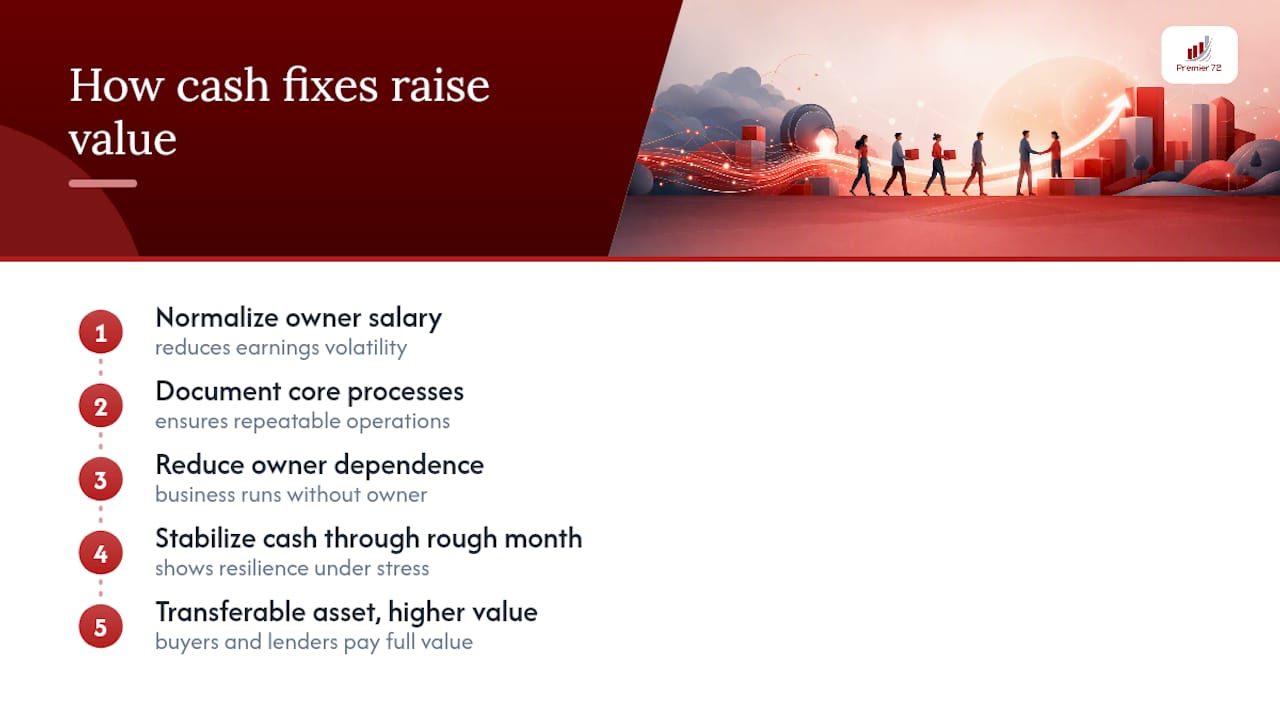
Premier72 built The Retirement Bank Method™ around a simple observation: the same fixes that stabilize your cash, normalizing your owner salary, documenting core processes, and reducing how much the business depends on you personally, are exactly what a buyer or lender wants to see before they'll pay full value. A business that can run smoothly through a rough month without the owner personally absorbing the shortfall is a transferable asset, not just a job with better hours.
Owners nearing retirement often discover their income planning and business cash position are more tightly linked than they assumed.
The Part of This Plan Most Advice Gets Backwards
Most cash flow content treats financing as step one and discipline as an afterthought. That ordering is backwards, and it's expensive. Lines of credit and invoice financing solve a timing problem, not a structural one, and reaching for capital before you've run a forecast or fixed your invoicing habits just delays the reckoning at a cost.
The research on this is consistent: the fastest, cheapest wins come from changing behavior around receivables and payables, not from finding a new lender. A 13-week forecast and an honest A/R aging report cost you an afternoon. A factoring arrangement costs you margin every month it's in place.
Where conventional advice really falls short is treating cash flow as a standalone finance problem instead of an operations and ownership problem. Owner dependence, undocumented processes, and inconsistent pricing all show up as cash flow symptoms eventually. Fix the habit first: forecast weekly, invoice same day, pay on terms not early. Only reach for financing once you can point to a specific, temporary gap on your own forecast. If you're within five years of an exit, treat every cash flow fix as a value-building move, because that's exactly what it is.
— Asa
Get Hands-On Help Stabilizing Cash Flow and Building Toward an Exit
Running through this plan alone gets you real results, but pairing it with a structured advisory review gets you further, faster, especially if you're also thinking about what your business is worth down the road. Premier72 works with established owners to stabilize cash flow, normalize owner compensation, and reduce the day-to-day dependence on the founder, all groundwork for a stronger sale price or a smoother retirement transition.

An engagement typically starts with a diagnostic review of your current cash position and operations, followed by a prioritized quick-win plan similar to the roadmap above, then hands-on support implementing it. If you want a second set of eyes on where your cash is actually going and what it means for your long-term exit value, visit Premier72's advisory services to start a structured review.
Sources
- Resolve — Net terms / A/R financing
- Cash flow management basics for small businesses — Bank of America
- How to Improve Cash Flow for Small Business: 8 Proven Strategies | CurrentCFO
- How to Improve Cash Flow in a Small Business — Due