

The employer decides each year whether to contribute and how much, up to the IRS-defined annual cap. There is no requirement to contribute in every year, which makes this structure one of the most cash-flow-friendly retirement vehicles available to small and medium business owners. According to the IRS, the plan must have a written allocation formula, may include a vesting schedule, and requires annual Form 5500 filings when applicable.
When to consider this plan: You run a profitable business with variable cash flow, you want to maximize your own tax-deferred retirement savings, or you want a retention tool that rewards employees without locking you into a fixed annual obligation.
Key Takeaways
A profit-sharing retirement plan is one of the most flexible employer-funded retirement tools available to small business owners, offering tax-deductible contributions, discretionary annual funding, and allocation formulas that can be designed to maximize owner benefit within IRS nondiscrimination rules.
| Point | Details |
|---|---|
| Discretionary contributions | Employers choose whether and how much to contribute each year; no fixed annual obligation. |
| 2024 per-participant cap | The IRS set the annual limit at $69,000 (lesser of that or 100% of compensation); verify current figures at IRS.gov. |
| Allocation formula choice | Pro-rata is simplest; new comparability can direct more to the owner but requires annual nondiscrimination testing. |
| Compliance requirements | Form 5500 filing, nondiscrimination testing, and participant disclosures are required annually; a TPA typically manages these. |
| Vesting as a retention tool | A 2-year cliff or 3–6 year graded schedule creates financial incentives for key employees to stay through a business transition. |
| Premier72 integration | Premier72 aligns profit-sharing plan design with owner exit readiness and retirement income strategy through a structured advisory review. |
Table of Contents
- What is a profit-sharing retirement plan and how does it work?
- How allocation formulas translate into real dollars
- What types of profit-sharing plans can you design?
- Contribution limits, tax treatment, and compliance requirements
- Who can participate, how vesting works, and what happens at distribution
- Advantages and disadvantages for small and medium businesses
- How to set up a profit-sharing plan for your small business
- How does profit-sharing compare with SEP IRA, SIMPLE IRA, and a standard 401(k)?
- How Premier72 uses profit-sharing in owner retirement and exit strategies
- A perspective on profit-sharing plans for business owners
- How Premier72 helps you design and manage a profit-sharing plan
- Sources
What is a profit-sharing retirement plan and how does it work?
The employer makes the decision. Every year, the business owner or plan sponsor determines whether to fund the plan and at what level. That decision flows through a structured process before a single dollar reaches an employee account.
The operational sequence looks like this:
- Plan document and trust: The employer adopts a written plan document and establishes a trust to hold assets. The document defines eligibility, the allocation formula, vesting, and distribution rules.
- Annual contribution decision: The employer decides the contribution amount. No profit is legally required to trigger a contribution; the plan name is somewhat misleading on this point.
- Allocation formula applied: The plan's formula divides the employer contribution among eligible participants' accounts.
- Recordkeeping and filing: The plan administrator (often a third-party administrator, or TPA) maintains participant records and files the annual Form 5500 with the DOL's EFAST system.
Common allocation methods
Three formulas dominate in practice. Each produces a different distribution of the employer contribution across the workforce:
- Pro-rata (comp-to-comp): Each employee receives a share proportional to their compensation relative to total eligible payroll. Simple to administer and least likely to trigger nondiscrimination issues.
- Age-weighted: Allocations are adjusted by age and years to retirement, so older participants receive a larger share. Useful when the owner is significantly older than most employees.
- New comparability (cross-tested): Employees are grouped by class (often owner vs. non-owner), and each class receives a different allocation rate. This method can concentrate the largest share with the owner but must pass nondiscrimination testing on an equivalent-benefit basis.
Pro Tip: A signed, IRS-approved prototype plan document from a financial institution or benefits professional reduces setup complexity and preserves design flexibility. Custom drafting is worth the cost only when your workforce structure or ownership situation falls outside standard templates.
How allocation formulas translate into real dollars
The math is straightforward for pro-rata; it becomes more involved with age-weighted and cross-tested designs.
Example 1: Pro-rata (comp-to-comp)
Suppose a business contributes $50,000 and has three eligible employees:
The owner captures the largest share simply because they earn the highest salary. No special testing is required because the formula is uniform.
Example 2: New comparability (cross-tested sketch)
Under a cross-tested design, the plan actuary demonstrates that the projected equivalent benefit at retirement age is nondiscriminatory. If it fails testing, the employer must either increase non-owner contributions or reduce the owner's allocation.
The trade-offs between these methods are real and worth understanding before you sign a plan document.
| Factor | Pro-Rata | Age-Weighted | New Comparability |
|---|---|---|---|
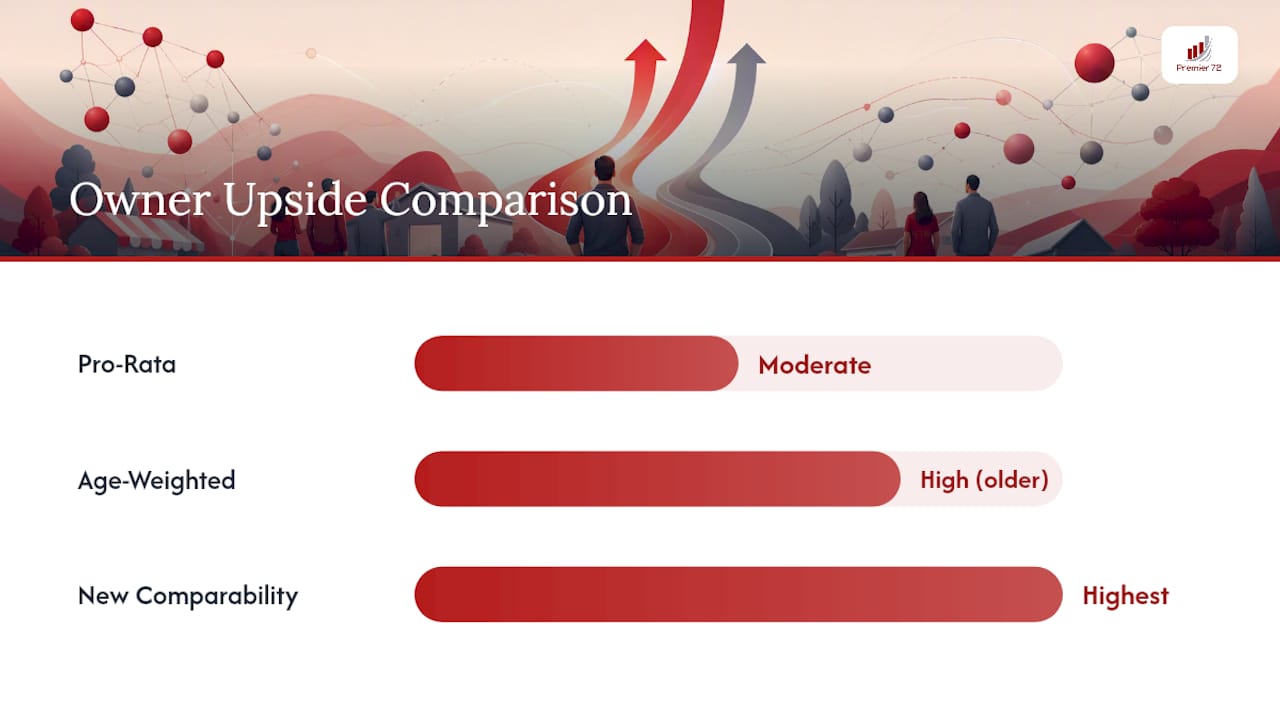
| Owner upside | Moderate | High (if owner is older) | Highest |
| Administrative complexity | Low | Medium | High |
| Nondiscrimination risk | Low | Low to medium | Medium to high |
| Typical use case | Simple workforce | Owner significantly older than staff | Owner wants maximum personal deferral |
A note on cross-tested formulas: The DOL is clear that plans must satisfy nondiscrimination rules and often require annual testing. Engage a qualified TPA or retirement plan advisor before adopting a new comparability design.
What types of profit-sharing plans can you design?
The core choice is whether to run a standalone profit-sharing plan or pair it with a 401(k). Adding a salary-deferral feature to a profit-sharing plan converts it into a 401(k) for regulatory purposes, per IRS guidance. That distinction matters because a combined plan opens the door to employee deferrals and employer matching, but it also adds compliance layers.
Key design choices every owner must make
- Allocation method: Pro-rata, age-weighted, or new comparability (see above).
- Vesting schedule: Immediate, 2-year cliff, or 3–6 year graded; vesting affects both retention and the cost of employee turnover.
- Eligibility rules: Minimum age (typically 21), service requirement (up to one year), and entry dates (quarterly, semi-annual, or annual).
- Contribution frequency: Annual lump sum or mid-year contributions. Most small businesses contribute once per year after books close.
- Contribution form: Cash contributions are standard. Company stock contributions are permitted but add valuation and liquidity complexity.
Standalone vs. combined 401(k) + profit-sharing
Standalone profit-sharing:
- Simpler administration and lower annual cost
- No employee deferrals; employer contributions only
- Fewer compliance tests to run annually
- Less attractive to employees who want to defer their own salary
Combined 401(k) + profit-sharing:
- Employees can defer up to the annual 401(k) limit from their own pay
- Employer can layer profit-sharing contributions on top of employee deferrals
- Stronger recruitment and retention tool
- Higher administrative cost and more annual testing requirements
Vesting schedule examples and retention impact
A 2-year cliff schedule means an employee who leaves before completing two years of service forfeits the entire employer contribution. The IRS Publication 4806 confirms that vesting options are a core design element employers use to align plan benefits with retention goals. For a business preparing for sale or succession, a well-designed vesting schedule can keep key employees in place through the transition.

Contribution limits, tax treatment, and compliance requirements
Employer contributions to a profit-sharing plan are tax-deductible in the year made, and assets grow tax-deferred until participants take distributions. That combination is the plan's primary financial argument for most owners.
Contribution limits
The IRS sets the annual per-participant cap at the lesser of 100% of the participant's compensation or a specified dollar limit, adjusted annually for cost-of-living. For 2024, that dollar cap was $69,000. Check the IRS limits page each year, as the COLA adjustment typically moves the cap upward.
Source: IRS. Figures subject to annual COLA adjustment; verify current limits at IRS.gov before contributing.
Annual compliance checklist
The administrative burden is real but manageable with the right support structure. Here is what the plan requires each year:
- Plan document maintenance: Keep the written plan document current with any law changes (SECURE Act updates, for example). Your TPA typically handles this.
- Nondiscrimination testing: Required annually for most plans. The TPA runs the tests; the owner reviews and approves results.
- Form 5500 filing: Plans with more than one participant generally file Form 5500 or 5500-SF annually with the DOL via EFAST. The deadline is seven months after the plan year ends, with a 2.5-month extension available.
- Participant disclosures: Summary Plan Description (SPD), annual funding notices, and benefit statements must reach participants on schedule.
- Contribution deposit: Employer contributions must be deposited by the tax-filing deadline (including extensions) for the deduction to apply in that tax year.
Missing a Form 5500 filing triggers penalties of $250 per day, up to $150,000 per filing. Nondiscrimination failures that go uncorrected can result in plan disqualification, which strips the tax-deferred status from all assets. Neither outcome is recoverable without significant cost and IRS correction procedures.
Who can participate, how vesting works, and what happens at distribution
The plan document sets participation rules within the limits the law allows. Employers have meaningful flexibility here, and the choices you make directly affect both the cost of the plan and its value as a retention tool.
Common eligibility rules employers use
- Minimum age: Most plans require participants to be at least 21 years old.
- Service requirement: Up to one year of service (1,000 hours in a 12-month period) before an employee becomes eligible.
- Entry dates: Plans may restrict new participants to entering on the first day of the plan year, semi-annually, or quarterly. Annual entry dates reduce administrative complexity.
- Exclusions: Certain employee classes (union employees covered by a collective bargaining agreement, for example) may be excluded if the plan document specifies it.
- Part-time employees: Employees who work fewer than 500 hours per year may be excluded, though recent SECURE 2.0 changes affect long-term part-time employee rules for 401(k) plans.
Withdrawals, rollovers, and early distribution penalties
Profit-sharing funds held in a qualified plan are subject to the same distribution rules as a 401(k). Participants who separate from service at age 55 or older may qualify for the "rule of 55" exception on employer plan assets. Funds can be rolled over to an IRA or another qualified plan at separation, preserving tax-deferred status.
Can you withdraw profit-sharing contributions from a 401(k)? Yes, but the timing and tax treatment depend on the plan's distribution triggers. Most plans allow distributions at separation from service, reaching age 59½, disability, or death.
Pro Tip: Structure vesting to match your retention timeline. If your business cycle runs on three-year growth phases, a 3-year cliff vesting schedule aligns employee incentives with the periods when you most need stability. A 3–6 year graded schedule works better when you want to reward loyalty progressively rather than in a single threshold.
Advantages and disadvantages for small and medium businesses
The primary advantage of a profit-sharing retirement plan is flexibility: the employer funds it, controls the amount, and can skip a year without violating the plan. The main downside is administrative complexity and the obligation to run nondiscrimination testing that can limit how much of the contribution flows to the owner.
Advantages
- Contributions are fully discretionary; no fixed annual obligation
- Employer contributions are tax-deductible, reducing current-year taxable income
- Assets grow tax-deferred until distribution
- Flexible allocation formulas can direct a larger share to the owner (within nondiscrimination limits)
- Vesting schedules support employee retention
- The DOL notes that profit-sharing plans help align employee incentives with company performance, creating a culture of shared ownership
- Can be combined with a 401(k) to offer employees salary-deferral capability
Disadvantages
- Annual nondiscrimination testing is required and can restrict owner-heavy allocations
- Form 5500 filings and participant disclosures add administrative overhead
- TPA and recordkeeping fees are ongoing costs
- Cross-tested formulas require actuarial work, adding cost
- All eligible employees must receive an allocation in years the employer contributes
Is this plan a good fit for your business?
Good fit if: You have strong but variable annual profits, you are the primary or highest-compensated employee, you want to maximize personal tax-deferred savings, or you are preparing for a business sale and need to retain key staff.
Consider alternatives if: Your workforce is large and relatively young (reducing the owner's proportional benefit), your cash flow is too unpredictable to absorb even occasional contributions, or you want a simpler plan with minimal annual administration.
How to set up a profit-sharing plan for your small business
The minimum path from decision to operational plan involves five core steps. Most small businesses complete the process in 60–90 days, though year-end plans can be adopted as late as the tax-filing deadline (including extensions) for the prior tax year.
Step-by-step setup checklist
-
Decide on plan design (Week 1–2): Choose your allocation formula, vesting schedule, eligibility rules, and whether to add a 401(k) deferral feature. This is the strategic decision that shapes everything downstream.
-
Adopt the plan document (Week 2–4): Work with a TPA or financial institution to adopt a written plan document. A pre-approved prototype document is cost-effective for most small businesses. The document must be signed and dated before contributions are made.
-
Establish a trust and open a custodial account (Week 3–5): The plan assets must be held in a trust separate from business assets. Your recordkeeper or financial institution typically serves as trustee or directed trustee.
-
Integrate with payroll (Week 4–6): Provide your payroll provider with participant data, eligibility dates, and contribution instructions. Accurate payroll data is the foundation of correct allocations.
-
Make the first contribution (by tax-filing deadline): Contributions must be deposited by the employer's tax-filing deadline, including extensions, to be deductible in the prior tax year. For a calendar-year S-corporation with an extension, that deadline is September 15.
-
Run annual operations: Each year, the TPA performs nondiscrimination testing, prepares participant statements, and files Form 5500. The owner reviews and approves results before filing.
-
File Form 5500 (7 months after plan year end): For a calendar-year plan, the deadline is July 31, with a 2.5-month extension to October 15 available via Form 5558.
What to ask when selecting a TPA or recordkeeper
- Do you offer IRS pre-approved prototype documents, and what is the annual document maintenance fee?
- Can you run cross-tested (new comparability) allocations in-house, or do you outsource actuarial work?
- What is your process for nondiscrimination testing, and how do you communicate results to the plan sponsor?
- How do you integrate with our payroll platform?
- What are your total annual fees, including setup, recordkeeping, testing, and Form 5500 preparation?
Premier72 works alongside TPAs and recordkeepers to integrate profit-sharing plan design with an owner's broader retirement income planning strategy, so the plan serves both the business and the owner's personal exit timeline.
How does profit-sharing compare with SEP IRA, SIMPLE IRA, and a standard 401(k)?
Profit-sharing is employer-funded and flexible; SEP and SIMPLE plans are simpler but carry different limits and eligibility rules. The right choice depends on your workforce size, your personal contribution goals, and how much administrative complexity you are willing to manage.
Side-by-side comparison
Decision rules of thumb
- Use a SEP IRA when you are self-employed or have very few employees and want maximum simplicity. The contribution limit matches profit-sharing, but the formula is always pro-rata and there is no vesting.
- Use a SIMPLE IRA when you have fewer than 100 employees and want employees to participate through salary deferrals without the cost of a full 401(k).
- Use profit-sharing or a combined 401(k) + profit-sharing when you want allocation flexibility, the ability to direct a larger share to the owner, and the option to add employee deferrals later. This is the structure most small business owners in growth or pre-exit phases benefit from most.
A combined 401(k) + profit-sharing plan is often the most powerful structure for an owner who wants to maximize personal tax-deferred savings while offering employees a meaningful benefit. The 401(k) handles employee deferrals; the profit-sharing layer is the employer's discretionary vehicle to boost total retirement savings in strong years.
How Premier72 uses profit-sharing in owner retirement and exit strategies
At Premier72, profit-sharing is rarely treated as a standalone benefit. It is a structural component of an owner's broader retirement and exit plan, one that needs to be calibrated against cash flow, workforce composition, and the owner's personal timeline.
Two scenarios where this plan creates real value
Scenario 1: Maximizing owner tax-deferral before exit An owner in their late 50s with a profitable business and a small, younger workforce adopts a new comparability profit-sharing plan layered on top of a 401(k). The cross-tested formula, designed by a TPA and reviewed for nondiscrimination compliance, directs the majority of the employer contribution to the owner's account. Combined with the owner's own 401(k) deferral, the total annual retirement contribution approaches the $69,000 per-participant cap. Over five years before a planned business sale, this structure shelters a meaningful portion of business income from current taxation while building a personal retirement asset outside the business.

Scenario 2: Retaining key employees through a business transition A business owner preparing for a sale in three years identifies two key managers whose departure would reduce the company's transferable value. The owner amends the profit-sharing plan to include a 3-year cliff vesting schedule for new contributions. Employees who stay through the transition date receive their full vested balance; those who leave early forfeit unvested amounts. The vesting structure costs nothing additional but creates a financial incentive for the employees most critical to the sale.
These are the kinds of decisions that benefit from coordination between a retirement plan advisor, a TPA, and a business exit strategist. Premier72's Retirement Bank Method™ integrates plan design with exit readiness so the two strategies reinforce each other rather than operating in isolation.
- Profit-sharing contributions can be timed to coincide with strong revenue years, preserving cash in leaner periods.
- Vesting schedules can be structured around a planned sale date to retain the employees a buyer will want to see in place.
- The plan's tax deduction reduces the business's taxable income in the years leading up to a sale, improving net cash flow and potentially the business's valuation multiple.
A perspective on profit-sharing plans for business owners
Most owners who ask about profit-sharing plans are really asking two questions at once: "How do I shelter more income from taxes?" and "How do I make sure my employees don't walk out the door?" The profit-sharing plan answers both, but only if it is designed with intention.
The mistake I see most often is treating the plan as a year-end tax move rather than a structural tool. An owner contributes whatever is left over in December, applies a pro-rata formula because it is the simplest option, and files the Form 5500 without ever asking whether a different allocation method would have served them better. That approach works, but it leaves significant value on the table.
The more useful frame is to think of a profit-sharing plan as one pillar in a retirement income architecture. It works alongside life insurance strategies, annuities, and the eventual proceeds from a business sale. None of those pieces is sufficient on its own. Together, they create the kind of layered, tax-efficient income structure that actually sustains an owner through a 20- or 30-year retirement.
The owners who get the most from profit-sharing are the ones who design the plan when they have time to think clearly, not when they are scrambling to reduce a tax bill in the final weeks of December.
How Premier72 helps you design and manage a profit-sharing plan
Premier72 works with established business owners to design profit-sharing plans that serve two purposes at once: reducing current-year tax liability and building a retirement asset that complements the eventual business sale. The firm coordinates with TPAs and recordkeepers to handle plan documents, nondiscrimination testing, and Form 5500 filings, so you are not managing compliance alone. Every plan design is reviewed in the context of your broader personal financial protection strategy and exit timeline, not in isolation. The result is a plan that is compliant, cost-effective, and calibrated to your specific workforce and ownership goals.

Ready to see how a profit-sharing plan fits your retirement and exit strategy? Connect with Premier72 at Premier72 to schedule a structured advisory review.
Sources
- Choosing a retirement plan: Profit sharing plan | Internal Revenue Service
- Profit Sharing Plans for Small Businesses | U.S. Department of Labor
This article is general information, not a substitute for advice from a qualified financial advisor. Consult a qualified financial professional about your own circumstances before acting on anything here.