

Disability insurance for business owners works on two tracks at once: it replaces your personal income when illness or injury keeps you from working, and it keeps your business financially stable while you recover. Most individual disability policies replace 60–70% of your pre-disability net income, with elimination periods typically running 90–180 days and benefit periods extending to age 65 or 67. Business overhead expense (BOE) insurance runs alongside that, covering fixed operating costs so your business stays solvent even when you are not at the helm. Disability buyout insurance adds a third layer, funding ownership transitions when a partner can no longer work.
Here is how each coverage type fits into a complete protection plan:
Personal income protection:
- Individual long-term disability insurance replaces 60–70% of your net earned income, with benefit periods typically running to age 65 or 67 and elimination periods of 90–180 days before benefits begin.
Business expense coverage:
- BOE insurance covers rent, utilities, employee wages, loan interest, and insurance premiums
- Shorter elimination periods, often around 30 days, activate benefits faster
- Benefit durations typically run 12–24 months
Ownership and continuity protection:
- Disability buyout insurance funds buy-sell agreements when a partner becomes disabled
- Key person disability insurance compensates the business for the loss of a critical employee's contribution
How disability insurance protects your personal income
Individual long-term disability insurance is the foundation of any personal income protection plan for a business owner. When you cannot work, this policy replaces 60–70% of your net income, giving you the cash flow to cover your mortgage, household expenses, and personal financial obligations without draining your savings or your business.
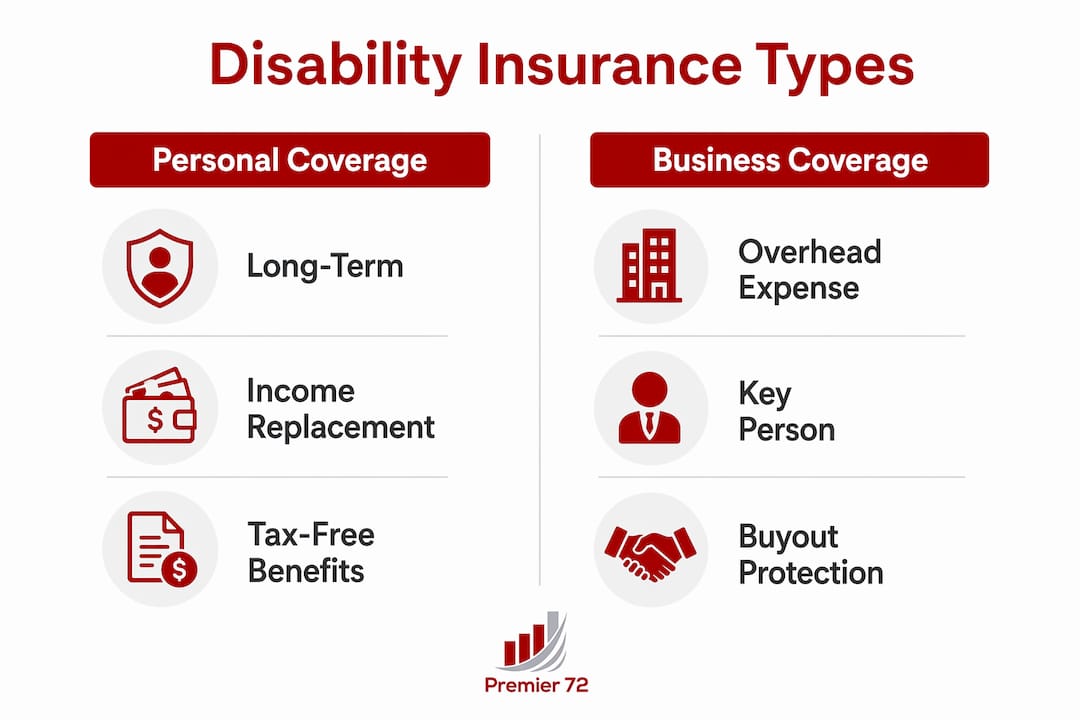
Benefit periods typically extend to the typical retirement age, which matters because a disability at 45 could mean two decades without earned income. Elimination periods lasting several months mean you need a personal cash reserve to bridge the gap before benefits start. Planning for that waiting period is just as important as choosing the right policy.
A few features worth building into your policy:
- Partial disability riders: If you can return to work part-time or at reduced capacity, residual disability benefits pay proportionate income to make up the difference.
- Own-occupation definition: This defines disability as the inability to perform your specific occupation, not just any job. For specialists and business owners, this distinction is significant.
- Non-cancelable and guaranteed renewable: The insurer cannot raise your premiums or cancel your coverage as long as you pay on time.
On the tax side, if you pay premiums personally with after-tax dollars, the benefits you receive are generally tax-free. If your business pays the premiums and deducts them, the benefits become taxable to you as income. That trade-off is worth modeling with your advisor before you structure the policy.
Pro Tip: Ask your insurance advisor to run a net-benefit comparison showing after-tax income under both premium-payment structures before you commit to one.
What BOE insurance covers when you cannot run your business
Business overhead expense insurance fills the gap that individual disability coverage deliberately leaves open. Your personal disability policy replaces your income. BOE insurance pays the fixed costs your business owes every month whether you are working or not.
Covered expenses typically include:
- Rent and lease payments on your office or facility
- Employee wages and payroll taxes
- Utilities and phone service
- Business insurance premiums
- Loan interest and equipment lease payments
- Professional fees such as accounting and legal retainers
BOE policies activate faster than individual disability coverage. Elimination periods are often around 30 days, compared to the 90–180 days on personal policies. The trade-off is duration: BOE benefit periods typically run 12–24 months, which is designed to give you time to recover, hire a replacement, or arrange a sale rather than fund indefinite operations.
One critical distinction: BOE insurance does not replace your personal income, and your individual disability policy does not pay your business's rent. Carrying both is what keeps both you and your business solvent during a long disability. Failing to separate the two is one of the most common and costly gaps business owners create in their coverage.

Protecting your ability to meet loan payments and financial obligations
A disability that sidelines you for six months or more can threaten more than your income. Business loans, commercial leases, and equipment financing do not pause because you are recovering. Missing payments damages your credit, triggers default clauses, and can force a premature liquidation of assets you spent years building.
Several coverage options address this directly:
- Loan protection riders: Some disability policies include riders specifically designed to cover loan repayments during a qualifying disability period, keeping you current with lenders without touching your personal savings.
- BOE coverage for loan interest: Standard BOE policies cover loan interest as a fixed business expense, which protects your credit standing while you are out.
- Structured benefit amounts: Work with your advisor to size your BOE coverage to include all fixed debt service, not just operating costs. Many owners undersize BOE and discover the gap only when a claim is filed.
Maintaining creditworthiness during a disability is not just a financial concern. It preserves your options. A business that stays current on its obligations during an owner's absence can be sold, transitioned, or handed to a successor at full value. A business that defaults loses that leverage entirely. For business owners who have built exit readiness into their planning, protecting loan obligations is a direct extension of protecting enterprise value.
Types of disability insurance every business owner should know
Understanding the four core policy types lets you build coverage that fits your actual risk profile rather than a generic template.
Individual long-term disability insurance replaces your personal earned income during a disability. It is underwritten based on your net income, not your business's gross revenue or profit margins. Insurers focus on what you actually take home, so coverage targets your real financial exposure.
Business overhead expense insurance covers fixed operating costs during your disability. It is a business-level policy, not a personal one, and the benefit goes directly toward keeping your doors open. BOE is especially valuable for solo practitioners and small business owners whose operations depend almost entirely on their personal presence.
Key person disability insurance compensates the business when a critical employee, not necessarily the owner, becomes disabled. If your business depends on a top salesperson, a lead engineer, or a specialized technician, this policy funds the cost of finding and training a replacement or absorbing the revenue loss during the transition.
Disability buyout insurance funds buy-sell agreements when a partner or co-owner becomes permanently disabled. Without it, the remaining partners may lack the capital to buy out the disabled owner's share, creating a deadlock that can paralyze the business. Disability buyout coverage provides the liquidity to execute a clean ownership transition, protecting all parties and the business itself.
Each type serves a distinct purpose. Stacking them strategically, rather than choosing one and assuming it covers everything, is what separates a well-protected business owner from one who discovers gaps at the worst possible moment.
How disability insurance supports business continuity and succession planning
Disability insurance is not just a personal safety net. For business owners, it is a structural tool that holds the business together when leadership is suddenly absent. The connection between disability planning and exit readiness is direct: a business that can survive an owner's disability is a business that can be successfully sold or transferred.
Key ways disability insurance supports continuity:
- Funding buy-sell agreements: A disability buyout policy provides the capital a co-owner needs to purchase a disabled partner's share at a pre-agreed price, preventing forced sales or ownership disputes.
- Stabilizing employee confidence: When BOE coverage keeps payroll running during an owner's absence, employees stay. Turnover during a leadership gap compounds the damage a disability already causes.
- Preserving enterprise value: A business that continues operating, paying its bills, and retaining its team during an owner's disability retains its market value. One that does not may be worth a fraction of its pre-disability valuation by the time the owner recovers.
- Integrating with succession planning: Disability coverage should be reviewed alongside your buy-sell agreement, your succession timeline, and your retirement income plan. These are not separate documents. They are interconnected pieces of the same strategy.
For Baby Boomer business owners working toward an eventual sale or transfer, disability insurance is part of exit readiness planning in the most literal sense. It protects the asset you are preparing to monetize.
Common pitfalls that leave business owners underprotected
Most coverage gaps are not the result of bad luck. They come from predictable mistakes made at the point of purchase or during years of neglect afterward.
Watch for these:
- Confusing business interruption insurance with disability coverage. Business interruption insurance covers lost income from physical property damage, like a fire or flood. Claims for owner disability are denied under these policies. They are entirely different products solving entirely different problems.
- Underinsuring personal income. Owners often insure based on salary rather than total net compensation, leaving bonuses, distributions, and other income streams unprotected.
- Relying solely on group coverage. Group disability policies through associations or employer plans typically cap benefits at lower amounts and use broader definitions of disability that are harder to meet. They also disappear if you change your business structure.
- Ignoring elimination periods. A 180-day elimination period means six months of personal expenses and business costs with no benefit payment. Without a cash reserve sized to that gap, the policy provides less protection than it appears to.
- Failing to update coverage as the business grows. A policy written when your business generated $400,000 in annual revenue may be badly undersized five years later. Coverage should be reviewed annually and updated when income or overhead changes materially.
Only 30–40% of small business owners carry business interruption insurance, which suggests that disability coverage, a more specialized product, is even less common. The gap between what owners have and what they actually need tends to be wide.
The dual-track strategy: why separate policies are the right structure
Business owners face a financial vulnerability that most employees do not: their personal income and their business's financial health are deeply intertwined. When you stop working, both are at risk simultaneously. A single policy cannot address both exposures adequately.
The dual-track approach means carrying separate policies for separate purposes:
- One individual disability policy sized to replace your personal net income
- One BOE policy sized to cover your business's fixed monthly overhead
- A disability buyout policy if you have business partners, funded to match your buy-sell agreement's valuation
This structure prevents the most common failure mode: an owner who carries only personal disability coverage and discovers, mid-claim, that their business expenses are consuming their benefit payments. Or the reverse: an owner whose BOE policy is paying the rent but whose personal bills are going unpaid because no personal policy exists.
For partner-owned businesses, the buyout layer is not optional. A disability that creates a permanent ownership dispute can destroy more value than the disability itself. Disability buyout insurance is the mechanism that converts a potential conflict into a clean, pre-funded transaction. Pair it with a well-drafted buy-sell agreement and you have a structure that protects every party, including the disabled owner's family.
Pro Tip: Have your attorney and insurance advisor review your buy-sell agreement and disability buyout policy together. Mismatches between the two are common and can create serious problems at the time of a claim.
Key Takeaways
Disability insurance for business owners requires two separate policies: one to replace personal income and one to cover business overhead, with a buyout policy added for any partner-owned business.
| Point | Details |
|---|---|
| Personal income replacement | Individual disability insurance replaces 60–70% of net income, with benefits typically running to typical retirement ages. |
| Business expense coverage | BOE insurance covers fixed costs like rent, wages, and loan interest, with benefit periods lasting a limited number of months. |
| Ownership transition funding | Disability buyout insurance funds buy-sell agreements, preventing deadlock when a partner becomes permanently disabled. |
| Common coverage gap | Business interruption insurance does not cover owner disability; claims filed under those policies are denied. |
| Premier72 planning approach | Premier72 helps business owners integrate disability coverage into a complete continuity and exit readiness plan. |
Why disability planning is the most overlooked pillar of business protection
Most business owners spend years building something worth protecting, then leave the most predictable risk unaddressed. A fire, a lawsuit, a market downturn: owners insure against all of these. But a long-term disability, which statistically affects a meaningful share of working adults before retirement age, often goes unplanned for until it is too late to structure coverage properly.
What I find most striking, after working through these planning frameworks with business owners across industries, is how often the personal and business coverage gaps exist simultaneously. An owner carries a modest group disability policy through an association, assumes it covers the business, and has no BOE policy at all. Then a health event occurs, the group policy pays a fraction of actual income, and the business expenses start consuming whatever benefit arrives. Within months, both the personal finances and the business are in distress.
The dual-track structure is not complicated. It is just disciplined. Two policies, sized correctly, reviewed annually, and connected to a buy-sell agreement if partners are involved. That structure does not eliminate the hardship of a disability. But it does prevent a health crisis from becoming a financial catastrophe. For a business owner who has spent decades building equity, that distinction is the difference between a temporary setback and a permanent loss.
Premier72 helps you build a complete business protection plan
Business owners who have spent years building profitable, owner-dependent companies need more than a single insurance policy. They need a plan that connects personal income protection, business expense coverage, ownership transition funding, and long-term exit readiness into one coherent structure.
Premier72 works directly with established business owners to design and implement that structure. Through The Retirement Bank Method™, Premier72 helps you reduce owner dependence, protect cash flow, and prepare your business for a successful transition, whether that means a sale, a family transfer, or a planned retirement. Disability insurance planning is one pillar of that work, alongside key person coverage, buy-sell funding, and legacy planning.
If your current coverage was set up years ago and has not been reviewed since, or if you have never had a structured advisory conversation about what happens to your business if you cannot work, Premier72's advisory team is the right starting point. The conversation costs nothing. The gap it closes could protect everything you have built.
Useful sources for further reading
Authoritative references for business owners researching disability insurance and income protection planning:
- NAIC: Business Interruption and Business Owner Policy — The National Association of Insurance Commissioners explains the scope and limits of business interruption coverage, including what it does and does not cover.
- InsuranceNewsNet: Two Disability Policies, Two Purposes — Covers the distinct roles of individual disability and BOE insurance, including benefit percentages and elimination periods.
- The Standard: Business Overhead Protection — Details what BOE insurance covers, how it is structured, and how it differs from personal disability coverage.
- BBG Broker: Disability Buy-Out Insurance — Explains who needs disability buyout coverage and how it protects business ownership structures.
- DisabilityQuotes: Is Disability Insurance Tax-Deductible? — Covers the tax treatment of premiums and benefits under different payment structures.
- Premier72 Blog: Disability Insurance for Business Owners Explained — Premier72's overview of how business owners can structure disability coverage to protect both personal and business income.
- Premier72 Blog: Income Replacement Insurance Types — A 2026 guide covering elimination periods, benefit percentages, and policy types for business owners.
- Family Guard Life & Health — A resource highlighting the financial vulnerabilities business owners face without proper disability coverage in place.