

Tax deferral keeps pre-tax dollars invested and compounding rather than shrinking them with an immediate tax bill, which can meaningfully increase your after-tax wealth when account choice, timing, and asset type align. The core mechanism is simple: delay the tax event, and every dollar that would have gone to the IRS stays invested and earns returns for years or decades before the government collects.
Three groups benefit most from understanding this:
- Long-horizon retirement savers who have decades for compounding to work before ordinary income tax comes due at withdrawal
- Business owners with illiquid sale proceeds who need structured vehicles to defer a large, concentrated taxable event
- Real-estate investors who can use Section 1031 exchanges, Qualified Opportunity Zone funds, or Delaware Statutory Trusts to defer capital gains and keep more equity working
Key Takeaways
Tax deferral builds long-term wealth by keeping more capital compounding, but the net benefit depends on your future tax rate, account fees, asset type, and estate goals.
| Point | Details |
|---|---|
| Deferral keeps more capital working | Delaying the tax event lets the full pre-tax amount compound, which increases after-tax wealth over long horizons. |
| Ordinary income risk at withdrawal | 401(k) and Traditional IRA withdrawals are taxed as ordinary income, which can exceed the capital gains rate you would have paid in a taxable account. |
| Fees can erase the advantage | A modest recurring administrative fee on a tax-deferred account can eliminate the compounding benefit over decades. |
| Asset location multiplies the benefit | Placing tax-inefficient assets in deferred accounts and growth assets in Roth or taxable accounts can add an estimated 0.2%–0.5% in annual after-tax return. |
| Premier72 models the full picture | Premier72's advisory process integrates exit timing, income planning, and legacy goals so owners can evaluate deferral decisions with their actual numbers. |
Table of Contents
- How tax deferral works in your wealth-building plan
- Common U.S. tax-deferred vehicles and how they compare
- Why deferral can genuinely boost your long-term wealth
- Key disadvantages and trade-offs to watch
- Advanced deferral tools and when investors use them
- How to decide whether tax deferral is right for you
- Special considerations for business owners and estate planning
- Concrete next steps: putting tax deferral to work
- The case for modeling your own numbers first
- How Premier72 approaches tax-deferred wealth planning
- Sources
How tax deferral works in your wealth-building plan
The timeline of a tax-deferred investment has three stages: contribution or purchase (where you may get a deduction or simply delay recognition), a growth period during which returns compound without annual taxation, and a taxable event at withdrawal or sale. Different accounts change the character of those returns. A 401(k) converts what would have been ordinary income today into ordinary income at withdrawal. A Roth IRA flips that: you pay tax now and withdraw tax-free. A Section 1031 exchange defers capital gains indefinitely until you sell outside the exchange chain.
A simple math illustration
The difference is not a rounding error; it compounds into tens of thousands of dollars over a multi-decade horizon. The exact outcome depends on your future withdrawal tax rate, state taxes, and account fees, but the directional benefit of deferral is consistent across most reasonable assumptions.
The Rule of 72: Divide 72 by your annual return to estimate how many years it takes to double your money. At 5%, money doubles roughly every 14 years. Tax drag effectively lowers your real return rate, which extends that doubling time. Deferring tax keeps the full rate working, so your money doubles on the faster schedule.
The Financial Planning Association notes that deferral can increase after-tax wealth in many scenarios, but that benefit can be negated when deferral converts lower-taxed capital gains into ordinary income at withdrawal, when future tax rates rise, or when administrative fees are material relative to account size.
Common U.S. tax-deferred vehicles and how they compare
Each vehicle has a distinct tax structure, liquidity profile, and best use. Here is a practical survey of the nine vehicles you are most likely to encounter.
A few practical notes worth keeping in mind:
- Roth IRA is technically tax-free rather than tax-deferred, but it belongs in any deferral conversation because it is the primary alternative when you expect higher future tax rates.
- HSA is the only triple-tax-advantaged account in the U.S. code: deductible contributions, tax-free growth, and tax-free withdrawals for qualified medical expenses.
- DSTs and QOFs are illiquid by design. They suit investors with a long horizon and no near-term need for the invested capital. For a deeper look at how real-estate capital gains deferral works across 1031s, DSTs, and QOZ funds, Kiplinger's explainer covers the mechanics and holding-period rules clearly.
- Tax-deferred annuities carry surrender charges that can run several years; always compare the net-of-fee benefit against a taxable alternative before committing. The types of annuities available for retirement income vary significantly in structure, cost, and income guarantees.
Why deferral can genuinely boost your long-term wealth
The most direct benefit is that every dollar not paid in taxes today remains invested and earns returns. Think of it as a permanent, interest-free loan from the government. You keep the full pre-tax amount working, and the IRS collects its share later, after decades of compounding have occurred.
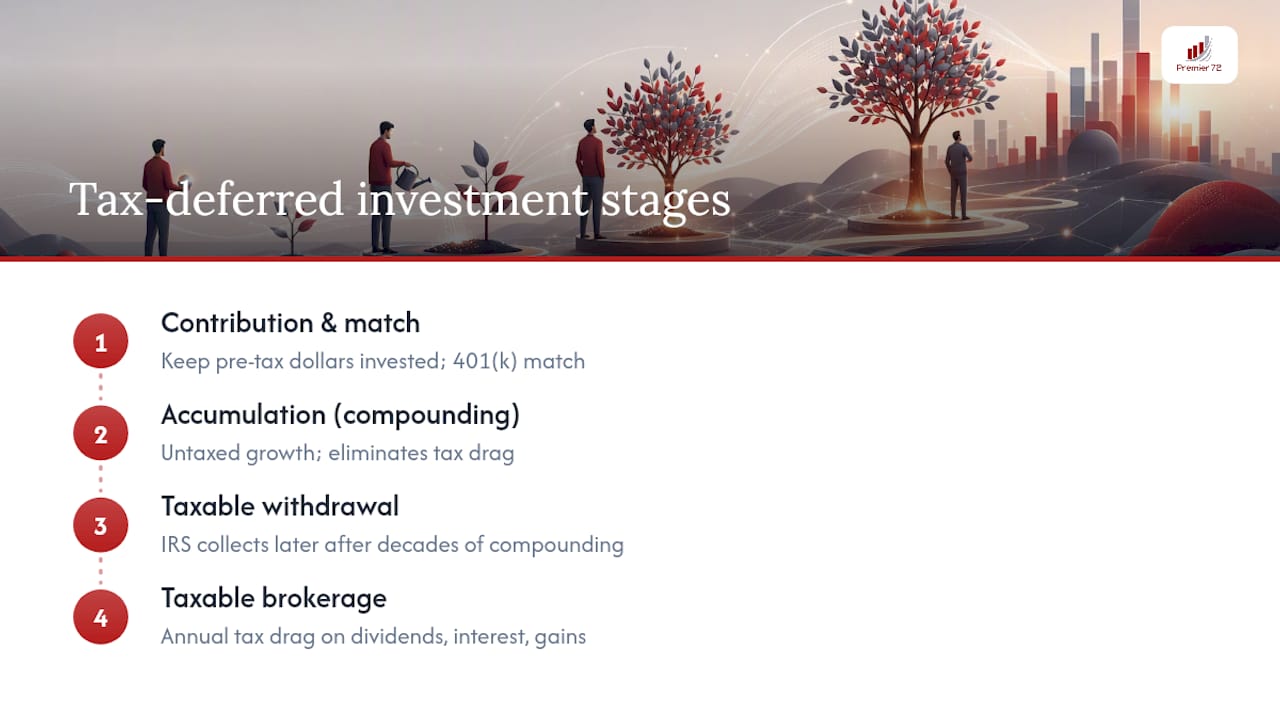
Employer matching in a 401(k) amplifies this further. No taxable account can replicate that. Investor identifies automated contributions and employer retirement plans as among the most effective routes for long-term wealth accumulation, precisely because they combine forced savings behavior with tax efficiency.
Tax drag is the annual erosion of returns caused by paying taxes on dividends, interest, and realized gains each year. Deferral eliminates that drag during the accumulation phase. The benefit is largest when your current marginal tax bracket is high and when the assets you hold generate significant taxable income, such as bonds, REITs, or high-turnover funds. Placing those assets inside a tax-deferred account rather than a taxable brokerage account preserves the full gross return for compounding. Investopedia's guidance on building wealth reinforces this: using tax-advantaged accounts, holding diversified investments long-term, and saving consistently are the core steps to accumulating wealth and reducing tax drag.

Key disadvantages and trade-offs to watch
Tax deferral is not universally superior. Several trade-offs can reduce or eliminate the expected benefit:
- Ordinary income conversion. Withdrawals from 401(k)s and Traditional IRAs are taxed as ordinary income, not at the lower long-term capital gains rate. If you had held the same assets in a taxable account and qualified for a 15% or 20% capital gains rate, deferral into an ordinary-income account may cost you more at withdrawal than it saved at contribution.
- Required minimum distributions (RMDs). Starting at age 73, the IRS requires annual withdrawals from most tax-deferred accounts whether you need the income or not. Large RMDs can push you into a higher bracket and increase Medicare premiums.
- Early withdrawal penalties. Most tax-deferred accounts impose a 10% penalty on withdrawals before age 59½, on top of ordinary income tax. Annuities add surrender charges that can last 7–10 years.
- No step-up in basis. Assets in taxable accounts receive a step-up in cost basis at death, eliminating embedded capital gains for heirs. Assets in tax-deferred accounts do not; heirs pay ordinary income tax on every dollar they inherit.
- Fee and administrative cost risk. As the Financial Planning Association documents, a modest recurring administrative fee can wipe out the compounding advantage of deferral over a multi-decade horizon, particularly in smaller plans.
Pro Tip: Moving tax-efficient assets, such as index funds or growth stocks you plan to hold long-term, into a tax-deferred account can backfire. You give up the preferential capital gains rate and the step-up in basis at death, while gaining little because those assets already generate minimal annual tax drag. Reserve tax-deferred space for your least tax-efficient holdings.
Future tax rates and state residency also matter. If you retire to a state with no income tax, deferral looks more attractive. If federal ordinary rates rise before you withdraw, the calculus shifts against traditional deferral and toward Roth conversions now.
Advanced deferral tools and when investors use them
Beyond the standard retirement accounts, several higher-complexity strategies can extend the role of tax deferral in wealth building for investors with larger portfolios or specific asset types.
Asset location is the practice of placing each asset class in the account type where it is taxed most favorably: bonds and REITs in tax-deferred accounts, growth stocks in Roth or taxable accounts where long-term capital gains rates apply. J.P.
Roth conversions involve moving money from a Traditional IRA or 401(k) into a Roth account, paying ordinary income tax now in exchange for tax-free growth and withdrawals later. The strategy is most valuable during low-income years, such as early retirement before Social Security begins, or after a business sale when income temporarily drops. Timing a Roth conversion to fill a lower bracket without crossing into the next is a precise exercise that benefits from a tax advisor's modeling.
Section 1031 exchanges let real-estate investors sell an investment property and defer capital gains by reinvesting proceeds into a like-kind property within strict IRS deadlines: 45 days to identify a replacement and 180 days to close. Investors can chain multiple exchanges across decades, deferring gains indefinitely. The deferred gain is eventually recognized at final sale, or it disappears entirely if the property passes to heirs with a step-up in basis.
Qualified Opportunity Zone investments through a Qualified Opportunity Fund defer capital gains from any asset class, not just real estate. Investors who hold a QOF interest for at least 10 years pay no federal tax on the appreciation generated inside the fund. The original deferred gain is recognized by December 31, 2026 under current law, so timing matters. Kiplinger's capital gains deferral guide covers QOZ mechanics and holding-period rules in detail.
Delaware Statutory Trusts allow 1031-eligible investors to exchange into a fractional interest in institutional-grade real estate without the management responsibilities of direct ownership. DSTs are illiquid and typically require accredited investor status, but they solve a common problem: an investor who cannot identify a suitable replacement property within the 45-day window can use a DST as a qualifying exchange vehicle.
Private placement variable annuities (PPVAs) are a less-discussed tool for high-net-worth investors. They wrap tax-deferred growth around a customized investment portfolio, often including alternative assets, without the contribution limits of qualified plans. Surrender charges and insurance costs apply, so the net benefit requires careful fee analysis. The pros and cons of different tax deferral strategies vary widely across these vehicles, and matching strategy to your liquidity needs, time horizon, and estate goals is the essential first step.
How to decide whether tax deferral is right for you
Run through this checklist before committing capital to any tax-deferred vehicle:
- Time horizon. Deferral benefits grow with time. A 30-year horizon justifies illiquid structures; a 5-year horizon generally does not.
- Current vs. expected future tax bracket. If you expect a lower bracket in retirement, traditional deferral likely helps. If you expect the same or higher bracket, a Roth conversion or taxable account may be better.
- Asset type. Tax-inefficient assets (bonds, REITs, high-dividend stocks) belong in tax-deferred accounts. Tax-efficient assets (index funds, growth stocks held long-term) often belong in taxable or Roth accounts.
- Fees and surrender costs. Calculate the net-of-fee return. A 1% annual fee on a tax-deferred annuity can eliminate the compounding advantage over a low-cost taxable index fund.
- Liquidity needs. If you may need the capital before age 59½ or before a required holding period ends, the penalty cost can exceed the tax benefit.
- Estate and beneficiary goals. Taxable accounts with a step-up in basis at death are often more efficient for heirs than tax-deferred accounts. If leaving a legacy is a priority, this changes the optimal account mix.
- State tax expectations. Retiring to a no-income-tax state improves the case for traditional deferral. Staying in a high-tax state reduces the withdrawal-phase advantage.
A practical decision flow: if your time horizon exceeds 15 years and you expect the same or a lower tax bracket at withdrawal, traditional deferral generally increases after-tax wealth. If you expect a higher bracket or plan to leave assets to heirs, a Roth conversion or taxable account with long-term capital gains treatment often wins. For borderline cases, run the numbers with a CPA or financial planner before committing to an illiquid structure.
Special considerations for business owners and estate planning
Business owners face a tax-deferral decision that is structurally different from a salaried employee's. When you sell a business, the proceeds often arrive as a single large taxable event, sometimes in the millions, compressed into one tax year. That concentration creates both a problem and an opportunity.

Structured installment sales, deferred annuities, and Qualified Opportunity Fund investments can spread or defer that gain across multiple years or decades, potentially keeping the effective rate lower than a lump-sum recognition would produce. Exit timing also interacts with state residency: establishing domicile in a no-income-tax state before closing a sale is a legitimate planning strategy, but it requires genuine relocation well in advance of the transaction. A retirement income plan built specifically for owners needs to account for this timing dimension from the start.
Estate planning adds another layer. Assets held in taxable accounts receive a step-up in cost basis at death, which erases embedded capital gains for heirs. Assets in a Traditional IRA or 401(k) carry no such benefit; every dollar a beneficiary inherits is subject to ordinary income tax, and under current law most non-spouse beneficiaries must deplete inherited IRAs within 10 years. This makes the composition of your estate, not just its size, a critical planning variable. Life insurance as a retirement and legacy asset can address the liquidity gap that arises when a large portion of an estate is locked in tax-deferred accounts.
Premier72's Retirement Bank Method™ is built around exactly this intersection: helping business owners convert owner-dependent companies into transferable retirement assets while structuring the exit, income, and legacy layers in a tax-aware sequence. Bringing projected sale proceeds, current account balances, and estate wishes to an advisory conversation gives a planner the inputs needed to model the real after-tax outcome across scenarios.
Concrete next steps: putting tax deferral to work
- Automate pre-tax contributions to your 401(k) at least up to the employer match. Capture that match before directing dollars anywhere else. Automating your savings goals removes the behavioral friction that causes most people to under-save.
- Map your current assets to tax buckets. List each holding and its account type. Identify any tax-inefficient assets sitting in taxable accounts that would compound faster inside a tax-deferred or tax-free account.
- Run a "tax now vs. defer" scenario on two or three holdings. Use your current marginal rate, an assumed future withdrawal rate, and a realistic fee estimate. The math often surprises people in both directions.
- Evaluate fees and surrender costs on any annuity or insurance product before purchasing. Ask for the net-of-fee internal rate of return and compare it to a low-cost index fund alternative.
- Meet with a CPA or financial planner if you are considering a Roth conversion, a 1031 exchange, or a QOZ investment. These strategies have strict deadlines and eligibility rules that require professional coordination. You can verify an advisor's credentials through the SEC adviser lookup or FINRA's BrokerCheck.
- Save a snapshot of your account cost-basis details for every taxable holding. Accurate basis records are the foundation of any future tax-deferral or exchange strategy.
- Schedule a planning meeting with documents ready: account statements, projected income for the next 3–5 years, and any business sale or real-estate transaction timelines.
Pro Tip: Start with changes that are low-cost and reversible, such as redirecting new contributions to a different account type, before committing to illiquid structures like DSTs or QOFs. Locking capital into a 10-year hold before you have modeled the full scenario is the most common and costly mistake in advanced deferral planning.
The case for modeling your own numbers first
Tax deferral is a structural tool, not a universal answer. The conventional wisdom, "always max your 401(k) first," holds in most cases but breaks down when fees are high, when your future tax rate is likely higher than today's, or when your estate plan depends on assets receiving a step-up in basis. The investors who get the most from deferral are the ones who model a before-and-after scenario with their actual numbers rather than accepting a general rule.
My view is that integrating deferral with asset location and estate planning produces better outcomes than treating each decision in isolation. A Roth conversion in a low-income year, combined with placing bonds in a tax-deferred account and growth assets in a Roth, can add more after-tax value than simply maximizing contributions to a single account type. The math is not complicated, but it requires knowing your numbers. Bring them to an advisor before committing to anything illiquid.
How Premier72 approaches tax-deferred wealth planning
Retirement income planning, business exit readiness, and insurance-based wealth preservation are the three areas where Premier72 works most closely with owners and families navigating tax-deferral decisions. Whether you are evaluating annuity options, structuring a business sale, or deciding between a Traditional IRA and a Roth conversion, the right answer depends on your projected income, your estate goals, and the assets you already hold.

Premier72's advisory process starts with those specifics. Bring your account summaries, a projection of your business or real-estate sale proceeds, and your estate wishes to a first conversation, and the planning team can model the after-tax scenarios that matter for your situation. For owners preparing for exit, The Retirement Bank Method™ integrates exit timing, income structuring, and legacy planning into a single coordinated plan rather than treating each as a separate decision. To start that conversation, visit Premier72 and schedule a planning review.
Sources
The sources below support the claims in this article and are worth bookmarking for deeper research. Each covers a distinct dimension of tax-deferred wealth planning.
- Tax Deferral: When Does It Make Sense and When Does It Cost Cents (or Dollars)? | Financial Planning Association
- Investor
- What Is Capital Gains Tax Deferral? | Kiplinger
- Simple steps to building wealth | Investopedia
This article is general information, not a substitute for advice from a qualified financial advisor. Consult a qualified financial professional about your own circumstances before acting on anything here.