

Sequence-of-returns risk is the danger that poor market performance early in retirement, combined with regular withdrawals, permanently shrinks a portfolio because those withdrawals lock in losses that growth alone cannot undo. The fix, in order of priority, is straightforward: build 1 to 3 years of cash or guaranteed income before you lean on portfolio withdrawals at all. The examples and steps below show why the order of returns matters as much as the average, and what to do about it starting this year.
TL;DR:
- Building a cash reserve of one to three years of expenses in high-yield accounts significantly reduces the risk of forced sales during market downturns.
- Delaying Social Security benefits or adding guaranteed income sources like annuities can lessen sequence-of-returns risk by providing stable income regardless of market performance.
- Adjusting withdrawal strategies to be flexible and market-responsive outperforms fixed rules like the 4% rule over a long retirement horizon, especially in volatile markets.
- Timing a business sale carefully and spreading payouts over time can help avoid market-related losses that impact retirement liquidity.
- Conducting scenario testing with your advisor on adverse market conditions and establishing pre-set contingency rules improves resilience against sequence risk.
Table of Contents
- What Sequence of Returns Risk Actually Means
- Same Average Return, Very Different Outcomes
- How Sequence Risk Shapes Retirement Timing and Withdrawal Rates
- Your Sequence Risk Mitigation Toolkit
- A Planning Checklist for Your Next Advisor Conversation
- Coordinating Business Exit Timing With Sequence Risk
- Ready to Pressure-Test Your Retirement Income Plan?
- Where to Read More
- The Real Lesson on Sequence Risk
- Sources
- FAQ
What Sequence of Returns Risk Actually Means
Two portfolios can post the exact same average annual return over 20 years and still land in completely different places by the time you're 80. The difference isn't skill or luck in the usual sense. It's timing.
Sequence-of-returns risk only shows up when money moves in or out of the account. If you're still accumulating and reinvesting dividends, a bad year early in your career barely registers, because you have decades to recover and you're buying shares at lower prices along the way. Retirement flips that script. Once you start pulling income, a market drop forces you to sell more shares to generate the same dollar amount, leaving fewer shares behind to participate in the eventual recovery.
Think of it as a financing problem, not a market problem. The Morningstar framing is useful here: sequence risk exists only where cash flows meet volatility. A retiree withdrawing 4% a year from a $1 million portfolio is far more exposed to a 25% drop in year one than a 35 year old contributing to a 401(k) during the same downturn.
A few reference points worth knowing as you build a plan:
- The Social Security Administration publishes actuarial data that helps model guaranteed income floors.
- FINRA lets you verify any advisor's licensing and disciplinary history before you act on their recommendations.
- SIPC protects brokerage account holdings (not investment losses) if a brokerage firm fails, which matters when you're deciding where to park reserve cash.
Same Average Return, Very Different Outcomes
Here's where sequence risk stops being theoretical. Picture two retirees, each starting with $1 million, each withdrawing a fixed amount annually, adjusted for inflation, each earning an identical average return over 25 years. The only difference is the order in which the good and bad years arrive.
Because the portfolio grew early, the withdrawals in later years come from a larger base. By year 25, the portfolio hasn't just survived. It has likely grown, even after a quarter century of income.
Retiree B retires straight into a downturn. Each withdrawal during those lean years sells more shares at depressed prices, and there's simply less capital left to benefit when the market finally turns. Even though the 25-year average return matches Retiree A's exactly, Retiree B's portfolio can run dry a decade or more earlier.
The core math: illustrations from BlackRock show that identical average returns produce dramatically different ending balances once inflation-adjusted withdrawals enter the picture. The average is almost irrelevant. The order is everything.
- Early losses require outsized future gains just to break even, because there's less capital left to compound.
- Early gains do the opposite: they build a cushion that absorbs later downturns without forcing a sale at a bad price.
- The flip side deserves attention too. Retiring into a bull market isn't luck you should ignore. It's an opportunity to bank gains into cash reserves rather than assume the streak continues.
How Sequence Risk Shapes Retirement Timing and Withdrawal Rates
Retiring on schedule regardless of what the market is doing is one of the more common planning mistakes near-retirees make. If the market has dropped sharply in the six to twelve months before your target retirement date, delaying even a year, or trimming planned withdrawals in the early years, can meaningfully extend how long your portfolio lasts.
The classic 4% withdrawal rule assumes a fixed inflation-adjusted withdrawal regardless of market conditions, and it was built on historical averages, not on your specific starting sequence. That's its weakness. A dynamic approach, where withdrawals flex down in bad years and up in good ones, tends to outperform a rigid rule precisely because it responds to sequence rather than ignoring it.
A few practical levers to consider around the retirement date itself:
- If markets are down sharply in the year or two before you planned to retire, consider working part-time or delaying full retirement by 12 to 24 months.
- Shift your asset allocation gradually in the five years before and after retirement, known as a glide path, rather than making one large reallocation at a single point in time.
- Reduce equity exposure specifically for the dollars you'll need in the first 3 to 5 years of retirement, while keeping longer-horizon money invested for growth.
Your Sequence Risk Mitigation Toolkit
Once you understand the mechanics, the response isn't complicated. It's a handful of concrete tactics layered together.
1. Build a cash bucket sized to 1 to 3 years of expenses. This is the single most effective first move. Hold it in a high-yield savings account or short-term Treasuries, not in the market. When a downturn hits, you draw from this bucket instead of selling shares at depressed prices, which buys the rest of your portfolio time to recover.
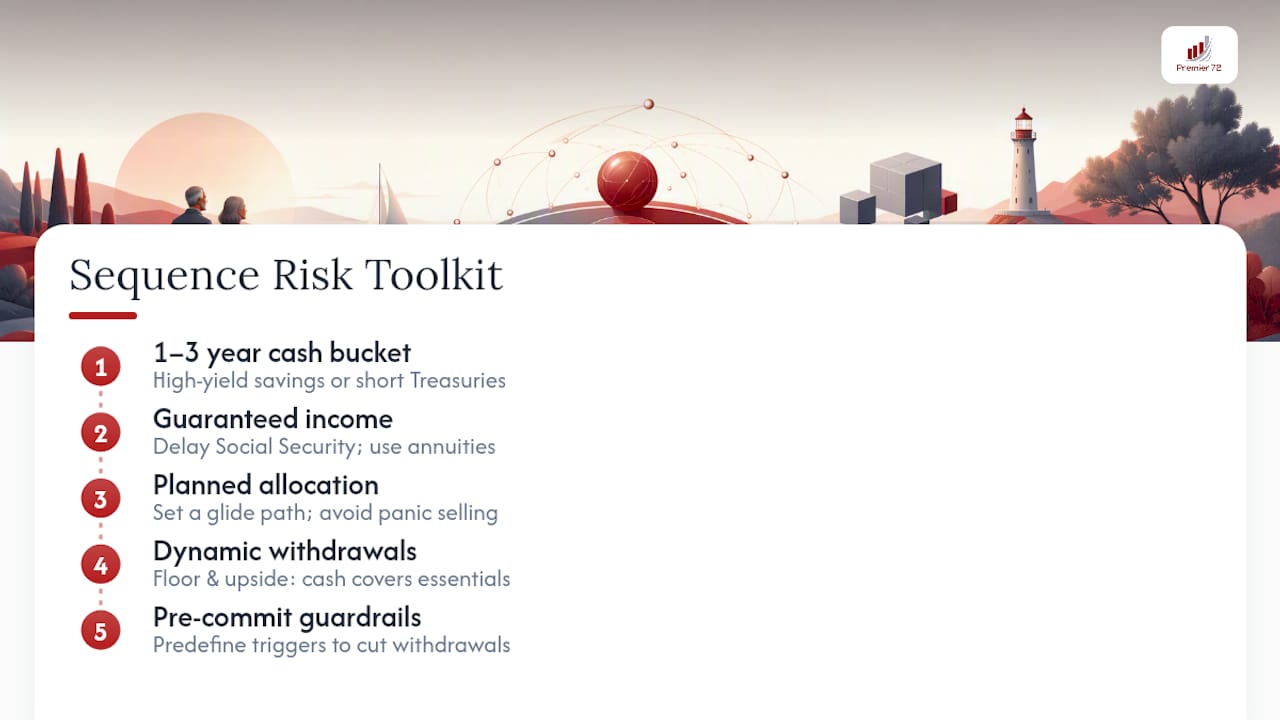
2. Layer in guaranteed income before you lean on withdrawals. Social Security claiming strategy matters more than most retirees realize. Delaying benefits from 62 to 70 increases the monthly payment substantially and reduces how much you need to pull from investments in those early, vulnerable years. Immediate annuities convert a lump sum into guaranteed income right away; deferred annuities start payments later, often at a higher rate. Either can eliminate sequence risk for the portion of income they cover, but they come with trade-offs worth weighing, including fees, surrender charges, and the financial strength of the issuing insurer. Our annuity guide breaks down which structures fit which situations.
3. Set your allocation with a plan, not a panic response. A glide path that gradually reduces equity exposure as you approach retirement, then holds steady rather than reacting to headlines, outperforms knee-jerk selling almost every time. The goal is balancing enough growth to fund a 30-year retirement against enough protection to survive the first decade.
4. Use a dynamic withdrawal method instead of a fixed percentage. A "floor and upside" approach, where guaranteed income and cash cover essential expenses and portfolio withdrawals fund discretionary spending, adjusts naturally to market conditions without requiring you to make emotional decisions in real time.
5. Pre-commit to rules before you need them. Decide now, in writing, what triggers a withdrawal reduction or a shift to the cash bucket. Retirees who set these rules in advance make better decisions during a downturn than those improvising in the moment.
Pro Tip: Pre-agreed guardrails, like "if the portfolio drops 15% in a calendar year, reduce discretionary withdrawals by 10% until it recovers," work because they remove the decision from a moment when fear is running the show.
Reducing fixed monthly expenses through options like downsizing your home lowers the withdrawal rate you need in the first place, which shrinks your sequence exposure without touching the portfolio at all.
A Planning Checklist for Your Next Advisor Conversation
Bring account balances, expected monthly spending, and your Social Security benefit statement to any planning meeting. Then ask pointed questions rather than accepting a single rosy projection.
- Ask for scenario testing: what happens if a bear market hits in year one, followed by a slow multi-year recovery?
- Ask what cash reserve they recommend and where, specifically, it should sit.
- If annuities are proposed, ask for the fee structure, surrender terms, and at least one non-annuity alternative for comparison.
- Verify any advisor's background through FINRA BrokerCheck before signing anything.
Red flags worth walking away from: a plan built on one optimistic market scenario, no stress-testing at all, or an advisor who can't articulate a contingency rule for a down market in your first five retirement years.
Coordinating Business Exit Timing With Sequence Risk
For business owners, sequence risk doesn't stop at the investment portfolio. It extends to the sale of the company itself. Selling into a depressed market, or accepting a deal structure with delayed buyer payments, can compound the same risk retirees face with withdrawals, except the stakes are the entire nest egg in one transaction.
Premier72 built The Retirement Bank Method™ around this exact problem. Rather than timing an exit to the calendar, the method establishes liquidity and contingency planning well before a sale closes, so a downturn during negotiations doesn't force a fire-sale decision.
Practical steps we recommend to owners heading toward an exit:
- Stage payouts across time instead of accepting a single lump-sum close, which spreads market timing risk.
- Fund a cash reserve independent of sale proceeds before you're locked into a closing date.
- Layer in guaranteed income, through annuitizing a portion of proceeds, so retirement income doesn't depend entirely on how the sale year performs. Our guide on retirement income planning for owners walks through how to sequence this alongside exit timing.
Ready to Pressure-Test Your Retirement Income Plan?
Sequence-of-returns risk isn't a reason to fear retirement. It's a reason to plan for it specifically, rather than trusting that a long-term average will smooth everything out on schedule. If you're a business owner whose retirement is tied up in company proceeds, that planning has an extra layer: the timing of your exit interacts with market cycles the same way portfolio withdrawals do.
Some advisory firms work with established business owners to build exit and income plans that account for both. If you're within five years of a planned sale or retirement date, a business owner planning review is the place to start pressure-testing your assumptions against real market scenarios rather than a single best-case projection.
Where to Read More
- Social Security actuarial tables for benefit timing data
- FINRA BrokerCheck to verify advisor credentials
- Investopedia's sequence of returns explainer for mitigation strategies
The Real Lesson on Sequence Risk
Most retirement content treats sequence-of-returns risk as a math curiosity, something to illustrate with a chart and move past. That undersells it. The order of your returns in the first five to ten years of retirement will do more to determine whether your money lasts than almost any other single variable you control, including how much you save in the final working years.
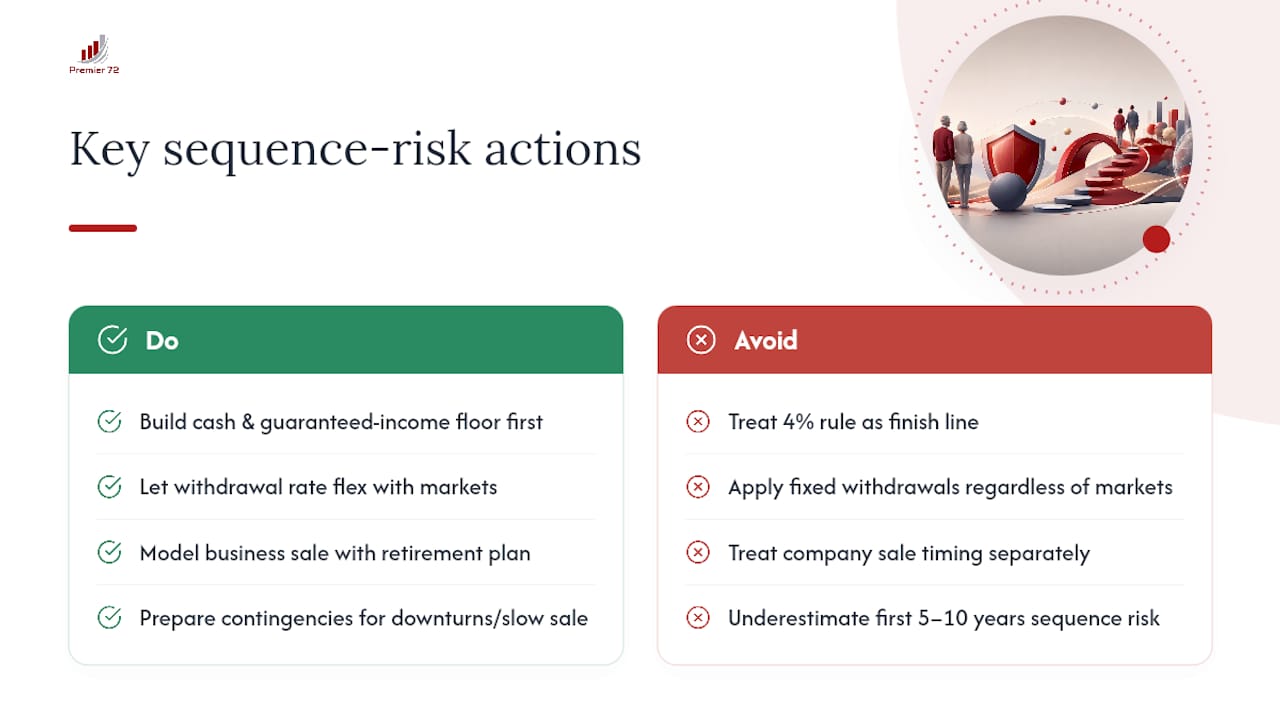
Here's where conventional advice falls short: it treats the 4% rule as a finish line rather than a starting assumption. A fixed percentage, applied blindly regardless of what the market just did, is the opposite of what sequence risk demands. The reader's actual priority should be building the cash and guaranteed-income floor first, then treating the withdrawal rate as something that flexes with conditions, not something set once and forgotten.
For business owners, the stakes compound. A company sale is often the single largest "return" of a financial life, and treating its timing as separate from retirement income planning is a mistake we see often. The two need to be modeled together, with contingency plans for both a market downturn and a slow buyer close.
— Asa
This article is general information, not a substitute for advice from a qualified financial advisor. Consult a qualified financial professional about your own circumstances before acting on anything here.
Sources
- What Is Sequence-of-Returns Risk? — Charles Schwab
- Sequence of returns — BlackRock (investor education PDF)
- Sequence of Returns Risk: Not All Total Returns Are Created Equal — Morningstar
FAQ
How do you avoid sequence of returns risk?
You can't eliminate it entirely, but you reduce it by holding 1 to 3 years of cash or short-term reserves, adding guaranteed income sources such as Social Security or annuities, and using a withdrawal rate that adjusts to market conditions rather than staying fixed.
What percentage of Americans have over $1 million in retirement savings?
Precise figures vary by source and year, and the reliable numbers tend to come from account-provider data like Fidelity's retirement account reports rather than broad surveys, so check a current provider report for the latest figure rather than relying on a single cited number.