

Buyers generally push for an asset sale because it lets them cherry-pick assets, avoid inherited liabilities, and get a stepped-up tax basis. Sellers generally push for a stock sale because it delivers cleaner capital-gains treatment and a full exit from every liability tied to the entity. The trade-off comes down to this: tax efficiency and a simple exit versus liability protection and future depreciation benefits. Neither side automatically wins. The final structure comes from negotiation, leverage, and how much each side is willing to pay for its preference.
TL;DR:
- Asset sales often result in higher taxes for C-corp sellers due to double taxation on gains, making stock sales more tax-efficient overall.
- Buyers prefer asset deals for the step-up in depreciation basis, but they face potential successor liability risks that require contractual safeguards.
- Asset sales involve complex contract and employee transfer issues, typically lengthening closing timelines by 30 to 60 days compared to stock deals.
- Preference for structure depends on priorities: full exit and capital gains favor stock, while liability shielding and partial sales favor assets.
- Using Section 338(h)(10) elections can combine tax advantages of asset deals with the legal simplicity of stock transactions in specific situations.
Table of Contents
- What Is an Asset Sale vs Stock Sale?
- Asset vs Stock Sale Taxes: Who Pays What?
- Who Bears the Liability Risk in Each Structure?
- How Contracts, Licenses, and Employees Move
- Which Structure Fits Your Deal?
- Section 338 and 338(h)(10): The Hybrid Option
- Negotiating Price, Escrows, and Indemnities
- Getting Your Business Ready to Sell
- How Premier72 Helps Owners Prepare for Either Structure
- The Bottom Line for Sellers
- What Owners Consistently Get Wrong
- Ready to Strengthen Your Position Before You Sell?
- Sources
What Is an Asset Sale vs Stock Sale?
An asset sale means the buyer purchases specific assets, brand, equipment, contracts, inventory, customer lists, and assumes only the liabilities spelled out in the Asset Purchase Agreement (APA). Everything not listed stays with the selling entity, along with most of its legacy risk. The buyer gets a fresh, stepped-up basis in what it acquires.
A stock sale (documented in a Stock Purchase Agreement, or SPA) transfers ownership of the company itself. The buyer inherits the entity whole, contracts, employees, licenses, and every liability sitting on or off the balance sheet.
Structure availability depends partly on entity type. C-corps and S-corps can do either. LLCs and partnerships technically sell "membership interests" rather than stock, but the tax and liability logic runs parallel.
- Asset sale: buyer picks specific assets and named liabilities; seller's entity survives with leftover items.
- Stock sale: buyer acquires the entity outright; all liabilities, known and unknown, transfer with it.
- Same economics, different form: deals can be structured either way, with the price adjusted to reflect who bears the tax and risk difference.
Asset vs Stock Sale Taxes: Who Pays What?
Tax treatment is usually the single biggest factor separating these two paths, and it hits C-corporations hardest. When a C-corp sells assets, the corporation pays tax on the gain, then shareholders pay tax again when the remaining cash is distributed. That double layer can push effective tax rates well past what a straightforward capital-gains sale would cost, and it often makes an asset sale far more expensive for the seller than a stock sale of the same business.
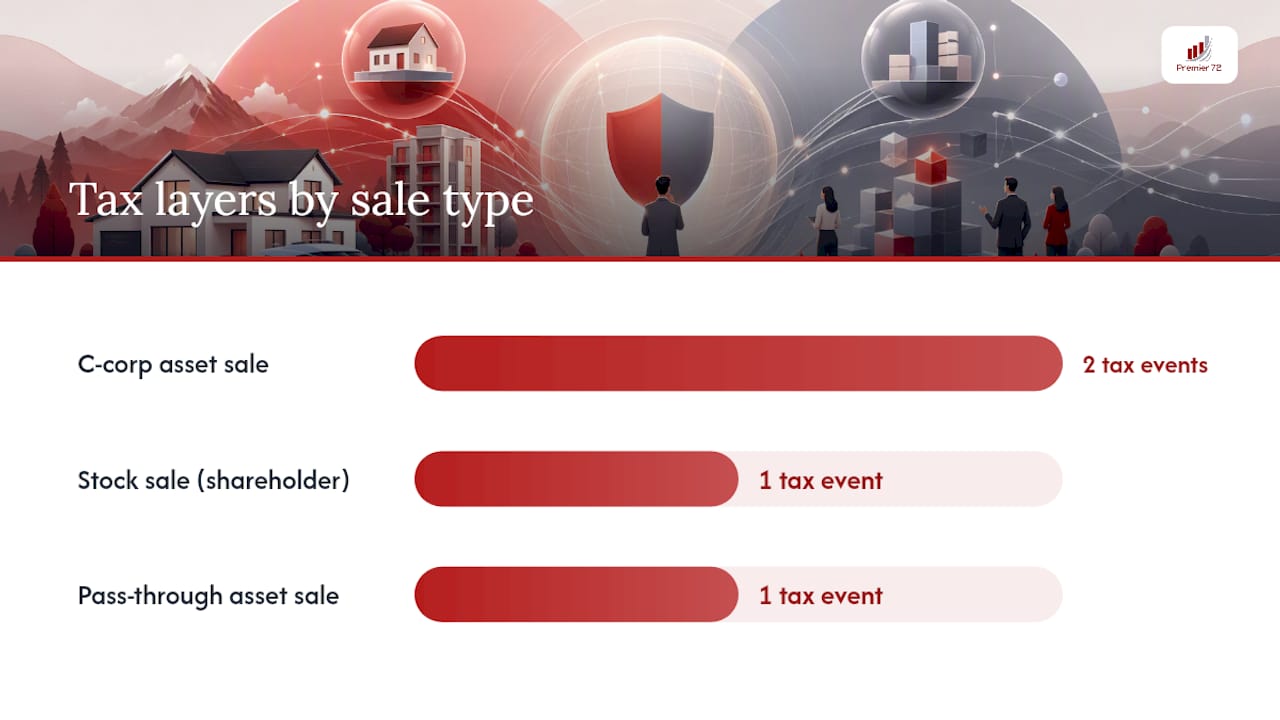
Stock sales usually avoid that second layer. Shareholders sell their shares directly and pay capital-gains tax once, at the individual level, which is why sellers so often prefer stock deals.
Buyers, meanwhile, want the asset structure for a different reason: the stepped-up basis. When a buyer pays $5 million for assets carried on the books at $1 million, that $4 million gap becomes new depreciable or amortizable basis, generating real cash-tax savings for years after closing.
The Trade-Off, In Numbers: A C-corp seller netting $4 million pre-tax from an asset sale might keep meaningfully less after both layers of tax than a shareholder selling the same value in stock, which is exactly why asset-sale buyers often need to offer a premium purchase price to make the seller economically indifferent between structures.
- Asset sale gains on equipment or inventory can trigger depreciation recapture, taxed as ordinary income rather than capital gains.
- Pass-through entities (S-corps, partnerships, LLCs) generally avoid the double-tax problem even in an asset sale, since income flows to owners once regardless.
- The step-up buyers gain in an asset deal is the mirror image of the extra tax sellers absorb, which is the core tension every negotiation has to resolve.
Who Bears the Liability Risk in Each Structure?
A stock sale hands the buyer everything sitting inside the entity, including risks nobody has spotted yet. Typical exposures include unpaid payroll taxes, pending employment claims, environmental cleanup obligations, product liability suits, and contract breaches from years before the deal closed.
Asset sales are supposed to let buyers walk past most of that. But "successor liability" doctrines carve real exceptions into that shield, particularly for environmental contamination, unpaid wages, certain product-liability claims, and fraudulent-transfer situations, so an asset structure alone doesn't fully insulate a buyer.
That gap is where deal mechanics get built:
- Indemnity provisions requiring the seller to cover losses from pre-closing issues.
- Escrow holdbacks, often 10% to 15% of purchase price, held for 12 to 24 months.
- Representations and warranties (R&W) insurance, now common enough in mid-market deals that it changes negotiating dynamics entirely, letting a buyer accept stock-sale speed without absorbing stock-sale risk.
Pro Tip: If you're a seller expecting a clean exit, price in the cost of an R&W policy early. Buyers who know insurance is available often negotiate smaller escrows, which puts more cash in your pocket at closing instead of tied up for two years.
How Contracts, Licenses, and Employees Move
Asset sales create real friction here. Contracts, leases, and licenses frequently contain anti-assignment clauses requiring the other party's consent before they transfer, and chasing down dozens of landlords, vendors, and licensors can stretch a closing timeline by weeks. Employees technically get "rehired" by the buyer, which means new offer letters, new payroll setup, and a new EIN on file.
Stock sales sidestep almost all of this. The legal entity doesn't change, so contracts, licenses, and employment relationships carry forward automatically in most cases.
- Contract review determines early whether key vendor or customer agreements require third-party consent to assign.
- License and permit transfers matter most in regulated industries, where an entity change can trigger a new approval process.
- Employee transition in asset deals requires new hire paperwork, benefit enrollment, and payroll re-registration.
- Timeline impact: asset deals with many contracts to reassign commonly add 30 to 60 days versus a comparable stock close.
Which Structure Fits Your Deal?
Certain priorities point clearly toward one structure or the other. Weigh these before you let a buyer's first term sheet set the agenda.
- Favors stock sale: you want a clean, complete exit; capital-gains treatment matters to your net proceeds; you may qualify for Qualified Small Business Stock (QSBS) exclusion benefits.
- Favors asset sale: the buyer wants to avoid inheriting specific liabilities; the buyer only wants part of the business, not the whole entity; depreciation recapture exposure is low enough that the tax hit is manageable.
- Forces asset structure regardless of preference: regulatory licenses that can't transfer with the entity, or a buyer only interested in select divisions.
- Bridges the gap: purchase-price adjustments, escrows, and indemnity caps let both sides land near the same after-tax outcome even when their preferred structures differ.
Pro Tip: Don't treat structure as fixed before negotiations start. A buyer insisting on assets today may accept stock with stronger indemnities once they understand what a gross-up would cost them in a different structure.
Section 338 and 338(h)(10): The Hybrid Option
Section 338 of the tax code lets certain stock purchases be treated as deemed asset sales for tax purposes, giving the buyer an inside basis step-up while the deal legally closes as a stock transaction. A plain 338(g) election is rare outside specific corporate contexts because it can trigger tax at both the target and shareholder level.
338(h)(10) is the version practitioners actually use. It applies when the target is an S-corp or a member of a consolidated group, and it lets the buyer get the depreciation benefits of an asset deal without the assignment headaches of one.
- The seller typically demands a gross-up in purchase price to offset the extra tax exposure the election creates.
- It works best when contracts or licenses make an actual asset transfer impractical, but the buyer still wants the basis step-up.
- Section 336 governs related liquidation and distribution consequences that advisors model alongside 338 elections.
Negotiating Price, Escrows, and Indemnities
Once structure is settled, the real work shifts to allocation and risk-sharing language buried in the purchase agreement.
- Purchase price allocation across asset categories (equipment, goodwill, inventory) determines each side's tax treatment, and the IRS requires both parties to report it consistently.
- Escrow and holdback periods commonly run 12 to 24 months, covering the window where undiscovered liabilities tend to surface.
- Indemnity baskets set a minimum loss threshold before claims kick in, while caps limit total seller exposure, though fundamental representations (title, authority, taxes) often carry no cap at all.
- Buyers sometimes raise their headline offer specifically to secure an asset structure, effectively paying for the liability protection they're buying.
Getting Your Business Ready to Sell
Preparation work done a year or two ahead of a sale routinely adds real dollars to the final number and shortens the time buyers spend in diligence.
- Normalize your financials. Strip out owner perks, reconcile books, and produce three years of clean statements a buyer's quality-of-earnings review will trust.
- Clean up legal loose ends. Resolve pending litigation where possible, consolidate IP ownership under the entity, and confirm titles on real property and equipment.
- Model both structures. Have your CPA run after-tax proceeds under an asset sale and a stock sale so you know your walk-away number before a buyer names theirs.
- Assemble your advisor team. M&A counsel, a valuation advisor, and an insurance broker who understands R&W policies should be in place before you go to market, not after an offer arrives.
How Premier72 Helps Owners Prepare for Either Structure
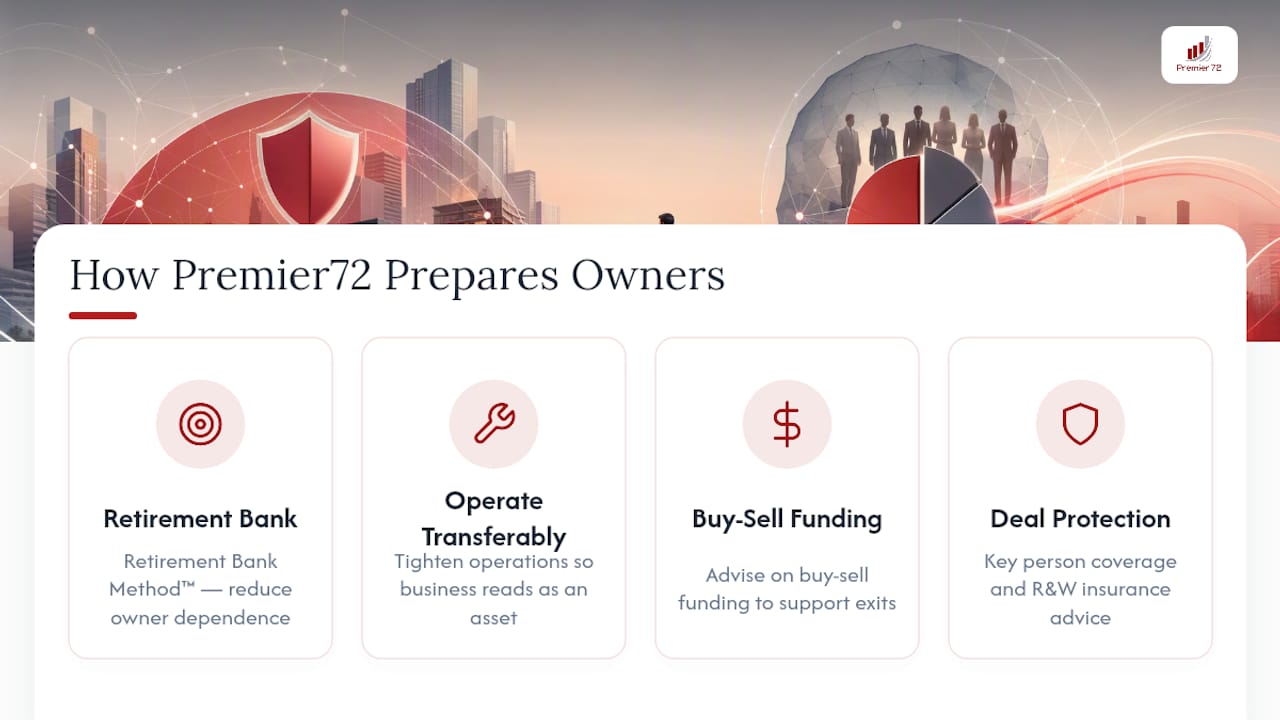
Most of what determines your outcome in this negotiation gets built long before a term sheet arrives. Premier72's Retirement Bank Method™ focuses on reducing owner dependence and tightening operations so your business reads as a transferable asset, not a job that happens to have your name on it. That groundwork strengthens your position under either structure. Premier72 also advises on buy-sell funding, key person coverage, and how R&W insurance factors into deal protection, drawing on Asa's analysis of the mechanics above.
The Bottom Line for Sellers
Insist on stock treatment when tax efficiency matters most. Accept asset structure only with a price adjustment that reflects your tax hit. Talk to tax counsel and start your diligence file now, before a buyer sets the terms.
What Owners Consistently Get Wrong
Owners are usually surprised by three things: how much owner pay inflates apparent profitability, how many contracts can't simply transfer, and how differently equipment gains get taxed compared to goodwill. Fix tax modeling and contract review before anything else.
— Asa
Ready to Strengthen Your Position Before You Sell?
Whether a buyer pushes for assets or you're holding out for a stock sale, your leverage comes from how ready your business looks on paper, not just from which structure you prefer. Premier72 works with established owners to reduce the risks buyers price into every offer, tightening financial records, reducing owner dependence, and lining up the right insurance protections, including R&W coverage and buy-sell funding, before you're negotiating from a weaker seat.

If you're weighing an exit in the next one to three years, an exit readiness review is the practical next step. Premier72 will walk through where your business stands today under either sale structure and what to fix first. Start a sale-structure planning session with Premier72 and get a clear read on your after-tax position before a buyer sets the agenda.
This article is general information, not a substitute for advice from a qualified financial advisor. Consult a qualified financial professional about your own circumstances before acting on anything here.
Sources
- Asset Sale vs. Stock Sale - Wall Street Prep
- 26 U.S. Code § 338 — Treatment of stock purchases as asset acquisitions
- Asset sale vs. stock sale guide - Fraim, Cawley & Company, CPAs