

A defined benefit plan for owners is an employer-funded retirement arrangement that promises a fixed monthly benefit at retirement, and it lets a business owner make far larger tax-deductible contributions than a 401(k) allows. The trade-off: the IRS requires an enrolled actuary to certify annual funding, and those contributions are mandatory, not optional, in most years.
Here's what that means for you in practice.
The advantages:
- Accelerated, high tax-deductible contributions, often well beyond what a 401(k) or SEP-IRA permits
- A predictable, formula-based retirement benefit rather than a market-dependent balance
- Strong creditor and estate protection under ERISA
The trade-offs:
- Mandatory annual funding, regardless of how your business performed that year
- Higher administrative and actuarial costs than simpler plans
- A poor fit if your cash flow is inconsistent or your business is young and unproven
Key Takeaways
Defined benefit plans let owners make substantially higher tax-deductible contributions than 401(k) plans allow, in exchange for mandatory annual actuarial funding and higher administrative cost.
| Point | Details |
|---|---|
| Employer bears the risk | Unlike a 401(k), the business absorbs investment and longevity risk under a defined benefit plan. |
| Actuary sign-off is mandatory | An enrolled actuary must certify funding annually and sign Schedule SB on Form 5500. |
| Best for stable, later-career owners | Owners 40 and older with consistent profits gain the most from accelerated contribution limits. |
| Plans can pair with a 401(k) | Combining an owner-only DB plan with a 401(k) adds personal salary deferrals on top of required contributions. |
| Premier72 supports the full setup | Premier72 coordinates actuaries, ERISA counsel, and plan design so owners can evaluate feasibility before committing. |
Table of Contents
- What Is a Defined Benefit Plan for Owners, and How Does It Differ From a 401(k)?
- How Does a Defined Benefit Plan Work for Owner-Only Businesses?
- What Types of Defined Benefit Plans Work Best for Owners?
- Why Do Defined Benefit Plans Allow Higher Tax-Deductible Contributions?
- What Are the Pros and Cons of a Defined Benefit Plan for Owners?
- How Do You Set Up and Administer a Defined Benefit Plan?
- Can You Combine a Defined Benefit Plan With a 401(k)?
- Is a Defined Benefit Plan Right for You? A Quick Checklist
- When Do Premier72 Advisors Recommend a Defined Benefit Plan?
- How Premier72 Helps You Build the Right Retirement Structure
- Where to Learn More About Defined Benefit Plan Rules
- Sources
What Is a Defined Benefit Plan for Owners, and How Does It Differ From a 401(k)?
A defined benefit plan promises a specific retirement benefit calculated by a formula, usually built from salary history, age, and years of service. The employer, not the participant, bears the investment and longevity risk. That single distinction separates it from every defined contribution plan on the market.
Here's how the two structures actually compare:
- Who contributes: In a DB plan, the employer funds it based on actuarial requirements. In a 401(k), employees defer their own salary, sometimes matched by the employer.
- Who bears investment risk: The employer absorbs market losses in a DB plan. In a 401(k), the participant absorbs them.
- Who controls investments: The plan trustee manages DB plan assets. Participants typically direct their own 401(k) investments.
- Distribution flexibility: DB plans often pay as an annuity, with limited early access. 401(k)s allow loans and broader distribution options.
A formula might weigh average salary over your highest-earning years, credited years of service, and a percentage multiplier. That's illustrative only. Your actual formula depends on plan design and actuarial assumptions specific to your business.
How Does a Defined Benefit Plan Work for Owner-Only Businesses?
If you own the business, you typically wear two hats: participant and plan sponsor. As the sponsor, your business funds the plan. As the participant, you're the one collecting the eventual benefit. An enrolled actuary sits between those two roles, calculating exactly how much your business must contribute each year to stay on track toward the promised benefit.

That calculation isn't optional guesswork. The IRS requires an enrolled actuary to sign Schedule SB, filed alongside Form 5500, certifying that your funding meets minimum requirements. Skip a required contribution and you risk excise taxes and compliance problems that follow the business, not just the plan.
Owner-specific realities worth knowing:
- Contributions are due by your business's tax-filing deadline, including extensions, giving you a somewhat flexible funding window
- Unlike a 401(k), there's no elective salary deferral mechanism. The contribution amount is actuarially determined, not chosen paycheck by paycheck
- Once you commit to a benefit formula, that promise locks in. Reducing it later isn't as simple as adjusting a contribution rate
Pro Tip: Many owners assume a DB plan works like "set it and forget it" retirement savings. It doesn't. It's an ongoing contractual funding obligation that follows your business's fiscal calendar every year, whether income is up or down.
What Types of Defined Benefit Plans Work Best for Owners?
Three plan designs dominate owner planning, and each fits a different business situation.
- Traditional defined benefit plan. Pays a formula-based pension tied to salary and years of service. Works best for businesses with longer-tenured staff or predictable payroll patterns.
- Cash-balance plan. Expresses the benefit as a hypothetical account balance that grows through pay credits and interest credits. Easier for employees to understand, and it pairs naturally with a 401(k) when you want both accelerated owner contributions and employee flexibility.
- Owner-only (personal) defined benefit plan. Built specifically for solo owners or owner-and-spouse businesses to maximize retirement contributions. Employee-inclusion rules limit how these plans scale once you hire staff, which is why owner-only plans often get paired with a separate 401(k) as the business grows.
Pro Tip: If contribution predictability and portability matter more to you, a cash-balance design usually wins. If your priority is maximizing late-career contributions in a short window, a traditional or owner-only DB plan can allow larger annual deposits.
Why Do Defined Benefit Plans Allow Higher Tax-Deductible Contributions?
The math behind DB plan contributions isn't arbitrary. An enrolled actuary calculates your required annual contribution using your age, your desired retirement benefit, and the number of years remaining until retirement. A 55-year-old owner targeting retirement at 65 with a substantial promised benefit can generate a dramatically larger deductible contribution than the same owner could achieve through a 401(k) alone, simply because there's less time for the money to grow and the formula compensates accordingly.
That structure creates real tax leverage, and the IRS confirms DB plans typically allow larger deductible contributions than other plan types.
The tax advantages stack up like this:
- The business deducts its contribution in the year it's made
- Plan assets grow tax-deferred until distribution
- Owners can often layer a 401(k) on top for additional personal deferrals
Contribution limits still apply under IRS benefit caps, and only an enrolled actuary can calculate what your business is actually permitted to deduct in a given year.
What Are the Pros and Cons of a Defined Benefit Plan for Owners?
The upside:
- Substantial tax-deductible contribution potential, especially for owners over 45
- A guaranteed, formula-driven retirement benefit rather than a market-exposed balance
- Meaningful creditor and bankruptcy protections
- A fast track to catching up on retirement savings late in a career
The downside:
- Mandatory annual funding that doesn't flex downward when business income dips
- Higher administrative and actuarial costs than a SEP-IRA or solo 401(k)
- Limited flexibility. Participants can't simply adjust distributions the way they would with a defined contribution account
Red flags that should stop you before you commit:
- Cash flow that swings unpredictably year to year
- A planned sale or exit within the next few years
- A workforce that's growing fast enough to make plan costs balloon unexpectedly
How Do You Set Up and Administer a Defined Benefit Plan?
Setting up a DB plan follows a fairly predictable sequence, though the advisors involved matter as much as the steps themselves.
- Run a feasibility study and illustration with an enrolled actuary to model realistic contribution ranges.
- Adopt a formal plan document that meets ERISA requirements.
- Select a trustee and establish an investment policy for plan assets.
- Set up a third-party administrator (TPA) for recordkeeping and compliance.
- File Form 5500 with Schedule SB annually, signed by your enrolled actuary.
The advisor team you'll need:
- An enrolled actuary to certify funding and sign required filings
- ERISA counsel to draft the plan document and confirm compliance
- A third-party administrator to manage annual filings and participant records
- An investment manager or trustee to oversee plan assets
Plan documents generally need to be in place before your fiscal year ends, and contributions are due by the tax-filing deadline, including extensions. Expect setup fees, recurring actuarial charges, and ongoing TPA and legal costs. For a business with unstable revenue, that administrative load can outweigh the tax benefit.
Can You Combine a Defined Benefit Plan With a 401(k)?
Pairing works, and it's common. A typical setup layers an owner-only DB plan with a 401(k), letting the owner add personal salary deferrals on top of the actuarially required DB contribution for meaningfully higher total retirement savings.
A few coordination points to watch:
- Nondiscrimination testing still applies once employees enter the picture
- Contribution timing and deductibility rules differ slightly between the two plan types
- A safe-harbor 401(k) design can simplify testing requirements
- Adding employees to either plan raises the total cost of maintaining both
Model any combination with your actuary early. Pairing plans can meaningfully boost retirement savings, but it also adds a second layer of administration to manage.
Is a Defined Benefit Plan Right for You? A Quick Checklist
Run through these questions before requesting a formal illustration:
- Does your business generate stable, high enough cash flow to absorb a mandatory annual contribution?
- Are you (or your co-owner) at least 40, with a clear runway of years before retirement?
- Do you have any near-term plans to add significant full-time staff?
- Are you comfortable committing to annual funding discipline, even in a slower year?
- Can your budget absorb the administrative and actuarial costs involved?
If most answers point favorably, the logical next step is requesting an actuarial illustration and feasibility conversation with a trusted advisor.
When Do Premier72 Advisors Recommend a Defined Benefit Plan?
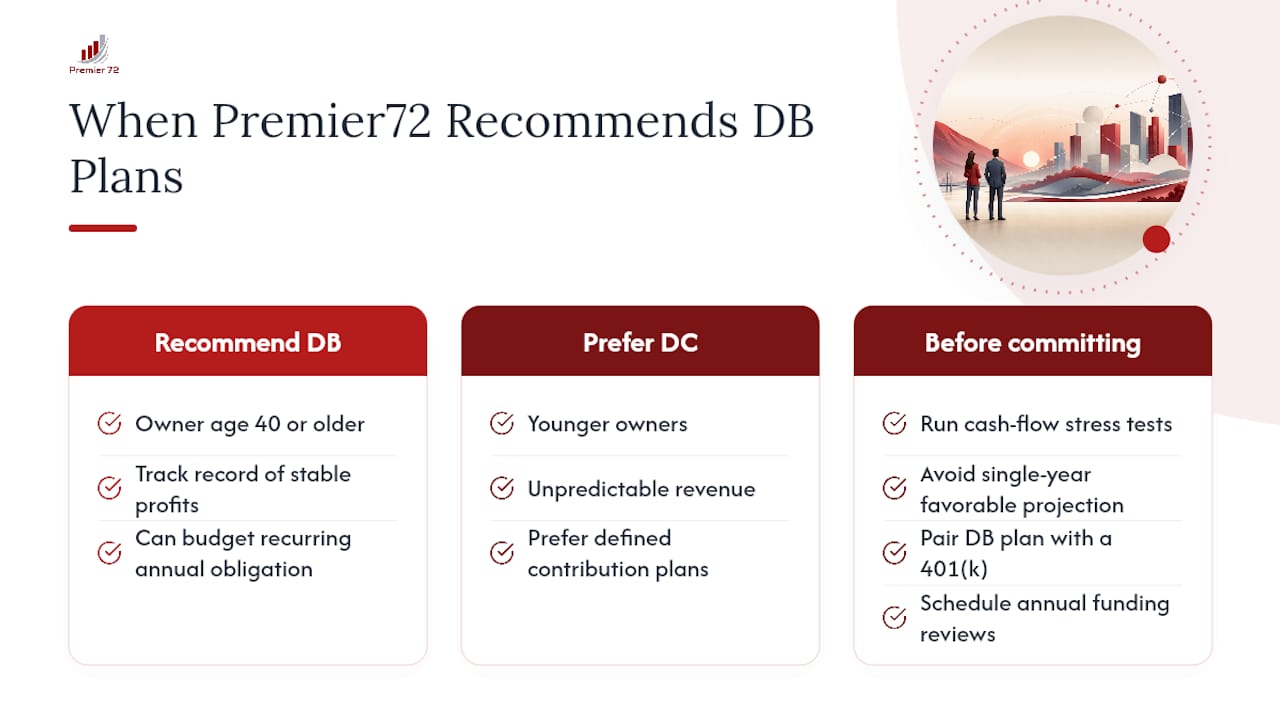
Premier72 typically recommends a defined benefit plan for owners 40 and older with a track record of stable profits who want to accelerate retirement funding and can comfortably budget for a recurring annual obligation. Younger owners, or those with unpredictable revenue, usually fit better with more flexible defined contribution structures.
Before committing, we push clients to run cash-flow stress tests against the proposed contribution schedule, not just a single favorable-year projection. Pairing the DB plan with a 401(k) for added flexibility is often part of that conversation, along with scheduling annual reviews so funding spikes never arrive as a surprise.
Pro Tip: Before signing anything, ask your actuary for multi-year contribution scenarios under different investment-return and longevity assumptions. Seeing the worst-case funding year on paper changes how owners think about commitment.
How Premier72 Helps You Build the Right Retirement Structure
Choosing the right plan design isn't something to work out alone with a spreadsheet. Premier72 coordinates the advisor network a defined benefit plan actually requires: feasibility and cash-flow modeling, introductions to enrolled actuaries and ERISA counsel, and hands-on support through plan design and implementation.

A structured advisory review looks at your business cash flow, your retirement income goals, and your realistic exit timeline together, rather than treating retirement planning as separate from the future of the business itself. That combination matters more for owners than for employees, since your business's health and your retirement funding are directly linked.
If you're weighing whether a defined benefit plan fits your situation, schedule a consultation with Premier72 to request an actuarial illustration and walk through your options before committing to a plan design.
Where to Learn More About Defined Benefit Plan Rules
For deeper reading beyond this overview, these sources cover the regulatory backbone of defined benefit plans:
- IRS: Defined Benefit Plan covers funding rules, Form 5500 filing, and actuarial requirements.
- IRS: Choosing a Defined Benefit Plan compares plan types and contribution potential.
- U.S. Department of Labor: Types of Retirement Plans explains ERISA coverage and PBGC protections.
- Tax Policy Center: What Are Defined Benefit Retirement Plans? traces historical adoption trends.
- Investopedia: What Is a Defined-Benefit Plan? details payout options and distribution restrictions.
This article is general information, not a substitute for advice from a qualified financial advisor. Consult a qualified financial professional about your own circumstances before acting on anything here.
Sources
- Defined benefit plan | Internal Revenue Service
- Choosing a Defined Benefit Plan | Internal Revenue Service
- Types of Retirement Plans | U.S. Department of Labor
- What are defined benefit retirement plans? | Tax Policy Center
- What Is a Defined-Benefit Plan? Examples and How Payments Work | Investopedia