

Most business owners who sell will owe capital gains tax on at least part of the proceeds, and the size of that bill depends on four variables: whether the deal is structured as a stock sale or asset sale, how the purchase price gets allocated under IRC Section 1060, how much depreciation recapture applies, and where you live.
Federal long-term capital gains rates run at 0%, 15%, or 20%, and high earners add a 3.8% Net Investment Income Tax on top. But depreciation recapture is taxed as ordinary income, sometimes at rates well above 20%, which can quietly inflate your real tax bill beyond what a quick back-of-envelope calculation suggests.
Before you go further, do three things: confirm whether the buyer wants a stock sale or asset sale, pull your basis and depreciation records, and ask for the buyer's proposed allocation schedule in writing.
- Determine deal structure (stock vs. asset) early. It changes everything downstream.
- Gather adjusted basis and full depreciation schedules for every major asset class.
- Request the buyer's Section 1060 allocation proposal before signing a letter of intent.
- Estimate your combined federal, NIIT, and state exposure before you negotiate price.
Quick math to keep in mind: the top federal long-term capital gains rate is 20%, plus 3.8% NIIT for high earners, pushing the federal ceiling close to 23.8% before any state tax or recapture is added.
Key Takeaways
Most business sales generate capital gains tax, and the final bill hinges on deal structure, IRC Section 1060 allocation, depreciation recapture, and state residency more than on the headline federal rate.
| Point | Details |
|---|---|
| Structure decides tax character | Stock sales favor capital gains treatment; asset sales trigger recapture at ordinary rates. |
| Allocation is negotiable | IRC Section 1060 governs how the purchase price splits across asset classes and tax character. |
| Recapture raises effective rate | Depreciation recapture under Sections 1245/1250 is taxed as ordinary income, not capital gains. |
| QSBS can eliminate federal tax | Qualifying C-corp stock held over five years may exclude a large share of gain under Section 1202. |
| Plan with Premier72 before listing | The Retirement Bank Method™ models your tax exposure and negotiation leverage ahead of a sale. |
Table of Contents
- Capital Gains Tax on Selling a Business: Asset Sale vs. Stock Sale
- What Federal Rates, NIIT, and Recapture Actually Cost You
- Strategies That Reduce or Defer Tax on a Business Sale
- Does Your State Change What You Keep After a Business Sale?
- How to Calculate Capital Gains: Two Worked Examples
- What to Bring to Your CPA Before Negotiating the Deal
- Why Most Sellers Underestimate Their Tax Bill
- How Premier72 Prepares You for a Tax-Efficient Sale
- Frequently Asked Questions About Capital Gains on a Business Sale
- Sources
Capital Gains Tax on Selling a Business: Asset Sale vs. Stock Sale
The single biggest driver of your tax outcome is how the deal is structured, and buyers and sellers usually want opposite things.
In a stock sale, the buyer purchases your ownership shares directly. The business entity stays intact, its liabilities transfer with it, and you as the seller typically report the entire gain as capital gain, taxed at the lower long-term rates. Sellers tend to prefer this route because it avoids depreciation recapture entirely.
In an asset sale, the buyer purchases specific assets and liabilities out of the business. Buyers push hard for this structure because it gives them a stepped-up basis in the assets, which means bigger depreciation deductions going forward. The IRS treats a lump-sum business sale as a sale of each individual asset, and requires the residual method under IRC Section 1060 to allocate the purchase price across defined asset classes.
That allocation determines your tax character, asset by asset:
- Inventory and receivables generally produce ordinary income.
- Equipment and depreciable property trigger recapture taxed at ordinary rates.
- Goodwill and going-concern value typically qualify for capital gains treatment.
This buyer-seller conflict over structure is often the single largest negotiation point in a deal. One workaround: a Section 338(h)(10) election, available for certain S-corp and qualified stock transactions, lets the buyer treat the purchase as an asset acquisition (getting the basis step-up) while the seller still reports it as a stock sale for tax purposes. It requires both parties to agree, and the drafting needs to be precise.
- Stock sale: cleaner for the seller, avoids recapture, usually faster to close.
- Asset sale: better for the buyer's future depreciation, but forces the seller into a mixed-character tax outcome.
- 338(h)(10) election: a negotiated middle ground, but not available in every deal type.
What Federal Rates, NIIT, and Recapture Actually Cost You
Modeling your true tax exposure means stacking four components, not just checking a capital gains rate table.
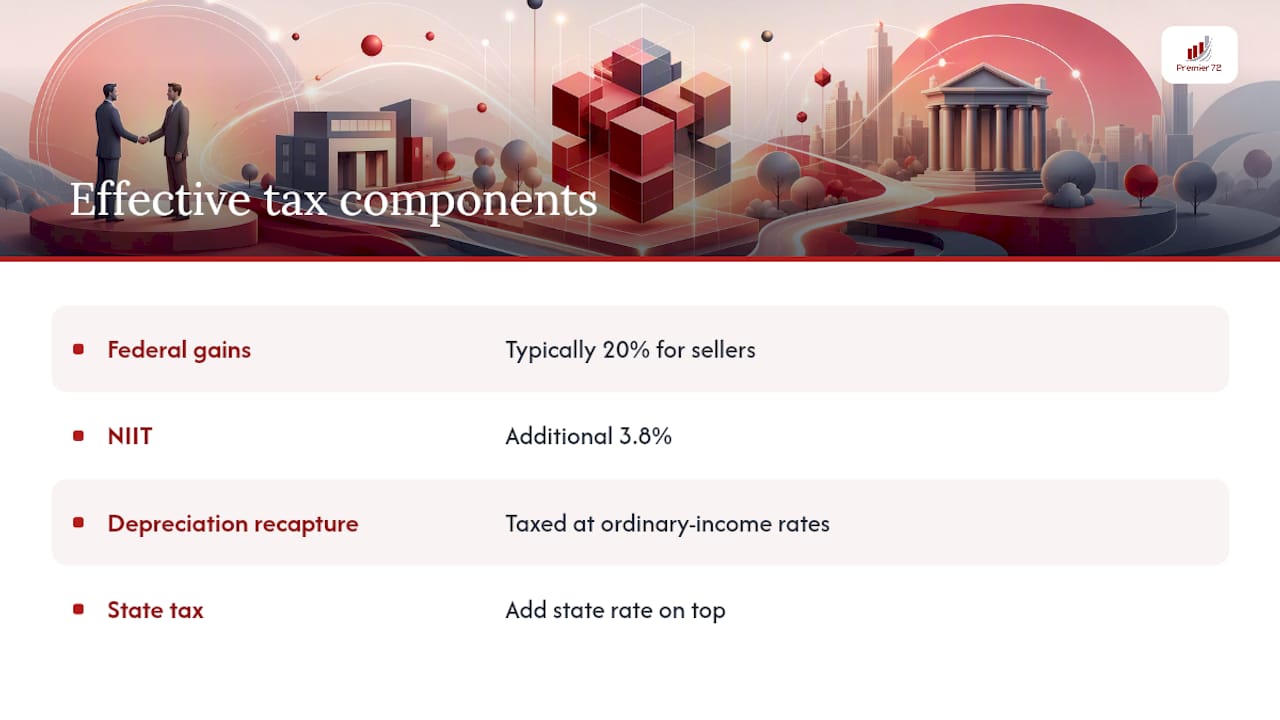
Federal capital gains brackets. Your taxable income for the year of sale determines whether long-term gains are taxed at 0%, 15%, or 20%. Most sellers of an established, profitable business land in the 20% bracket the moment the sale closes, since the gain itself pushes taxable income up.
Net Investment Income Tax. High-income sellers typically owe an additional 3.8% NIIT on top of the capital gains rate, bringing the effective federal rate close to 23.8% for many sellers. There's a notable exception worth flagging to your CPA: gain from an active trade or business you materially participated in can sometimes escape NIIT because it isn't treated as passive investment income. This carve-out has real teeth, but material participation tests are fact-specific, so don't assume it applies without confirming it in writing.
Depreciation recapture. Sections 1245 and 1250 convert prior depreciation deductions back into ordinary income when you sell the underlying asset. If you've depreciated equipment, vehicles, or leasehold improvements aggressively over the years, expect a meaningful chunk of the sale price to be recaptured at your ordinary income rate rather than the capital gains rate.
State tax. Add your state's rate on top of everything above.
A rough effective-rate stack for a seller in the top federal bracket might look like: 20% federal capital gains, plus 3.8% NIIT, plus recapture on the depreciated portion at ordinary rates (which can run higher than 20% depending on income) plus whatever your state charges. That combination is why two sellers with identical sale prices can walk away with very different net proceeds.
Strategies That Reduce or Defer Tax on a Business Sale
You have more leverage than most sellers realize, but every strategy below has real constraints. Work through these with your CPA well before you sign a letter of intent.
- Qualified small business stock (Section 1202 / QSBS). If your business is a C-corp and the stock meets original-issuance and active-business tests, holding it more than five years can let you exclude a substantial portion of the gain from federal tax entirely. This is one of the most powerful exclusion tools available for qualifying owners, but the eligibility window closes fast once you're near a sale, so this needs planning years in advance, not months.
- Installment sale (Section 453). Spreading buyer payments across multiple years defers the associated tax into those future years instead of taking the full hit at closing. The trade-off is risk of buyer default, since you're taxed based on payments you expect to receive, not payments guaranteed to arrive.
- 338(h)(10) election. As covered above, this lets buyer and seller negotiate a hybrid outcome. It's most useful when the buyer insists on an asset-sale basis step-up but you want stock-sale tax treatment.
- Charitable remainder trusts. Contributing a portion of the business interest before sale can defer tax on that portion and generate an income stream, though it permanently removes that share from your estate.
Pro Tip: Negotiation leverage often hides in the payment structure, not just the price. Allocation schedules, earnouts, and non-cash consideration (like seller notes or rollover equity) are all levers you can pull to shift the timing and character of your tax bill, even after the headline purchase price is agreed.
Does Your State Change What You Keep After a Business Sale?
State tax on the gain varies enormously, and it's easy to underestimate by how much. Texas and Florida charge no individual income tax on the gain, while California taxes it as ordinary income at rates that can exceed 13%, with New York not far behind.
- Some sellers consider changing residency before closing to capture a lower-tax state's treatment.
- California's Franchise Tax Board is aggressive about scrutinizing residency changes timed around a liquidity event, and audits are common.
- Timing the sale around a move rarely works cleanly unless the residency change is genuine and well documented long before the transaction.
- Bring in state tax counsel if you're weighing a residency change, not just your regular CPA.
How to Calculate Capital Gains: Two Worked Examples
The core formula never changes: amount realized minus adjusted basis equals gain. From there, you allocate that gain between ordinary income items and capital gain items, then apply the relevant rates to each piece.
Scenario 1: Stock sale, $3 million proceeds, $500,000 basis. Gain equals $2.5 million, all treated as long-term capital gain.
Scenario 2: Asset sale, same $3 million proceeds, with $800,000 attributable to depreciation recapture. Combined federal tax approaches $700,000 before state tax, noticeably higher than the stock-sale scenario despite identical proceeds.
A capital gains tax calculator can help you stress-test your own numbers before you sit down with a CPA.
What to Bring to Your CPA Before Negotiating the Deal
Walk into your first tax-planning meeting with these ready, and you'll get a far more useful answer than a generic estimate.
- Adjusted basis records and full depreciation schedules for every major asset.
- Entity formation documents and three years of financial statements.
- The buyer's proposed purchase-price allocation, in writing.
- Proposed payment schedule, including any escrow, holdbacks, or earnout terms.
- A clear answer on who controls the final Section 1060 allocation in the purchase agreement.
Ask your CPA directly: can we elect 338(h)(10) here, is the buyer open to a stock sale, and who bears the tax risk if an earnout underperforms? Reviewing your pre-sale preparation checklist alongside these questions tends to surface gaps most owners miss until it's too late to fix them.
Why Most Sellers Underestimate Their Tax Bill
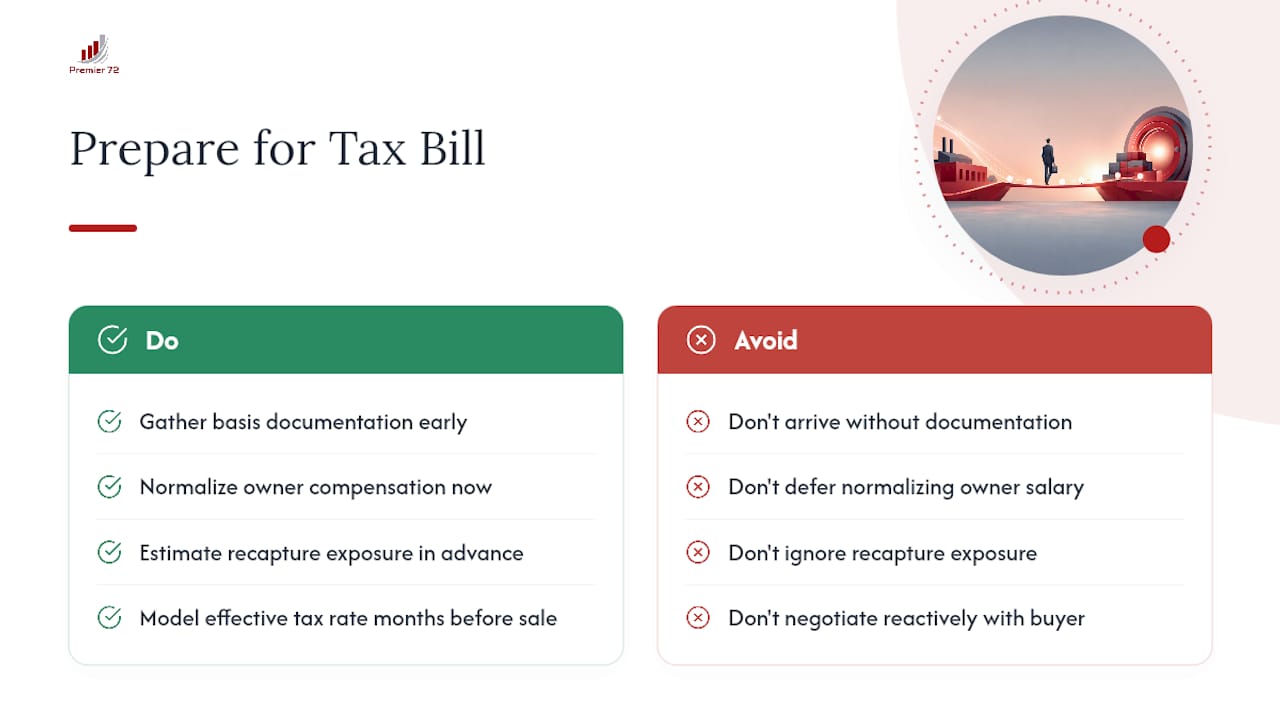
The most common mistake is not the tax code itself. It's showing up to the negotiating table without basis documentation, without a normalized view of owner compensation, and without any real estimate of recapture exposure. Sellers who haven't normalized owner salary ahead of time often discover their adjusted earnings, and therefore their basis calculations, are messier than expected right when precision matters most.
Advance exit-readiness planning changes the negotiation, not just the paperwork. Owners who model their effective tax rate months before going to market walk into buyer conversations knowing which structure protects their proceeds, and they negotiate from that position instead of reacting to whatever the buyer proposes first.
How Premier72 Prepares You for a Tax-Efficient Sale
Premier72 is the practical alternative to walking into a sale unprepared and negotiating tax structure after the letter of intent is already signed. Through The Retirement Bank Method™, we help you model your all-in tax exposure, normalize your financials, and build the leverage to negotiate deal structure, not just price, months before you ever talk to a buyer.

Our exit-readiness engagements walk you through purchase-price allocation scenarios, installment sale tradeoffs, and buy-sell or key-person insurance funding so your business protection planning lines up with your tax strategy instead of working against it. If you're within two to three years of a sale, schedule a consultation with Premier72 now to get a real all-in tax estimate before you're sitting across from a buyer.
Frequently Asked Questions About Capital Gains on a Business Sale
Do I always owe capital gains tax when I sell my business? Almost always, yes, though the portion taxed as capital gain versus ordinary income depends heavily on deal structure and asset allocation.
Is a stock sale or asset sale better for taxes? Sellers generally net more after tax in a stock sale since it avoids depreciation recapture, while buyers usually prefer asset sales for the basis step-up.
Can QSBS eliminate my entire tax bill? Only if your stock qualifies under Section 1202's active-business and holding-period tests, and even then, exclusion limits apply, so confirm eligibility with your CPA years before selling.
Does my business structure (LLC, S-corp, C-corp, partnership) change my tax treatment? Yes. C-corp stock can access QSBS benefits that pass-through entities cannot, while S-corps and partnerships often see gain flow through to your personal return with different basis rules.
Can I use capital losses to offset gain from selling my business? Yes, capital loss carryforwards from prior years can offset capital gain from the sale, though they generally can't offset ordinary income from depreciation recapture.
What forms do I need to report the sale? Most sellers report the transaction using IRS Form 8949 and Schedule D for capital gains, alongside Form 4797 for the ordinary-income and recapture portions.
This article is general information, not a substitute for advice from a qualified financial advisor. Consult a qualified financial professional about your own circumstances before acting on anything here.
Sources
The IRS page on the sale of a business explains Section 1060 allocation and recapture rules directly from the source. The SBA's tax strategies guide covers timing and deferral considerations worth reviewing with your advisor. Each addresses a piece of the puzzle your CPA will need to model your specific deal accurately.
- Tax Implications of Selling a Business | U.S. Bank