

For most donors giving under multimillion-dollar horizons, a donor-advised fund is the simpler, more tax-efficient choice. Private foundations pay off when you need institutional control and plan to give substantial sums across generations. The IRS treats these vehicles very differently under Form 990-PF disclosure rules and Section 4940 excise tax, and that gap drives most of the decision. Premier72 works with business owners weighing this choice every time an exit or liquidity event is on the horizon.
- Tax edge: DAFs allow higher AGI deduction caps and fair-market-value treatment on more asset types.
- Control edge: Foundations give you a governing board, staff hiring power, and multigenerational program design.
Key Takeaways
Donors with charitable assets below a certain multimillion-dollar threshold typically save on cost and complexity with a DAF, while larger, multigenerational giving plans justify a foundation's control and overhead.
| Point | Details |
|---|---|
| Deduction caps favor DAFs | Cash gifts to DAFs deduct up to 60% of AGI versus 30% for foundations. |
| Basis rules hit illiquid gifts | Foundations often cap deductions at cost basis for non-public assets; DAFs allow more FMV treatment. |
| Foundations carry fixed costs | Legal, accounting, and Form 990-PF filings apply regardless of asset size. |
| Privacy differs sharply | Foundation filings are public; DAF grants can be made anonymously. |
| Breakeven runs mid-seven-figures | Practitioner guidance puts the foundation cost-efficiency threshold in that range. |
Ready to align your charitable vehicle with your exit timeline? Premier72's advisory team helps business owners coordinate charitable giving, tax timing, and succession planning into one strategy.
Table of Contents
- DAF vs Foundation: A Side-by-Side Comparison
- How U.S. Tax Rules Treat Each Vehicle Differently
- What Foundations and DAFs Actually Cost to Run
- Who Actually Controls the Money and the Mission
- Giving Illiquid Assets, Scholarships, and Grants to Individuals
- When Pairing a DAF and a Foundation Makes Sense
- A Checklist Before You Decide
- Why Timing Beats the Vehicle Itself
- Frequently Asked Questions
- Sources
DAF vs Foundation: A Side-by-Side Comparison
The two vehicles solve different problems, and the differences show up fastest when you line up the mechanics that actually affect your bottom line and your family's involvement.
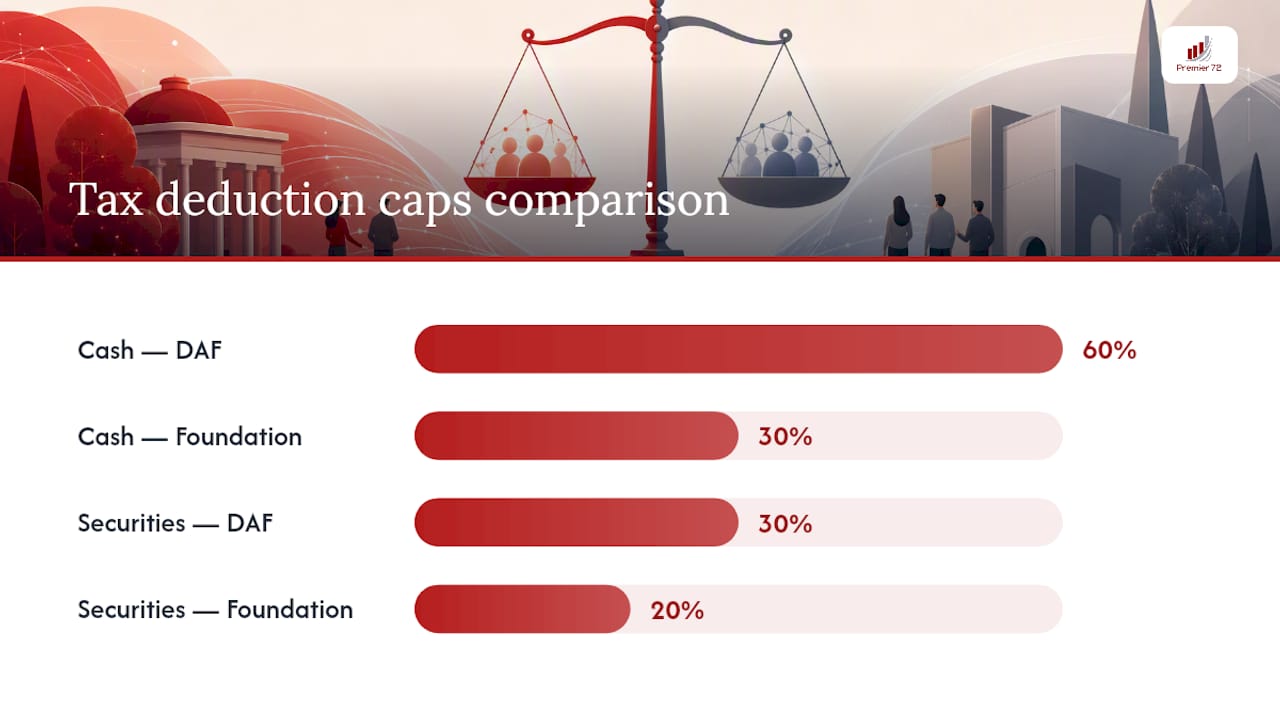
Tax treatment and AGI caps. DAFs let you deduct cash gifts up to 60% of AGI and appreciated public securities up to 30%. Private foundations cap those same gifts at 30% and 20% respectively, per National Philanthropic Trust. If you're funding a large gift in a high-income year, that spread can determine how much you actually get to deduct this year versus carrying forward.
Excise tax and payout. Foundations owe an excise tax on net investment income and must meet mandatory annual distribution requirements under Section 4942. DAFs carry neither obligation.
Control. Foundation boards have direct legal authority over grants, staff, and investments. DAF donors hold advisory privileges only; the sponsoring organization has final say.

Privacy. Foundation Form 990-PF filings are public record, listing grants, trustees, and compensation. DAF grants can be made anonymously.
Costs. DAF setup is often just an account application. Foundations require legal formation, ongoing accounting, and annual tax filings.
Asset acceptance. DAF sponsors frequently accept complex assets like closely held stock or real estate at fair market value. Foundations often limit the deduction to your cost basis on the same assets.
Best for: DAFs suit donors prioritizing simplicity, privacy, and deduction efficiency. Foundations suit families wanting a permanent institution, staff, and direct programmatic control over decades.
How U.S. Tax Rules Treat Each Vehicle Differently
The deduction math is where most donors first notice the daf vs foundation gap, and it's not a small difference once you're gifting appreciated assets or company stock.
Pro Tip: Model your deduction under both AGI caps before you commit assets. A gift that clears in one tax year through a DAF might spread across five years of carryforward through a foundation.
DAFs generally permit deducting cash gifts up to 60% of AGI and appreciated publicly traded securities up to 30%. Foundations cap cash at 30% and other appreciated assets at 20%, according to NPTrust's comparison. That gap compounds when you're gifting seven or eight figures in a single tax year tied to a business sale.
The basis rule matters even more for closely held assets. When you donate stock in a private company or real estate that isn't publicly traded, a private foundation typically limits your deduction to your original tax basis, not fair market value. DAF sponsors more often accept the same gift at fair market value, which can mean a materially larger deduction on the exact same asset.
- Section 4940 imposes an excise tax on a foundation's net investment income, a recurring drag DAFs don't carry.
- Section 4942 requires foundations to pay out a mandatory portion of average net assets each year, whether or not you're ready to grant that much.
- DAFs have no mandatory annual distribution and no excise tax on investment growth, per the statute itself.
What Foundations and DAFs Actually Cost to Run
A DAF account typically comes with a tiered sponsor fee, often a fraction of a percent of assets annually, with no legal setup and minimal paperwork. You fund it, recommend grants, and the sponsoring charity handles compliance.
Foundations carry real fixed costs regardless of size: legal formation, annual accounting, Form 990-PF preparation, state registration, and often a part-time or outsourced administrator once grant activity picks up.
- DAF setup: often same-day, with fees scaling down as assets grow.
- Foundation setup: legal formation, IRS exemption application, and ongoing compliance infrastructure.
- Fixed costs stay roughly flat whether your foundation holds $2 million or $20 million, which is why the economics shift with scale.
Practitioner guidance from Greater Houston Community Foundation suggests that a foundation's overhead typically starts to become cost-effective at higher asset levels, often in the multimillion-dollar range.
Pro Tip: Ask any foundation administrator for an itemized annual cost estimate, including audit fees, before you commit. Fixed costs on a $3 million foundation eat a much bigger percentage than the same costs on a $15 million one.
Who Actually Controls the Money and the Mission
A foundation board holds legal authority. Trustees vote on grants, hire staff, set investment policy, and can compensate family members serving in defined roles. A DAF donor holds advisory privileges only. The sponsoring organization approves every grant recommendation and retains final legal control of the assets.
That distinction shapes what each vehicle can build. Foundations support a permanent name, a physical or programmatic identity, and staff dedicated to your mission. DAFs operate under the sponsor's name and infrastructure.
- Foundations: family members can serve as paid staff or trustees; the board sets bylaws that outlive any single donor.
- DAFs: successor advisors (often children or a designated committee) simply continue recommending grants from the existing account.
- Succession in a foundation runs through board governance; succession in a DAF runs through named successor advisors on the account.
Families planning multigenerational giving often pair this decision with broader legacy planning strategies that coordinate the charitable vehicle with trusts and estate documents.
Giving Illiquid Assets, Scholarships, and Grants to Individuals
Business owners exiting a company often want to gift equity before a sale closes, and vehicle choice changes the outcome substantially. DAF sponsors more commonly accept closely held stock, real estate, or LLC interests at fair market value. Foundations frequently limit the same gift to your cost basis, per basis-rule guidance on non-publicly traded assets.
Foundations can also do things a DAF generally cannot: fund program-related investments, run scholarship programs, and make grants directly to individuals under IRS-approved procedures. DAFs are restricted to grants that flow to qualified public charities.
- Time the gift before a signed sale agreement, not after, to preserve valuation flexibility.
- Bring in valuation counsel and a tax advisor as soon as a sale process starts, not once terms are final.
- Confirm with IRS guidance on minimum investment return how a foundation's payout math will treat illiquid holdings once they convert to cash.
When Pairing a DAF and a Foundation Makes Sense
Many donors don't choose one. They use both, and the pattern is consistent enough that DAF sponsors publish guidance on it.
- Fund the DAF in a high-income year to capture the larger AGI deduction and accept complex assets at fair market value.
- Use foundation dollars for ongoing program work where board control, staffing, and public identity matter more than deduction size.
- Grant from the DAF into the foundation in years when the foundation needs to hit its 5% payout but liquidity is tight elsewhere.
DAF industry guidance frames this as capturing the DAF's tax efficiency while preserving the foundation's institutional identity, and it's the structure Premier72 sees most often among business-owner clients selling a company.
A Checklist Before You Decide
Work through these questions with counsel before signing formation documents or opening an account:
- How much do you realistically expect to give over your lifetime, and at what pace?
- Do you hold illiquid or closely held assets you'll want to gift, and does basis-versus-FMV treatment change the math?
- Does your family want public recognition, or does privacy matter more than institutional visibility?
- Are you prepared to staff, budget for, and file annual paperwork for a permanent legal entity?
Pro Tip: Ask your tax advisor to model both vehicles against your actual asset mix, not a generic example. A gift of publicly traded stock behaves nothing like a gift of pre-sale company equity under these rules.
Watch for three common mistakes: underestimating foundation administrative costs at smaller asset levels, assuming FMV treatment applies to every asset type, and forgetting that a foundation's Form 990-PF makes trustee names, grants, and compensation public record.
Why Timing Beats the Vehicle Itself
The vehicle you pick matters less than when you fund it. Business owners going through a sale under Premier72's Retirement Bank Method™ often benefit from funding a DAF in the year equity converts to cash, then deciding later whether a foundation earns its keep for the next generation. We've seen owners default to a foundation for prestige and later regret the fixed overhead on a smaller-than-expected windfall. Get the timing right first; the entity choice usually follows.
Frequently Asked Questions
Is a DAF better than a foundation for most donors? For giving under roughly $5 million, yes, largely because of lower costs, higher AGI deduction caps, and no mandatory payout. Above that range, a foundation's control and permanence often justify the overhead.
What's the main difference between a DAF and a private foundation? A DAF is an account you advise within a public charity; a foundation is a separate legal entity you control directly. That control comes with public disclosure and a mandatory 5% annual payout foundations must meet.
Can I use both a DAF and a foundation together? Yes. A common structure funds a DAF in a high-income year for the larger deduction, then grants from the DAF to support a foundation's ongoing program work.
Do private foundations pay taxes? Foundations owe a 1.39% excise tax on net investment income under Section 4940. DAFs carry no comparable excise tax on their growth.
How does gifting company stock differ between the two vehicles? Foundations often limit the deduction on closely held stock to your cost basis, while DAF sponsors more frequently accept the same gift at fair market value, which can produce a substantially larger deduction.
This article is general information, not a substitute for advice from a qualified financial advisor. Consult a qualified financial professional about your own circumstances before acting on anything here.
Sources
- 26 U.S. Code § 4940 — tax on net investment income of private foundations
- Public disclosure and availability of exempt organizations' returns and applications (IRS)
- Donor-Advised Funds vs. Private Foundations (National Philanthropic Trust)
- Private family foundation tax benefits (Greater Houston Community Foundation)
- Basis rules for charitable donations of non-publicly traded assets (PlannedGiving / GiftLawPro)