

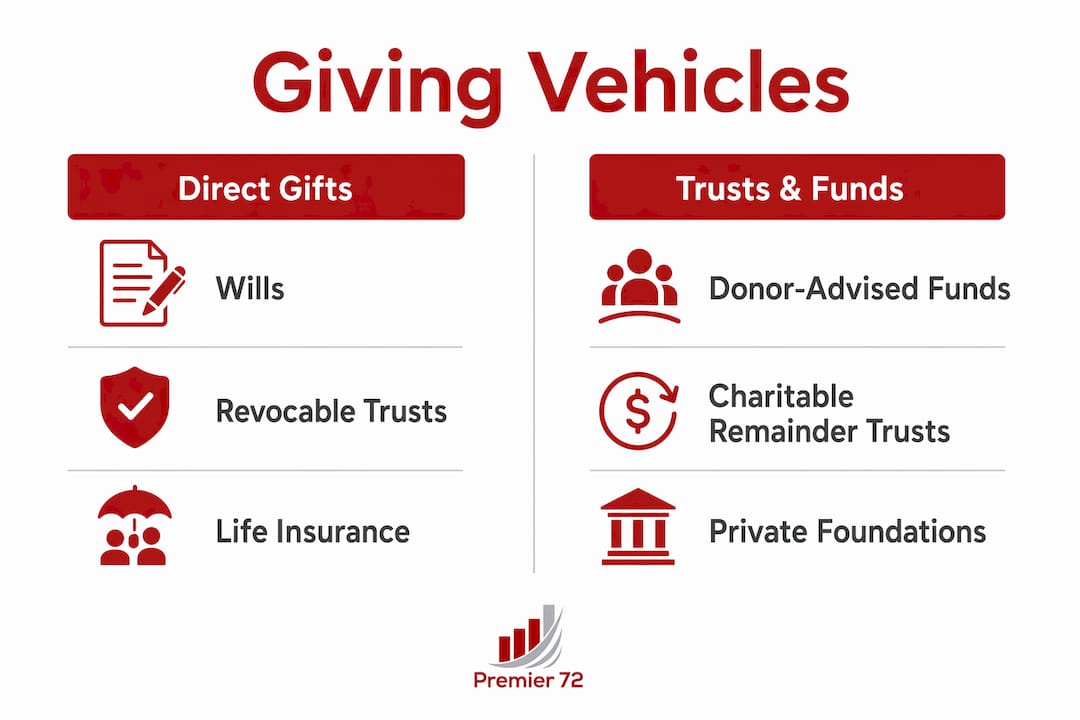
The most effective charitable legacy planning strategies do three things at once: they direct wealth to causes you care about, reduce estate and income taxes for your family, and create a philanthropic identity that outlasts you. The core vehicles available in 2026 are wills and revocable trusts with charitable beneficiaries, donor-advised funds (DAFs), charitable remainder trusts (CRTs), charitable lead trusts (CLTs), private foundations, and pooled income funds. Each one serves a different combination of income needs, tax goals, and family involvement preferences.
Key strategies at a glance:
- Wills and revocable trusts: Designate a percentage, fixed amount, or residue of your estate to named charities, with potential estate tax savings.
- Donor-advised funds (DAFs): Make an irrevocable, tax-deductible contribution now and recommend grants to qualified charities over time, including after your death.
- Charitable remainder trusts (CRTs): Transfer appreciated assets into an irrevocable trust, receive income for life or a term of years, and pass the remainder to charity while deferring capital gains.
- Charitable lead trusts (CLTs): Pay income to charity for a set term, then transfer remaining assets to heirs with reduced gift or estate tax exposure.
- Private foundations: Establish a family-controlled grantmaking entity with full discretion over charitable programs, subject to IRS compliance requirements.
- Pooled income funds: Contribute assets to a charity-managed fund, receive a proportional income stream for life, and claim a partial charitable deduction.
Aligning these tools with your estate plan from the start, rather than adding them as afterthoughts, is what separates a legacy that endures from one that dissolves in probate or tax liability.
How wills and revocable trusts establish your charitable legacy

A will or revocable trust is the most direct way to name a charity as a beneficiary of your estate. You can designate a specific dollar amount, a percentage of your estate, or the residue after family distributions are satisfied. Revocable trusts carry an added advantage: assets held in trust generally bypass probate, which means your charitable gift reaches its destination faster and with fewer administrative costs.
Precision in drafting these provisions protects your intent. Naming specific charities with their full legal name and Employer Identification Number (EIN) prevents disputes if an organization merges, rebrands, or dissolves before your estate is settled. Including contingent beneficiary language, such as directing the gift to a DAF sponsor if the named charity no longer exists, adds another layer of protection.
Best practices for charitable bequests:
- State the gift as a percentage of the estate rather than a fixed dollar amount when possible, so inflation and asset fluctuations do not erode the charitable share.
- Include a purpose clause if you want the gift restricted to a specific program, but confirm the charity can and will accept restricted gifts before finalizing the language.
- Review your will and trust documents after every major life event: marriage, divorce, the birth of a child, or the death of a named beneficiary.
- Balance family and charitable interests by using residuary bequests for charity, ensuring family members receive specific assets first.
Life insurance is another instrument worth considering alongside a will. Naming a charity as a beneficiary of a policy can fund a substantial bequest without reducing the assets your heirs inherit from the estate. Premier72's life insurance legacy planning resources walk through exactly how this structure works for families at different wealth levels.
How to clarify your charitable goals and choose the right assets
Defining what you want your philanthropy to accomplish is the foundation of any sound plan. Wealth advisors consistently find that clarifying family values before selecting vehicles produces more durable outcomes than choosing instruments first and retrofitting a mission later. Ask whether your priority is supporting a single cause deeply or spreading giving across multiple organizations, and whether you want family members involved in grant decisions after your death.
Asset selection is where tax efficiency is won or lost. Gifting long-term appreciated securities, such as stocks or mutual funds held more than one year, lets you claim a deduction at fair market value while avoiding the capital gains tax you would owe if you sold the shares first. Cash is simpler but less tax-efficient for most donors in higher brackets.
Retirement accounts deserve special attention. Assets left in a traditional IRA or 401(k) can face up to 70% tax erosion when inherited by individuals, because heirs pay ordinary income tax on every distribution. Leaving those same accounts directly to a qualified charity eliminates that tax entirely, since charities do not pay income tax. Your family, meanwhile, inherits other assets, such as a home or taxable brokerage account, that carry a stepped-up cost basis and far lower tax exposure.
Asset selection priorities:
- Appreciated securities: Maximize deduction and avoid capital gains; ideal for DAFs and direct gifts.
- Retirement accounts (IRAs, 401(k)s): Best candidates for charitable bequests at death to avoid income tax erosion.
- Real estate: Can fund large gifts but requires appraisal and careful legal structuring; consult an advisor experienced in complex charitable gifts.
- Cash: Simplest to administer; best used when appreciated assets are unavailable or already depleted.
- Closely held business interests: High potential value but subject to Unrelated Business Income Tax (UBIT) rules that can reduce the net benefit to the charity; expert guidance is required to avoid costly mistakes when gifting business interests.
For donors age 70½ or older, a Qualified Charitable Distribution (QCD) from a traditional IRA offers a direct path to tax-efficient giving during your lifetime. The 2025 QCD limit is $108,000 per person, and the distribution is excluded from gross income entirely rather than requiring itemization. That exclusion can also reduce Medicare premium surcharges and the taxable portion of Social Security benefits, two benefits that a standard charitable deduction does not provide. For a deeper look at how QCDs interact with filing status and income thresholds, the IRS tax filing guide provides clear, current guidance.
Donor-advised funds give you flexibility and control over lifetime giving
A donor-advised fund is a charitable account sponsored by a public charity, such as a community foundation or a national sponsoring organization, that lets you make an irrevocable, tax-deductible contribution and then recommend grants to IRS-qualified charities over time. The IRS defines DAFs as funds owned and controlled by the sponsoring charity, with donors retaining advisory privileges over grant recommendations.
The tax timing advantage is significant. You can contribute appreciated assets to a DAF in a high-income year, claim the full deduction immediately, and then distribute grants to charities across multiple years as your priorities evolve. This separates the tax event from the giving decision, which is particularly useful in years when you sell a business, receive a large bonus, or convert a retirement account.
DAF advantages for legacy planning:
- Name individual successors, such as children or grandchildren, to continue recommending grants after your death, creating a multi-generational giving program without the administrative burden of a private foundation.
- Name a DAF sponsor as the beneficiary of a retirement account or life insurance policy, bypassing probate and allowing successors to distribute grants to multiple charities from a single account.
- Contribute complex assets, including closely held stock or real estate, that many charities cannot accept directly.
- Fund a DAF with long-term appreciated assets to maximize tax savings while retaining flexibility on which charities ultimately receive the grants.
Pro Tip: Establishing a clear succession plan for your DAF, including written guidance on your philanthropic priorities, gives your successors a framework for grant decisions and reduces the risk that your giving legacy drifts from your original intent.
DAFs are generally more cost-effective and easier to administer than private foundations, making them the preferred starting point for most donors. For those with very large philanthropic commitments and a desire for direct control over grantmaking, a private foundation may be worth the added complexity.
How CRTs and CLTs balance income, family wealth, and charitable giving
Charitable remainder trusts and charitable lead trusts are the two primary split-interest vehicles in philanthropic estate planning. Both divide trust assets between charitable and non-charitable beneficiaries; the key difference is the order in which each receives benefit.
Charitable remainder trusts
A CRT is an irrevocable trust that pays income to you or another named beneficiary for life or a term of up to 20 years, with the remaining assets passing to charity at the end of the term. Transferring appreciated assets into a CRT defers capital gains that would otherwise be recognized on a sale, and you receive a partial charitable income tax deduction in the year the trust is funded. Two common structures are the charitable remainder annuity trust (CRAT), which pays a fixed dollar amount each year, and the charitable remainder unitrust (CRUT), which pays a fixed percentage of the trust's value recalculated annually.
CRTs work well for donors who hold low-basis appreciated assets, need retirement income, and want to make a meaningful charitable gift without sacrificing cash flow. The trade-off is irrevocability: once funded, the trust cannot be unwound.
Charitable lead trusts
A CLT reverses the sequence. The trust pays income to a designated charity for a set term, typically 10–20 years, and then distributes the remaining assets to your heirs. This structure can significantly reduce gift and estate taxes on the transfer to heirs, because the taxable value of the remainder interest is discounted by the present value of the charitable payments made during the term.
CLTs suit donors who want to support a charity now, reduce the taxable value of assets passing to the next generation, and are comfortable delaying the family inheritance. They are more complex to administer than CRTs and generally require an attorney experienced in trust drafting.
Key decision factors for both vehicles:
- Your current and projected income needs during the trust term.
- The type and cost basis of assets you plan to contribute.
- Whether your primary goal is income now (CRT) or wealth transfer efficiency later (CLT).
- The administrative costs of maintaining an irrevocable trust over a multi-year term.
Pro Tip: Naming a DAF sponsor as the charitable beneficiary of a CRT gives you flexibility to redirect grants among multiple charities after the trust is established, without the cost and legal complexity of amending the trust document itself.
Private foundations and pooled income funds for sustained family philanthropy
Private foundations
A private foundation gives you and your family direct control over grantmaking, investment policy, and charitable programs. You fund the foundation with an irrevocable contribution, receive a charitable deduction subject to IRS limits, and the foundation then makes grants to qualified organizations. Family members can serve on the board or as paid staff, creating a formal structure for multi-generational philanthropic engagement.
The governance obligations are real. Private foundations must file Form 990-PF annually, distribute at least 5% of their net investment assets each year, and comply with strict self-dealing rules that prohibit certain transactions between the foundation and its insiders. Failure to meet these requirements triggers excise taxes. For most donors, a DAF delivers similar family involvement with far less administrative overhead. A private foundation makes sense when you want to make grants to individuals, fund scholarship programs, or support causes that fall outside the standard 501(c)(3) framework, all of which a DAF cannot accommodate.
Pooled income funds
A pooled income fund is a trust maintained by a charity that combines contributions from multiple donors into a single investment pool. Each donor receives a proportional share of the fund's annual income for life, and at death, that donor's share of the pool passes to the charity. You receive a partial charitable deduction when you contribute, calculated based on your age and the fund's expected income rate.
Pooled income funds are less common than they were before DAFs became widely available, but they remain a useful option for donors who want a lifetime income stream from a charitable gift without the complexity of establishing a separate trust. Stanford University's pooled income fund is one example of how major institutions structure these vehicles for donors.
Administrative considerations:
- Private foundations carry ongoing legal, accounting, and filing costs that can be substantial for smaller endowments.
- Pooled income funds are managed by the sponsoring charity, removing administrative burden from the donor entirely.
- Both vehicles require careful coordination with your estate attorney and tax advisor before funding.
Integrating charitable giving into your full estate and wealth plan
Charitable planning integrated with overall wealth management consistently produces better outcomes than isolated gifts made without reference to your estate documents, tax situation, or family dynamics. The goal is a plan where every element, your will, your beneficiary designations, your trust structures, and your giving vehicles, reinforces the others.
Coordination steps that matter most:
- Align beneficiary designations with your will. Beneficiary designations on retirement accounts, life insurance policies, and DAF accounts override your will. An outdated designation can redirect assets away from your intended charitable beneficiaries entirely. Review designations after every major life event: marriage, divorce, the birth of a child, or the death of a named beneficiary.
- Coordinate estate tax planning with charitable deductions. The unlimited estate tax charitable deduction means assets passing directly to a qualified charity are fully excluded from your taxable estate. Structuring large charitable gifts through your estate plan can reduce or eliminate federal estate tax for your heirs.
- Involve family members early. Sharing your philanthropic values with heirs before your death reduces the risk of disputes and increases the likelihood that your giving legacy continues. DAFs and private foundations both provide formal mechanisms for family involvement in grant decisions, which builds shared ownership of the mission.
- Document your charitable intent precisely. Work directly with nonprofit partners to confirm they can accept and administer your intended gift. Vague or ambiguous gift language creates legal risk and can delay or reduce the benefit to the charity.
- Measure and report on impact. Ask the charities you support for annual impact reports and financial statements. Evaluating whether an organization is financially stable and mission-aligned protects your legacy from being absorbed by an institution that has drifted from its original purpose.
- Engage qualified advisors for complex gifts. Business interests, real estate, and retirement assets each carry specific tax and legal rules. An estate attorney, a CPA, and a financial advisor working together, rather than in isolation, produce plans that hold up over time.
Premier72 works with business owners and families to build legacy and estate plans that coordinate charitable giving with income protection, business succession, and wealth transfer. The goal is a plan that reflects your values and protects the people and causes you care about most.
Work with Premier72 to build your charitable legacy plan

Charitable legacy planning works best when it is built into your overall financial and estate strategy from the start, not added at the end. Premier72 helps business owners, professionals, and families structure giving plans that reduce taxes, protect family wealth, and create lasting philanthropic impact. Whether you are evaluating a donor-advised fund, a charitable remainder trust, or a private foundation, the right structure depends on your income needs, asset types, and family goals.
Connect with Premier72 at premier72.com to start building a legacy plan that reflects what matters most to you.
Key Takeaways
Effective charitable legacy planning integrates the right giving vehicles, asset types, and estate documents into a single coordinated plan that maximizes both philanthropic impact and tax efficiency.
| Point | Details |
|---|---|
| Retirement accounts for charity | Retirement assets left to charity avoid up to 70% tax erosion that occurs when inherited by individuals. |
| QCD annual limit | Donors age 70½ or older can direct up to $108,000 per year from a traditional IRA to charity, excluded from gross income. |
| Beneficiary designations override wills | Outdated designations redirect assets away from intended beneficiaries; review after every major life event. |
| DAFs vs. private foundations | DAFs provide similar family involvement with far less administrative overhead than private foundations. |
| Integrated planning produces better outcomes | Charitable giving coordinated with estate, tax, and family wealth plans consistently outperforms isolated gifts. |