

Yes, an installment sale under IRC §453 generally lets you defer capital gain recognition, reporting a portion of gain only as principal payments arrive. Depreciation recapture is the exception: it lands as ordinary income in full during the year of sale, interest on the note is taxed separately, and the whole arrangement gets tracked on Form 6252, with related amounts flowing to Form 4797, Form 8949, Schedule D, and Schedule B.
TL;DR:
- The installment sale method defers capital gains but requires full recognition of depreciation recapture in the year of sale, resulting in potential high upfront taxes.
- It applies automatically unless you sell at a loss, deal with inventory or dealer property, or sell publicly traded securities; the election deadline is the filing due date of the sale year.
- Calculation of taxable gain depends on the gross profit ratio, which must be determined at sale and applied to each principal payment, including noncash and assumed debt considerations.
- Form 6252 is essential for reporting installment sales annually, with explicit checks needed for recapture, interest, and related-party rules to avoid penalties.
- Proper modeling of buyer creditworthiness, recapture, and interest rates before finalizing the deal mitigates risks and ensures accurate tax planning.
Table of Contents
- What Counts as an Installment Sale Under Installment Sale Tax Rules?
- How Do You Calculate Installment Sale Income?
- Which Tax Forms Do Installment Sales Require?
- How Does Depreciation Recapture Affect Installment Sale Taxation?
- How Is Interest Taxed on an Installment Sale?
- Can You Elect Out of the Installment Method?
- What Should Sellers Consider Before Choosing Installment Treatment?
- Installment Sale Checklist: What to File and When
- What Business Owners Get Wrong About Installment Sale Tax Planning
- How Premier72 Helps Structure Installment Sales
- Where to Find the Official Installment Sale Tax Rules
- Sources
What Counts as an Installment Sale Under Installment Sale Tax Rules?
An installment sale is any disposition of property where you receive at least one payment after the tax year of the sale. That's the entire test. You don't need a formal "installment sale agreement" with that exact title. A note, a mortgage held by the seller, a land contract, or a simple promise to pay the balance next year all qualify, as long as cash or its equivalent doesn't change hands entirely at closing.
The IRS's Publication 537 treats the installment method as the default, not an election. If your sale qualifies, the IRS assumes you're using it unless you actively elect out. That surprises a lot of sellers who structured a deal thinking they had a choice to make later. You don't. The choice happens by the filing deadline for the year of sale.
Not every deferred payment arrangement qualifies, though. The installment method is off the table in three common situations:
- Sales resulting in a loss. If your adjusted basis exceeds what you're receiving, you recognize the full loss immediately. There's nothing to defer.
- Inventory and dealer sales. Property held primarily for sale to customers in the ordinary course of business doesn't qualify, regardless of payment terms.
- Publicly traded stock or securities. Sales of securities traded on an established market must be reported in full in the year of the trade, even with a deferred payment structure, according to Publication 537.
Most business owners run into the installment method when selling real estate, equipment, or an entire company where the buyer can't (or won't) pay 100% at closing. Seller financing bridges that gap, and it's often the difference between a deal closing and a deal falling apart over financing contingencies.
How Do You Calculate Installment Sale Income?
Four numbers drive every installment sale calculation: selling price, adjusted basis, selling expenses, and contract price. Get these right and the rest is arithmetic.
Selling price is the total the buyer agrees to pay, including cash, the fair market value of any property received, and any debt assumed by the buyer. Adjusted basis is what you paid for the asset, adjusted for improvements and depreciation taken over the years. Selling expenses cover commissions, legal fees, and similar transaction costs. Contract price usually equals the selling price, unless the buyer assumes a mortgage or debt that exceeds your adjusted basis, in which case only the excess counts toward the contract price.
Gross profit is selling price minus adjusted basis minus selling expenses. From there, the gross profit ratio does the heavy lifting:
Gross profit ratio = Gross profit ÷ Contract price
Apply that ratio to every principal payment you receive, and the result is the portion treated as taxable gain for that year. The rest of each payment is simply a return of your basis, untaxed.
Here's how it plays out with real numbers.
- Sale terms: You sell a rental property for $500,000. Your adjusted basis is $200,000, and you pay $20,000 in selling expenses.
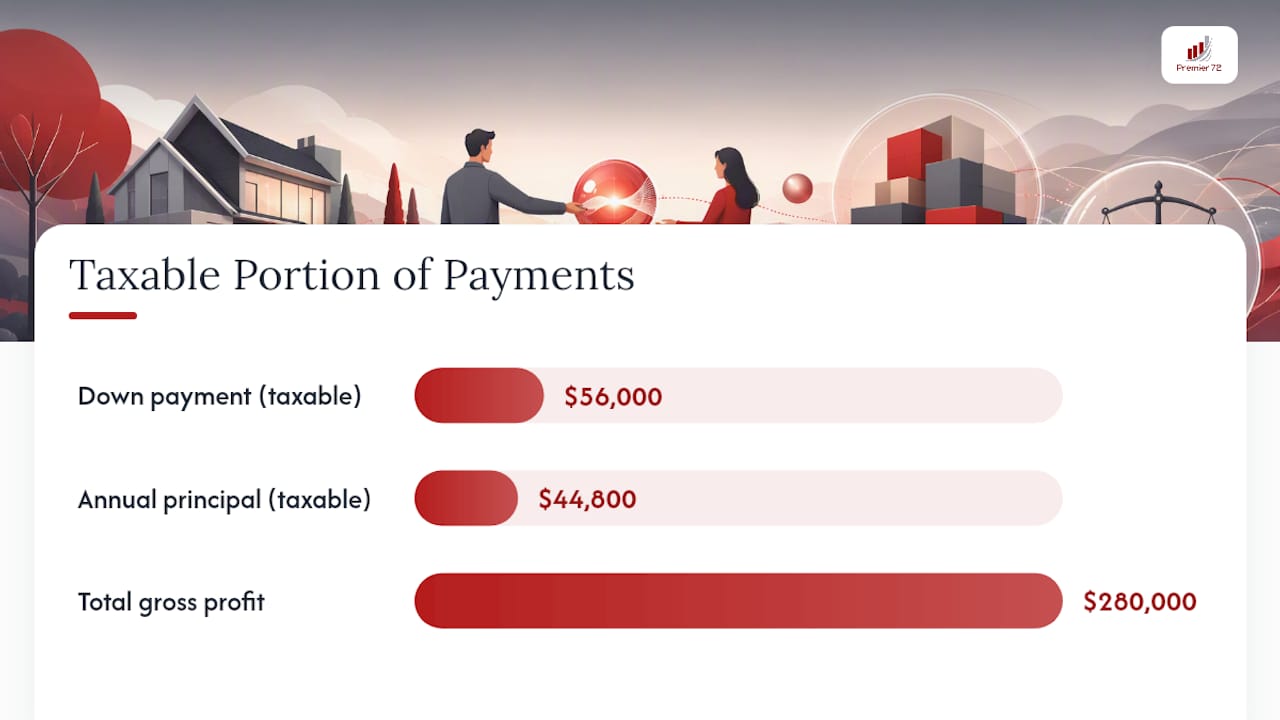
- Gross profit: $500,000 minus $200,000 minus $20,000 equals $280,000.
- Contract price: Assume no debt assumption, so contract price equals $500,000.
- Gross profit ratio: $280,000 ÷ $500,000 equals 0.56, or 56%.
- Payment structure: The buyer pays $100,000 down and $80,000 per year for five years, plus interest.
- Year 1 taxable gain: $100,000 down payment times 56% equals $56,000 of taxable gain.
- Year 2 taxable gain: $80,000 principal payment times 56% equals $44,800 of taxable gain.
Pro Tip: Run this calculation before you sign the contract, not after. The gross profit ratio is fixed once the sale closes, so if depreciation recapture will eat most of your down payment in taxes, you want to know that while you can still negotiate a larger down payment or different terms.
Two wrinkles complicate this in practice. First, if the buyer assumes existing debt on the property that exceeds your adjusted basis, that excess is treated as a payment received in the year of sale, even though no cash changed hands. Second, if you receive noncash property as part of the deal, such as other real estate or equipment, it's valued at fair market value and treated as a payment in the year received.
Partial-year receipts don't require a different formula. Whatever principal you actually collect in a given calendar year gets multiplied by the same gross profit ratio you calculated at the outset. That ratio doesn't change from year to year, which is exactly why getting it right at the start matters.
Which Tax Forms Do Installment Sales Require?
Form 6252 is the anchor. You file it in the year of sale and again in every subsequent year you receive a principal payment, according to the IRS's Topic No. 705. It has three parts, and understanding what each one does prevents most of the filing errors that trigger IRS notices.
Part I computes the gross profit ratio in the year of the sale. This is where your selling price, basis, selling expenses, and contract price all get entered. You calculate this once, and it carries forward.
Part II applies that gross profit ratio to the current year's payments. You complete this section every single year you collect principal, not just in year one.
Part III applies only when you sold to a related party. It tracks whether that related party resells the property within two years, which can accelerate your remaining deferred gain.
From Form 6252, the taxable capital gain portion flows to Form 8949 and then Schedule D. If depreciation recapture applies, that portion instead flows to Form 4797, Sales of Business Property, and it's recognized in full in the year of sale regardless of how little cash you actually received.
Interest income is a separate animal entirely. Every dollar of interest on the installment note is ordinary income, reported on Schedule B, not on Form 6252. Many sellers mistakenly lump interest in with principal when tracking payments, which throws off both the gross profit calculation and the interest reporting.
A few filing habits worth building:
- Keep a running payment ledger separating principal from interest for every payment received.
- Retain the original sale contract, security agreements, and any amendments for as long as the obligation is outstanding.
- Check your state's treatment of installment income. Most states with income tax follow the federal installment method, but a handful require full gain recognition in the year of sale regardless of federal treatment, so confirm your state's specific rule before assuming automatic conformity.
- File Form 6252 every year you receive a payment, even a small one. Skipping a year because the payment was minor is one of the most common triggers for IRS correspondence.
How Does Depreciation Recapture Affect Installment Sale Taxation?
Depreciation recapture is where sellers get blindsided. The installment method defers capital gain, but it does not defer recapture. That distinction sits at the center of nearly every miscalculation Premier72 sees when reviewing a proposed sale structure.
Section 1245 recapture applies to gains attributable to depreciation taken on personal property, like equipment or machinery. Under Publication 537, this amount must be recognized as ordinary income in full, in the year of sale, no matter how the payment schedule is structured. A five-year note with a small down payment doesn't spread this tax out. It hits all at once.
Section 1250 unrecaptured gain applies to real property and works differently. The allocation order matters: recapture-eligible gain under §1250 comes out of each payment before regular capital gain does.
Here's why this catches sellers off guard. Say you sell equipment for $300,000 with a $30,000 down payment, and $150,000 of the total gain is §1245 recapture. You collect $30,000 in cash, but you owe ordinary income tax on the full $150,000 recapture amount in year one. Your tax bill can easily exceed the cash you actually received.
- §1245 recapture: ordinary income, fully recognized in year of sale, no deferral available.
- §1250 unrecaptured gain: taxed as payments are received, capped at a 25% maximum rate, allocated ahead of standard capital gain.
- Dealer dispositions and inventory sales: excluded from installment treatment entirely, as covered above.
- Publicly traded securities: full gain or loss recognized in the year of the trade.
Pro Tip: Before you agree to installment terms, ask your accountant to isolate the recapture amount separately from the capital gain portion. If recapture represents more than your down payment, you need a plan for paying that tax bill out of other funds, because the sale itself won't generate enough cash in year one to cover it.
How Is Interest Taxed on an Installment Sale?
Every payment on an installment note typically has two components: principal, taxed under the gross profit ratio, and interest, taxed as ordinary income on Schedule B. Sellers who set the interest rate too low, or skip stating interest altogether, run into a different problem: the IRS steps in and recharacterizes part of the deal.
If the contract doesn't specify adequate stated interest, the IRS treats part of each principal payment as unstated interest or original issue discount (OID) instead. This recalculation uses the Applicable Federal Rate (AFR), published monthly by the IRS, as the benchmark for what "adequate" interest looks like. Fall below that rate and a portion of what you thought was tax-deferred principal gets reclassified as ordinary interest income, taxed immediately rather than spread across the gross profit ratio.
Finding the current AFR takes a quick check of the IRS's monthly revenue rulings, and pricing your note at or above the applicable short-term, mid-term, or long-term rate (depending on the note's length) sidesteps this issue entirely.
- Interest income is always ordinary income, reported annually on Schedule B, regardless of the underlying asset sold.
- Contracts with below-market or no stated interest risk automatic reclassification under the unstated interest and OID rules described in Form 6252's instructions.
- AFRs vary by note length and compounding period, so match the rate category to your actual contract terms.
- Section 453A imposes an additional interest charge on the deferred tax liability itself for certain large installment obligations, layering a real dollar cost on top of standard reporting.
The §453A charge catches larger transactions specifically. If your outstanding installment obligations from sales exceeding certain thresholds carry into future years, the IRS charges interest on the deferred portion of your tax liability, separate from and in addition to the eventual capital gains tax itself. Business owners selling a company for a substantial sum on extended terms should have this checked before finalizing deal structure, not after.
Can You Elect Out of the Installment Method?
You can, and sometimes you should. Electing out means reporting the entire gain, including any portion that would otherwise be deferred, in the year of sale as if you'd received full payment upfront.
The election happens by reporting the full gain on a timely filed return, including extensions, for the year of the sale. There's no separate election form. You simply choose not to use Form 6252 for deferral and instead recognize everything immediately on Form 8949, Schedule D, or Form 4797 as applicable, per IRC §453.
Once made, this election is generally locked in. Revoking it requires IRS consent, and the agency doesn't grant that easily. Sellers considering electing out should model the decision carefully before filing, since reversing course later is far harder than the initial decision.
Why would anyone elect out of tax deferral voluntarily? A few scenarios come up regularly:
- You expect your marginal tax rate to rise substantially in future years and prefer to lock in gain at today's rate.
- You're carrying a large capital loss in the current year that would otherwise expire unused, and the installment gain can absorb it.
- You want to avoid the ongoing compliance burden of filing Form 6252 annually for a small remaining balance.
Related-party rules under IRC §453(e) deserve separate attention. If you sell to a related party (a spouse, child, or an entity you control, for example) and that related party resells the property within two years, your remaining deferred gain can be accelerated and taxed immediately, even though you haven't collected the money yet. This rule exists specifically to prevent families from using installment sales to shift basis around without paying tax. Structuring an installment sale to a related party without accounting for this two-year lookback is one of the more common and avoidable mistakes we see in family business transitions.
What Should Sellers Consider Before Choosing Installment Treatment?
Modeling cash flow before you sign anything beats discovering the tax bill after the fact. Run the numbers on expected year-one tax given recapture, factor in the down payment size, and stress-test what happens if the buyer misses a payment or defaults entirely partway through the note term.
Buyer credit risk is the piece sellers underweight most often. You've deferred your gain, but you've also become the buyer's lender, with all the collection risk that implies. If the buyer's business underperforms and payments stop, you're left holding a note that may be difficult to collect on, while the IRS still expects reporting based on the original contract terms until the obligation is formally resolved.
A few risk mitigations worth building into any seller-financed deal:
- Secure the note with a lien or security interest in the assets sold, not just a personal guarantee.
- Require an escrow or reserve account for a portion of early payments.
- Consider key person or business protection coverage on the buyer, particularly if the buyer's continued operation of the business is what funds your payments.
- Ask prospective buyers for financial statements, tax returns, and a clear capital structure before agreeing to extended terms.
Pro Tip: If the buyer is financing a large portion of the deal through seller notes, ask about their own debt service coverage before you finalize terms. A buyer who's overleveraged elsewhere is a buyer more likely to miss your payments first.
Generally, we recommend installment treatment when a seller's cash-flow needs allow for deferral, the buyer's credit is strong, and the recapture exposure is modest relative to the down payment received. We lean toward electing out, or restructuring the deal entirely, when recapture would consume most of the cash received at closing, or when the buyer's financial position raises real collection concerns. Every exit plan we build starts with understanding the actual capital gains exposure before any payment structure gets finalized.
Installment Sale Checklist: What to File and When
Closing an installment sale correctly means following the same sequence every time, whether it's your first sale or your fifth.
- Before closing: Model expected recapture, capital gain, and interest income under different down payment scenarios to see year-one cash-flow impact.
- At closing: Calculate gross profit, contract price, and the gross profit ratio; document the sale contract, security agreements, and payment schedule.
- Year of sale: File Form 6252 Part I to establish the gross profit ratio; report any recapture on Form 4797; report the first year's taxable gain on Form 8949 and Schedule D.
- Every subsequent payment year: Complete Form 6252 Part II using the same gross profit ratio; report interest income on Schedule B; carry the taxable gain portion to Form 8949 and Schedule D.
- Ongoing: Retain copies of the contract, amortization schedule, security agreements, and AFR documentation for the life of the obligation.
Missing a single year's Form 6252 filing, even for a modest payment, is one of the fastest ways to draw an IRS inquiry on an otherwise straightforward sale.
What Business Owners Get Wrong About Installment Sale Tax Planning
The biggest misconception is treating the installment method as a blanket tax deferral tool. It isn't. It defers capital gain, but depreciation recapture arrives on schedule regardless of your payment terms, and that timing mismatch is where I see business owners get caught most often.
The second mistake is skipping buyer diligence. Sellers spend weeks negotiating price and terms, then accept a buyer's personal guarantee without checking whether that guarantee means anything. A note is only as good as the buyer's ability to pay it, and no amount of clever tax structuring fixes a buyer who runs out of cash in year two.
If there's one rule of thumb worth carrying into any seller-financed deal, it's this: model the recapture and the buyer's creditworthiness before you model the tax rate you'll pay on the deferred gain, because the first two determine whether the third ever matters.
— Asa
How Premier72 Helps Structure Installment Sales
We work with established business owners who are weighing exactly this decision: whether seller financing fits their exit, and how to structure it so the tax outcome matches the cash-flow reality. Advisory engagements include tax-aware sale structuring, cash-flow modeling that accounts for recapture and buyer risk, and liquidity planning designed to protect what you've built.

If you're weighing an installment sale as part of a business exit, the time to model the tax consequences is before terms get finalized, not after. A structured advisory review walks through specific numbers, including expected recapture, contract price, and buyer credit exposure, so you know what you're agreeing to. Visit Premier72 to schedule a review of your exit structure and see how installment treatment fits your specific transaction.
Where to Find the Official Installment Sale Tax Rules
- Publication 537 (Installment Sales) is the IRS's primary guide covering definitions, exclusions, and worked examples.
- Topic No. 705, Installment Sales and the instructions for Form 6252 explain the filing mechanics for each payment year.
- IRC §453 provides the statutory authority behind the entire installment method.
This article is general information, not a substitute for advice from a qualified financial advisor. Consult a qualified financial professional about your own circumstances before acting on anything here.
Sources
- Publication 537 (Installment Sales) — IRS
- Topic No. 705, Installment Sales — IRS
- 26 U.S.C. §453 — Installment method (US Code)
- About Form 6252, Installment Sale Income — IRS