

If you're 59½ or older, sit in the 22% federal tax bracket or higher, and can lock money away for the term, a multi-year guaranteed annuity typically outperforms a CD on an after-tax basis. If you're under 59½, may need the cash before maturity, or want the simplicity of federal deposit insurance, a certificate of deposit is usually the better fit. The gap comes down to yield, tax deferral, and how each product handles early access. The decision checklist below walks through them step by step.
TL;DR:
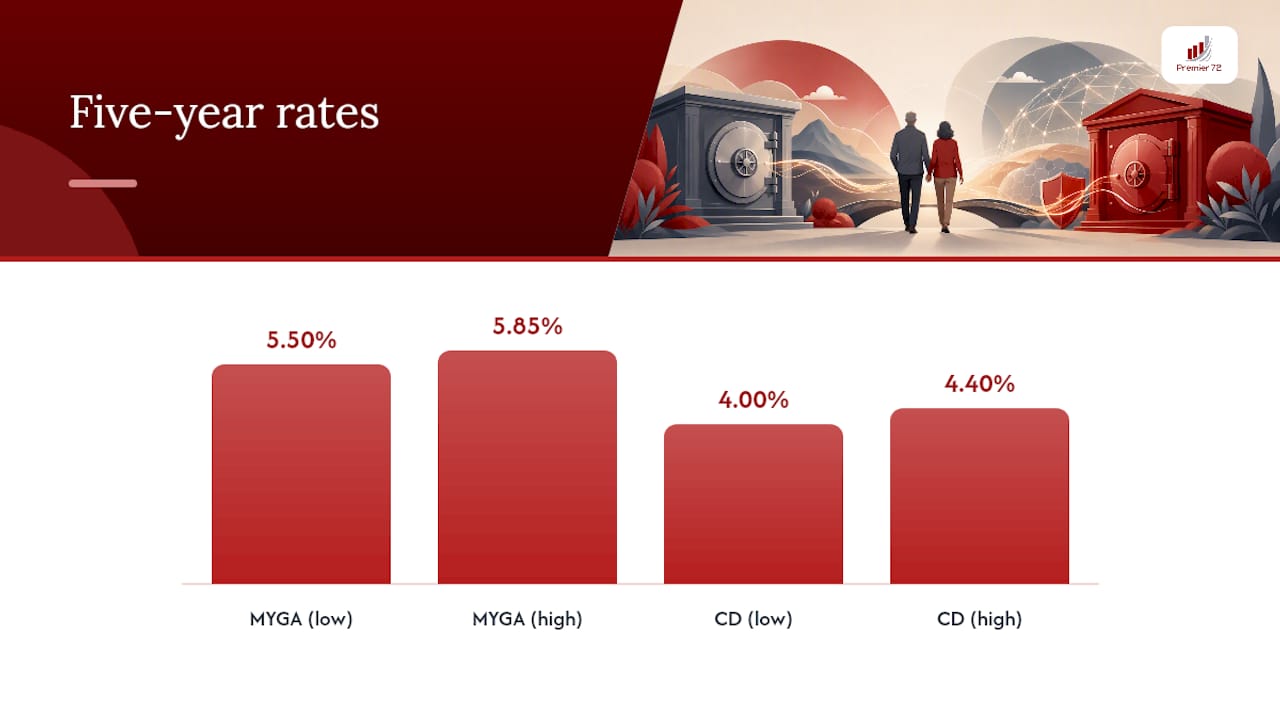
- MYGAs typically offer higher rates, around 5.50% to 5.85% over five years, compared to CD rates of 4.0% to 4.40%, benefiting taxpayers in higher brackets after tax deferral.
- Early withdrawal costs for MYGAs depend on surrender charges and market value adjustments, while CDs usually impose penalties of a few months' interest, making liquidity considerations crucial.
- For individuals over 59½ in the 22% or higher tax bracket, a MYGA can outperform a CD after taxes if funds are locked for the full term and withdrawals are delayed until maturity.
- A CD provides federal deposit insurance up to $250,000 per bank and has a simple, predictable penalty structure, making it preferable for those needing quick access or smaller deposits.
- Combining a MYGA with a CD ladder and shopping for multiple quotes maximizes yields and flexibility, especially for large deposits exceeding FDIC limits or uncertain liquidity needs.
Table of Contents
- What Is a MYGA vs CD? Two Fixed-Rate Tools, Different Foundations
- How MYGAs and CDs Actually Work Day to Day
- MYGA vs CD Rates in 2026: The Spread and Why It Exists
- Weighing the Trade-Offs: MYGA Advantages Over CD, and Where CDs Win
- A Step-By-Step Checklist for Choosing Between MYGA and CD
- What to Request When Comparing Offers
- Where This Fits Into a Bigger Retirement or Exit Plan
- How Premier72 Helps You Put This Comparison to Work
- Sources
What Is a MYGA vs CD? Two Fixed-Rate Tools, Different Foundations
A multi-year guaranteed annuity, or MYGA, is a single-premium fixed annuity issued by an insurance company and features tax-deferred growth mechanics that can enhance long-term accumulation. You deposit a lump sum, the insurer guarantees a fixed rate for a set term, usually three to ten years, and your earnings grow tax-deferred until you withdraw them. A certificate of deposit is a time deposit issued by a bank or credit union, insured by the FDIC or NCUA, with interest taxed as ordinary income every year you earn it.
Both products exist because savers want predictability without market exposure. That shared purpose is exactly why people compare them, even though one is an insurance contract and the other is a bank product regulated under an entirely different framework.
They share more structural DNA than most savers realize:
- Both lock in a fixed interest rate for a defined term set at purchase.
- Both penalize you for pulling money out early, though the mechanics differ sharply.
- Both work well for money you don't need to touch until a known future date.
- Neither carries stock-market risk. Your principal is protected by contract terms, not by price appreciation.
The difference that actually matters starts once you look at how the two are taxed, insured, and unwound early. That's where a MYGA versus CD comparison stops being academic and starts changing your after-tax number.
How MYGAs and CDs Actually Work Day to Day
You buy a CD directly from a bank or credit union, often online in minutes, with minimums as low as $500 to $1,000. A MYGA requires going through a licensed insurance agent or annuity marketplace, and minimum deposits commonly start around $10,000 to $25,000, sometimes higher depending on the carrier.
The tax timing is where the two products genuinely diverge. A CD generates a 1099-INT every year, and you owe tax on that interest whether or not you touch the account. A MYGA defers taxation entirely until you take a withdrawal, which means your money compounds on the full pretax balance every year of the term.
Withdrawal rules follow the same split:
- CDs charge an early-withdrawal penalty, typically a set number of months of interest, detailed on your account disclosures.
- MYGAs use a declining surrender-charge schedule and sometimes apply a market value adjustment that can move the surrender value up or down with interest rates.
- Most MYGAs also allow a 10% free withdrawal each year without triggering the surrender charge, a feature few CDs match.
Either product can also sit inside a traditional or Roth IRA, which changes the tax picture again since IRA rules, not the product's native tax treatment, govern withdrawals.
Pro Tip: If you're funding a MYGA with IRA money you already control, ask the carrier for the free-withdrawal percentage in writing before you sign. It varies by contract, and it's the detail that determines how much flexibility you actually have if plans change.
MYGA vs CD Rates in 2026: The Spread and Why It Exists
The rate gap between the two products right now is wide enough to change real outcomes. Top 5-year MYGA rates run roughly 5.50% to 5.85%, while top 5-year CD rates cluster closer to 4.0% to 4.40%. That's a typical spread of 130 to 165 basis points in the MYGA's favor.
Insurers can pay more because they invest premiums in longer-duration bonds and commercial mortgages that banks generally avoid holding against short-term deposit liabilities. Banks price CDs against their own funding costs and liquidity needs, which tends to cap what they can offer.
Run the tax-deferral math and the gap widens further for the right saver. On a $200,000 deposit, a 5-year MYGA at 5.75% can beat a 5-year CD at 4.30% after tax for someone in the 22% bracket or higher who is past 59½. Pull the money out early, before 59½, and the 10% IRS penalty on the earnings portion usually erases that advantage and flips the math back toward the CD.
The guarantee structures behind each product also diverge in ways that matter more than most savers assume:
- CDs carry FDIC or NCUA coverage up to $250,000 per depositor, per institution, backed by the federal government.
- MYGAs are backed by the issuing insurer's claims-paying ability, with a safety net from state guaranty associations that varies by state and carries its own coverage caps.
- Checking a carrier's AM Best rating before buying a MYGA is not optional due diligence. It's the closest thing to a credit check you'll get on an insurance company.
Three quick scenarios show how this plays out. A retiree with $200,000 and no near-term liquidity need, past 59½, in the 22% bracket, is a strong MYGA candidate. A 45-year-old saver building an emergency fund needs the CD's penalty-light exit and FDIC backing. A saver with $400,000 to place can ladder MYGAs across two or three highly rated carriers, or split CDs across multiple banks, to stay inside FDIC limits while still capturing the higher MYGA yield on part of the balance.
Weighing the Trade-Offs: MYGA Advantages Over CD, and Where CDs Win
Neither product is universally better. Each carries real advantages and real limitations, and the right answer depends entirely on your age, tax bracket, and need for access.
MYGA strengths:
- Higher guaranteed rate in the current environment, often 100+ basis points above comparable CDs.
- Tax-deferred growth compounds on the full pretax balance, not the after-tax remainder.
- Often includes a 10% annual free-withdrawal allowance most CDs don't offer.
MYGA weaknesses:
- Backed by insurer strength and state guaranty limits, not federal deposit insurance.
- Surrender charges plus a possible market value adjustment make early exits costlier and less predictable than a CD penalty.
- Less familiar product, so shopping around takes more effort than opening a bank CD.
CD strengths:
- FDIC or NCUA insurance up to $250,000 per bank, unconditional and government-backed.
- Simple, well-understood early-withdrawal penalty, usually just months of forfeited interest.
- Widely available with low minimums and fast setup.
CD weaknesses:
- Interest taxed annually, even when reinvested, which drags down real compounding.
- Lower yield ceiling than MYGAs in most current-rate environments.
Locking either product into a long fixed-rate term also means giving up flexibility if rates rise or inflation runs hot during the term. That opportunity cost is real, and it's the main argument for laddering rather than committing an entire balance to a single term length.
A Step-By-Step Checklist for Choosing Between MYGA and CD
- Are you under 59½? If yes, lean toward a CD. Early MYGA withdrawals of earnings before 59½ typically trigger ordinary income tax plus a 10% IRS penalty, which usually outweighs the rate advantage.
- Will you need this money before the term ends? If there's a real chance you will, favor a CD or build a CD ladder with staggered maturities instead of locking everything into one term.
- What's your marginal federal tax bracket? Below the 12% bracket, the tax-deferral benefit of a MYGA shrinks and may not offset the extra shopping effort. At 22% or above, deferral starts pulling real weight.
- How large is your deposit relative to the $250,000 FDIC limit? If you're placing more than that in one bank, a MYGA, a CD ladder across multiple institutions, or a mix of both keeps you fully covered.
Pro Tip: Don't treat this as all-or-nothing. Splitting a large balance between a MYGA for the portion you won't touch and a CD ladder for the portion you might need is often smarter than picking one product for the entire deposit.
Laddering across carriers, using an IRA wrapper where it makes sense, and collecting at least three quotes before committing are the three habits that separate savers who get a fair rate from savers who don't.
What to Request When Comparing Offers
Getting an apples-to-apples quote takes more than asking "what's your rate." Request these specifics from every bank or carrier before deciding:
- Guaranteed rate or APY, stated for the exact term you're considering.
- Full surrender or early-withdrawal schedule, including whether a market value adjustment applies.
- Free-withdrawal percentage allowed annually without penalty.
- Minimum deposit and any breakpoints for higher rates at larger balances.
- Carrier financial strength rating, checked independently rather than taking the agent's word for it.
- Written confirmation of FDIC or NCUA coverage status for CDs.
For a quick after-tax comparison, take each product's stated rate, apply your marginal tax rate annually to the CD and only at withdrawal to the MYGA, and compare the compounded ending balance over the full term. Verify any insurer's rating and your state's guaranty association limits before signing, since those numbers vary. Getting three quotes, not one, is what actually moves the needle. Rate shopping in the current environment, where the Fed's rate path favors locking in now, rewards patience more than it did a few years ago.
Where This Fits Into a Bigger Retirement or Exit Plan
Inside our Retirement Bank Method™, we treat guaranteed-rate instruments like MYGAs and CDs as one bucket in a larger structure, not a standalone decision. Business owners heading toward a sale or succession often need a portion of proceeds parked in something predictable while the rest of the plan builds around cash flow and legacy goals. Matching the instrument's term to your actual exit timeline, not just the highest posted rate, is what makes this piece of the plan hold up. Get the term wrong and you either lock money past the day you need it or leave yield on the table by going too short.

How Premier72 Helps You Put This Comparison to Work
Choosing between a MYGA and a CD is one decision inside a much bigger picture: how your retirement income, business exit timeline, and tax situation fit together. We help business owners and retirement-minded savers evaluate fixed-rate instruments as part of a full plan, not in isolation, drawing on experience in retirement income planning, annuity placement, and exit readiness advisory.

If you're weighing a MYGA against a CD ladder, or trying to figure out how either fits alongside a pending business sale, a structured advisory review can clarify the tradeoffs faster than shopping rates alone. You can also read more about how tax deferral builds long-term wealth or explore how GLWB riders add income guarantees to a MYGA strategy. When you're ready to compare real numbers against your own timeline, schedule a consultation and get quotes built around your actual retirement or exit plan, not a generic rate table.
This article is general information, not a substitute for advice from a qualified financial advisor. Consult a qualified financial professional about your own circumstances before acting on anything here.
Sources
- Annuity vs CD (2026): MYGA at 5.75% vs CD at 4.30%
- IRS Publication P575: Pension and Annuity Income
- FDIC