
If you're buying an owner-occupied building or heavy equipment with a long useful life, the SBA 504 loan usually costs less over time, if you need flexibility for working capital, acquisitions, or refinancing, SBA 7(a) is the better tool. Some borrowers use both, since SBA rules now allow combined exposure across the two programs. The right pick depends on what you're financing, not just the rate on the term sheet.
TL;DR:
- Borrowers planning to finance owner-occupied real estate or heavy equipment should prefer the SBA 504 loan for its fixed interest rate over long terms.
- Complex projects involving both real estate and working capital often benefit from a combined SBA 7(a) and 504 structure, with coordination between lenders required.
- The typical closing timeline for a 7(a) loan ranges from 45 to 90 days, while 504 loans generally take 60 to 120 days due to multi-party underwriting.
- The fixed-rate advantage of 504 is most cost-effective for assets held for 15 to 20 years, but may be less competitive over shorter periods due to higher upfront costs.
- Successful SBA loan application preparation involves organized financial documentation, a clear use-of-funds plan, and an understanding of loan structure relative to asset holding period.
Table of Contents
- SBA 7(a) vs. 504: A Quick Side-by-Side Comparison
- What SBA 7(a) Loans Actually Cover
- What SBA 504 Loans Are Built For
- A Decision Checklist for Choosing Between 7(a) and 504
- What to Expect During Underwriting and Closing
- Using Both Programs Together
- Getting Your SBA Application Lender-Ready
- The Real Trade-off Nobody Frames Correctly
- Sources
SBA 7(a) vs. 504: A Quick Side-by-Side Comparison
Both programs are backed by the U.S. Small Business Administration, but they solve different problems. The 7(a) program works through a single lender and covers almost anything a growing business needs. The 504 loan runs through a bank and a Certified Development Company (CDC) together, and it's built specifically for owner-occupied real estate and long-life equipment.
Here's how the two stack up on the factors that actually drive your decision:
- Best fit: 7(a) suits acquisitions, working capital, and mixed-use projects; 504 suits owner-occupied property and major equipment purchases.
- Maximum loan size: 7(a) tops out around $5 million; the 504's CDC/SBA-backed portion runs up to roughly $5 to $5.5 million, with total project cost often exceeding $10 million once the bank's first mortgage is added.
- Rate structure: 7(a) rates are commonly variable; the 504's CDC debenture carries a long-term fixed rate.
- Down payment: Both typically expect 10% equity, rising to 15% or 20% for startups or special-use properties.
- Owner-occupancy: Required for 504; not required for 7(a).
- Timeline: 7(a) usually closes faster than 504 because it involves one lender instead of three parties.
What SBA 7(a) Loans Actually Cover
The 7(a) program is the flexible option, and that flexibility is the whole point. The maximum loan amount generally caps at $5 million, and terms typically stretch from several years for working capital up to longer terms for real estate. Rates are usually variable, tied to the prime rate plus a lender spread, though some lenders offer fixed-rate options on shorter terms.
Where 7(a) earns its reputation is in business acquisitions. Because the 504 program cannot finance goodwill or working capital, any deal involving substantial intangible value, like buying an established service business with a loyal customer base, almost always runs through 7(a) instead. It's also the right call when you need cash for inventory, payroll, or a mix of uses that don't fit neatly into a real estate purchase.
What SBA 504 Loans Are Built For
The 504 structure looks different from 7(a) because three parties share the risk: a bank funds roughly 50% of the project through a conventional first mortgage, a CDC funds up to 40% through an SBA-backed debenture, and you contribute the remaining 10% to 20% as equity. That CDC portion typically caps between $5 million and $5.5 million, but because the bank's contribution isn't subject to the same cap, total project financing can run well past $10 million on larger deals.
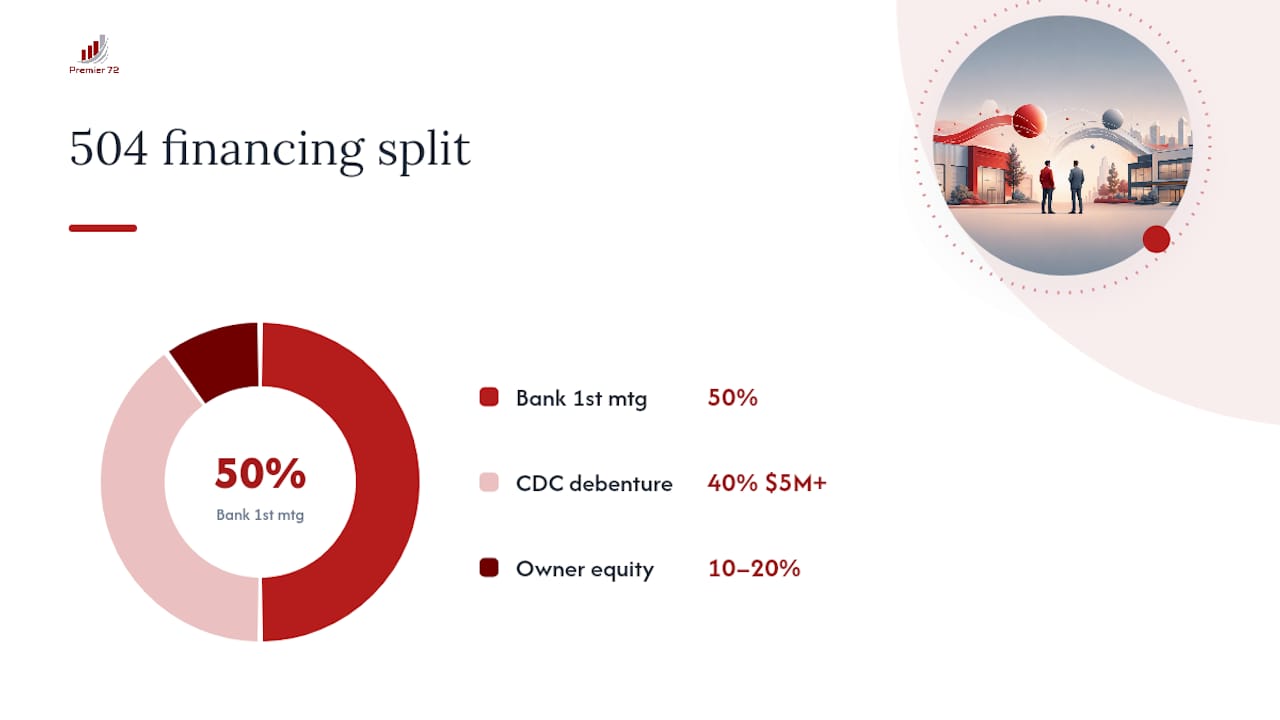
Equity requirements typically rise for startups or newer businesses, and can go higher for special-use properties such as hotels or gas stations. The trade-off for that added complexity is the CDC debenture's long-term fixed rate, which often produces a materially lower blended cost than a variable-rate 7(a) loan over a 20 or 25-year term. If you're buying a warehouse you plan to occupy for the next two decades, that rate certainty can save real money. The cost is a longer close and heavier documentation, since you're coordinating a bank and a CDC instead of one lender.
A Decision Checklist for Choosing Between 7(a) and 504
Before you call a lender, work through these five questions:
- What are you financing? Real estate or heavy equipment points to 504; working capital, acquisitions, or mixed uses point to 7(a).
- Will you occupy the property? 504 requires at least 51% owner-occupancy; if you won't meet that threshold, 7(a) is your only SBA option.
- How fast do you need funding? If speed matters more than rate, 7(a)'s single-lender structure usually closes faster.
- How large is the project? Larger real estate projects often benefit from 504's higher combined ceiling.
- How much equity do you have? Thin equity may steer you toward whichever program your lender can structure with the lowest injection.
Three quick scenarios: buying a competitor with significant goodwill calls for 7(a), since 504 can't touch intangible value. Purchasing the building your business already operates from usually favors 504's fixed rate. A project that needs both a new facility and extra working capital may call for a combined structure, which is worth raising directly with your lender.
What to Expect During Underwriting and Closing
Collateral usually includes the asset being financed, and most owners sign a personal guarantee regardless of program.
Beyond the loan itself, plan for the SBA guarantee fee, third-party costs like appraisals and environmental reports on real estate deals, and your equity injection. On timelines, 7(a) commonly closes in 45 to 90 days, while 504 often takes 60 to 120 days because the bank and CDC have to coordinate underwriting and closing schedules. The single biggest lever you control is document completeness. Missing tax returns or incomplete financials are the most common reason closings slip past their target date.
Using Both Programs Together
A common structuring pattern pairs 7(a) for intangibles and working capital with 504 for the real estate and fixed equipment in the same project. Since mid-2026, SBA guidance allows combined exposure across both programs up to a higher aggregate limit in many cases, which makes this pairing more workable than it used to be. It requires real coordination between your bank, your CDC, and you, so lender experience with combined structures matters more here than in a single-program deal. If your project doesn't split cleanly into real estate and non-real estate components, stacking probably isn't worth the added complexity.
Getting Your SBA Application Lender-Ready
Before you sit down with a lender, pull together three years of financials, a current debt schedule, and a realistic use-of-funds breakdown. Run your debt service coverage ratio yourself so you already know where you stand.
Premier72 works with established owners preparing for financing, growth, or eventual sale, and packaging a stronger loan file often overlaps with the same financial cleanup that improves debt service coverage and lender confidence. A well-prepared package, sequenced correctly between your bank and CDC, tends to move faster and land better terms.
The Real Trade-off Nobody Frames Correctly
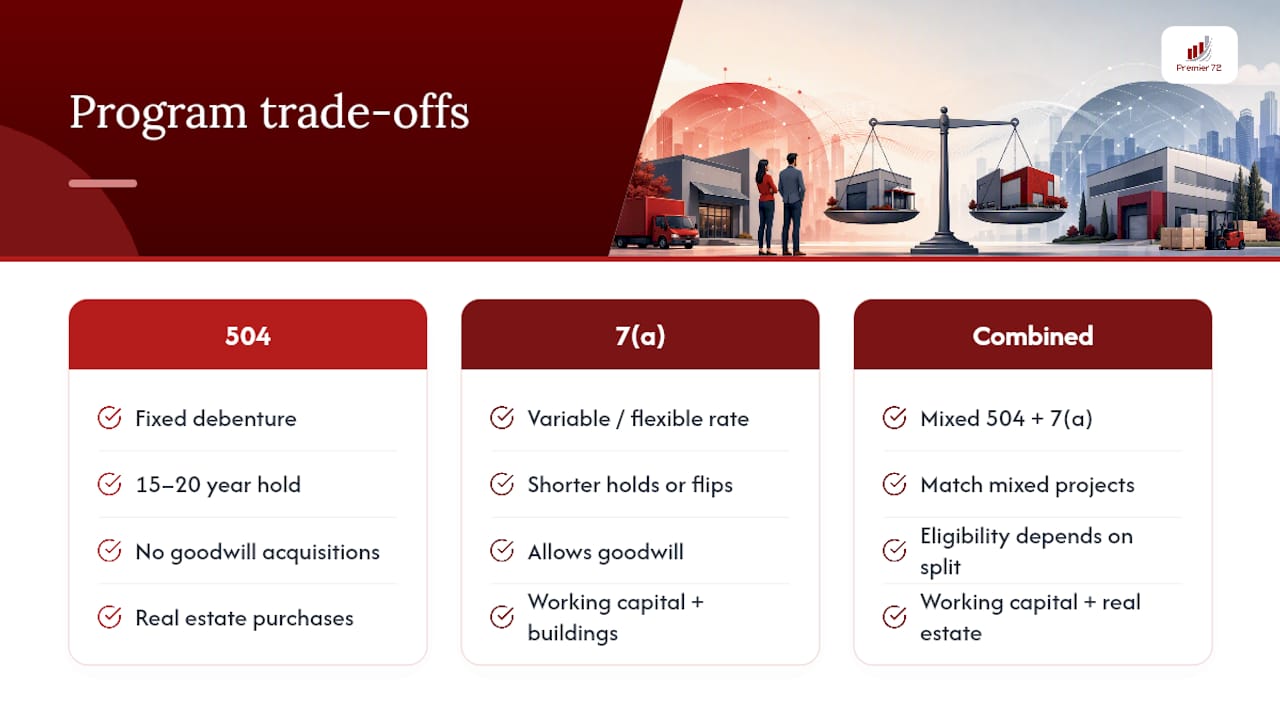
Most advice on this topic treats 7(a) versus 504 as a rate comparison, and that framing misses what actually separates the two programs. Rate is a symptom of structure, not the decision itself. A 504's fixed-rate debenture looks cheaper on paper, but it's only cheaper if you're financing an asset you'll hold for 15 or 20 years. Put a 504 structure around a five-year hold and the closing costs and equity requirements can erase the rate advantage entirely.
The more useful question, and the one most owners skip, is whether their project can even qualify for 504 in the first place. Acquisitions with meaningful goodwill simply don't fit the program's rules, no matter how attractive the fixed rate looks on a lender's rate sheet. I'd also push back on the common advice to "shop both programs and compare." That works fine for a straightforward real estate purchase, but for a mixed project, working capital plus a building purchase, the smarter move is asking your lender about a combined structure from the start, rather than treating 7(a) and 504 as mutually exclusive paths. The owners who get the best outcomes aren't the ones who found the lowest rate. They're the ones who matched the loan structure to how long they'll actually hold the asset, and who had clean financials ready before the first lender conversation instead of scrambling for them mid-process.
— Asa
Sources
- SBA 504 loans (SBA site) — program descriptions and links to SBA loan program details
- SBA loans explained: Complete guide to 7(a) and 504 loans (CommittedToCapital)
- SBA 7(a) vs 504 vs Express — comparison (SBA Calculators)
- SBA 7(a) vs 504 explainer (PeerSense)