

Value-based pricing sets your price by what a customer's outcome is worth to them, not by what your product costs to make. It works best when your offering is differentiated and outcome-driven, since customers who can measure their return will pay for it. Done well, it lifts margins because you are finally charging for the value you already deliver.
TL;DR:
- Segmentation by value profile is essential to avoid leaving money on the table and to properly target pricing for different customer groups.
- Using structured research methods like conjoint analysis or Van Westendorp surveys helps identify which value drivers truly influence customers' willingness to pay.
- Setting a pricing range inside the customer's perceived value ceiling and aligning tiers with outcomes ensures higher adoption and satisfaction.
- Pilot testing multiple price points on new customers first allows for data-driven adjustments and reduces risks of negative churn.
- Strengthening pricing discipline and documentation before exit can significantly boost valuation, especially for owner-dependent businesses.
Table of Contents
- What Value-Based Pricing Is and When It Fits
- The Value Stick: Finding What Customers Actually Pay For
- Research Methods: Conjoint, Surveys, Elasticity, and ROI Math
- How Do You Implement Value-Based Pricing Step by Step?
- Choosing a Value Metric and Structuring Your Tiers
- Where Value-Based Pricing Goes Wrong
- Measuring Whether Your Pricing Is Actually Working
- Why Owner-Dependent Businesses Should Treat Pricing as an Exit Lever
- Editorial Take: Pricing Discipline Is an Exit Strategy, Not Just a Revenue Tactic
- How Premier72 Helps You Turn Pricing Gains Into Exit Value
- Sources
- FAQ
What Value-Based Pricing Is and When It Fits
Cost-plus pricing starts with your expenses and adds a margin. Competition-based pricing starts with what rivals charge and nudges around it. Value-based pricing starts somewhere else entirely: the dollar value your customer captures from using your product. When that value is easy to demonstrate, companies can charge 5 to 10 times their unit cost and still close the deal, because the buyer is comparing price to outcome, not price to production expense.
This approach fits best under specific conditions. Ask yourself three questions before committing to it:
- Does your offering solve a problem with a measurable financial outcome (time saved, revenue gained, risk avoided)?
- Is your product meaningfully differentiated, so customers cannot easily substitute a cheaper commodity option?
- Can you credibly document that outcome to a skeptical buyer, not just assert it?
If you answered yes to all three, value-based pricing beats cost-plus almost every time.
The Value Stick: Finding What Customers Actually Pay For
Harvard Business School's "value stick" framework has four points: willingness to pay, price, cost, and willingness to sell. The gap between willingness to pay and price is what the customer keeps. The gap between price and cost is what you keep. Value-based pricing works by widening the top gap first, through real differentiation, then setting price to capture a fair share of it.
The hard part is identifying which value drivers actually move that top gap. The usual suspects are:
- Time saved (hours of labor eliminated per month)
- Revenue uplift (incremental sales attributable to your product)
- Cost avoided (fines, downtime, or waste prevented)
- Brand or image lift (harder to quantify, still real to enterprise buyers)
You validate these drivers two ways: structured customer interviews that ask what would happen without your product, and usage-data signals that show which features customers actually rely on daily.
Pro Tip: Ask customers to estimate the cost of solving the problem themselves, in-house or with a competitor. Their answer usually reveals a ceiling higher than what you are currently charging.
Research Methods: Conjoint, Surveys, Elasticity, and ROI Math
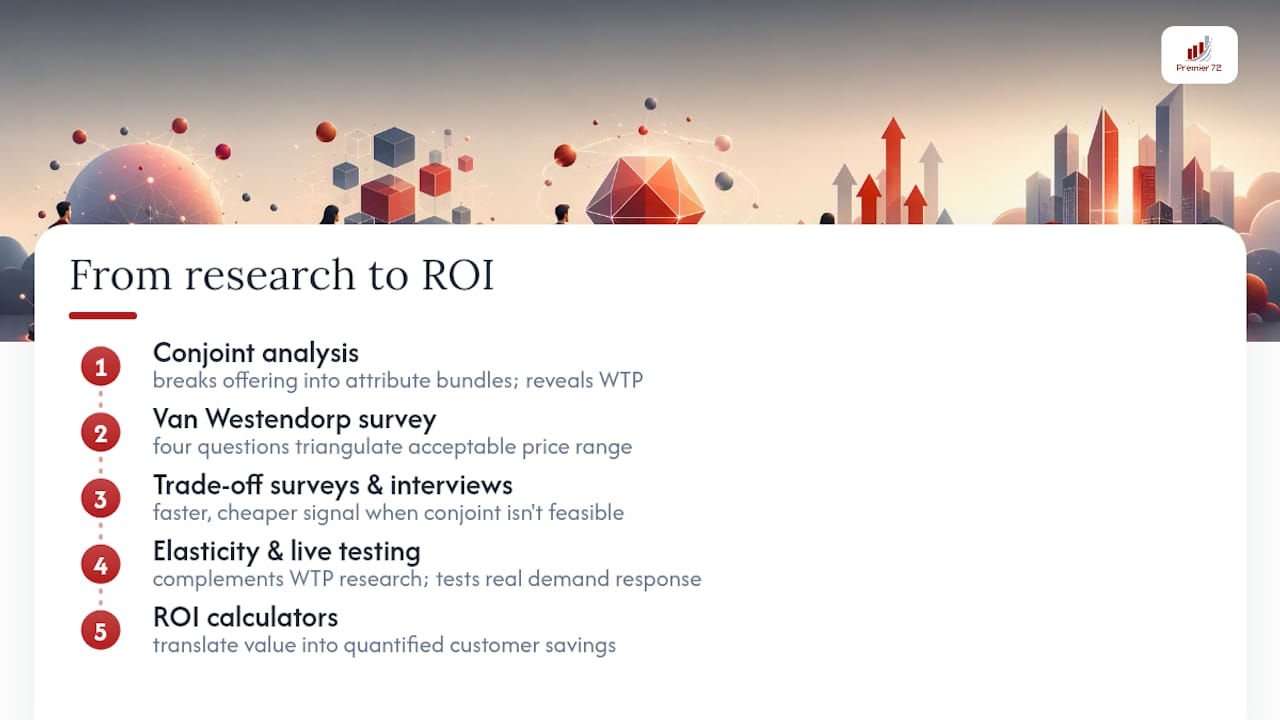
Conjoint analysis breaks your offering into discrete attributes, price included, and asks respondents to choose between bundles. The trade-offs they make reveal which features actually carry willingness to pay versus which ones are just noise. It is the gold standard for pricing research, but it takes time and a decent sample size to run properly.
Van Westendorp price-sensitivity surveys are the faster, cheaper cousin. Four questions (too cheap, cheap, expensive, too expensive) triangulate an acceptable price range without the analytical overhead of conjoint. For teams without that capacity, structured trade-off surveys and customer interviews still produce usable signal.
Elasticity studies and live testing round out the toolkit; Simon-Kucher treats these as essential complements to willingness-to-pay research, not substitutes for it. Meanwhile, ROI calculators do the last mile of work: they turn "our product is valuable" into "our product saves you $40,000 a year," a claim a buyer's finance team can actually approve.
How Do You Implement Value-Based Pricing Step by Step?
Moving from research to a live price takes a defined sequence, not a leap of faith.
- Segment customers by value profile. Group accounts by the outcome they get, not by firmographics alone. A logistics company saving 200 driver-hours a month is a different segment than one saving 20.
- Set a floor and ceiling per segment. The floor covers cost plus a minimum margin; the ceiling approaches the customer's calculated willingness to pay. Price somewhere in that band, closer to the ceiling for the most differentiated segments.
- Choose your value metric and build tiers around it. The metric should scale naturally with the value the customer receives.
- Pilot before you roll out. Pick a representative cohort, test two or three price points at once, and track early conversion and churn against a pre-defined statistical threshold before expanding company-wide.
- Iterate on real data. If conversion holds but churn spikes, the metric is probably wrong, not the price.
Pro Tip: Run your pilot on new customers first. Repricing existing accounts without a grandfathering plan creates more support tickets than pricing insight.
Choosing a Value Metric and Structuring Your Tiers
The value metric is the unit your price scales with, whether that is users, transactions, seats, or throughput. The right metric grows in lockstep with the value the customer captures, so a customer processing ten times the volume pays proportionally more, not the same flat fee.
Good tier design differentiates on outcomes, not on a checklist of minor features:
- Anchor each tier to a distinct use case or scale of outcome, not a random feature bundle.
- Reserve your highest-leverage feature, the one tied most directly to ROI, for a paid tier rather than giving it away at the entry level.
- Avoid stuffing tiers with rarely used features just to justify a price gap; buyers notice when a tier's price outpaces its actual utility.
A practical example: a workflow tool tracks that a specific automation feature gets daily use among power accounts but rarely touched by casual accounts. That usage split becomes the natural line between a mid tier and a premium tier.
Where Value-Based Pricing Goes Wrong
The most common mistake is applying one value-based price uniformly across a customer base that has wildly different value profiles. A single flat rate leaves money on the table with your highest-value accounts and prices out your most price-sensitive ones, which is why segmentation is not optional.

The second mistake is billing for a feature customers rarely open. That disconnect between price and utility breeds resentment fast, even among accounts that are otherwise satisfied.
Sales needs new muscle for this to work, shifting the commercial motion from transactional to outcome-focused conversations. Reps must document outcomes credibly, since the entire commercial motion shifts from transactional to outcome-focused, and that only works if they can back claims with data, not adjectives.
- Segment before you price, not after.
- Cut or bundle differently any feature nobody actually uses.
- Train sales to lead with a customer's own numbers, not a features list.
- Be willing to walk away from accounts that will never value what you offer; chasing them usually damages the price integrity everyone else is paying for.
Experts note that value-based pricing is not universal; it demands differentiation and a willingness to lose some low-value business on purpose.
Measuring Whether Your Pricing Is Actually Working
Price realization, the share of your list price that customers actually pay after discounts, tells you more than revenue growth alone. Watch it alongside gross margin, churn broken out by tier, average revenue per account, and how your LTV-to-CAC ratio shifts after a price change.
A/B or cohort-based pilots are how you interpret those numbers honestly rather than guessing. Run two price points against comparable cohorts, hold the test long enough to see churn (not just signup conversion), and use the result to decide whether the fix is the price itself, the packaging around it, or the segment you are targeting.
| Metric | What it tells you |
|---|---|
| Price realization | Gap between list price and what customers actually pay |
| Margin by segment | Whether value capture is happening where you designed it to |
| Churn by tier | Whether a tier's price matches its perceived value |
| ARPA/ARPU trend | Whether upsell and expansion are working |
| LTV-to-CAC shift | Whether pricing changes improved long-term unit economics |
Why Owner-Dependent Businesses Should Treat Pricing as an Exit Lever
For an established business owner eyeing retirement, pricing is one of the fastest levers available to improve seller's discretionary earnings or EBITDA without adding headcount or new customers. A price increase that sticks flows almost entirely to the bottom line, which is exactly the kind of margin improvement buyers pay a premium multiple for.
Pricing changes can also reduce owner dependence. Moving from ad hoc, owner-negotiated deals to a documented, tiered pricing structure makes the business easier for a buyer, or a successor, to run without the founder in every negotiation. That kind of documentation and repeatability is central to what Premier72 evaluates in a structured advisory review, where pricing insight gets translated directly into valuation and transferability improvements ahead of a sale.
Editorial Take: Pricing Discipline Is an Exit Strategy, Not Just a Revenue Tactic
Most advice on value-based pricing treats it as a growth tactic: raise margins, protect against commoditization, out-position competitors. That framing is not wrong, but it undersells the bigger opportunity. For an owner within five or ten years of exiting, pricing discipline is one of the few operational changes that improves both cash flow today and the multiple a buyer will pay tomorrow.
The conventional playbook also overstates how much conjoint analysis and elasticity modeling matter for a mid-sized private company. Those tools matter, but a founder who simply interviews ten best customers about what the product actually saves them will usually find more mispriced value than a six-week research project will. Rigor should scale with the size of the decision.
What I would prioritize first: fix the segmentation problem before the research problem. Most owner-run businesses are charging the same price to customers who get wildly different value, and that gap is usually visible in the customer list already, no survey required.
— Asa
How Premier72 Helps You Turn Pricing Gains Into Exit Value
Raising prices is one move. Making that gain permanent, documented, and visible to a future buyer is another. We work with established business owners to research, pilot, and lock in pricing improvements as part of a broader profitability and exit-readiness engagement, including the systems and documentation that make a pricing change durable rather than a one-time bump.

An engagement typically starts with a review of your current pricing against customer value data, moves through a controlled pilot on a segment of your book, and ends with the packaging, sales materials, and financial reporting a buyer will actually scrutinize. Whether you sell in two years or ten, higher price realization compounds into a stronger valuation multiple through Premier72's advisory services for business owners. Consider starting with a review of where your current pricing may be leaving value on the table.
Sources
A Quick Guide to Value-Based Pricing | HBR
Value-driven pricing strategy: What it is and how it works | Stripe
Value-based Pricing Strategy | Simon-Kucher
Value-Based Pricing: A Complete Overview & Guide | Salesforce
Everything you need to know about value-based pricing | HubSpot
- Value-driven pricing strategy: What it is and how it works | Stripe
- Value-based Pricing Strategy | Simon-Kucher
- Value-Based Pricing: A Complete Overview & Guide | Salesforce
- Everything you need to know about value-based pricing | HubSpot
FAQ
What Is Value-Based Pricing, With an Example?
Value-based pricing means setting price according to the outcome a customer receives rather than production cost. A software tool that saves a client a significant amount annually might reasonably charge a portion of that, since the customer still keeps most of the value while the vendor captures a fair share of it.
What Is a Real-Life Example of Value-Based Pricing?
Companies with clearly demonstrable ROI can charge multiple times their unit cost, such as a workflow tool priced well above its hosting and support cost because it measurably cuts labor hours for its customers.
What Is the Definition of Value-Based Pricing?
It is a pricing strategy that bases price on customer-perceived value and outcomes rather than on production cost or competitor rates, using tools like conjoint analysis and willingness-to-pay research to set the number.
What Are the Four Types of Pricing Strategies?
The four common approaches are cost-plus pricing, competition-based pricing, value-based pricing, and dynamic pricing, each starting from a different anchor: expenses, rivals, customer value, or real-time demand.
How Does Value-Based Pricing Affect a Business Sale?
Pricing improvements that raise margin without adding cost flow directly into SDE or EBITDA, which is a core driver of the multiple buyers pay, making pricing work a practical part of exit readiness planning.