

An exit readiness assessment is a structured diagnostic that scores your company across governance, financials, operations, and people, then hands you a prioritized action roadmap tied to dates. Established owners preparing to sell, transition to family, or retire within the next one to ten years need one now, not once a buyer shows interest. The next step is simple: take a self-assessment this week or book an advisor-led review before you assume your business is worth what you think it is.
TL;DR:
- Most assessment scores are more meaningful when linked to specific timelines, with low scores requiring over 18 months of improvements before sale talks.
- A middle score indicates the business is sellable but may face price adjustments during due diligence, while a high score enables a competitive sale process.
- Improving governance, financial, operational, customer, and people domains typically takes from one to three years, requiring a structured, phased plan.
- An advisor-led audit provides a defensible score and detailed roadmap, which is essential for fixing issues that buyers will verify during diligence.
- Select an advisor with proven M&A experience, coordination with legal/tax professionals, and a track record of closing sell-side deals to ensure effective execution.
Table of Contents
- What Does an Exit Readiness Assessment Cover?
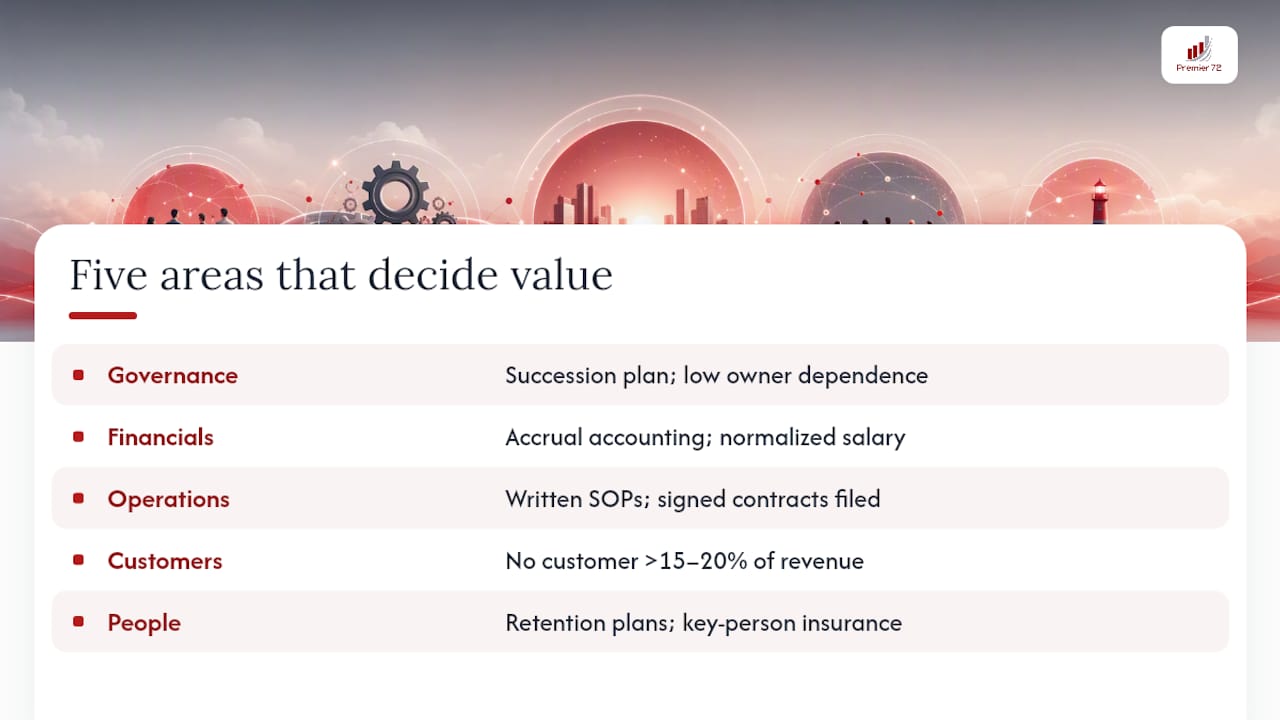
- The Five Areas That Decide What Your Business Is Worth
- What Does an Exit Readiness Assessment Actually Deliver?
- Turning Your Score Into a Dated Action Plan
- How Do You Choose the Right Advisor for the Audit?
- How Premier72 Turns Assessment Results Into a Sale-Ready Business
- Why Most Readiness Advice Misses the Point
- Start Your Exit Readiness Assessment With Premier72
- Sources
What Does an Exit Readiness Assessment Cover?
Most assessments organize around five domains: governance and leadership, financial preparedness, operational documentation, customer and market position, and people risk. Each domain generates a subscore, and those roll up into a composite readiness score, usually on a 100-point or five-tier scale.
Score bands matter more than the number itself. A low band signals you need 18 to 36 months before a sale conversation makes sense. A middle band means you're sellable but leaving money on the table. A high band means you could run a competitive process now.
Two formats exist:
- Self-audit: A questionnaire you complete in 10 to 30 minutes, giving a directional score without document verification.
- Advisor-led audit: A one to four week engagement involving financial statement review, interviews with key managers, and document collection, producing a defensible score and roadmap.
The Exit Planning Institute's research on owner readiness found many owners overestimate their company's value because buyers price a business from their own risk perspective, not the owner's. That gap is exactly what a structured assessment exposes before a buyer does.
The Five Areas That Decide What Your Business Is Worth
Buyers price risk, not effort. Each of the following domains carries specific, checkable indicators.
Governance and leadership. Strong companies have a documented succession plan, an advisory board or at least regular outside input, and low owner dependence. Weak companies have one person making every material decision, with no written record of who takes over if that person is unavailable for six months.
Financial preparedness. Buyers want clean, accrual-based accounting, a normalized owner salary that reflects market rate rather than tax convenience, and recurring revenue that isn't concentrated in a handful of contracts. Quality of earnings, or QoE, issues, like personal expenses run through the business or one-time gains inflating a single year, are the most common reason deals get repriced mid-diligence.
Operations and documentation. This means written standard operating procedures, current process diagrams for core workflows, contracts that are actually signed and filed (not verbal understandings), and clear ownership of intellectual property and vendor relationships that don't depend on personal friendships.
Customer and market position. Watch customer concentration (any single customer above 15 to 20% of revenue raises flags), churn trends, and whether you can raise prices without losing volume. Pricing power is one of the clearest signals of a defensible market position.
People and key-person risk. Does the business have a retention plan for the managers a buyer would need to keep? Is there key-person insurance on the owner or critical leaders? Have role handovers ever been tested, even informally?
Pro Tip: Run a two-week test where you take zero operational decisions and let your management team run the business. What breaks reveals your real owner-dependence score faster than any questionnaire.
The Bank of America transition planning guide recommends forming a transition team and resolving operational and financial problems before buyers see them, precisely because these gaps are cheaper to fix on your own timeline than on a buyer's.
What Does an Exit Readiness Assessment Actually Deliver?
A completed assessment produces three concrete outputs, not a vague summary.
- A composite readiness score with subscores by domain, showing exactly where you rank against a sellable benchmark.
- A priority action roadmap, sorted into quick wins (weeks), medium-term projects (3 to 12 months), and long-lead items (12 to 36 months) like building a second layer of management.
- A timeline and effort estimate, so you know whether you're looking at a one-year cleanup or a three-year rebuild before a sale makes sense.
Owners who invest in management depth and financial reporting quality typically need 12 to 36 months of consistent, demonstrated improvement. Buyers can spot a rushed, last-minute cleanup, and it rarely survives diligence intact.
A low score usually means postponing any sale conversation before significant improvements. A middle-tier score means you're negotiable but likely to face price adjustments during diligence. A top-tier score supports running a competitive process with multiple buyers, which can help owners capture more value.
Turning Your Score Into a Dated Action Plan
A readiness score without dates attached is just a diagnosis nobody acts on. The most useful version pairs the diagnostic to a four-phase workplan run over 6 to 36 months.
- Diagnose (Month 1). Complete the assessment, verify financials, and rank gaps by dollar impact on valuation.
- Strategize (Months 2 to 3). Assign owners and deadlines to each gap. Decide which fixes you handle internally and which need outside advisors.
- Transform (Months 4 to 24). Execute the roadmap: normalize compensation, document SOPs, build management redundancy, diversify customer concentration.
- Validate (Months 24 to 36). Re-run the assessment, confirm the score has moved, and prepare sale documents while the improvements are still fresh.
Sample workstreams by horizon:
- 6 months: clean up bookkeeping, document top five customer contracts, draft a basic succession memo.
- 12 months: install a second-tier manager, normalize owner salary, formalize vendor agreements.
- 24 to 36 months: demonstrate two consecutive years of adjusted EBITDA growth without owner involvement in daily operations.
Track progress with a short list of KPIs: revenue retention rate, adjusted EBITDA margin trend, and a management independence score (how many decisions still route through the owner). The Hartford's transition planning guide points to a documented succession team and formal knowledge transfer as the backbone of continuity through a handover, and those same workstreams double as buyer-facing proof that the business runs without you.
How Do You Choose the Right Advisor for the Audit?
Not every consultant who offers a "readiness review" can execute the fixes it recommends. Screen for four capabilities before you sign anything:
- Valuation and quality of earnings experience, not just bookkeeping cleanup.
- Actual sell-side or M&A execution history, not theoretical advice.
- Coordination with tax and legal counsel, since exit structure changes tax exposure significantly.
- Business protection planning, including buy-sell funding and key-person coverage design.
Ask directly: "How many sell-side engagements have you closed in the last three years?" and "What does your QoE process actually look like?" Vague answers, no documented deliverable list, or no mention of tax coordination are red flags worth walking away from.
If you're engaging anyone involved in capital markets or securities-based transition funding, verify their credentials through FINRA's BrokerCheck before moving forward.
Pro Tip: A free self-assessment is fine for a first directional read. Once your score suggests a sale within three years, an advisor-led audit pays for itself by catching the QoE issues a buyer's diligence team will find anyway, on your terms instead of theirs.
Buy-sell funding often comes up early in these conversations, and mechanisms like whole life or corporate-owned life insurance for business financing are worth understanding before you need them.
How Premier72 Turns Assessment Results Into a Sale-Ready Business
A score and a roadmap are only useful if someone helps you execute them. Premier72 built The Retirement Bank Method™ specifically to close the gap between diagnosis and delivery, mapping directly to the same domains an assessment measures: systems, leadership depth, cash flow quality, and documentation.
The goal isn't a higher score on paper. It's a business that keeps generating cash flow and value whether or not you show up on Monday.
Owners can start with a free readiness resource or request a direct advisor review to convert findings into a dated, trackable plan.
Why Most Readiness Advice Misses the Point
The conventional advice treats an exit readiness assessment as a one-time report card. Owners take it, feel either relieved or alarmed, and then file it away. That's backwards. The research from the Exit Planning Institute is clear that most owners overvalue their business precisely because they never repeat the exercise or track whether their fixes actually moved the needle.
What gets underestimated is how much of readiness is a leadership problem disguised as a financial one. Owners fixate on clean books and QoE, and those matter, but a business that still can't run a normal week without the owner will get repriced regardless of how tidy the financials look. The domain that most often decides deal certainty is people and management depth, not the balance sheet.
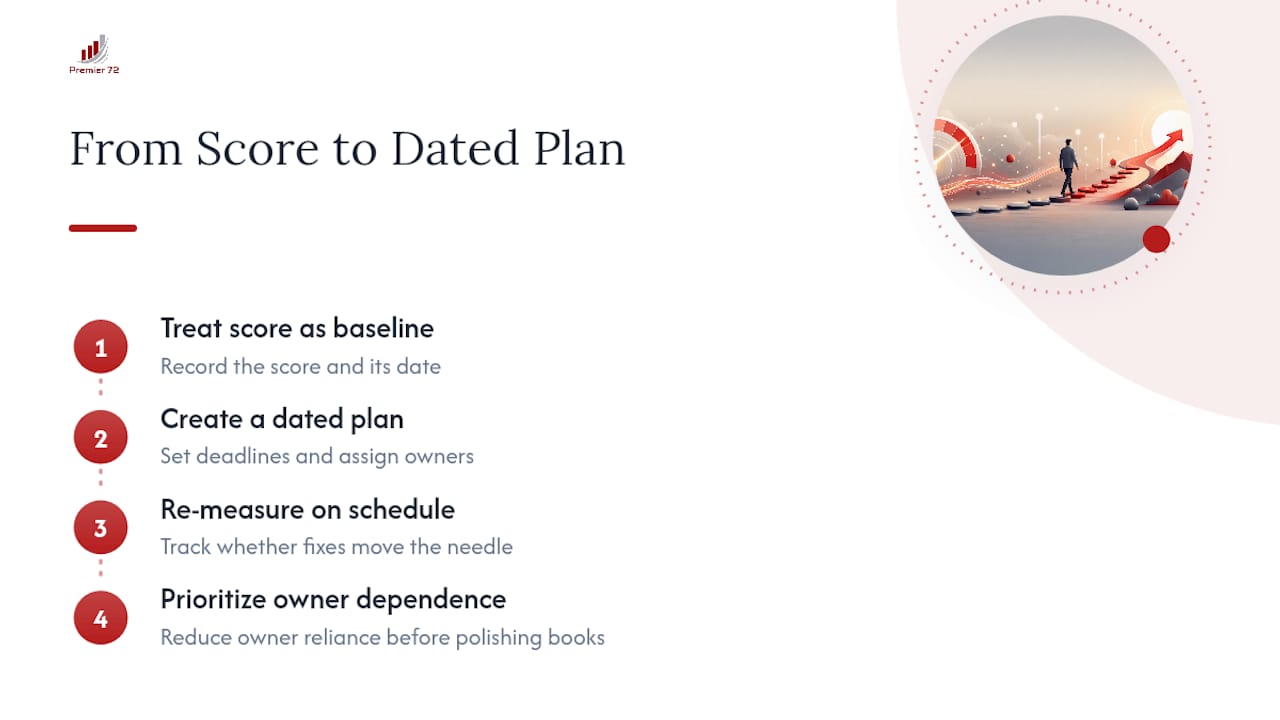
If you take one thing from this: don't treat the score as the finish line. Treat it as the baseline for a dated plan, re-measure it on a schedule, and prioritize reducing owner dependence before you polish anything else. That's the fix that actually changes what a buyer is willing to pay.
— Asa
Start Your Exit Readiness Assessment With Premier72
An assessment pairs your readiness score with an advisor-led review of the exact gaps slowing down your valuation, then builds a dated roadmap around a structured exit readiness method.

Your first meeting focuses on where your score currently sits, which domains carry the biggest dollar risk, and whether a 12-month cleanup or a multi-year rebuild fits your timeline. From there, Premier72 coordinates the financial, operational, and business protection pieces, including buy-sell funding and key-person coverage, so the roadmap doesn't stall waiting on outside pieces to catch up. If retirement or estate considerations are part of your exit, Premier72's estate planning guidance folds directly into the same plan.
Visit Premier72 to schedule your exit readiness review and get a dated action plan built around your actual numbers, not a generic template.
Sources
- Exit Planning Institute — State of owner readiness
- Bank of America — How to create a transition plan for a small business
- The Hartford — Business transition planning