

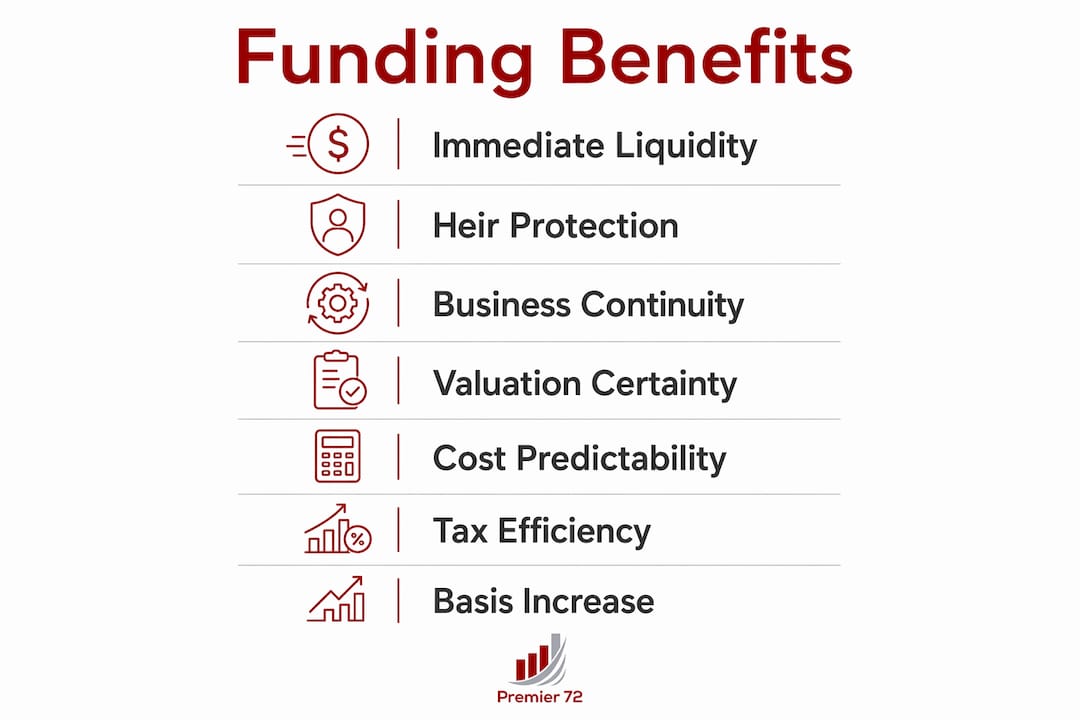
A buy-sell agreement without funding is a contract you cannot keep. Life insurance is the mechanism that transforms a written ownership transfer plan into a financially executable one, delivering immediate, tax-free proceeds the moment a triggering event occurs. For established business owners, the core reasons to fund a buy-sell agreement with life insurance come down to four pillars:
- Immediate liquidity at death, without depleting company capital or taking on debt
- Protection for heirs, who receive cash compensation rather than an unmarketable ownership stake
- Business continuity, keeping operations stable during a vulnerable ownership transition
- Tax efficiency, since death benefit proceeds are generally income tax-free to beneficiaries
Two primary structures exist for this funding: a cross-purchase arrangement, where each owner holds policies on the others, and an entity purchase (also called a redemption) arrangement, where the business itself owns and is the beneficiary of the policies. Both approaches serve the same goal, but they carry different tax and administrative implications that every business owner should understand before choosing one.
How life insurance funds a buy-sell agreement
Life insurance converts a legal obligation into a funded one. When an owner dies, the policy pays out a lump sum that the surviving owners or the business uses to purchase the deceased's interest, with the heirs receiving cash in exchange for their inherited stake.
The two main structures work differently in practice:
- Cross-purchase: Each owner buys and owns a policy on every other owner, naming themselves as beneficiary. Upon a death, surviving owners receive proceeds income tax-free and use them to buy the deceased's interest directly. A key advantage is that surviving owners increase their basis in the business, which reduces future capital gains taxes.
- Entity purchase (redemption): The company buys one policy per owner, names itself as beneficiary, and uses the proceeds to redeem the deceased's interest from the estate. This simplifies policy management but generally does not provide a basis step-up for surviving owners.
- Premium responsibility: In a cross-purchase plan, individual owners pay premiums from personal funds. In an entity plan, the business pays, though those premiums are not tax-deductible as a business expense.
- Administrative complexity: Cross-purchase arrangements multiply quickly. Three owners require six policies; four owners require twelve. This is where a third structure, the Insurance LLC, becomes worth considering.
An Insurance LLC is a separate limited liability company formed by the business owners solely to own the life insurance policies. Rather than each owner holding multiple policies or the operating company holding them, the Insurance LLC centralizes ownership, simplifies premium allocation, and preserves the basis increase benefits of a cross-purchase structure while reducing the policy count to one per owner.
Key reasons to fund buy-sell agreements with life insurance
1. Immediate liquidity at the moment it is needed most

Financial obligations triggered by an owner's death, including estate taxes, income replacement for the family, and the buyout itself, arise instantly. They cannot wait for the business to generate cash flow or arrange financing. Life insurance proceeds provide a lump-sum payout at exactly that moment, funded in advance through predictable premium payments.
2. Protection for the deceased owner's heirs
Without a funded agreement, heirs inherit an ownership interest in a private company they may not want and cannot easily sell. Life insurance funding gives them cash at an agreed-upon price, honoring the deceased's intent without forcing the family into a prolonged negotiation or a fire-sale valuation.
3. Business continuity and operational stability
An unfunded ownership transition creates uncertainty for employees, customers, lenders, and suppliers. A properly funded buy-sell agreement keeps the business in the hands of the surviving owners without operational disruption, because the financial mechanics are already in place before the event occurs.
4. Predefined valuation prevents disputes
Buy-sell agreements establish a valuation method in advance, and life insurance funding locks in the capital to honor that valuation. This removes the most common source of post-death conflict: disagreements between heirs and surviving owners over what the business is actually worth and who owes what to whom.
5. Cost predictability compared to alternatives
Life insurance premiums are fixed and known in advance. Loan-funded buyouts introduce interest costs, repayment obligations, and lender approval risk, all of which can strain the business at precisely the moment it is most vulnerable. Installment payments create years of cash flow pressure and often generate resentment between the paying owners and the receiving family.
6. Tax efficiency that other funding methods cannot match
Insurance proceeds used for buyouts are generally income tax-free to the beneficiary, whether that is an individual owner in a cross-purchase plan or the business in a redemption plan. No other funding mechanism, not cash reserves, not debt, not installment notes, delivers a comparable tax outcome on the capital received.
7. Basis increase for surviving owners in cross-purchase structures
When surviving owners use insurance proceeds to purchase a deceased owner's interest directly, their tax basis in the business increases to the purchase price paid. This matters significantly when the business is eventually sold, because a higher basis means lower taxable gain.
What happens when a buy-sell agreement is not properly funded
An unfunded buy-sell agreement is, in practice, unenforceable. The legal obligation exists on paper, but without capital to execute it, the agreement collapses under financial pressure.
- Default to promissory notes: When buyout funding is unavailable, agreements typically default to multi-year installment payments. Heirs want immediate cash; surviving owners face years of cash flow obligations that can destabilize the business.
- Operational disruption: Without a funded transition plan, the business may need to sell assets, draw down reserves, or take on debt to meet buyout obligations, all of which weaken the company at a critical moment.
- Family and partner conflicts: Disputes over valuation, payment timing, and terms become far more likely when no pre-funded mechanism exists. These conflicts can escalate into litigation that damages both the business and family relationships.
- Coverage gaps from outdated policies: A policy adequate for a $6 million valuation in 2018 can leave a $12 million gap if the business grows to $18 million by 2026 and the coverage was never updated. That gap falls on the surviving owners and the estate to resolve.
- Cash in the wrong hands: Mismatches between policy ownership and the buy-sell structure create legal and financial crises. If the company owns the insurance but the agreement calls for a cross-purchase between individual owners, the proceeds go to the business while the obligation sits with the individuals.
- Debt-funded buyouts that threaten survival: Businesses that borrow to fund a buyout take on repayment obligations with after-tax dollars, plus interest. The cash flow burden can prevent investment in growth, reduce creditworthiness, and in serious cases, push the business toward failure.
Pro Tip: Review your buy-sell funding every two to three years, and immediately after any major change in business value, ownership structure, or the addition of a new partner. A well-drafted agreement with outdated coverage is still an unfunded agreement.
Tax implications and valuation considerations you need to understand
Tax treatment in a life-insurance-funded buy-sell agreement depends heavily on how the plan is structured. Getting this wrong can create unexpected tax liabilities for the estate, the surviving owners, or the business.
- Death benefits are generally income tax-free: Life insurance proceeds paid to a beneficiary upon an owner's death are not subject to income tax, making this the most tax-efficient way to fund a buyout obligation.
- Premiums are not deductible: Whether the business or individual owners pay the premiums, those payments are not deductible as a business expense. This adds to the true cost of coverage and should be factored into the funding plan.
- The Connolly decision and estate tax: The Supreme Court's ruling in Connolly v. United States established that insurance proceeds increase a company's fair market value for estate tax purposes. Owners with larger estates need a current appraisal at death and should evaluate whether a redemption structure exposes their estate to higher taxes as a result.
- Basis differences between structures: Cross-purchase plans give surviving owners a stepped-up basis equal to the purchase price, reducing future capital gains exposure. Redemption plans generally do not provide this benefit, which can cost surviving owners significantly when the business is eventually sold.
- Valuation must stay current: A buy-sell agreement that fixes a price from five years ago may no longer reflect the business's actual value. If the insurance coverage does not match the current valuation, the agreement creates a funding shortfall that neither the heirs nor the surviving owners anticipated.
- Policy ownership changes carry tax risk: Transferring ownership of a life insurance policy, such as moving it from the business to an individual owner at retirement, can trigger income taxation on the policy's value. Structuring ownership correctly from the beginning avoids this problem.
How to choose the right life insurance funding strategy
Selecting the right structure depends on your business's size, number of owners, growth trajectory, and long-term exit goals. There is no single correct answer, but there are clear criteria that point toward the better choice for most situations.
- Two owners: A cross-purchase plan is usually straightforward. Each owner holds one policy on the other, premiums are manageable, and the basis increase benefit is preserved.
- Three or more owners: The policy count in a cross-purchase plan grows quickly. An Insurance LLC is worth serious consideration here, as it centralizes policy ownership, reduces administrative burden, and maintains the tax advantages of a cross-purchase structure.
- Business valuation and growth: Match coverage to current value, not the value at the time the agreement was drafted. Work with a qualified appraiser to establish a current figure, then review it on a regular schedule. A policy that covered your business in 2020 may cover only a fraction of it today.
- Disability and retirement triggers: Life insurance only activates at death. For disability-triggered buyouts, disability buy-sell coverage or riders provide the liquidity that death benefits cannot. Retirement and voluntary departure require separate funding mechanisms, often a combination of installment terms and sinking fund provisions.
- Policy type: Permanent life insurance, such as whole life or universal life, costs more in early years but remains in force indefinitely and builds cash value. Term insurance is less expensive initially but expires, leaving the agreement unfunded if an owner outlives the policy term. For long-term buy-sell obligations, permanent coverage is generally the more reliable foundation.
- Engage qualified professionals: An insurance professional with experience in buy-sell agreement funding will structure ownership, beneficiary designations, and policy design to align with the agreement's legal terms. An attorney drafts the agreement; the insurance professional ensures the funding matches it. Both are necessary.
- Regular review: Build a review cycle into the agreement itself. Tie it to specific events, such as a valuation increase above a set threshold, the addition of a new owner, or a change in ownership percentages, so the funding obligation and the coverage stay aligned. Financial advisors who stay current with 2026 best practices recommend treating this review as a standing agenda item, not a one-time task.
Premier72 helps you build a buy-sell plan that actually works
Most business owners have a buy-sell agreement. Far fewer have one that is properly funded, correctly structured, and reviewed on a schedule that keeps pace with their business's growth.

Premier72 works directly with established business owners to design and implement life insurance funding strategies for buy-sell agreements, key person coverage, and broader succession planning. Through The Retirement Bank Method™, Premier72 helps you turn an owner-dependent business into a transferable asset, with the protection structures in place to support that transition. Whether you need to evaluate your current coverage levels, restructure policy ownership for tax efficiency, or add disability funding alongside your death benefit coverage, Premier72 provides the advisory depth to get it right. Visit Premier72 to schedule a structured advisory review and confirm your buy-sell funding is built to hold.
Key Takeaways
Life insurance funding is what converts a buy-sell agreement from a legal document into a financially executable ownership transition plan, protecting heirs, surviving owners, and the business itself.
| Point | Details |
|---|---|
| Immediate liquidity at death | Life insurance delivers a lump-sum payout the moment a triggering event occurs, with no debt or capital depletion. |
| Tax-free proceeds | Death benefit proceeds are generally income tax-free to beneficiaries, making insurance the most tax-efficient buyout funding method. |
| Coverage must match current value | A policy sized for a $6 million valuation leaves a $12 million gap if the business grows to $18 million and coverage is never updated. |
| Structure determines tax basis | Cross-purchase plans give surviving owners a stepped-up basis; redemption plans generally do not, affecting future capital gains exposure. |
| Premier72 advisory support | Premier72 helps established business owners design, fund, and maintain buy-sell insurance structures aligned with their succession goals. |