

A CRAT pays a fixed dollar amount set at funding, giving you income certainty for the life of the trust. A CRUT pays a variable percentage of assets revalued every year, giving you growth potential and the right to add more assets later. The choice comes down to whether you value predictability or flexibility, and IRS rules under §664 and the §7520 rate determine whether either structure is even feasible for your numbers.
TL;DR:
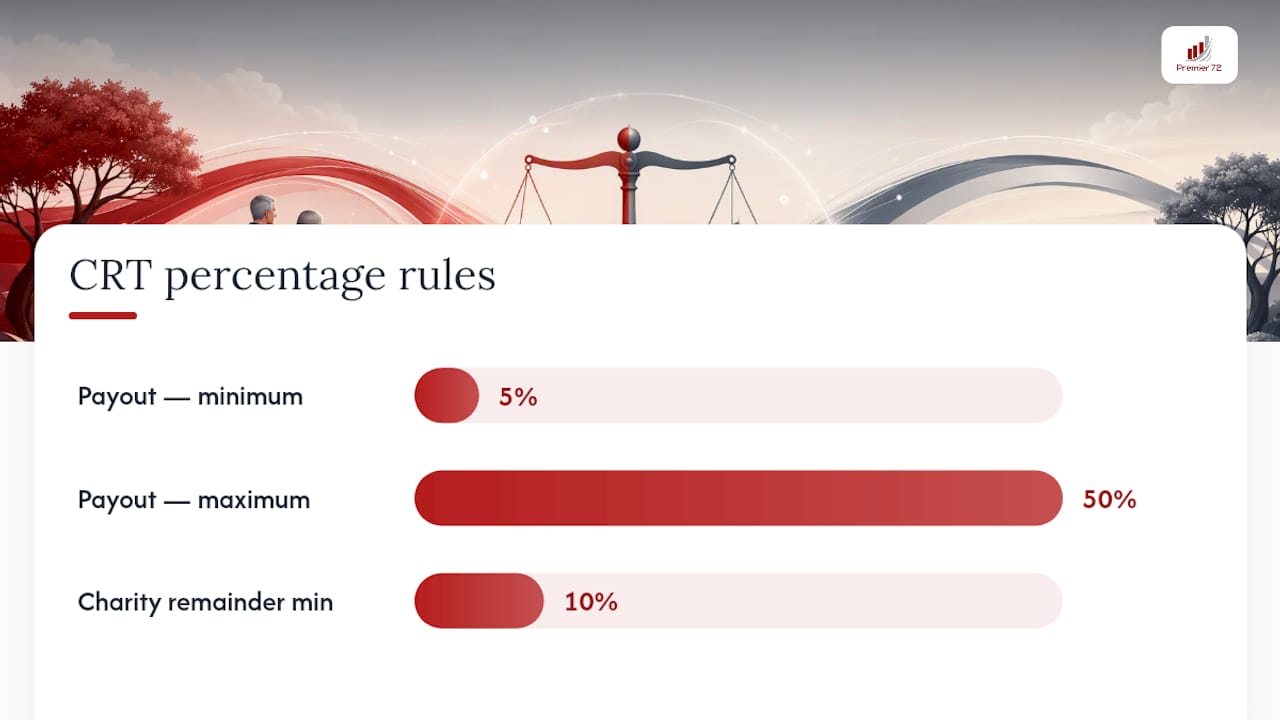
- A CRT must maintain payout rates between 5% and 50%, with fixed or variable payments depending on whether it is a CRAT or CRUT, affecting predictability and growth.
- The IRS uses the §7520 rate and the 10% remainder value rule to determine the trust's feasibility, which can cause payout adjustments or disqualifications over time.
- Fixed CRAT payouts are consistent but do not adjust for inflation, while CRUT payouts fluctuate with asset values, impacting income stability and growth potential.
- Proper modeling against current and stressed §7520 rates is essential, as low rates may invalidate high payout configurations or cause the trust to fail IRS tests.
- Trust selection heavily depends on the donor's age, asset liquidity, growth goals, and willingness to manage administration costs, with most under $500,000 favoring simpler funding options.
Table of Contents
- What Is a Charitable Remainder Trust and How Does It Work?
- CRAT vs CRUT: Payouts, Contributions, and Real Outcomes
- What IRS Rules Decide Whether Your CRT Works?
- Who Actually Benefits From Each Structure?
- Common Pitfalls, Costs, and Administration Traps
- How Do You Choose Between a CRAT and a CRUT?
- How Premier72 Views CRT Selection Within a Bigger Plan
- What This Comparison Boils Down To
- How Premier72 Supports Your CRT Decision
- Where to Go for Official Rules and Deeper Modeling
- Sources
What Is a Charitable Remainder Trust and How Does It Work?
A charitable remainder trust (CRT) is a split-interest arrangement: you or your named beneficiaries receive income for a set term or for life, and whatever remains passes to charity at the end. You can fund one during your lifetime or through your estate, and you can structure the payout period around a fixed number of years (capped at 20) or the life of one or more beneficiaries.
The tax benefits show up almost immediately. Fund the trust with appreciated stock or real estate, and you get a partial charitable income tax deduction the year you transfer the asset. Just as important, the trust can sell that appreciated property without triggering capital gains tax at the point of sale, deferring that liability rather than eliminating it.
The IRS puts firm guardrails on the structure. Every CRT, whether it's a CRAT or CRUT, must:
- Distribute no less than 5% and no more than 50% of trust value each year
- Show a charitable remainder with a present value of at least 10% of the property's initial fair market value
- Name a qualified charitable organization as the eventual remainder beneficiary
- Follow strict timing rules for when income payments must be made annually
Miss either threshold and the trust doesn't qualify, which is why the payout rate you choose isn't just a personal preference. It's a design constraint.
CRAT vs CRUT: Payouts, Contributions, and Real Outcomes
The mechanical difference between these two trusts drives everything else about how they behave over time.
- Payout calculation. A CRAT locks in a fixed dollar amount at funding, calculated as a percentage of the trust's initial value. A CRUT recalculates the payout every year, applying the chosen percentage to that year's fair market value instead.
- Contribution rules. Once a CRAT is funded, that's it. No more assets go in. A CRUT allows additional contributions throughout its term, which matters if you expect more liquidity events, like a business sale, down the road.
- Inflation and market exposure. CRAT payments never adjust, so a fixed $50,000 annual distribution buys less with each passing year of inflation. A CRUT's payment moves with the market, rising in strong years and falling in weak ones.
The CRAT pays a flat $120,000 every year, full stop, regardless of what happens to the underlying portfolio. The CRUT pays 6% of whatever the trust is worth each January. If the portfolio grows to $2.3 million in year three, the payout that year jumps to $138,000. If a downturn drops it to $1.7 million, the payout falls to $102,000. One donor gets certainty; the other gets a payment tied to performance, for better or worse.
What IRS Rules Decide Whether Your CRT Works?
The mechanics above only matter if your trust design survives IRS scrutiny. Three rules do the heavy lifting.
- The 5%–50% payout corridor. Every CRAT and CRUT must fall inside this range, no exceptions.
- The §7520 rate. Published monthly by the Treasury, this rate is used to calculate the present value of the remainder interest that eventually goes to charity, under Treasury Regulation 1.664-2.
- The 10% remainder test. The charity's projected share must be worth at least 10% of the original contribution in present-value terms.
Rate check: When the §7520 rate is low, a high payout rate can push the projected remainder below that 10% floor, which is exactly why donors requesting large fixed CRAT payouts sometimes get turned away by the math before they ever meet with a trustee.
That interaction between §7520 and the 10% test explains why the same payout percentage can pass in one funding year and fail in another. A CRAT designed under a favorable rate environment might not work when rates drop, since its fixed payout doesn't adjust to compensate.
Administration isn't optional either. The trust files an annual Form 5227 informational return, and taxable trust income may also require Form 1041. CRUTs carry the added burden of annual asset revaluation, since the payout depends on current fair market value every single year.
Who Actually Benefits From Each Structure?
Your age, asset mix, and appetite for variability point toward one structure more than the other.
CRATs tend to fit:
- Donors in their 70s or 80s who want a locked-in number to plan a budget around
- Retirees who already have market exposure elsewhere and want one predictable income stream
- Simpler funding situations, since a fixed payout removes annual valuation headaches
CRUTs tend to fit:
- Donors with growth-oriented assets like appreciated stock, who want the remainder (and the income) to grow alongside the portfolio
- High-net-worth donors who anticipate future liquidity events and want the flexibility to add contributions later
- Owners of illiquid property, such as real estate or closely held business interests, where a Flip CRUT or NIMCRUT structure allows income to start only after the asset actually sells
Pro Tip: CRTs carry real setup and administration costs, so most advisors won't recommend one below roughly $500,000 in appreciated assets. Below that threshold, a donor-advised fund or straightforward gift usually makes more economic sense.
Common Pitfalls, Costs, and Administration Traps
Ambitious payout rates are the most frequent design failure. Push too high, and the 10% remainder test collapses, especially in a low §7520-rate environment.
Costs add up beyond drafting. Trustee fees, annual CRUT valuations, and tax preparation for Form 5227 and Form 1041 are recurring expenses, not one-time setup costs.
- Distributions aren't taxed uniformly. They flow through a four-tier system: ordinary income first, then capital gains, then other income, then tax-free return of principal.
- Funding with illiquid assets before securing a buyer can create a liquidity mismatch, leaving no cash on hand to make the first required distribution.
How Do You Choose Between a CRAT and a CRUT?
- List your priorities. Rank income certainty, growth potential, and the ability to add future contributions.
- Model both structures. Run each payout rate against current and stressed §7520 scenarios to see which one clears the 10% remainder test comfortably.
- Match the vehicle to the asset. Illiquid property often points toward a Flip CRUT rather than a standard CRAT or CRUT.
- Engage a tax attorney and trustee before drafting. Bring an asset inventory and target payout figures to that first conversation.
Run the numbers before you fund anything. A model built on last month's §7520 rate can look very different six months later.
How Premier72 Views CRT Selection Within a Bigger Plan
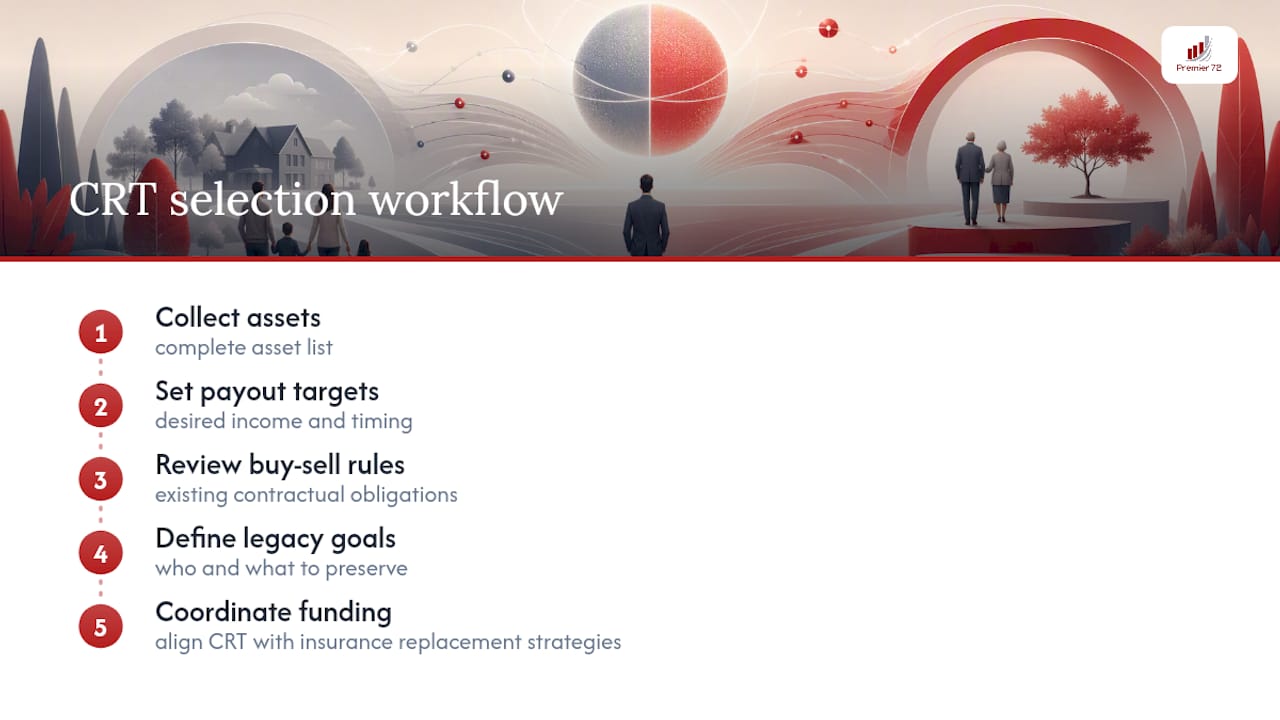
We rarely look at a CRAT or CRUT in isolation. For business owners, the trust decision usually sits alongside exit-readiness modeling under The Retirement Bank Method™. We typically ask for an asset list, target payout figures, any existing buy-sell obligations, and a clear picture of the legacy you want to leave, then coordinate CRT funding with insurance-based wealth-replacement strategies so your heirs aren't left short.
What This Comparison Boils Down To
Model first, involve counsel early, and lean toward a CRUT when growth and flexibility matter more than a fixed number. Choose a CRAT when short-term certainty outweighs everything else. Watch §7520 sensitivity closely. Trustee selection matters more than most donors expect.
— Asa
How Premier72 Supports Your CRT Decision
Premier72 gives business owners and high-net-worth donors something most estate attorneys can't: a direct line between your charitable trust design and your broader exit and retirement plan. We model CRAT and CRUT scenarios against current §7520 rates, coordinate trust drafting with your legal team, and help structure insurance-based wealth-replacement strategies so your family's legacy isn't reduced by what goes to charity.

Before your first conversation, gather an inventory of the assets you're considering for funding, a rough target payout number, and any buy-sell obligations tied to your business. Explore how trusts fit into a broader legacy plan, and see how governance concerns factor in for high-asset families managing complex estates. When you're ready to model your own numbers against real §7520 scenarios, reach out to Premier72 to start a structured advisory review.
Where to Go for Official Rules and Deeper Modeling
- IRS: Charitable Remainder Trusts — payout rules and remainder test
- Treasury Regulation 1.664-2 — §7520 rate mechanics
- IRS Form 5227 instructions — annual reporting requirements
This article is general information, not a substitute for advice from a qualified financial advisor. Consult a qualified financial professional about your own circumstances before acting on anything here.
Sources
- Charitable remainder trusts | Internal Revenue Service
- Charitable remainder unitrust | Legal Information Institute (Cornell Law)
- Charitable remainder trusts | Fidelity Charitable