

Customer concentration risk is material when one customer exceeds roughly 20% of revenue or your top five exceed 40%. If either threshold applies to your business, unmanaged concentration can compress margins, spike cash-flow volatility, and pull down your exit multiple. Run the calculation in the next section before you decide how much this affects you.
TL;DR:
- Businesses with a top customer exceeding 20% of revenue or top five customers exceeding 40% face higher risks of margin compression and cash-flow volatility.
- Measuring concentration risk by revenue and margin share helps identify vulnerabilities, especially when a large client could account for significant profit loss if lost.
- Warning signs include co-termination clusters, deep discounts, late payments, and reliance on single-relationship clients, which signal rising exposure levels.
- Concentration risk reduces valuation multiples, complicates loan terms, and requires proactive contractual safeguards like longer-term agreements and retention clauses.
- Owners should prioritize detailed analysis and documentation over diversification, focusing on fixing contractual terms well before an exit or financing event.
Table of Contents
- What Is Customer Concentration Risk and Why Does It Matter?
- How Do You Measure Customer Concentration Risk?
- Worked Example: Calculating Concentration in Practice
- Which Warning Signs Point to Rising Concentration Risk?
- How Does Customer Concentration Affect Valuation and Due Diligence?
- What Mitigation Tactics Actually Reduce Concentration Risk?
- Premier72's Perspective on Concentration in Owner-Dependent Businesses
- Where Does Concentration Risk Bite Hardest by Industry?
- What Can Past Cases Teach Owners About Concentration Risk?
- What Regulatory and Compliance Factors Apply to Concentration Risk?
- How Does Concentration Risk Factor Into Lending Decisions?
- What Should Owners Actually Prioritize Here?
- Get a Concentration and Exit-Readiness Assessment
- Sources
What Is Customer Concentration Risk and Why Does It Matter?
Customer concentration risk is the exposure a business carries when a disproportionate share of revenue depends on a small number of customers. It differs from general revenue risk, which spreads across market cycles and product lines. Concentration risk is narrower and sharper: losing one major client can materially affect revenue, profitability, and cash flow almost overnight, with little time to replace the volume.
Unmanaged concentration shows up in predictable ways:
- Margin compression as large customers use their leverage to negotiate lower prices or extended terms
- Loss of negotiating power, since walking away from a major account is rarely a real option
- Cash-flow volatility tied to a single renewal date or payment cycle
- Operational distraction as leadership spends disproportionate time serving one account's demands
A renewal cliff on your biggest contract, bespoke engineering work built around one client's specifications, or chronically late payments from your largest account are the concrete symptoms owners actually experience.
How Do You Measure Customer Concentration Risk?
The formula is simple, even if the data pull takes some effort:
Customer concentration % = Revenue from customer ÷ Total revenue
Here's how to run it properly:
- Pull revenue by customer for a consistent period, either trailing 12 months or annual recurring revenue (ARR) if you run a subscription model.
- Calculate each customer's share of total revenue for that period.
- Rank customers and compute both the top single customer's share and the combined top-5 share.
- Repeat by margin, not just revenue, since a customer generating 15% of revenue but 30% of gross profit carries more real exposure than the raw percentage suggests.
- Decide your period standard and stick with it. ARR smooths seasonal noise for SaaS businesses; trailing 12 months works better for project-based or seasonal companies where ARR doesn't apply.
Weighting by margin rather than top-line revenue often changes the picture entirely. A discounted enterprise account can look modest on revenue share and dangerous on margin share once you account for the concessions it took to win and keep it.
Worked Example: Calculating Concentration in Practice
Take a small services firm with $2 million in annual revenue. That alone crosses the single-customer concentration threshold that practitioners flag as a red flag once it clears roughly 10 to 20%.
Quick math:
- Top customer: $460,000 ÷ $2,000,000 = 23%
- Top 5 customers: $920,000 ÷ $2,000,000 = 46%
A SaaS company with $5 million ARR and a top-5 group at 38% faces a gentler version of the same math, but the sensitivity test matters just as much. Model what happens to ARR if your largest logo churns at renewal, not just what your dashboard shows today.
Which Warning Signs Point to Rising Concentration Risk?
Percentage share tells you where you stand today. These seven indicators tell you where you're heading, and each one maps to a specific report or metric your finance team can pull this quarter.
- Top-customer revenue percentage — pull it from your revenue-by-customer ledger monthly, not annually
- Contract term cliffs — check for co-termination clusters where multiple large contracts expire in the same quarter
- Concession depth — track discount percentage and non-standard terms granted to top accounts over time
- Payment behavior and DSO — measure days sales outstanding by account, not just company-wide
- Single-threading — flag accounts where only one product or service line is in use, with no cross-sell
- Pipeline skew — review whether new business is concentrating in the same industry or customer profile as existing risk
- Sector or geography concentration — check whether your customer base clusters in one region or industry vulnerable to the same shock
Seven diagnostic indicators form the basis of a workable early-warning system once you're tracking them consistently.
Pro Tip: *Map contract renewal dates against revenue share before you build any other dashboard.
How Does Customer Concentration Affect Valuation and Due Diligence?
Buyers and lenders discount concentrated businesses for three reasons: forecast instability, elevated default risk if a top account leaves, and the negotiating leverage a large customer holds over pricing. Regulatory and buyer scrutiny treat concentration as a material diligence item in nearly every transaction and financing conversation, not an afterthought.
The practical effects show up in the numbers:
- Lower exit multiples, often negotiated down specifically to price in concentration risk
- Tougher leverage terms from lenders who view a concentrated customer base as a repayment risk
- Demands for retention evidence, not just revenue history
Due-diligence artifacts that ease buyer concern include multi-year contract terms, documented renewal rates by account, margin breakdowns by customer, and customer references that confirm the relationship survives beyond one key contact. Private equity and strategic buyers increasingly run stress tests that remove your top customers entirely to see whether the remaining cash flow still supports the multiple you're asking for.
What Mitigation Tactics Actually Reduce Concentration Risk?
Fixing concentration risk works best as a sequence, not a single move. Here's the order that tends to produce results without disrupting the accounts you're trying to protect:
- Normalize pricing and terms at the next renewal. Bring outlier discounts back toward your standard rate card gradually, not all at once.
- Add minimum-notice clauses to contracts so a departing customer gives you runway to replace the revenue.
- Request deposits or shorter payment terms from your largest accounts to reduce DSO exposure.
- Diversify channels and industries over 12 to 24 months rather than chasing one replacement whale.
- Productize bespoke work built for a single client so it can be resold to others.
- Rebalance sales territory and incentive structures so new pipeline doesn't recreate the same concentration pattern.
- Build cash reserves sized to cover a top-customer loss for at least one full sales cycle.
- Consider trade credit insurance when remediation will take longer than your receivables exposure can tolerate.
Diversification, contractual safeguards, liquidity buffers, and monitoring together form the standard mitigation toolkit, and trade credit insurance in particular works well when a concentrated account can't be diversified away quickly. A cash reserve funded partly through key-person coverage or buy-sell instruments adds a layer of protection buyers notice during due diligence.
Pro Tip: Track top-customer revenue percentage and DSO by account monthly, and set an automatic alert when either crosses your threshold. Reacting to a concentration problem after the renewal notice arrives is always more expensive than catching the trend six months earlier.
Premier72's Perspective on Concentration in Owner-Dependent Businesses
Concentration risk rarely travels alone. In owner-dependent companies, it tends to sit alongside thin documentation, informal pricing, and relationships that run through the owner personally rather than the business. That combination is what actually kills transferability, since a buyer sees both a concentrated revenue base and no evidence anyone besides the owner can hold it together.
A revenue-by-customer ledger, a DSO dashboard segmented by account, and a contract map showing renewal dates are the three tools that surface this fastest.
Where Does Concentration Risk Bite Hardest by Industry?
Concentration risk plays out differently depending on the sector, and owners often underestimate how much industry structure shapes their exposure.
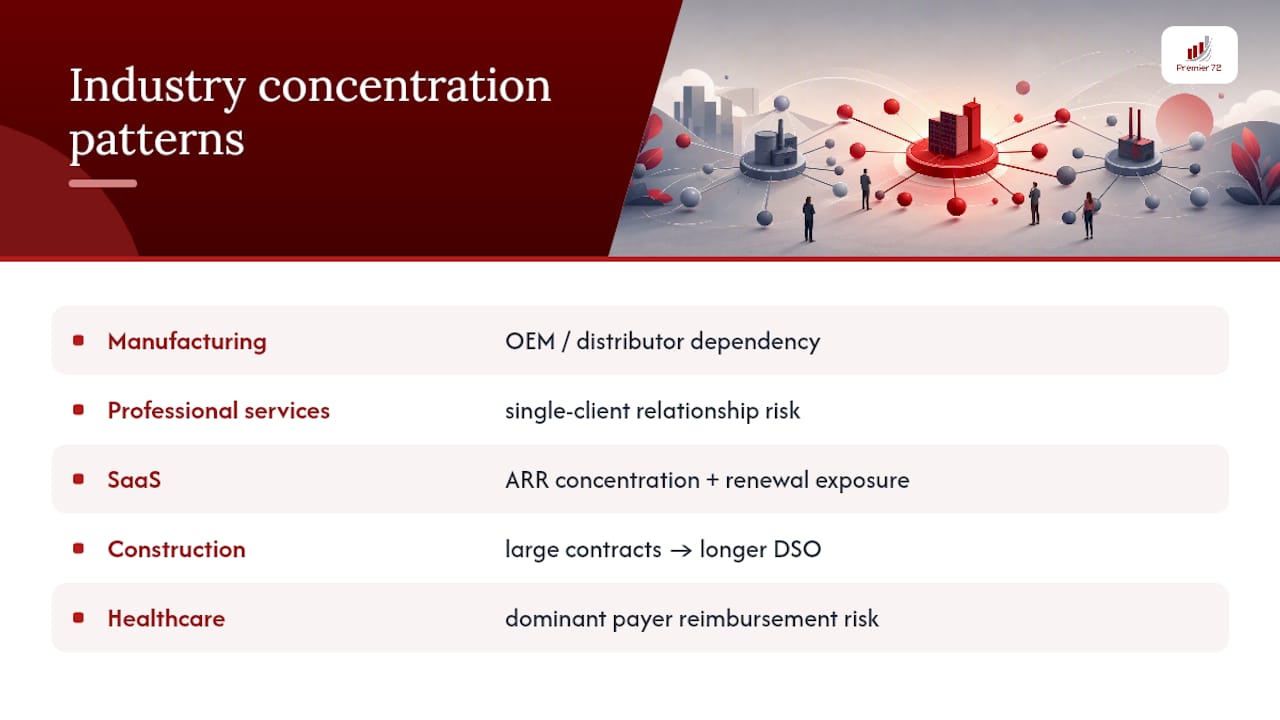
Manufacturing and industrial services tend to carry concentration through a handful of OEM or distributor relationships.
Professional services and agencies face a different pattern. Concentration builds through relationship dependency, where one client relationship, often tied to a specific partner or account lead, drives a disproportionate share of billings. Losing the relationship owner and the client can happen together.
SaaS and subscription businesses measure concentration in ARR terms, and the risk compounds with contract length. A short-term or month-to-month top account is more dangerous than a locked three-year deal at the same revenue share, because the renewal risk resets constantly.
Construction and project-based businesses see concentration spike around large government or institutional contracts. These come with longer payment cycles and stricter compliance terms, which raises the DSO and concession-depth risks discussed earlier even when the percentage share looks acceptable on paper.
Healthcare and medical suppliers face concentration risk compounded by payer mix, where a shift in reimbursement policy from one dominant insurer can mimic the effect of losing a major customer, even without any change in the underlying client relationship.
What Can Past Cases Teach Owners About Concentration Risk?
Concentration failures tend to follow a familiar arc: a company grows quickly around one anchor customer, treats the relationship as permanent, and gets caught without a backup plan when priorities shift.
Retail supply chains offer some of the clearest patterns. Suppliers that built their entire production model around a single big-box retailer have repeatedly discovered how fast a renegotiated purchase order or a shifted sourcing strategy can gut annual revenue. The supplier rarely sees it coming because the relationship felt stable for years before the terms changed.
Technology vendors serving a single large enterprise client show a similar pattern, particularly when that client represents both the largest customer and the primary source of product feedback. When the enterprise customer's internal priorities shift, or the champion managing the relationship leaves, the vendor can lose both the revenue and the product direction that customer had been quietly shaping.
Defense and government contractors illustrate the same risk. Businesses that scaled around a handful of contract vehicles have faced sharp revenue drops when a single agency reallocated its budget or moved to a different vendor at recompete. The lesson that recurs across these situations isn't that concentration is avoidable. Growth around a strong customer relationship is often how good businesses scale. The lesson is that concentration without a documented mitigation plan, contractual protection, and a diversification timeline turns a strength into a structural vulnerability the moment that one relationship changes.
What Regulatory and Compliance Factors Apply to Concentration Risk?
Customer concentration itself isn't a regulated category the way, say, data privacy or workplace safety are. But it intersects with several compliance obligations owners and finance teams need to track.
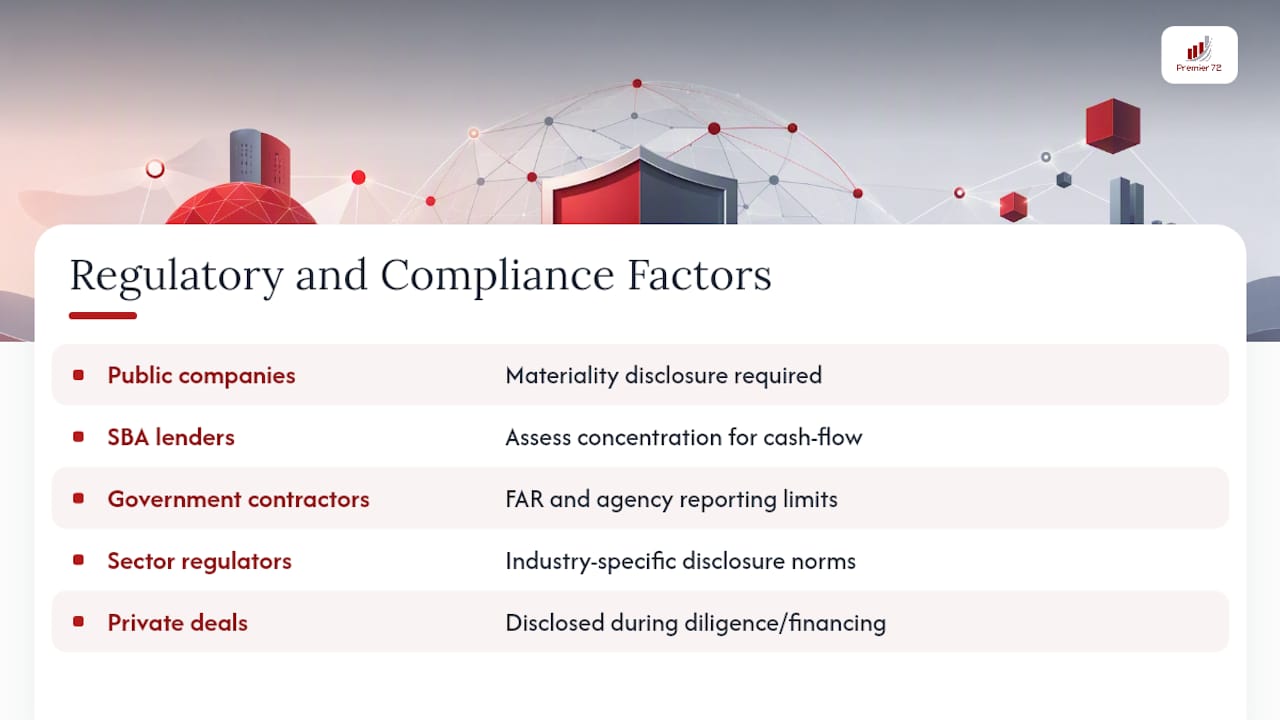
Public companies and businesses preparing for a transaction that involves SEC-reviewed disclosures face materiality obligations around customer concentration in financial statements, since a revenue base overly dependent on one customer is considered information a reasonable investor would want disclosed. Private companies pursuing SBA-backed financing or SBA-aligned acquisition structures face similar scrutiny, since lenders operating under SBA guidelines specifically evaluate customer concentration as part of cash-flow risk assessment before approving loan terms.
Government contractors carry additional layers, since federal acquisition regulations and agency-specific compliance requirements can restrict how contract revenue is structured or reported, which affects how concentration gets measured and disclosed during a sale or refinancing.
Industries with sector-specific oversight, such as healthcare providers subject to payer concentration disclosure norms or financial services firms with counterparty exposure reporting, face similar expectations even without a single unified "concentration regulation" governing them. The practical takeaway for most privately held businesses: concentration disclosure isn't usually mandated by statute, but it's functionally required the moment you enter due diligence, apply for financing, or bring in outside investors, since every one of those processes treats undisclosed concentration as a red flag once discovered.
How Does Concentration Risk Factor Into Lending Decisions?
Lenders treat customer concentration as a core input into credit risk assessment, not a secondary consideration. When a bank or alternative lender underwrites a loan against receivables or projected cash flow, a concentrated customer base directly affects how much they'll lend and on what terms.
The mechanics are straightforward.
Cash-flow lending decisions follow a parallel logic. Underwriters model revenue continuity under a stress scenario that removes the top one or two customers, similar to the private equity stress tests noted earlier in valuation discussions. If the business can't service debt under that scenario, lenders either reduce the loan amount, raise the interest rate to price in the added risk, or require additional collateral and personal guarantees to close the gap.
SBA lenders apply this scrutiny particularly closely on acquisition financing, since the entire loan thesis depends on the acquired business's cash flow surviving ownership transition. Owners who fix this before financing conversations begin routinely get better terms than owners who discover it mid-underwriting.
What Should Owners Actually Prioritize Here?
The research on concentration risk supports one clear judgment: percentage thresholds are a starting point, not the diagnosis itself. The number alone tells you where to look, not how worried to be.
Conventional advice on this topic stops at "diversify your customer base," which is true but incomplete. Diversification takes 12 to 24 months to meaningfully move the percentages, and most owners facing a near-term sale or financing decision don't have that runway. What actually moves the needle faster is contractual and documentation work: locking in longer terms, mapping renewal cliffs, and building the retention evidence buyers and lenders want to see.
If you're within three years of an exit or a major financing event, prioritize the diagnostic work first. Know your exact numbers before anyone else finds them for you. The remediation timeline you choose should follow directly from that exit timeline, not run parallel to it.
— Asa
Get a Concentration and Exit-Readiness Assessment
If your numbers came back above the thresholds covered here, Premier72 helps established business owners turn that diagnosis into a plan. Through The Retirement Bank Method™, Premier72 works directly with owners to map customer concentration against exit readiness, strengthen documentation and contract terms, and build the cash-flow resilience buyers and lenders actually look for in due diligence.

That includes structured advisory reviews, business continuity planning through key-person and buy-sell coverage, and practical steps to prepare your business for sale before concentration becomes a deal-breaker instead of a footnote. Concentration issues rarely resolve themselves on a timeline that suits a buyer's schedule, so the sooner the diagnostic work starts, the more options you keep. Schedule a structured assessment with Premier72 at Premier72 to find out where your business stands and what to fix first.
Sources
- Customer Concentration | Formula + Calculator — Wall Street Prep
- Customer Concentration — Corporate Finance Institute
- How to Avoid High Customer Concentration Risk — Allianz Trade
- Key indicators of revenue concentration risk — Sirion