

SDE adds owner pay and discretionary draws back into earnings, built for owner-operator transactions. EBITDA excludes owner pay entirely, built for enterprise-focused buyers who install their own management team. Owner-operators selling under roughly $5 million usually lead with SDE; larger, institutionally financed deals run on EBITDA. The smart move for most sellers is preparing both.
TL;DR:
- Business owners should prepare both SDE and EBITDA calculations because different buyers and deal sizes require different valuation metrics.
- SDE is most relevant for businesses under 2 million dollars in value, especially for owner-operator buyers, while EBITDA suits larger, institutionally financed deals.
- Accurate documentation of owner compensation, personal expenses, and one-time costs is essential for establishing defensible SDE and EBITDA figures.
- Quoting the wrong metric to the wrong buyer can lead to undervaluation or lowball offers, so understanding which measure to use based on deal size and ownership structure is critical.
- Conducting a thorough Quality of Earnings review and normalizing earnings before listing improves credibility and maximizes valuation.
Table of Contents
- EBITDA vs SDE: What Each One Actually Measures
- What Is SDE and What Does It Capture for Owners?
- EBITDA vs SDE: Owner Pay, Buyer Type, and Common Mistakes
- When Should You Use SDE Instead of EBITDA?
- How to Calculate a Defensible SDE and Adjusted EBITDA
- Example Recast: How SDE and EBITDA Produce Different Values
- Why EBITDA Multiples Run Higher Than SDE Multiples
- A Seller Checklist for Defensible SDE and EBITDA Numbers
- Why Showing Both Metrics Changes the Outcome
- Get Your Business Recast-Ready Before You List It
- Sources
EBITDA vs SDE: What Each One Actually Measures
EBITDA strips out interest, taxes, depreciation, and amortization to reveal how a business performs regardless of how it's financed. Two formulas get you there: Net Income + Interest + Taxes + Depreciation + Amortization, or Operating Income + Depreciation + Amortization. If a company nets $400,000 with $60,000 in depreciation, $30,000 in interest, and $110,000 in taxes, EBITDA lands at $600,000.
Institutional buyers and lenders lean on EBITDA because it lets them compare operating performance across companies with wildly different debt loads or tax structures. That consistency is also its blind spot.
EBITDA has real limits worth knowing before you quote it to a buyer:
- It ignores capital expenditures, so a business with aging equipment can look identical to one that's fully modernized.
- It skips working capital swings, which can hide a cash crunch that never shows up in the earnings line.
- It's non-GAAP, meaning public companies must reconcile it back to net income precisely because it can overstate what's actually available to an owner.
Pro Tip: Never quote EBITDA to a buyer without also showing recent capex. A high EBITDA sitting on a fleet of trucks that needs replacing next year isn't the number it looks like.
What Is SDE and What Does It Capture for Owners?
SDE (Seller's Discretionary Earnings) starts from net income and adds back everything a new owner-operator wouldn't necessarily spend: owner compensation, discretionary personal expenses, and one-time costs. The formula is straightforward: SDE = Net Income + Owner Compensation + Discretionary Expenses + Non-Recurring Costs.
Say a business shows $150,000 in net income. Add back a $90,000 owner salary, $15,000 in personal auto and travel expenses run through the business, and a one-time $10,000 legal settlement. SDE comes out to $265,000, the real day-one benefit a new owner-operator could expect to pocket.
That's why SDE dominates Main Street deals and owner-operated small businesses: it answers the buyer's real question, "What do I actually take home if I run this myself?"
Add-backs buyers will want documented, not just claimed, include:
- Owner salary and payroll taxes, verified against W-2s or K-1s.
- Personal expenses run through the business, like a car lease or a family member's cell phone.
- One-time legal fees, insurance claims, or COVID-era relief costs.
- Above-market rent paid to a related party, adjusted to fair market value.
EBITDA vs SDE: Owner Pay, Buyer Type, and Common Mistakes
The core split comes down to one line item: owner compensation. SDE treats it as an add-back the new owner captures. EBITDA treats it as a real, ongoing operating expense, because an institutional buyer has to hire a manager to replace the owner's labor.
That single difference reshapes who uses which metric:
- Individual and owner-operator buyers want SDE. They're buying a job plus a business, and they need to know their real take-home before financing.
- Private equity and strategic buyers want EBITDA, then typically layer in a market-rate management salary as a deduction, effectively reconstructing SDE math from the other direction.
- Common seller mistakes include quoting SDE to an institutional buyer (it reads as inflated), quoting bare EBITDA to a Main Street buyer (it understates real cash benefit), and stacking unsupported add-backs that collapse the moment a buyer's accountant asks for invoices.
Sellers who misapply the metric to the wrong buyer don't just confuse the conversation. They often trigger a lowball first offer that takes weeks to walk back with better documentation.
When Should You Use SDE Instead of EBITDA?
Deal size and ownership structure point you toward the right metric well before you sit down with a buyer. Three directional rules hold up across most Main Street and lower-middle-market transactions:
- Under roughly $2 million in enterprise value, SDE is used almost universally. Buyers here are individuals seeking self-employment, and SDE speaks their language directly, according to Flippa's deal-size analysis.
- Between roughly $2 million and $5 million, the choice depends on governance. A business with a general manager already running daily operations can support an EBITDA story. One still fully dependent on the owner should lead with SDE.
- Above roughly $5 million, EBITDA becomes the default because buyers at this level are typically institutional, financed with debt structures that make interest and depreciation genuinely relevant.
That $2 million to $5 million range is where showing both numbers pays off. It lets an individual buyer see their real take-home while giving a private equity buyer the enterprise-earnings frame they need to run their own model. SBA lenders, notably, will often want to see SDE regardless of deal size, since SBA underwriting centers on the owner-operator's debt-service capacity.
How to Calculate a Defensible SDE and Adjusted EBITDA
Building numbers a buyer's due diligence team won't tear apart takes a specific sequence, not a spreadsheet full of guesses.
- Start with net income from your tax return or reviewed financials, not an internal management report that hasn't been reconciled.
- List every SDE add-back line by line: owner salary, payroll taxes on that salary, personal expenses, and one-time costs. Total them separately rather than lumping them into one "adjustments" figure.
- Convert to adjusted EBITDA by removing the owner's discretionary items and instead deducting a market-rate replacement salary for whoever would run the business day-to-day. Adjusted EBITDA modifies the raw figure for exactly these unusual or nonoperating items.
- Gather source documentation for every add-back: invoices, bank statements, lease agreements, and payroll records. Anything unsupported gets discounted or dropped entirely once a buyer's accountant starts asking questions.
Pro Tip: Buyers probe add-backs first because that's where inflated valuations usually hide. Reconcile every add-back to an actual document before you ever put a number in front of a buyer, not after they ask.
Example Recast: How SDE and EBITDA Produce Different Values
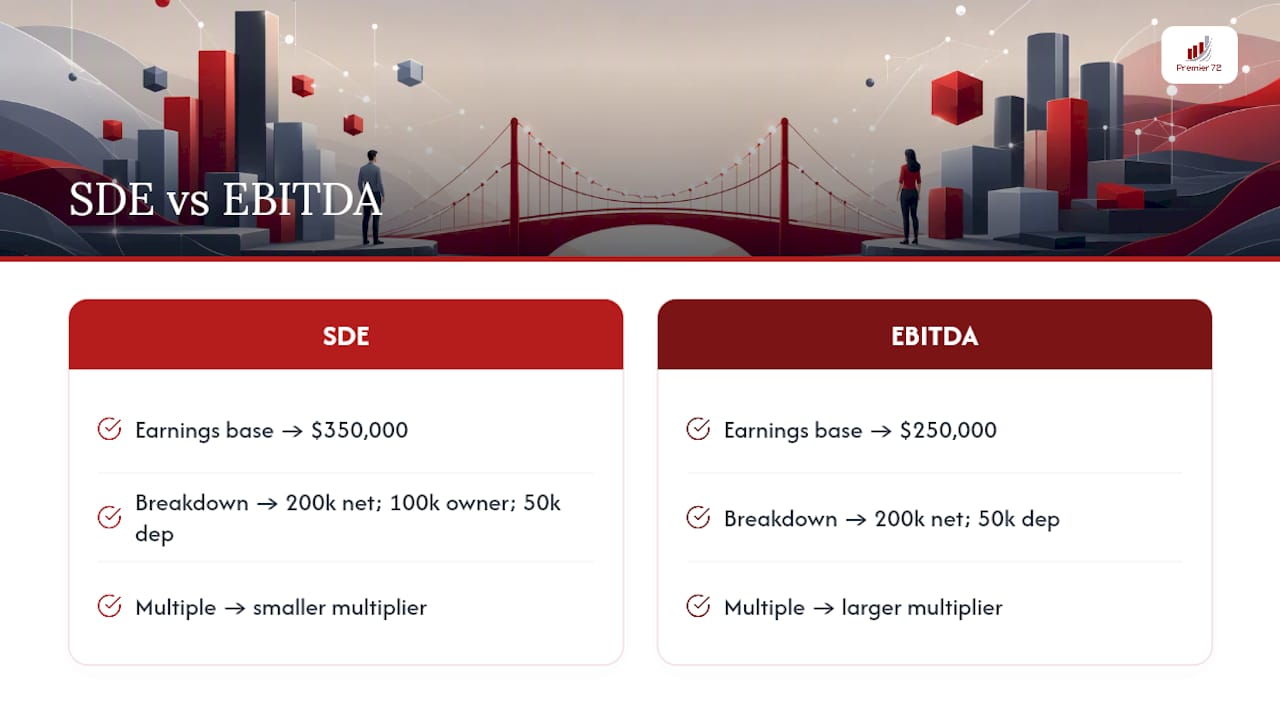
Run the same business through both lenses and the valuation gap becomes obvious fast. Take a company with $200,000 in net income, a $100,000 owner salary, and $50,000 in depreciation.
The earnings base and the multiple move in opposite directions: SDE produces a bigger number with a smaller multiplier, EBITDA a smaller number with a bigger one. Quoting a multiple without stating which earnings base it applies to tells a buyer almost nothing.
Why EBITDA Multiples Run Higher Than SDE Multiples
EBITDA multiples typically sit higher than SDE multiples because institutional buyers have already deducted a market-rate management salary before applying their multiple, while SDE multiples compress to account for the owner-labor value baked into the earnings figure.
What actually moves a multiple up or down within either framework:
- Sector and growth trajectory. A recurring-revenue software business commands a very different multiple than a seasonal landscaping company.
- Capex intensity. Asset-heavy businesses (trucking, manufacturing) get discounted multiples because buyers know reinvestment is coming.
- Revenue concentration and owner dependence. A business reliant on one client or one irreplaceable owner rarely earns a premium multiple, regardless of which earnings metric you quote.
Before you accept a quoted multiple at face value, ask which earnings base it's built on. A "4x" offer means something entirely different applied to EBITDA than applied to SDE.
A Seller Checklist for Defensible SDE and EBITDA Numbers
A business advisory firm can walk owners through a specific sequence before any business goes to market, because buyers reward documentation and punish guesswork.
- Produce both an SDE recast and an adjusted EBITDA recast, reconciled from the same net income figure.
- Tie every add-back to a source document: invoices, payroll records, lease agreements, and bank statements.
- Commission a Quality of Earnings review if you're targeting a private equity or strategic buyer. It materially reduces pushback on your adjustments.
- Reduce owner dependency before marketing the business, since a stronger management structure directly supports a higher EBITDA multiple.
- Review asset versus stock sale structure early, since it changes how buyers and their advisors read your recast.
Pro Tip: A Quality of Earnings review costs money upfront, but it almost always costs less than the price concession a buyer will demand after finding unsupported add-backs during their own diligence.
Why Showing Both Metrics Changes the Outcome
Sellers who present only one number invite a buyer to fill in the gap with their own assumptions, usually the less favorable one. Showing both SDE and adjusted EBITDA lets an individual buyer see their real take-home while giving an institutional buyer the enterprise-earnings frame they need. That's not hedging. It's controlling the conversation before someone else does.
— Asa
Get Your Business Recast-Ready Before You List It
There are firms that focus on turning a business that's profitable but owner-dependent into a company that reads clean on paper, whether the buyer across the table wants SDE or adjusted EBITDA. That's the practical edge over guessing at your own numbers or handing a buyer a single unreconciled figure and hoping it holds up.

An advisory process can walk owners through normalizing historical earnings into both metrics, documenting every add-back against real source records, and coordinating a Quality of Earnings review before the business ever reaches a buyer's desk. That sequence is exactly what closes the gap between what you think your company is worth and what a buyer is willing to pay for it. If you're within a few years of selling, visit Premier72 to start a structured advisory review and get your recast built before a buyer's due diligence team builds it for you.
Sources
- SDE vs EBITDA: Which Valuation Metric Matters for a $250k to $10m exit? | Flippa
- EBITDA definition and explanation | Investopedia