

Insurance is defined as the primary financial defense against the events that wipe out decades of accumulated wealth in a single year. For Baby Boomer business owners, the role of insurance in wealth preservation goes far beyond replacing a lost asset. It provides liquidity when estate taxes come due, protects business value from liability verdicts, and creates a structured path for transferring wealth to the next generation. Without a coordinated insurance plan, even a profitable, well-run business can force its owner into a fire sale at exactly the wrong moment.
What is the role of insurance in wealth preservation?
Insurance for asset protection works by absorbing financial shocks that would otherwise force you to sell investments, drain retirement accounts, or liquidate business equity. Think of it as a financial buffer. When a lawsuit, disability, or unexpected death creates an immediate cash obligation, insurance steps in so your long-term assets stay intact.
The importance of insurance in wealth cannot be overstated for business owners approaching retirement. Your wealth is likely concentrated in illiquid assets: your company, commercial real estate, and equipment. A single uninsured event can trigger a chain reaction. You sell assets at a discount, lose compounding growth, and reduce what you pass on to your heirs.

Insurance planning supports investment resilience by preventing forced sales during downturns and enabling steady wealth accumulation. That insight reframes insurance from a cost center into a growth protection tool. Premier72 works with business owners to apply exactly this framing when building financial plans.
How does insurance protect business owners' assets from risks?
Business owners face a wider range of financial threats than most people realize. Liability exposure, property damage, key person loss, disability, and market volatility all threaten the wealth you have spent a lifetime building. Each risk requires a specific insurance response.
The most dangerous gap for high-net-worth business owners is inadequate liability coverage. Courts now regularly deliver "nuclear verdicts" exceeding $10 million. High-net-worth advisors recommend umbrella liability limits starting at $5 million to $10 million, with $25 million or more for owners with significant public or professional exposure. That number reflects the real cost of a single catastrophic verdict, not a theoretical worst case.
Standard business policies also suffer from valuation gaps. A coordinated portfolio of 5–10 policies eliminates the coverage gaps that standard insurance misses, including failure to cover true replacement costs and specialized liability risks. Most business owners carry two or three policies and assume they are covered. They are not.
Key risks that demand dedicated coverage include:
- Liability exposure: General liability, professional liability, and umbrella coverage protect personal and business assets from lawsuits.
- Key person risk: A policy on a critical employee or owner provides cash to stabilize the business after an unexpected loss.
- Disability: Short and long-term disability insurance protects your income if you cannot work, preserving your ability to fund retirement.
- Property damage: Replacement-cost coverage, not actual cash value, covers the real cost of rebuilding after a loss.
Pro Tip: Never mix personal and business coverage under a single policy. Blended policies create ambiguity during claims and can leave both your personal assets and your business exposed at the same time.
How does life insurance support liquidity and legacy planning?
Life insurance moves beyond income replacement to become a tactical wealth-building and business succession tool for business owners. This shift in thinking changes how you size a policy and when you use it.
The most immediate problem life insurance solves is estate liquidity. Consider a business owner with a $5 million estate. The IRS may assess a $1 million estate tax bill due within nine months of death. Life insurance can cover that tax obligation directly, preventing a forced sale of the business or real estate to raise cash. Without it, heirs often sell at a discount under time pressure.
Survivorship life insurance, also called second-to-die coverage, pays out after both spouses have passed. This structure works well for estate planning because the payout arrives when the estate tax bill is largest. It also costs less than two individual policies, making it a practical choice for couples with significant illiquid assets.
Life insurance also solves the inheritance equalization problem. A real-world example illustrates the point clearly:
- A business owner has three children. One child works in the business. Two do not.
- The owner wants to leave the business to the child who runs it, but also wants to treat all three children fairly.
- A $20 million second-to-die policy provides $10 million in tax-free cash to the two children outside the business while the third inherits the company intact.
- No forced buyout. No family conflict. No business disruption.
| Scenario | Without life insurance | With life insurance |
|---|---|---|
| Estate tax obligation | Forced asset sale | Policy pays the bill |
| Inheritance equalization | Business must be split or sold | Cash equalizes shares |
| Business continuity | Disrupted or dissolved | Ownership transfers cleanly |
Pro Tip: Coordinate life insurance ownership through an Irrevocable Life Insurance Trust, commonly called an ILIT. This keeps the death benefit out of your taxable estate and gives the trustee control over how proceeds are distributed. Learn more about funding estate taxes with life insurance.
How does insurance integrate with retirement planning?
Financial security through insurance during retirement means protecting the income streams you depend on, not just the assets you have accumulated. Two products do most of the work here: annuities and disability insurance.
Annuities convert a lump sum into a guaranteed income stream. They remove the risk of outliving your money, which is the single greatest financial fear among Baby Boomers. A fixed or indexed annuity provides predictable monthly income regardless of market conditions. That stability lets you leave growth-oriented investments untouched during downturns rather than selling at a loss to cover living expenses.
Disability insurance protects your earning capacity before retirement. If you become unable to work in your 50s or early 60s, disability coverage replaces a portion of your income and allows you to keep funding your retirement accounts. Without it, a two-year disability can permanently reduce your retirement savings by hundreds of thousands of dollars.
Insurance also prevents forced liquidation of investments during market downturns. Insurance provides immediate liquidity for taxes or debts, preserving the compounding growth of long-term investments. For senior investment risk management, this liquidity function is one of the most underappreciated benefits of a well-structured insurance plan.
Key insurance products that protect retirement wealth include:
- Fixed annuities: Guaranteed income regardless of market performance.
- Indexed annuities: Income tied to a market index with downside protection.
- Long-term disability insurance: Replaces income if illness or injury prevents you from working.
- Long-term care insurance: Covers nursing home or in-home care costs that would otherwise drain retirement savings rapidly.
What are the best practices for insurance in business succession?
The most common mistake business owners make is treating insurance as a one-time purchase. Coverage bought at age 45 rarely matches the risks and assets of a business owner at 62. The misconception that insurance is a one-time purchase hinders wealth preservation. Continuous integration within broader planning is the correct approach.
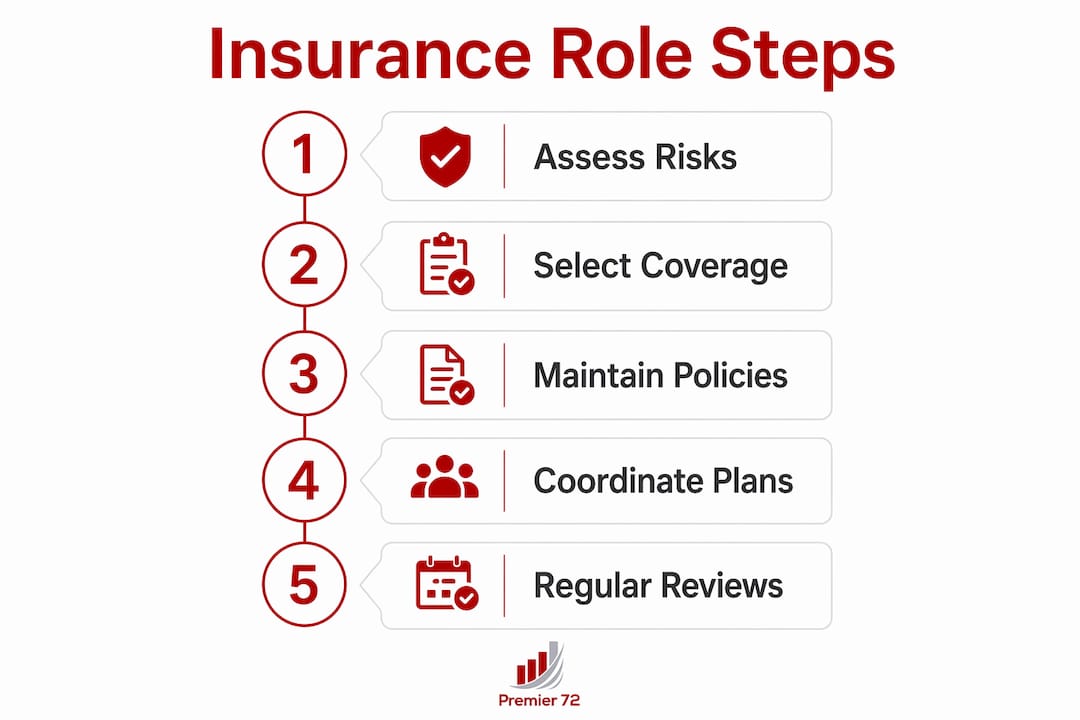
Regular, structured insurance reviews aligned with changes in finances, family, and business risks prevent overpaying, underinsuring, and losing cohesion in your wealth protection plan. A review should happen at minimum every two years, and immediately after any major life or business event.
Effective asset protection combines insurance as the primary defense with trusts and proper asset titling to segregate personal wealth from business liabilities. Insurance alone is not enough. The legal structure around it determines whether the protection actually holds when challenged.
Insurance must also coordinate with tax and estate planning to avoid overpaying for coverage and creating dangerous gaps. A policy that makes sense in isolation may create a tax problem or a coverage overlap when viewed alongside your full financial picture.
Pro Tip: Review your buy-sell agreement every time your business valuation changes. An underfunded buy-sell policy is one of the most common and costly gaps in business succession planning. The policy must match the current value of your ownership interest, not the value from five years ago.
Best practices for managing insurance in a succession plan:
- Schedule a full insurance audit every two years with a qualified advisor.
- Align policy ownership and beneficiary designations with your current estate plan.
- Use premium financing for large life insurance policies to preserve liquidity.
- Layer coverage with legal structures like LLCs, family limited partnerships, and ILITs.
- Confirm that your buy-sell agreement is fully funded at current business valuation.
Key Takeaways
Insurance is the financial foundation that keeps a business owner's wealth intact through liability events, estate obligations, disability, and the transition of ownership to the next generation.
| Point | Details |
|---|---|
| Insurance prevents forced sales | Liquidity from insurance covers taxes and debts without selling business assets at a discount. |
| Umbrella coverage must be high | Advisors recommend $5M–$10M minimum, and $25M+ for owners with high public exposure. |
| Life insurance equalizes estates | Second-to-die policies fund estate taxes and balance inheritances among heirs. |
| Annuities protect retirement income | Guaranteed income streams prevent forced liquidation of investments during market downturns. |
| Reviews are non-negotiable | Insurance must be audited regularly and coordinated with tax, legal, and succession plans. |
Why I think most business owners get insurance exactly backward
Most of the business owners I work with have spent decades building something genuinely valuable. They have managed risk in their operations every single day. But when it comes to their personal and business insurance, they treat it like a utility bill: pay it, file it, forget it.
The gap I see most often is not the absence of coverage. It is the absence of coordination. A business owner has a life insurance policy, a commercial liability policy, and maybe an umbrella. None of them were designed to work together. The beneficiary designations are outdated. The umbrella limit was set in 2011. The buy-sell policy is funded at a valuation from three years ago.
What surprises people is how quickly those gaps become expensive. A nuclear verdict, an estate tax bill, or a disability does not wait for you to update your paperwork. The owners who come through those events intact are the ones who treated insurance as a living part of their financial plan, not a static purchase.
I also see business owners resist larger policies because the premium feels like a cost. The better frame is this: the premium is the price of keeping everything else you have built. A $25 million umbrella policy costs a fraction of what a single uncovered verdict would take from you. That is not a cost. That is a return on protection.
If you are within ten years of retirement or succession, the time to build a coordinated insurance plan is now. Not after the next business milestone. Now.
— Asa
How Premier72 helps you protect what you have built
Protecting a lifetime of business value requires more than a collection of policies. It requires a plan where every piece works together.

Premier72 works with Baby Boomer business owners to build insurance strategies that align with their succession plans, retirement goals, and estate structures. From life insurance for wealth transfer to key person coverage and buy-sell funding, Premier72 coordinates the full picture. The goal is simple: make sure the wealth you have built reaches the people and purposes you intend. Visit Premier72 to connect with an advisor who specializes in business owner protection and legacy planning.
FAQ
What is the role of insurance in wealth preservation?
Insurance preserves wealth by providing liquidity for obligations like estate taxes and debts, preventing forced sales of business assets, and protecting income streams during disability or retirement.
How much umbrella liability coverage does a business owner need?
High-net-worth advisors recommend a minimum of $5 million to $10 million in umbrella coverage, with $25 million or more for owners with significant public or professional exposure to large verdicts.
How does life insurance help with business succession?
Life insurance funds buy-sell agreements, covers estate tax obligations, and equalizes inheritances among heirs, allowing a business to transfer to the next generation without a forced sale or family conflict.
What insurance products protect retirement income?
Fixed and indexed annuities provide guaranteed income regardless of market conditions, while long-term disability and long-term care insurance protect retirement savings from being drained by incapacity or health costs.
How often should a business owner review their insurance coverage?
A full insurance review should occur at minimum every two years, and immediately after any major change in business value, family structure, or estate plan to prevent coverage gaps and misalignment.