

Life insurance is defined as the most reliable tool for funding estate taxes because it delivers immediate, generally income tax-free cash to heirs at exactly the moment they need it most. Without that cash, families face a hard choice: sell a home, a farm, or a business at whatever price the market offers in nine months or less. Understanding why life insurance funds estate taxes means understanding one core fact. The death benefit arrives fast, costs nothing in income tax to receive, and can be sized to match the exact liability your estate will owe. Premier72 works with families and business owners every day to build this kind of protection into a complete legacy plan.
Why life insurance funds estate taxes
Life insurance proceeds are generally income tax-free when paid as a lump sum to beneficiaries. That single fact makes life insurance uniquely suited to cover estate taxes. No other asset class delivers a large, predictable sum of money to heirs without triggering an additional tax bill on receipt.
The federal estate tax exemption stood at $12.92 million per individual in 2023. Estates above that threshold owe federal estate tax at rates up to 40 percent. Life insurance proceeds deposited directly into an estate or controlled by the insured are counted toward that threshold, which is why ownership structure matters as much as coverage amount.

The IRS requires estates to pay taxes within nine months of death. That deadline does not flex for illiquid assets. A family that owns a $5 million commercial property cannot sell a corner of it in nine months at full value. Life insurance solves that problem by delivering cash before the deadline, not after a distressed sale.
How do federal and state estate taxes apply to life insurance?
Federal and state estate taxes operate on separate tracks, and families often get caught by the state level.
Approximately 12 states plus Washington D.C. impose their own estate taxes. Some state exemptions start as low as $1 million. A family in Oregon or Massachusetts with a $2 million estate owes state estate tax even though they are far below the federal threshold. Life insurance proceeds owned by the insured are pulled into that state calculation just as they are at the federal level.
The table below shows how federal and state estate taxes differ in key ways.
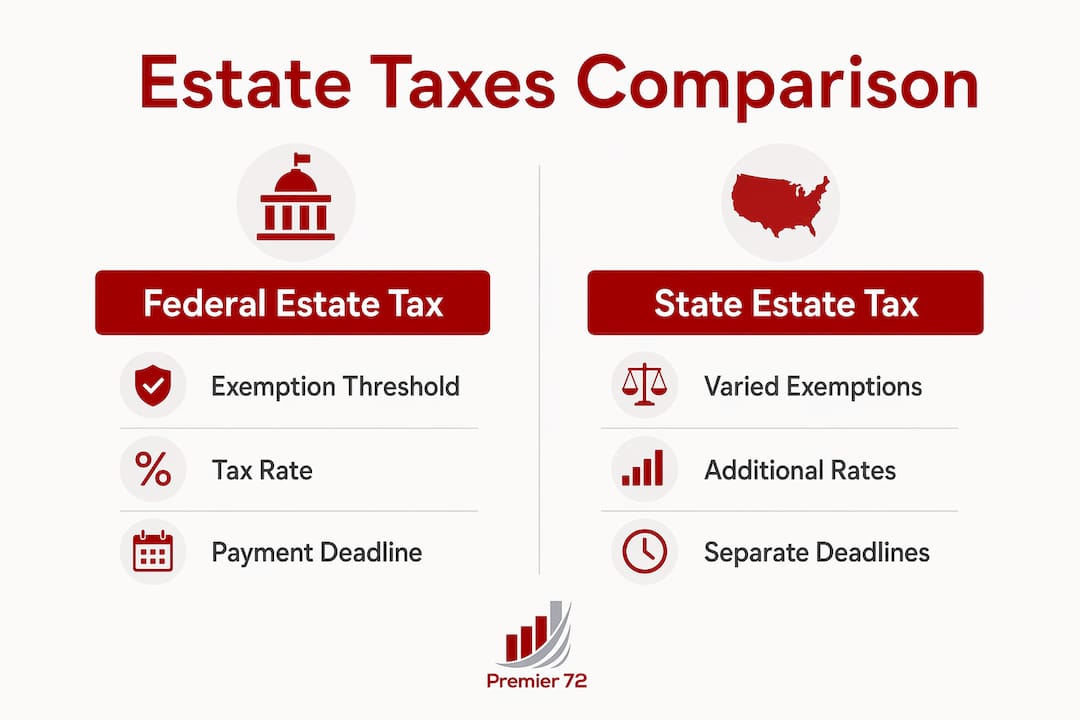
| Feature | Federal estate tax | State estate tax |
|---|---|---|
| Exemption threshold | $12.92 million (2023) | As low as $1 million |
| States that impose it | All U.S. estates | 12 states plus D.C. |
| Top rate | Up to 40% | Varies by state |
| Payment deadline | 9 months after death | Varies, often similar |
| Life insurance inclusion | Yes, if insured owns policy | Yes, same ownership rules |
The practical implication is clear. Families with estates well below the federal threshold can still face a meaningful state tax bill. Life insurance sized to cover only federal exposure may leave a gap at the state level. Reviewing both thresholds is a required step in any complete estate plan.
Key conditions that pull life insurance into a taxable estate include:
- The insured owns the policy at death
- The insured holds any incidents of ownership, such as the right to change beneficiaries
- The insured can borrow against the policy's cash value
- The policy was transferred to a trust within three years of death
What ownership scenarios determine if life insurance is taxable?
Policy ownership is the single biggest variable in estate tax planning with life insurance. The IRS uses the concept of "incidents of ownership" to decide whether proceeds belong in your taxable estate.
Incidents of ownership include any right to change beneficiaries, borrow against the policy, assign the policy, or cancel it. If you hold any of those rights at death, the full death benefit is included in your gross estate. The coverage amount does not matter. A $3 million policy owned by the insured adds $3 million to the taxable estate.
The most effective way to remove a policy from your estate is to place it inside an Irrevocable Life Insurance Trust, commonly called an ILIT. An ILIT excludes policies from the taxable estate under IRS Section 2042, provided the trust was properly established and the insured holds no incidents of ownership. The trust owns the policy. The trust pays the premiums. The insured has no control.
- Establish the ILIT before purchasing the policy. Buying the policy in the trust's name from day one avoids the three-year lookback rule entirely.
- Transfer an existing policy carefully. The IRS imposes a three-year rule on policies transferred to an ILIT. If the insured dies within three years of the transfer, the proceeds return to the taxable estate.
- Fund the trust with annual gifts. Premiums are paid from gifts to the trust. These gifts must comply with IRS gift tax rules, including Crummey notices that give beneficiaries a brief window to withdraw the gift.
- File proper gift tax returns. ILITs must be carefully managed to comply with IRS rules, including gift tax filings to allocate Generation Skipping Transfer exemptions where applicable.
- Work with an estate attorney. An ILIT that is not properly documented can be contested as a sham trust, which would pull the proceeds back into the estate.
Pro Tip: If you already own a policy and want to transfer it to an ILIT, start the clock immediately. The three-year rule begins on the transfer date, not the policy issue date. Every year you wait is a year of exposure.
Why is life insurance essential for estate liquidity?
Many families underestimate the liquidity problem and focus instead on minimizing taxes through deductions. That approach leaves heirs facing a cash shortfall at the worst possible time. Tax minimization and liquidity planning are two different problems, and life insurance solves the second one.
Estates frequently hold assets that cannot be converted to cash quickly at full value. A family farm, a closely held business, a commercial building, or a collection of investment properties all take time to sell properly. Forced sales under a nine-month deadline produce below-market prices. The family loses wealth not to taxes but to the discount required to close a deal fast.
"Life insurance provides liquidity that prevents forced sales of real estate, businesses, or investments at distressed prices needed to pay tax bills due within nine months after death." — Estate planning research
Life insurance also functions as an inheritance equalizer. Consider a family where one child will inherit the family business and another will not. Without life insurance, the non-business heir receives a smaller or less liquid inheritance. A well-structured policy allows the business to pass intact to one heir while the death benefit delivers equivalent value to the other. That structure reduces family conflict and keeps the business whole.
The specific liquidity benefits of life insurance in estate planning include:
- Immediate cash availability. Death benefits are typically paid within days or weeks of a claim, well ahead of the nine-month tax deadline.
- No forced discounting. Heirs pay taxes from insurance proceeds rather than selling assets at whatever price a rushed market will bear.
- Predictable coverage amount. The death benefit is set at policy purchase, so families know exactly how much liquidity will be available.
- No income tax on receipt. Beneficiaries receive the full death benefit without owing income tax, making every dollar available for the tax bill.
How do you integrate life insurance into an estate plan?
Effective estate planning with life insurance requires coordinating policy ownership, coverage amounts, and legal structures before a crisis occurs. The goal is to match the death benefit to the projected tax liability, then structure ownership so the proceeds are available to pay that liability without adding to it.
Choosing the right policy type matters. Permanent life insurance, including whole life and universal life, builds cash value and provides lifelong coverage. That matters for estate planning because the tax liability exists as long as the estate exists. Term life insurance expires, which creates a gap if the insured outlives the policy. Most estate planners recommend permanent coverage for this purpose, sized to cover the projected estate tax at the expected time of death.
Buy-sell agreements and business succession plans must be coordinated carefully with estate tax life insurance. Business owners sometimes use the same policy to fund a buy-sell agreement and cover estate taxes. That creates a conflict. The buy-sell proceeds go to the business or a co-owner, not to the estate. The estate still owes taxes but has no insurance proceeds to pay them. Separate policies for separate purposes is the correct structure.
Pro Tip: Review your coverage amount every three to five years. Estate values change as real estate appreciates, businesses grow, and tax laws shift. A policy sized for a $3 million estate may fall short when that estate reaches $6 million.
For families with retirement income planning considerations, life insurance can serve dual purposes. Cash value accumulation inside a permanent policy can supplement retirement income, while the death benefit handles estate tax exposure. That dual function makes permanent life insurance one of the most efficient tools in a complete financial plan.
Business owners should also review how their business legacy planning interacts with estate tax exposure. A business valued at $4 million adds $4 million to the taxable estate. If the business passes to a child who continues operating it, the estate still owes tax on that value. Life insurance held outside the estate in an ILIT provides the cash to pay that tax without forcing a partial sale of the business.
Key Takeaways
Life insurance funds estate taxes by delivering immediate, income tax-free cash that heirs can use to pay obligations without selling core assets at distressed prices.
| Point | Details |
|---|---|
| Income tax-free proceeds | Beneficiaries receive the full death benefit with no income tax owed, maximizing available funds. |
| Ownership determines inclusion | Policies owned by the insured are included in the taxable estate; ILIT ownership removes them. |
| State taxes create hidden exposure | Twelve states plus D.C. impose estate taxes with exemptions as low as $1 million. |
| Liquidity prevents forced sales | Life insurance cash arrives before the nine-month tax deadline, protecting asset values. |
| Separate policies for separate goals | Buy-sell insurance and estate tax insurance must be structured independently to avoid coverage gaps. |
The liquidity problem is the one most families miss
Most estate planning conversations start with the tax bill and end there. Families spend months working with attorneys to reduce the taxable estate, and that work has real value. But the families I see in the most trouble are not the ones who paid too much in taxes. They are the ones who had no cash to pay any taxes at all.
A $2 million estate in a state with a $1 million exemption owes real money. If that estate is a family home and a small business, the heirs face a genuine crisis. They cannot pay the tax without selling something. They cannot sell something at full value in nine months. The result is a forced sale that destroys more wealth than the tax itself would have.
Life insurance is not a tax minimization tool. It is a liquidity tool. That distinction matters because it changes how you size the coverage. You are not trying to reduce the estate. You are trying to make sure cash is available when the bill arrives. Those are two different problems that require two different solutions.
The families who handle this well are the ones who planned early, structured ownership correctly, and sized coverage to match projected liability. The families who struggle are the ones who assumed the problem was smaller than it was, or assumed someone else had handled it. Early planning with a qualified advisor is the only way to know which category you are in.
— Asa
How Premier72 helps with estate tax planning
Estate tax planning with life insurance requires getting the ownership structure, coverage amount, and legal coordination right before it matters. Premier72 works with families and business owners to align life insurance with legacy goals, making sure proceeds are available when heirs need them and structured to stay outside the taxable estate.

Premier72's advisory approach covers the full picture, from ILIT structuring and policy sizing to buy-sell agreement funding and business succession coordination. Families with illiquid estates, business owners planning for succession, and anyone concerned about state estate tax exposure can work with Premier72 to build a plan that protects what they have built. Connect with Premier72 at premier72.com to start the conversation.
FAQ
Why does life insurance fund estate taxes instead of other assets?
Life insurance delivers a large, income tax-free lump sum immediately after death, before the nine-month estate tax deadline. Other assets like real estate or businesses take time to sell and often lose value in a forced sale.
Are life insurance proceeds always included in the taxable estate?
Proceeds are included when the insured owns the policy or holds any incidents of ownership at death. Policies owned by an ILIT are generally excluded from the taxable estate under IRS Section 2042.
What is the three-year rule for life insurance and ILITs?
The IRS requires that policies transferred to an ILIT within three years before the insured's death be included in the taxable estate. Buying a new policy directly in the ILIT's name avoids this rule entirely.
Do state estate taxes apply even if the federal exemption is not exceeded?
Yes. Twelve states plus Washington D.C. impose their own estate taxes, with exemptions as low as $1 million. Families with estates below the federal threshold can still owe significant state estate taxes.
How much life insurance do I need to cover estate taxes?
Coverage should match the projected estate tax liability at the expected time of death, accounting for both federal and applicable state taxes. Review the coverage amount every few years as estate values and tax laws change.