

Estate equalization is defined as the process of distributing an estate's total value fairly among heirs when assets cannot be split evenly. The role of life insurance in estate equalization is to create immediate, income tax-free cash that compensates heirs who receive no share of illiquid assets like a family business, farm, or real estate. Without this mechanism, one child inherits a working operation worth millions while siblings receive nothing of comparable value. The IRS estate tax rules, the probate process, and the illiquid nature of most family wealth make this imbalance the default outcome. Life insurance is the most direct tool for correcting it.
How does life insurance solve the liquidity gap in estate equalization?
Illiquid assets are the core problem in most unequal estates. A family farm, a closely held business, or a commercial property cannot be divided like a bank account. When one heir receives the operating asset, the others receive whatever cash remains, which is rarely equivalent.
Life insurance solves this by delivering immediate, tax-free cash directly to named beneficiaries within weeks of death. That speed matters because probate for business shares or real estate can take 6–12 months. The heir running the business keeps it intact. The other heirs receive insurance proceeds that match the asset's value.
The benefits of life insurance in estates extend beyond simple fairness:
- Probate bypass. Death benefits go directly to beneficiaries, outside the estate, avoiding court delays and legal costs.
- Income tax-free receipt. Beneficiaries receive the full face amount with no federal income tax deduction.
- Forced sale prevention. Heirs do not need to liquidate the business or property to pay out siblings.
- Estate cost coverage. Insurance funds can also cover estate taxes, final expenses, and outstanding debts, preserving the estate's full value for distribution.
- Timing alignment. Cash arrives while the estate is still in probate, so non-participating heirs are not left waiting years for their share.
Pro Tip: Size the policy to the appraised value of the illiquid asset, not its purchase price. Family businesses and farms often appreciate significantly over decades, and an outdated valuation leaves heirs undercompensated.
What policy types work best for equalizing estates?
The right policy structure depends on the owner's age, marital status, estate size, and tax exposure. Three structures dominate estate equalization planning.

Joint Last-to-Die (survivorship) policies
A Joint Last-to-Die policy, also called a survivorship policy, covers two lives and pays only after both spouses have died. This timing aligns perfectly with estate settlement because most estates are not fully distributed until the second spouse passes. Joint policies reduce premium costs significantly compared to two individual policies, making them the most cost-effective choice for married couples with illiquid family assets.
Individual policies
Individual policies pay at the first death. They work well when the estate plan requires liquidity at the death of one specific owner, such as a business owner whose partner needs a buyout funded immediately. They cost more per dollar of coverage than survivorship policies but provide faster access to funds.
Irrevocable Life Insurance Trusts (ILITs)
An ILIT owns the life insurance policy rather than the insured individual. This structure excludes death benefits from the taxable estate, which prevents the policy payout from pushing the estate over federal estate tax thresholds. High-net-worth owners with estates approaching or exceeding the federal exemption limit should treat an ILIT as a standard component of their plan, not an optional add-on.
| Structure | Best for | Key advantage |
|---|---|---|
| Joint Last-to-Die | Married couples with illiquid assets | Lower premiums, matches estate settlement timing |
| Individual policy | Single owners or first-death liquidity needs | Faster payout, targeted coverage |
| ILIT-owned policy | High-net-worth estates near tax thresholds | Removes death benefit from taxable estate |
Pro Tip: Establish the ILIT before purchasing the policy. Transferring an existing policy into an ILIT triggers a three-year lookback rule under IRS guidelines. If the insured dies within three years of the transfer, the death benefit is pulled back into the taxable estate.
How should life insurance align with wills, trusts, and buy-sell agreements?
Life insurance does not operate in isolation. A policy that conflicts with a will or a buy-sell agreement can produce outcomes worse than having no plan at all. Legal coordination is the step most owners skip, and it is the step that causes the most family disputes.
The most common failure point is beneficiary designation. Beneficiary designations override the will entirely. If a will directs equal shares to three children but the policy names only one as beneficiary, the policy controls. The other two children receive nothing from that policy regardless of what the will says. This misalignment is not a legal gray area. It is a binding outcome that courts will enforce.
Key coordination steps every estate plan requires:
- Review beneficiary designations annually. Life events like divorce, remarriage, or a child's death can make existing designations obsolete overnight.
- Align policy ownership with the estate plan. An ILIT-owned policy must name the trust as beneficiary, not individuals, to preserve the tax benefit.
- Fund buy-sell agreements with life insurance. A buy-sell agreement funded by insurance gives surviving business partners immediate cash to buy out a deceased owner's share, preventing minority owner conflicts and forced sales.
- Draft a letter of wishes. This non-binding document explains the reasoning behind the estate plan to heirs, reducing the likelihood of disputes when the plan is executed.
- Coordinate with your attorney after every major asset change. A business acquisition, a property sale, or a significant valuation change should trigger a review of both the will and the insurance coverage amount.
Life insurance is most effective when integrated with wills, trusts, and business agreements, creating a cohesive plan rather than standalone coverage. Treating the policy as a separate financial product, disconnected from legal documents, is the single most common planning error.
What do real estate equalization strategies look like in practice?
Concrete scenarios make the mechanics clear. Three common situations illustrate how equalizing estates with insurance works in practice.
Scenario 1: The family farm
A couple owns a farm appraised at $2.4 million. They want their eldest child, who has worked the farm for 20 years, to inherit it outright. They have two other children. A certified appraisal establishes the farm's value. The couple purchases a Joint Last-to-Die policy with a $1.6 million death benefit, split equally between the two non-farming children at $800,000 each. The farmer keeps the farm. The siblings receive cash equivalent to their share of the estate's value. No forced sale occurs.
Scenario 2: The family business
A business owner's company is valued at $3 million by a certified business appraiser. One child has managed the business for a decade and will take over operations. Two other children have careers outside the business. The owner purchases a $2 million individual policy naming the two non-participating children as equal beneficiaries. Proper valuation is the foundation of this calculation. An outdated or informal estimate creates a gap that heirs will dispute.
Scenario 3: The buy-sell funded succession
Two business partners each own 50% of a company valued at $4 million. Each partner purchases a $2 million life insurance policy naming the other as beneficiary, funded through a cross-purchase buy-sell agreement. When one partner dies, the survivor receives $2 million in insurance proceeds and uses them to buy the deceased partner's shares from the estate. The deceased partner's family receives fair market value in cash. The surviving partner retains full ownership. No court involvement, no forced sale, no family conflict.
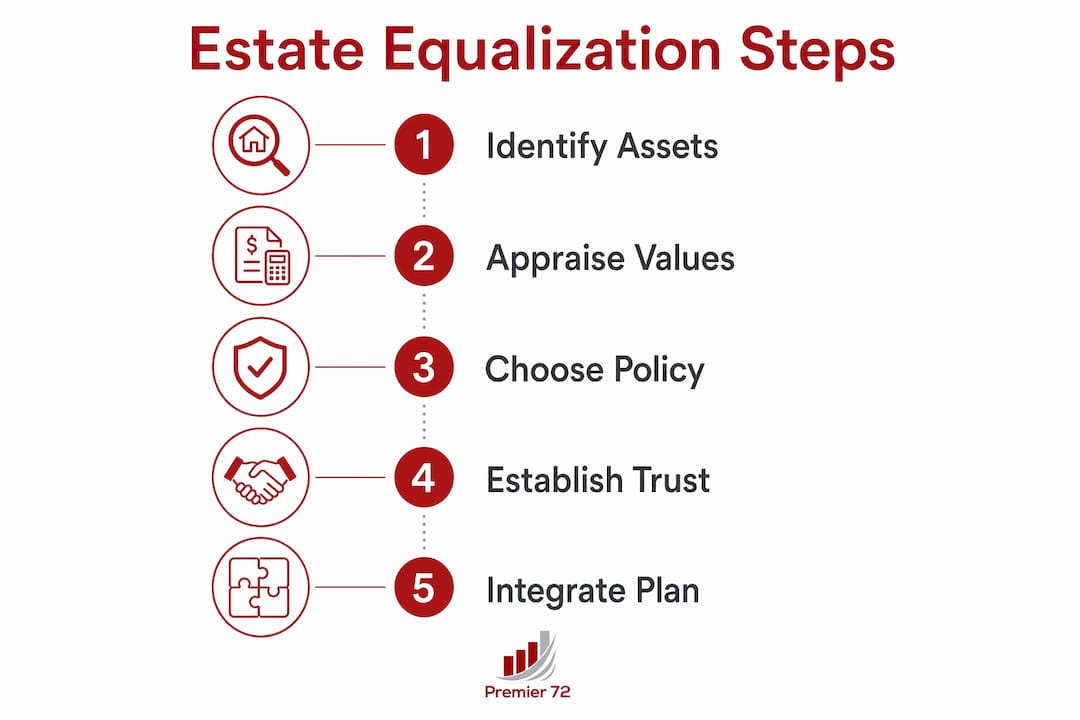
The numbered steps for sizing coverage in any of these scenarios follow a consistent process:
- Obtain a certified appraisal or business valuation from a qualified professional.
- Determine the total estate value and each heir's intended share.
- Calculate the shortfall each non-participating heir would face without insurance.
- Purchase coverage in that amount, accounting for projected asset appreciation.
- Review the coverage amount every three to five years or after any major asset change.
Key Takeaways
Life insurance is the most direct tool for equalizing estates that contain illiquid assets, because it delivers tax-free cash to non-participating heirs without forcing the sale of family businesses, farms, or real estate.
| Point | Details |
|---|---|
| Liquidity at death | Death benefits pay within weeks, income tax-free, bypassing probate entirely. |
| Policy structure matters | Joint Last-to-Die policies cost less; ILITs remove benefits from the taxable estate. |
| Beneficiary designations control | Designations override wills, so misalignment creates unintended and legally binding outcomes. |
| Valuation drives coverage | Certified appraisals set the correct insurance amount; informal estimates leave heirs undercompensated. |
| Legal coordination is required | Life insurance works only when aligned with wills, trusts, and buy-sell agreements. |
What I've learned from watching estate plans succeed and fail
I have seen estate plans that looked complete on paper fall apart at execution because one document contradicted another. The most painful situations involve families where the business owner communicated the plan verbally but never updated the beneficiary designations. The will said one thing. The policy said another. The policy won.
The owners who get this right share one habit: they treat the estate plan as a living document, not a one-time task. They schedule reviews after every major business event, every property acquisition, and every family change. They use life insurance for estate planning as the funding mechanism for a plan that is already legally coherent, not as a patch applied after the fact.
The second mistake I see consistently is undervaluing the illiquid asset. A business owner who bought a company for $500,000 thirty years ago often still thinks of it as a $500,000 asset. A certified appraisal regularly reveals a value three to five times higher. The insurance coverage sized to the original purchase price leaves two out of three children significantly shortchanged.
Early planning also matters more than most owners realize. Premiums rise with age and declining health. A 55-year-old business owner in good health can secure substantial coverage at a fraction of the cost a 70-year-old would pay for the same benefit. Waiting until retirement to address estate equalization is the most expensive version of the plan.
The emotional benefit of a clear, funded plan is real. Families who know exactly what they will receive, and why, are far less likely to contest the estate. That clarity is the most underrated outcome of good planning.
— Asa
How Premier72 approaches estate equalization planning
Business owners with significant illiquid assets need more than a life insurance policy. They need a plan that connects the policy to the legal documents, the business valuation, and the succession structure.

Premier72 works with established business owners and families to build estate equalization strategies that hold together at execution. From sizing coverage based on certified valuations to coordinating policies with buy-sell agreements and trusts, Premier72 brings advisory depth to a process most owners approach piecemeal. If you own a business, a farm, or significant real estate and want heirs treated fairly without forcing a sale, visit Premier72 to connect with an advisor who specializes in exactly this work.
FAQ
What is estate equalization in simple terms?
Estate equalization is the process of ensuring all heirs receive equivalent value from an estate, even when some assets cannot be divided. Life insurance provides the cash that compensates heirs who do not inherit the illiquid asset.
How does life insurance aid inheritance for non-participating heirs?
Life insurance pays a death benefit directly to named beneficiaries, bypassing probate, within weeks of death. Non-participating heirs receive cash equivalent to their share of the estate without waiting for asset sales or court proceedings.
Can life insurance equalize inheritances when a business is involved?
A life insurance policy sized to the business's appraised value funds equal payouts to heirs who do not inherit the business. A buy-sell agreement can also use insurance to fund a clean ownership transfer at fair market value.
What is an ILIT and why does it matter for estate planning?
An Irrevocable Life Insurance Trust owns the policy and receives the death benefit, keeping the payout outside the taxable estate. High-net-worth individuals use ILITs to prevent death benefits from triggering additional estate taxes.
How much life insurance do I need to equalize my estate?
The coverage amount equals the gap between what non-participating heirs would receive and their fair share of the total estate value. A certified appraisal of all illiquid assets is the required starting point for that calculation.