

If you want maximum cash on closing day and a clean exit, a strategic buyer typically pays the higher headline price. If you want to keep skin in the game, share in future upside, and accept more risk over a longer runway, private equity fits better. The real decision hinges on three tradeoffs: cash now versus rollover later, control now versus integration later, and certainty now versus a bigger eventual number.
TL;DR:
- Private equity firms value businesses based on standalone cash flow and are willing to accept rollover equity, debt, and longer exit timelines.
- Strategic buyers pay a premium for synergies like cross-selling and cost elimination but tend to execute faster and demand quicker integration.
- Deal terms between the two buyers differ significantly in cash at closing, rollover percentages, leverage, and post-close owner involvement.
- Owners with normalized earnings, a strong management team, and documented systems generally secure better offers from both buyer types.
- Prioritizing exit readiness over predefined buyer type allows owners to maximize value and obtain more favorable, competitive terms.
Table of Contents
- Private Equity vs Strategic Buyer: What Sets a Financial Buyer Apart
- What Strategic Buyers Actually Pay For
- Private Equity vs Strategic Buyer: Comparing the Deal Terms
- Which Buyer Type Fits Your Exit Goals?
- Negotiation Levers and a Diligence Checklist Before You Sign
- Premier72's Take: Fix These Three Things Before You Sell
- Why the "Pick a Lane" Advice Misses the Point
- Sources
Private Equity vs Strategic Buyer: What Sets a Financial Buyer Apart
Private equity firms buy companies to generate a return, not to fold them into an existing operation. They are financial buyers first. Their model is simple to describe and demanding to live through: acquire a business, improve its performance, and sell it again, usually within 4 to 7 years.
That model shapes everything about how a PE firm structures a deal. Sponsors typically use leverage to finance a portion of the purchase price, which means your company's cash flow will service debt after closing, as detailed in how lenders evaluate business health. They also ask most sellers to roll over equity, a request that shows up in roughly two-thirds of sponsor transactions, usually at 10% to 30% of deal value.
Before writing a check, private equity firms scrutinize three things harder than almost anything else:
- The durability and quality of your earnings, not just the top-line number
- Whether the business model scales without you personally driving every deal
- How deep your management bench runs beneath the owner
Dry powder callout: Buyout funds are sitting on record levels of uninvested capital heading into 2026, and median PE entry multiples climbed to 11.9x EV/EBITDA in Q1 2026, up from 11.5x the year before. That capital overhang is one reason PE has stayed a competitive bidder even as rates have stayed elevated.
If your business runs well without you in the room every day, a sponsor will notice and pay for it. If it doesn't, expect that gap to show up in the price or the earnout terms.
What Strategic Buyers Actually Pay For
A strategic buyer already operates in your industry or an adjacent one, and they're acquiring your company to make their existing business stronger. That distinction changes the entire valuation conversation. Where private equity underwrites your standalone cash flow, a strategic acquirer underwrites what your company adds to theirs.
Common synergy drivers that strategics pay for include:
- Cross-selling your products into their customer base
- Eliminating duplicate overhead, facilities, or back-office functions
- Gaining access to a distribution channel, geography, or license they don't have
When those synergy dollars are specific and defensible, a strategic can justify a real premium over a standalone multiple. EY projects strategic deal volume to rise about 11% in 2026, a signal that operating companies are hunting for exactly this kind of accretive fit. But that premium comes with a price of its own: integration. Strategics tend to move faster to fold your systems, brand, and often your team into theirs, and they typically expect a shorter transition period from you as the seller. Where PE wants you to keep running the company, a strategic usually just wants you to hand off the playbook.
Private Equity vs Strategic Buyer: Comparing the Deal Terms
The two buyer types diverge on nearly every dimension that determines what your exit actually feels like, not just what it pays.
| Dimension | Private equity | Strategic buyer |
|---|---|---|
| Primary motivation | Financial return over a hold period | Synergy value inside their operations |
| Valuation approach | Standalone multiple on cash flow | Standalone multiple plus quantifiable synergies |
| Cash at close vs. rollover | Lower cash, 10 to 30% rollover common | Higher cash, minimal rollover |
| Leverage and structure | Debt-financed, structured for exit | Often funded from balance sheet or stock |
| Owner's post-close role | Frequently retained, incentivized to grow | Often transitional, shorter tenure |
| Typical hold or exit horizon | 4 to 7 years, then a second sale | Permanent, folded into ongoing operations |
| Integration risk | Low, business often runs independently | Higher, systems and teams merge |
| Certainty and speed to close | Structured process, financing contingencies | Can be faster if strategic rationale is clear |
A stylized example makes the tradeoff concrete. Say your company is generating $10 million in EBITDA and both a strategic and a sponsor are bidding around the same entry multiple. A strategic buyer, valuing the deal partly on synergies, might land at a certain high cash amount at close. A private equity buyer on the same baseline might offer a slightly lower cash amount, with the remainder structured as rollover equity rather than cash. On day one, the numbers look nearly identical. Over a five-year hold, though, the outcomes diverge sharply: the strategic deal is done, while the PE rollover's ultimate value depends entirely on how well the business performs and how the fund exits it.
Certain company traits nudge the decision in one direction. High customer concentration or a thin management bench tends to worry PE firms more than strategics, since a sponsor needs the business to run without a fund manager sitting in the CEO's chair. A fragmented market with clear consolidation logic, on the other hand, often draws strategics willing to pay up for share.
Which Buyer Type Fits Your Exit Goals?
Run through this checklist before you take a call from either side of the table:
- How much cash do you need on day one? If your retirement or next venture depends on a large lump sum now, weight your process toward strategics.
- Do you want to stay involved? If you're not ready to fully step away, private equity's rollover model gives you a second bite at the apple.
- How much risk can you tolerate? Rollover equity is illiquid and tied to fund performance, so only take it on if you can absorb a disappointing outcome.
- How deep is your management team? A strong bench makes you attractive to PE; a thin one may point you toward a strategic who can absorb the gaps.
Three quick scenarios: an owner who wants out entirely and values certainty should lean strategic. An owner who wants to keep building and is comfortable with leverage should lean PE. An owner who genuinely isn't sure should run a competitive process and let both buyer types bid against each other.
Pro Tip: Don't pre-select a buyer type before you've tested the market. Owners who run a broad process often discover the highest bidder isn't the one they expected.
Negotiation Levers and a Diligence Checklist Before You Sign
Whichever buyer you pick, the terms you negotiate matter as much as the buyer type itself. On the economic side, focus on cash at close, escrow size and duration, earnout triggers, the rollover percentage, and whether a seller note is part of the mix. Each one shifts risk between you and the buyer.
Non-economic terms deserve equal attention:
- Closing timeline and financing contingencies that could delay or kill the deal
- Your role, title, and reporting structure after close
- Board composition if you're retaining equity
- How often you'll report results, and to whom
Before you sign anything, insist on a real diligence process on your own numbers: a quality-of-earnings review, a hard look at customer contract terms and renewal risk, IP ownership documentation, and adequate insurance coverage. Many sellers now negotiate representations and warranties insurance to limit personal liability after closing, a point worth raising early with your advisor.
Premier72's Take: Fix These Three Things Before You Sell
The Retirement Bank Method™ focuses on reducing owner dependence, strengthening leadership, and documenting systems, exactly what both buyer types underwrite hardest. Three near-term fixes matter most: normalize your owner salary, build out your management bench, and document your operating systems before you go to market.
Why the "Pick a Lane" Advice Misses the Point
Most exit content pushes owners to decide, early and firmly, whether they're a "PE seller" or a "strategic seller." That framing sells the decision short. The research on manager selection makes clear that not all PE firms are equal, and the same logic applies to strategics: a synergy-driven premium from one acquirer can look nothing like the offer from another in the same industry.
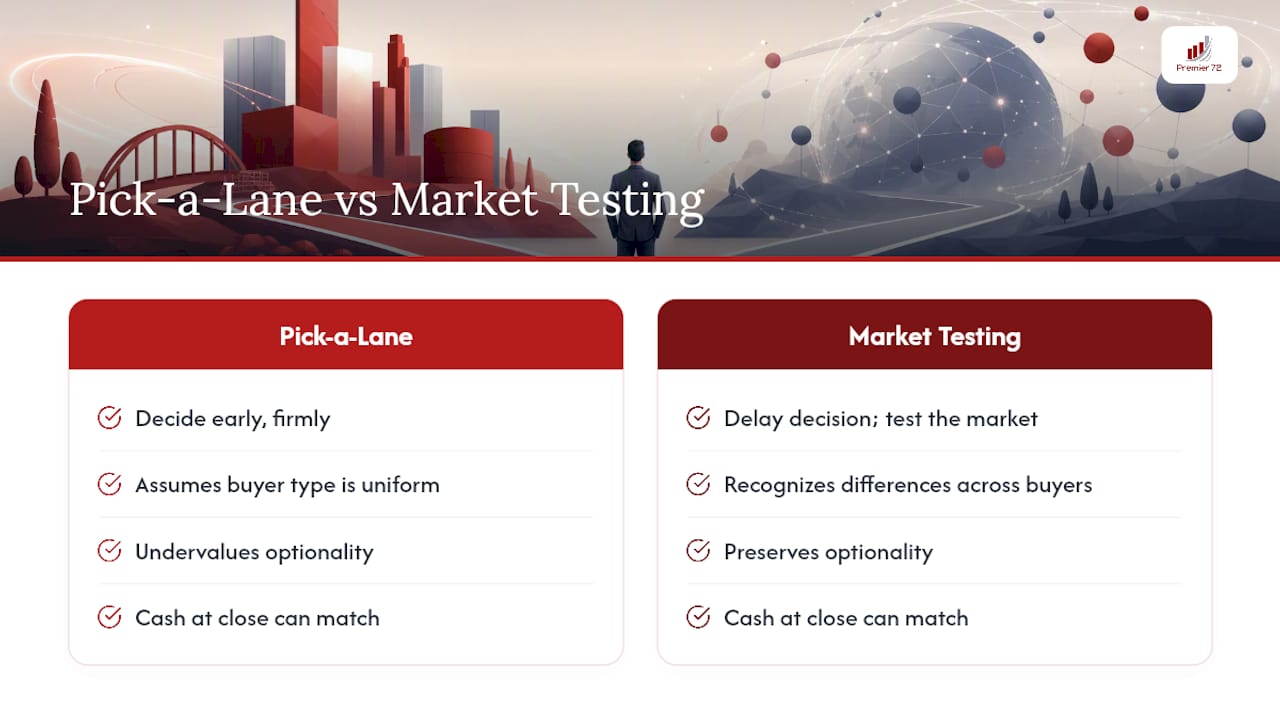
What conventional advice underweights is optionality. Owners who lock themselves into one buyer type before testing the market routinely leave money, or better terms, on the table. The stylized math above shows cash at close can look similar across buyer types; the real gap shows up later, in what happens to your rollover equity or your role post-close.
My honest read: prioritize exit readiness first, buyer type second. A business with normalized earnings, a real management team, and documented systems earns a better offer from either kind of buyer, and it earns the leverage to run a competitive process instead of accepting the first term sheet.
— Asa
Sources
For more on deal mechanics, review the Goldman Sachs primer on private equity and Premier72's step-by-step sale preparation guide and scalable operations examples.
- Introduction to Private Equity - Goldman Sachs Asset Management
- Strategic vs. Financial Buyer: A 2026 founder's guide - DailyDime
- Private Equity’s advantage is shifting, not shrinking | BCG
- Private equity: potential risks and benefits - Schwab