

A death benefit is the monetary payout that surviving family members receive after a loved one dies, and its role in family financial security goes well beyond covering funeral costs. When structured properly, death benefits from life insurance, Social Security, and annuities can replace lost income, eliminate debt, and give your family the time and stability to rebuild without financial panic.
Here is what death benefits typically cover:
- Lost income replacement to maintain your family's standard of living
- Final expenses including funeral costs, medical bills, and probate fees
- Outstanding debts such as mortgages, car loans, and credit card balances
- Ongoing household costs including utilities, childcare, and education
- Estate taxes and settlement costs that could otherwise force asset sales
- Long-term goals like college funding and retirement savings for a surviving spouse
Most life insurance death benefits are received free from federal income tax, meaning your family keeps the full payout. That tax treatment alone makes death benefits one of the most efficient wealth transfer tools available to American families.
How Social Security survivor benefits work for your family
Social Security survivor benefits are one of the most underestimated pillars of family financial protection. The Social Security Administration notes that the value of survivors insurance you have under Social Security is likely greater than the value of your individual life insurance policy, because it delivers ongoing monthly income rather than a single lump sum.
Who qualifies for survivor benefits:
- A surviving spouse at full retirement age receives 100% of the deceased worker's basic benefit amount
- A surviving spouse aged 60 or older but below full retirement age receives a reduced percentage of that amount based on age
- A surviving spouse of any age caring for a child under 16 receives 75% of the worker's benefit
- Unmarried children under 18 (or up to 19 if attending school full time) receive 75% of the worker's benefit
- Dependent parents aged 62 or older may qualify if the deceased provided at least half of their support
- Divorced spouses may qualify if the marriage lasted at least 10 years and they are 60 or older
Key payment details:
- The SSA pays a one-time lump sum of $255 to an eligible surviving spouse or child. Survivors must apply within two years of the date of death.
- Monthly benefit amounts are based on the deceased worker's lifetime earnings record. The more the worker paid into Social Security, the higher the family's monthly payment.
- Total family benefits are capped at a percentage of the deceased worker's basic benefit amount.
Eligibility depends on work credits earned during the worker's lifetime. No one needs more than 10 years of work to qualify for any Social Security benefit, and a special rule allows benefits for children and a caregiving spouse if the worker had at least 1.5 years of work in the 3 years before death.
Life insurance death benefits: what your family actually receives
A life insurance death benefit is a lump-sum payment made to your named beneficiaries when you die. It is the most direct and customizable form of death benefit available, and families use it to cover everything from the mortgage to college tuition.
What life insurance death benefits accomplish:
- Replace the primary earner's income for years or even decades
- Cover final expenses so survivors are not forced to drain savings accounts
- Pay off debts, preventing creditors from claiming estate assets
- Fund education for children who would otherwise lose that financial support
- Provide essential liquidity to avoid selling investments or real estate at a loss
Term vs. permanent policies: Term life insurance pays a death benefit only if the insured dies during the policy period, making it affordable for income replacement during high-obligation years. Permanent policies, such as whole life or universal life, carry a death benefit for life and often build cash value alongside it.
Coverage for non-earning spouses deserves special attention. The economic value of domestic services like childcare, household management, and caregiving can be substantial. Without a death benefit to replace those services, the surviving spouse faces real out-of-pocket costs immediately.

Payout flexibility matters too. Beneficiaries can often choose between a lump sum or structured payments over time, which helps families manage a large payout responsibly rather than spending it all at once. Life insurance also plays a central role in estate tax planning and legacy strategies, making it a tool that extends well beyond simple income replacement.
How annuity death benefits protect your beneficiaries
An annuity death benefit pays a designated beneficiary if the annuity owner dies before the contract has been fully paid out. The specific amount depends on the type of annuity and any riders attached to the contract.
How annuity death benefits are calculated:
- Fixed annuities typically pay the remaining account value or a guaranteed minimum, whichever is greater
- Variable annuities pay based on the current account value, which fluctuates with market performance
- Guaranteed minimum death benefit (GMDB) riders protect beneficiaries from market downturns by guaranteeing a floor value regardless of how the underlying investments performed
Annuity death benefit riders can guarantee minimum benefits regardless of market performance, which is a meaningful protection when variable accounts have declined in value. Without a rider, a beneficiary of a variable annuity could receive significantly less than the original premium paid.
Annuity death benefits complement life insurance rather than replace it. They tend to be most valuable for families where one spouse has accumulated retirement savings in an annuity and wants to ensure those funds pass to a beneficiary rather than revert to the insurance company. Payout options typically include a lump sum or a series of payments, and the choice affects both the tax treatment and the long-term income stream available to the surviving family member.
Death benefits do more than pay bills
The financial relief a death benefit provides creates something harder to quantify: time. Survivors who receive a death benefit are not forced to return to work immediately, sell the family home under pressure, or liquidate retirement accounts at a loss. That psychological flexibility to grieve without a financial crisis running in the background is one of the most underappreciated aspects of proper coverage.

Death benefits also protect estate value by covering immediate costs like funeral expenses, estate taxes, and probate fees without forcing the sale of long-term assets at inopportune times. A family that would otherwise need to sell real estate or liquidate a brokerage account in the months following a death can instead use the death benefit to cover those costs and hold their assets until the market is favorable.
Pro Tip: Review your death benefit coverage whenever a major life event occurs: the birth of a child, a home purchase, a job change, or a significant shift in debt. Coverage that was adequate three years ago may leave your family short today.
Financial planners consistently advise treating death benefits as a dynamic part of your financial plan, not a fixed number you set once and forget. As your obligations grow and shrink, your coverage should follow.
Tax implications of death benefits and your family's finances
Tax treatment varies by benefit type, and understanding the differences helps your family keep more of what they receive.
Life insurance death benefits are generally not subject to federal income tax when paid directly to a named beneficiary. The full payout is available for debts, income replacement, and long-term goals without reduction.
Social Security survivor benefits are treated as ordinary income for federal tax purposes. Depending on the survivor's total income, up to 85% of Social Security benefits may be taxable.
Annuity death benefits carry more complexity. If the annuity was funded with pre-tax dollars, the beneficiary pays ordinary income tax on the full distribution. If funded with after-tax dollars, only the earnings portion is taxable. Beneficiaries who inherit an annuity generally must take distributions within 10 years under current IRS rules, which affects how the tax liability is spread.
Naming beneficiaries correctly on life insurance and annuity contracts keeps proceeds out of the probate estate, which protects both the tax efficiency and the speed of distribution. Proceeds that flow through a will can be delayed and may become subject to estate creditors.
Strategies to get the most from your death benefits
Getting the most from your death benefits requires planning before a death occurs, not after.
Coverage sizing: Calculate your family's actual income replacement need, not just a round number. A common starting point is 10 to 12 times the primary earner's annual income, but families with young children, large mortgages, or a non-earning spouse often need more. Premier72 works with families to build coverage that reflects real obligations, not generic formulas.
Layering benefit sources: Social Security survivor benefits, life insurance, and annuity death benefits each serve different functions. Social Security provides ongoing monthly income. Life insurance delivers immediate liquidity. Annuities protect accumulated retirement savings. Using all three in coordination creates a more complete safety net than any single source alone.
Beneficiary designations: Review and update beneficiary designations after every major life event. An outdated designation can send proceeds to an ex-spouse or a deceased parent, bypassing your current family entirely.
Payout structure: Beneficiaries who receive a large lump sum often benefit from structured settlement options or placing proceeds in a trust. This approach, detailed in wealth transfer planning, reduces the risk of mismanagement and can extend the financial protection over many years.
Policy type alignment: Term coverage fits high-obligation years. Permanent coverage fits legacy and estate planning goals. Matching the policy type to the purpose prevents paying for coverage you do not need or losing coverage when you need it most.
Limitations and exclusions you should know about
Death benefits are not unconditional. Every policy and program carries exclusions that can reduce or eliminate the payout.
Life insurance exclusions commonly include suicide within the first two years of the policy (the contestability period), death resulting from fraud or material misrepresentation on the application, and certain high-risk activities if not disclosed at underwriting. Some older policies exclude death from specific causes.
Social Security survivor benefits require the deceased to have earned sufficient work credits. A worker who died young with limited work history may not have earned enough credits to trigger full family benefits.
Annuity death benefits can be reduced or eliminated depending on the contract terms. Some annuity contracts include a "period certain" feature that pays only for a defined number of years. If the owner and beneficiary both die within that period, remaining payments may stop.
Group life insurance through an employer typically ends when employment ends, leaving families without coverage during job transitions unless the policy is converted to an individual plan.
Understanding these limitations before a crisis occurs gives your family the opportunity to fill gaps with additional coverage or savings.
How death benefits interact with your other financial resources
Death benefits work best when they are part of a broader financial picture that includes savings, pensions, and investment accounts.
A well-funded emergency savings account reduces the pressure on a death benefit to cover every immediate expense, allowing the payout to focus on longer-term income replacement. Pension survivor benefits, where available, provide another layer of monthly income that reduces the total life insurance coverage your family needs.
For business owners, death benefits intersect with business continuity planning in ways that affect both the family and the company. A buy-sell agreement funded by life insurance uses the death benefit to buy out a deceased owner's share, preventing the family from inheriting an illiquid business interest they cannot manage.
Coordinating death benefits with estate planning ensures that proceeds reach the right people at the right time, without unnecessary delays or tax exposure. The goal is a plan where each resource covers a specific need, and no single source is asked to do everything.
Key Takeaways
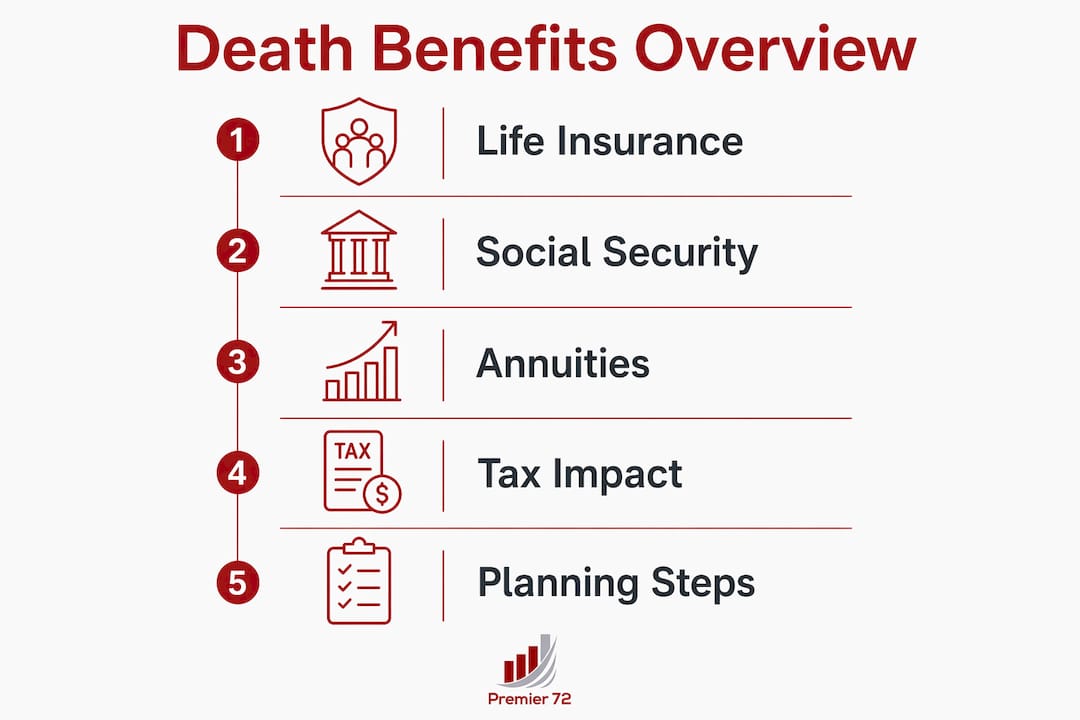
Death benefits from life insurance, Social Security, and annuities form a layered financial safety net that protects your family's income, assets, and long-term stability after a loss.
| Point | Details |
|---|---|
| Social Security pays monthly income | Survivor benefits often exceed private life insurance value by delivering ongoing monthly support. |
| Life insurance proceeds are tax-free | Federal law generally exempts life insurance death benefits from income tax, preserving the full payout. |
| The SSA lump sum is $255 | This one-time payment must be claimed within two years of the worker's death. |
| Annuity riders protect against market loss | Guaranteed minimum death benefit riders ensure beneficiaries receive at least the floor value regardless of market performance. |
| Coverage must be reviewed regularly | Life events like new children, debt changes, or job transitions require updating death benefit amounts and beneficiary designations. |