

A second in command is the person holding the second-highest authority in an organization, formally designated to act on the leader's behalf when that leader is unavailable. The title changes by industry (executive officer, deputy CEO, chief of staff), but the function stays constant: real decision-making power, not just proximity to power. Common shorthand includes 2IC, XO, and simply "number two."
TL;DR:
- A credible second in command must have documented authority to make decisions, including approval limits that exceed usual support roles like executive assistants.
- Most organizations require formal documentation, such as board resolutions or delegations of authority, with clear scope and time limits, to prevent disputes over decision-making power.
- Building trust as a second in command involves consistently making decisions that hold up, gaining operational fluency, financial literacy, and handling crises independently.
- Owners depend on a tested deputy for valuation and business continuity, making credible succession planning essential to avoid undervaluation during exit or transition events.
- Titles like deputy CEO, XO, or chief of staff are less important than actual authority, decision limits, and proven ability to act independently under defined conditions.
Table of Contents
- What Does "Second in Command" Actually Mean?
- Where Does This Role Show Up, and What Is It Called?
- What Does a Second in Command Actually Do?
- Second in Command vs. Executive Assistant vs. Chief of Staff
- How Do Organizations Handle Succession and Acting Authority?
- How Do You Become a Credible Second in Command?
- How Does This Apply to Business Succession Planning?
- Why a Real Deputy Changes What Your Business Is Worth
- Where to Learn More
- Sources
What Does "Second in Command" Actually Mean?
The term describes the second-highest authority in an organization, the deputy who relieves or replaces the leader when needed. Oxford Learner's Dictionaries defines it the same way: the person with the second-highest rank who takes charge when the leader isn't there.
Abbreviations and variants show up across sectors:
- 2IC or 2i/c: common in military and Commonwealth organizational charts.
- XO (executive officer): the naval and army standard for a unit's deputy commander.
- Deputy CEO / COO: the corporate translation of the same authority structure.
- Chief of Staff: sometimes used interchangeably, though the roles differ in meaningful ways (more on that below).
Whatever the label, the test is the same: does this person hold documented authority to act, or just proximity to someone who does?
Where Does This Role Show Up, and What Is It Called?
Every institution that runs on a hierarchy eventually needs someone who can step in without a vote or a delay. The title just depends on the room you're standing in.
- Military: the U.S. Army typically uses "executive officer" for a unit's deputy commander, while naval and Commonwealth traditions often use "first lieutenant" for the ship's second-in-command.
- Corporate: deputy CEO, chief operating officer, or VP of Operations, depending on how the org chart splits strategy from execution.
- Political: deputy leader or deputy prime minister in parliamentary systems, where the role has explicit constitutional standing.
- Nonprofit: deputy director, second only to the executive director in program authority and often the one who signs off when the ED travels.
A restaurant group's deputy CEO might run daily operations across 40 locations while the CEO handles investor relations. A battalion's executive officer runs logistics and readiness so the commanding officer can focus on strategy. Different rooms, same structural logic.
What Does a Second in Command Actually Do?
The job splits into four buckets: operational leadership, delegated authority, crisis response, and stakeholder management. None of these are honorary. A deputy who only attends meetings isn't really a deputy.
- Operational leadership: running staff meetings, overseeing department heads, and representing the organization at events the leader can't attend.
- Signing authority within limits: most deputies can approve spending or contracts up to a set threshold, with anything larger routed back to the leader or the board.
- Acting-leader duties: stepping into full decision-making when the leader is traveling, incapacitated, or has formally stepped away.
- Stakeholder and confidentiality management: handling sensitive conversations with clients, investors, or board members that require judgment, not just information relay.
The boundary usually sits at binding, irreversible commitments. A deputy can typically approve a vendor contract or a hiring decision. A deputy usually cannot sell the company, change bylaws, or commit to something the leader hasn't pre-authorized.
Pro Tip: If you want to know whether someone is a real second-in-command or just a senior assistant with a fancy title, ask what dollar amount they can approve without checking in first. The answer tells you everything about actual authority.
Second in Command vs. Executive Assistant vs. Chief of Staff
This is where most confusion happens, especially in smaller companies where titles get inflated faster than job descriptions get rewritten.
An executive assistant role, as O*NET's occupational data describes it, centers on scheduling, research, and reporting. It's a high-level administrative position, not a decision-making one. Job postings for the role commonly ask for 4 to 6 years of experience in calendar management, travel coordination, and stakeholder scheduling, useful and demanding work, but fundamentally supportive rather than authoritative.
A chief of staff sits closer to the deputy line but usually functions as a coordinator and gatekeeper rather than a line authority holder. Chiefs of staff manage information flow and priorities; deputies make calls and own outcomes.
- Look for documented acting authority, not just calendar control.
- Check whether the person has actually run the organization solo, even briefly.
- Watch for title inflation: "Chief of Staff" and "Executive Assistant" sometimes describe the same administrative job dressed differently.
How Do Organizations Handle Succession and Acting Authority?
Acting authority needs a paper trail. Verbal understandings collapse the moment there's a dispute, a lawsuit, or a leader who suddenly can't be reached.
- Formal designation: a board resolution, an acting-letter, or a written delegation of authority that specifies scope and duration.
- Time limits: most acting appointments run 30 to 90 days before requiring board renewal or a permanent decision.
- Documentation review: bylaws and operating agreements should already name who becomes acting leader, and under what conditions, before a crisis forces the question.
- Legal and HR involvement: bringing in counsel or HR before authority is exercised, not after, prevents disputes over what the deputy was actually allowed to do.
Undocumented delegation is where things go wrong. Without a written scope, two board members can walk away from the same conversation with two different understandings of what the deputy can approve.
How Do You Become a Credible Second in Command?
Credibility here isn't about title. It's built through a track record of decisions that held up.
The core competencies are operational fluency, basic financial literacy, people management, and the willingness to make calls under uncertainty, as highlighted by expert financial planner services that emphasize these skills in high-level finance roles. None of these come from a single promotion.
- Take on acting assignments early, even small ones like running a department for a week.
- Get exposure to a budget or P&L, not just a headcount.
- Document your own decisions and outcomes so a track record exists when someone asks for one.
- Seek stretch projects that cross departments, not just deeper work within your own lane.
Ask yourself six questions before pursuing the role: Have you run a meeting the leader usually runs? Have you approved a spend without checking in first? Do stakeholders come to you directly during the leader's absence? Have you handled a conflict without escalating it? Do you understand the numbers behind your department, not just the tasks? Would the board trust your judgment on a decision that can't wait?
Pro Tip: A history of small "acting" assignments, leading an offsite, signing a limited approval, builds more real authority than any title change. Formal succession should be the finish line, not the starting point.
How Does This Apply to Business Succession Planning?
Owner-dependent businesses run into a specific version of this problem: the owner has never actually delegated real authority, so there's no credible deputy when it's time to sell, retire, or step back. That gap shows up immediately during due diligence, and it depresses valuation.
Premier72's advisory work on exit readiness focuses on closing that gap through systems, documentation, and leadership coaching rather than title changes alone. The typical sequence:
- Document core operating routines so decisions don't live only in the owner's head.
- Assign staged acting responsibilities to build a real track record before a formal handoff.
- Coach the designated deputy through decisions the owner previously kept to themselves.
- Reduce owner dependence gradually, not through a single transition event.
The outcome owners want is a business that runs, and sells, without them standing in the room.
Why a Real Deputy Changes What Your Business Is Worth
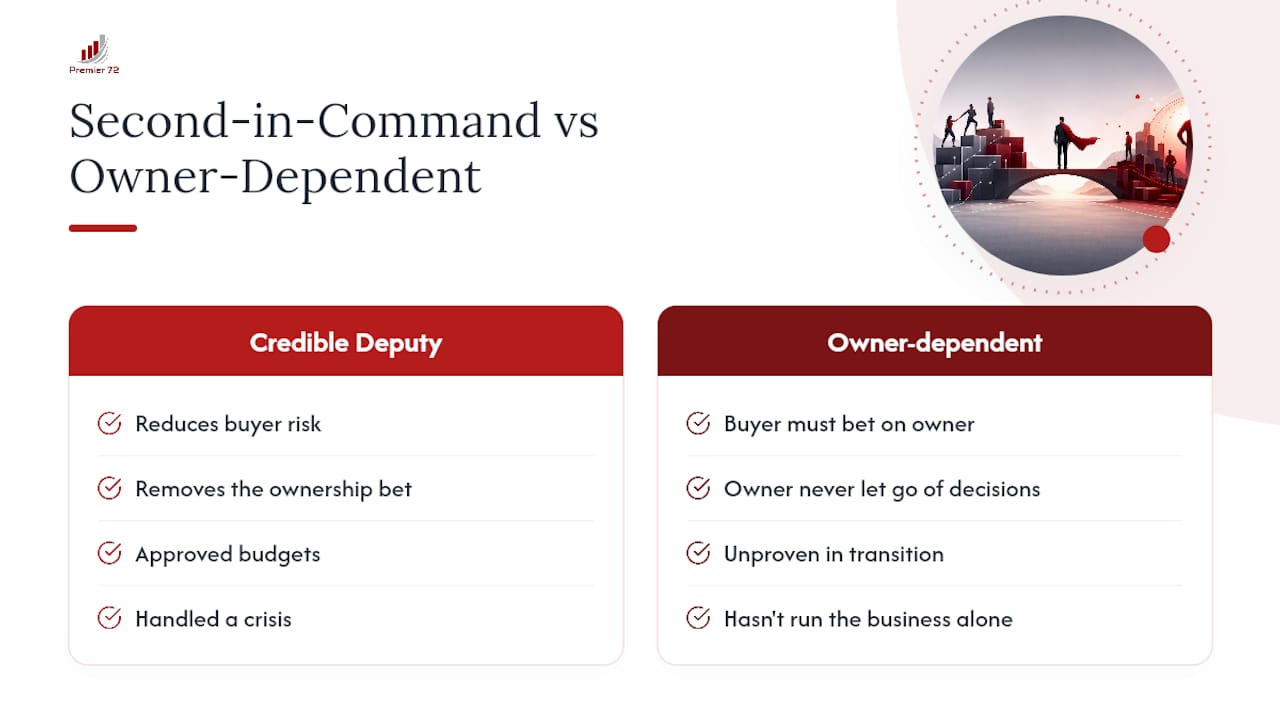
A company with a credible second-in-command is worth more than one without, because buyers are pricing risk, not just revenue. An owner-dependent business asks a buyer to bet on someone who's never actually run the place. A business with a tested deputy, someone who's approved budgets, handled a crisis, and kept clients calm during a transition, removes that bet entirely.
The gap between those two businesses usually isn't strategy. It's whether the owner ever let go of a decision long enough to see if someone else could make it well. If you're thinking about your own transition timeline, Premier72's planning roadmap is a reasonable place to start that conversation before a buyer forces it.
— Asa
Where to Learn More
For the formal definition and naming history behind the role, Wikipedia's entry on second-in-command covers military and organizational usage in depth. Oxford Learner's Dictionaries offers the concise dictionary version. For the administrative side of the comparison, O*NET's profile on executive administrative assistants lays out the occupational standard, and the Bryant & Stratton career overview shows how that role differs from operational deputy authority in practice.
Sources
- Second-in-command - Wikipedia
- 43-6011.00 - Executive Secretaries and Executive Administrative Assistants - O*NET
- second in command noun - Oxford Learner's Dictionaries
- Executive & administrative assistant career overview - Bryant & Stratton