

A trust is a legal arrangement where one party holds and manages assets for the benefit of another, and the role of trusts in legacy planning is to give you precise control over how, when, and to whom your wealth transfers. Unlike a simple will, a trust operates outside probate court, protects assets from creditors, and can reduce federal estate tax exposure. For business owners and families with significant assets, trusts are not optional accessories. They are the structural foundation of a sound estate plan.
What role do trusts play in legacy planning?
Trusts serve three core functions in estate planning: asset management, controlled distribution, and tax efficiency. Each function addresses a gap that a will alone cannot fill. A will tells the court what you want. A trust tells your successor trustee what to do, and that trustee can act immediately without court permission.
Irrevocable legacy trusts exclude the initial principal and all future appreciation from the 40% federal estate tax, provided you permanently surrender ownership and control. That means a $5 million transfer growing to $50 million can bypass estate tax entirely. The compounding effect alone makes irrevocable structures one of the most powerful tools in multigenerational wealth transfer.

Spendthrift provisions add another layer of protection. These clauses prevent beneficiaries from assigning their interest to creditors before a distribution is made. Combined with staggered distribution schedules, they protect heirs from poor financial decisions and outside claims. Premier72 works with clients to identify which provisions fit their family's specific circumstances before any documents are drafted.
What are the primary types of trusts used in legacy planning?
Trust structures differ significantly in flexibility, tax treatment, and purpose. Choosing the wrong type is a common and costly mistake.
Revocable living trusts
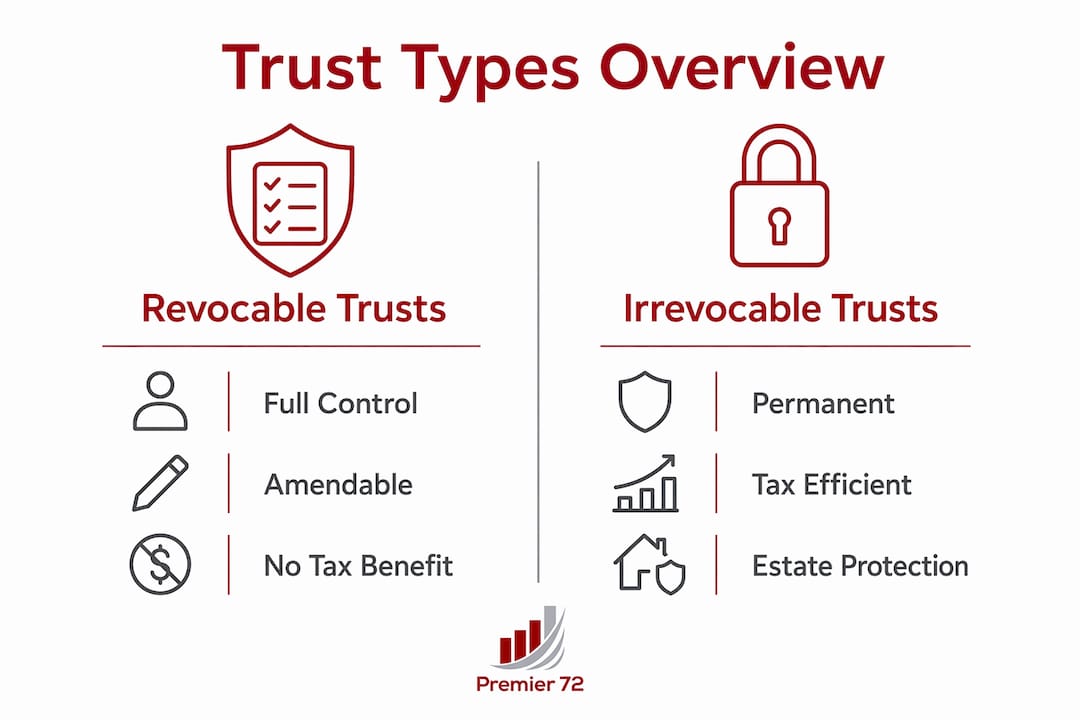
A revocable living trust lets you retain full control during your lifetime. You can amend it, revoke it, or change beneficiaries at any time. The trade-off is that revocable trusts offer no estate tax protection because the IRS still considers those assets part of your taxable estate. Their primary value is probate avoidance and incapacity planning, not tax reduction.
Irrevocable trusts and legacy trusts
An irrevocable trust permanently removes assets from your estate. Once funded, you cannot reclaim those assets or change the terms without beneficiary consent. Legacy trusts, sometimes called dynasty trusts, are irrevocable structures designed to hold wealth across multiple generations. They are the vehicle of choice when the goal is multigenerational preservation rather than near-term distribution.
Testamentary trusts
A testamentary trust is created inside a will and takes effect only after death. It does not avoid probate because the will itself must go through the court process. However, testamentary trusts protect vulnerable beneficiaries by staggering distributions and shielding assets while preserving government benefits eligibility. They also provide ongoing court oversight, which some families find reassuring.
The three roles in any trust are the grantor (you, the creator), the trustee (the manager), and the beneficiary (the recipient). In a revocable trust, you often serve as all three during your lifetime. In an irrevocable trust, separating those roles is legally required and practically important.
| Trust type | Tax benefit | Probate avoidance | Best use case |
|---|---|---|---|
| Revocable living trust | None | Yes | Incapacity planning, simple transfer |
| Irrevocable legacy trust | Yes, removes assets from estate | Yes | Multigenerational wealth, estate tax reduction |
| Testamentary trust | Limited | No | Vulnerable beneficiaries, post-death control |
How do trusts benefit legacy planning beyond basic inheritance?
The benefits of legacy trusts extend well past tax savings. Trusts allow estates to bypass probate, saving heirs legal fees, avoiding public record disclosures, and simplifying multi-state asset management. That last point matters more than most people realize. If you own real estate in three states, a trust avoids three separate probate proceedings.
Privacy is a concrete benefit that wills cannot provide. A will becomes a public document once it enters probate. A trust does not. Business owners especially benefit from keeping asset details, beneficiary names, and distribution terms out of public record.
Trusts also outperform powers of attorney in incapacity planning. A successor trustee can manage assets immediately upon your incapacity without court involvement. Financial institutions often resist powers of attorney but routinely honor trust authority. That distinction can mean the difference between a smooth transition and a legal battle during a family crisis.
- Probate avoidance: Assets transfer immediately to beneficiaries without court delays or fees.
- Privacy: Trust terms stay out of public record, unlike a will filed in probate.
- Tax efficiency: Irrevocable structures remove appreciating assets from the taxable estate.
- Creditor protection: Spendthrift provisions block creditors from reaching distributions before they are made.
- Special needs planning: Trusts preserve government benefits eligibility for disabled beneficiaries.
- Blended family management: Trusts let you provide for a surviving spouse while protecting children from a prior relationship.
Pro Tip: If you own a business, a trust can hold your business interest and specify exactly how ownership transfers at death or incapacity. This prevents a forced sale and keeps operations stable during transition.
What are the critical challenges in using trusts effectively?
Trusts are only as effective as their funding. Many people mistakenly believe a trust works simply by signing documents. Effectiveness depends on comprehensive funding and ongoing asset retitling. A trust that holds no assets avoids no probate and provides no protection.
The tax trade-offs in irrevocable trusts deserve careful analysis. Permanent removal of assets forfeits the step-up in basis that heirs normally receive at death. For estates near exemption limits, capital gains taxes on a future sale may exceed the estate tax savings. This is not a reason to avoid irrevocable trusts. It is a reason to run the numbers with a qualified tax advisor before funding one.
State law adds another layer of complexity. Trust duration rules, income tax treatment, and trustee requirements vary significantly by state. A dynasty trust structured in South Dakota operates under different rules than one in California. These differences affect long-term outcomes in ways that are not obvious at signing.
- Fund the trust completely. Retitle every intended asset into the trust's name. Real estate, bank accounts, and investment accounts each require separate paperwork.
- Review beneficiary designations. Retirement accounts and life insurance pass by contract, not through the trust. Coordinate these designations with your overall plan.
- Select trustees carefully. A trustee who lacks objectivity or financial competence creates conflict and liability. Corporate trustees offer objectivity and consistent management that reduces family conflict risks in long-term trusts.
- Build in adaptability. Consider naming a trust protector with the power to replace trustees or modify terms as laws change. Trust protectors play a growing role in legacy trusts by enabling adaptations without court intervention.
- Review the trust periodically. Tax law changes, family circumstances shift, and asset values fluctuate. A trust drafted in 2015 may not reflect your goals in 2026.
Pro Tip: Ask your estate attorney for a "trust funding checklist" at closing. This document lists every asset that needs retitling and prevents the most common trust failure: a fully drafted but completely empty trust.
How can you practically implement trusts in your legacy plan?
Start by defining your goals before selecting a trust type. A business owner protecting a company interest has different needs than a parent providing for a child with special needs. Estate planning for business owners requires coordinating trust structures with buy-sell agreements, key person coverage, and succession timelines.
Trusts work best as part of a coordinated plan, not as standalone documents. Coordinate your trust with your will, beneficiary designations, and powers of attorney. Each document handles a different scenario, and gaps between them create problems your heirs will have to solve under pressure.
- For business owners: Use a trust to hold business interests and specify succession terms. Pair it with a funded buy-sell agreement to prevent forced liquidation.
- For parents of minor children: A testamentary or revocable trust with a named trustee ensures assets are managed responsibly until children reach a defined age.
- For blended families: A qualified terminable interest property (QTIP) trust provides for a surviving spouse while directing remaining assets to children from a prior relationship.
- For special needs beneficiaries: A special needs trust preserves eligibility for Medicaid and Supplemental Security Income while supplementing government benefits.
Work with an estate attorney, a CPA, and a financial advisor together. These three professionals address different dimensions of the same plan. An attorney drafts the documents. A CPA models the tax outcomes. A financial advisor ensures the trust integrates with your broader wealth transfer strategy. Trusts are not set-and-forget tools. Review them after major life events: marriage, divorce, a business sale, or a significant change in asset value.
Key Takeaways
Trusts are the most effective tool for combining asset control, tax efficiency, and beneficiary protection in a single legal structure.
| Point | Details |
|---|---|
| Trusts bypass probate | Assets transfer immediately to heirs, avoiding court delays, legal fees, and public disclosure. |
| Irrevocable trusts reduce estate tax | Removing assets permanently from your estate shields appreciation from the 40% federal estate tax. |
| Funding is non-negotiable | A trust must hold retitled assets to function. Signing documents without funding provides no protection. |
| Trustee selection matters | Corporate or professional trustees reduce family conflict and ensure consistent, compliant management. |
| Trusts require ongoing review | Tax law changes and life events make periodic trust reviews a necessity, not a formality. |
Why trusts are more than a tax strategy
Most clients come to me focused on one thing: avoiding estate tax. That is a legitimate goal, but it is also the narrowest way to think about what a trust actually does. The clients who get the most value from their trusts are the ones who use them to solve real family problems, not just tax problems.
I have seen estates where the trust documents were beautifully drafted and completely useless because no one ever retitled the assets. The house stayed in the grantor's name. The brokerage account never got transferred. The trust existed on paper and nowhere else. That is not a legal failure. It is an administrative one, and it is entirely preventable.
The other mistake I see constantly is treating trust planning as a one-time event. Tax law changes. Family dynamics shift. A child who was financially responsible at 25 may have creditor problems at 45. A trust protector with the authority to modify terms is not a luxury. For any trust designed to last decades, it is a necessity.
The most durable legacy plans I have seen treat the trust as a living system, not a signed document in a drawer. They have professional trustees, scheduled reviews, and clear communication with beneficiaries about what the trust is designed to do. That transparency prevents conflict and keeps the plan working the way the grantor intended.
— Asa
Legacy planning support from Premier72
Trusts are powerful, but only when they are built around your specific goals and kept current over time. Premier72 works with business owners and families to design legacy plans that integrate trust structures with business continuity, succession planning, and income protection strategies.

Whether you need to protect a business interest, provide for a special needs beneficiary, or reduce estate tax exposure, Premier72 brings together the advisory, insurance, and planning expertise to build a plan that holds up. Visit Premier72 to connect with an advisor and start building a legacy plan designed for your situation, not a generic template.
FAQ
What is the main role of trusts in legacy planning?
Trusts manage and distribute assets according to your instructions, outside of probate court. They provide control over timing, protect beneficiaries from creditors, and can reduce federal estate tax exposure.
What is the difference between a revocable and irrevocable trust?
A revocable trust lets you retain control and make changes during your lifetime but offers no estate tax protection. An irrevocable trust permanently removes assets from your taxable estate, which reduces estate tax but eliminates your ability to reclaim those assets.
Do trusts avoid probate?
Yes. Assets held in a properly funded trust transfer directly to beneficiaries without going through probate court, saving time, legal fees, and keeping estate details private.
What happens if a trust is not funded?
An unfunded trust provides no legal protection and does not avoid probate. Every asset intended for the trust must be retitled into the trust's name through separate legal paperwork.
Are trusts only for wealthy families?
Trusts benefit anyone managing blended families, special needs beneficiaries, business interests, or multi-state property. The control and protection they provide are valuable at many asset levels, not just for large estates.