

The annual gift tax exclusion for 2026 is $19,000 per recipient. Married couples who elect gift-splitting can give $38,000 to each recipient without any federal gift tax liability. The exclusion applies per donor, per donee, per calendar year, which means you can give $19,000 to as many individuals as you like without touching your lifetime exemption. The donor, not the recipient, is responsible for any gift tax owed, and recipients generally pay no tax on gifts they receive. The two key federal references are the IRS gift tax FAQs and Form 709, the United States Gift Tax Return.
Key facts at a glance:
- $19,000 per recipient, per year (2026)
- This amount doubles when married couples elect gift-splitting
- Exclusion is per donee, not a total cap on all gifts you make
- Donor pays any gift tax; recipients owe nothing
- Gifts at or below the annual limit do not reduce your lifetime exemption
- Gifts above the limit must be reported on Form 709
Key Takeaways
The 2026 annual gift tax exclusion is $19,000 per recipient, and married couples who elect gift-splitting can transfer $38,000 per recipient this year without federal gift tax liability or any reduction in their lifetime exemption.
| Point | Details |
|---|---|
| 2026 exclusion amount | $19,000 per recipient; $38,000 per recipient for married couples electing gift-splitting. |
| Per-donee rule | The exclusion applies to each recipient separately, so you can give $19,000 to any number of people. |
| Form 709 filing triggers | File when any single gift exceeds $19,000 or when you elect gift-splitting, even if no tax is owed. |
| Lifetime exemption interaction | Gifts above the annual exclusion reduce your lifetime exemption dollar for dollar but rarely produce immediate tax. |
| Premier72 planning support | Premier72 models gifting, insurance, and exit strategies together through The Retirement Bank Method™. |
Table of Contents
- How the annual gift tax exclusion works in practice
- How the $19,000 figure has changed over time
- Transfers that aren't subject to gift tax at all
- When you need to file Form 709
- How annual exclusion gifts interact with your lifetime exemption
- Practical strategies for business owners and families
- Common scenarios: down payments, large gifts, and gifts to minors
- Recordkeeping, valuation, and state tax considerations
- Why business owners should act on annual gifting now
- How Premier72 can help you build a gifting and legacy plan
- Sources
How the annual gift tax exclusion works in practice
A "gift" for federal tax purposes is any transfer of property for less than full and fair consideration. Cash, real estate, stocks, and even forgiving a loan can all qualify as gifts. The donor is responsible for reporting and, if applicable, paying the tax.
Present interest vs. future interest
The annual exclusion applies only to gifts of present interest, meaning the recipient has an immediate, unrestricted right to use and enjoy the property. A future interest gift, where the recipient's enjoyment is delayed or subject to conditions, does not qualify. Per Form 709 instructions, this distinction is one of the most common reporting traps practitioners encounter.
- Qualifies (present interest): Cash deposited directly into an adult child's bank account; publicly traded stock transferred outright; a check the recipient can cash immediately.
- Does not qualify (future interest): A gift of a remainder interest in a trust; a transfer where the beneficiary cannot access the funds until a future date or condition is met.
Gifts to minors require extra care. A transfer to a custodial account under UGMA or UTMA typically qualifies as a present interest because the custodian can use the funds for the child's benefit right away. A trust that restricts access until the child turns 30 generally does not qualify.
How the math works across multiple recipients
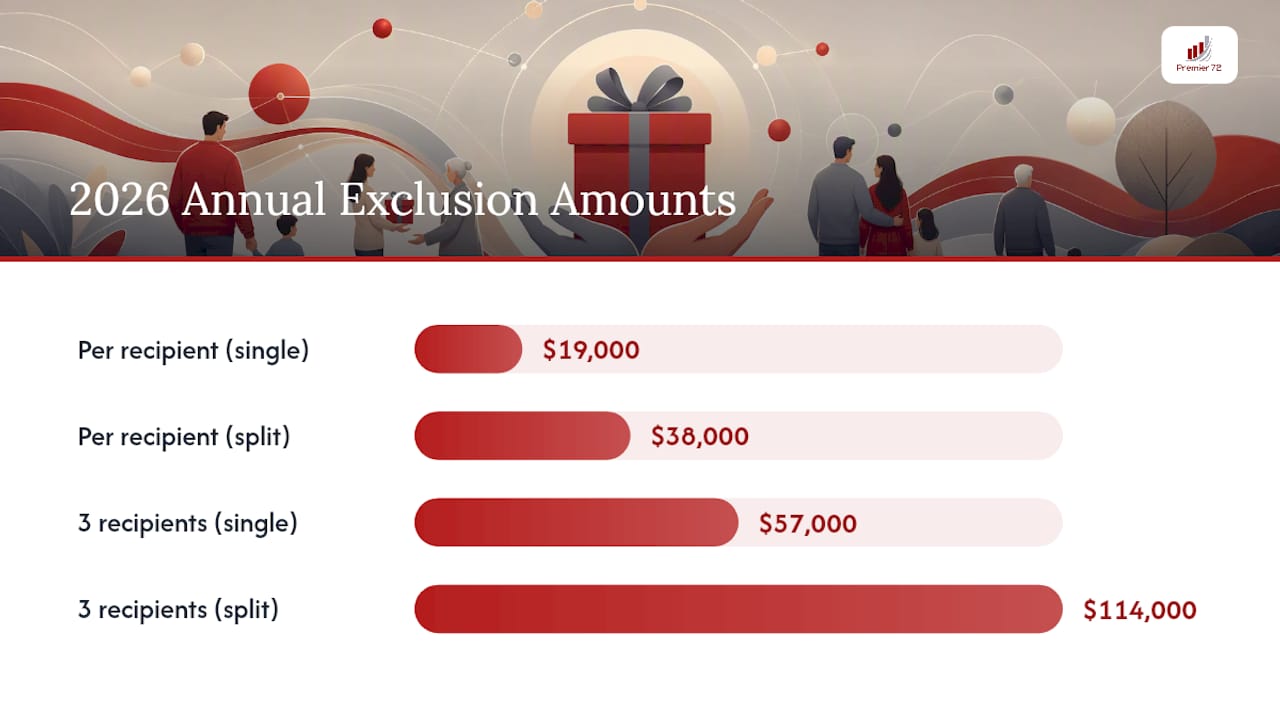
The per-donee rule is what makes annual gifting so powerful as a planning tool. You are not limited to one $19,000 gift per year. You can give $19,000 to each of your children, grandchildren, friends, or anyone else, and none of those gifts reduce your lifetime exemption.
Here is a straightforward example:
- You have three adult children.
- You give each child $19,000 in 2026.
- Total gifts: $57,000.
- Federal gift tax owed: $0. Lifetime exemption reduced: $0. Form 709 required: No.
Now add a spouse who elects gift-splitting:
- You and your spouse give each of the three children $38,000 ($19,000 from each of you).
- Total gifts: $114,000.
- Federal gift tax owed: $0. Lifetime exemption reduced: $0.
- Form 709 is required to document the gift-splitting election, even though no tax is owed.
Vanguard's gift tax guidance confirms that donors may give up to the annual exclusion amount to any number of recipients without affecting the lifetime exemption, making this one of the most accessible estate-reduction tools available to families.
How the $19,000 figure has changed over time
The annual exclusion is not fixed by statute at a specific dollar amount. The IRS adjusts it periodically for inflation, always in increments of $1,000. The table below shows how the per-donee exclusion has increased in recent years as adjusted by the IRS for inflation.
The IRS confirmed the 2026 exclusion remains at $19,000 on its "What's New — Estate and Gift Tax" page. The exclusion jumped $3,000 between 2022 and 2023 alone, reflecting the broader inflation environment of that period, then continued rising by $1,000 increments through 2025 before holding steady for 2026.
$19,000 per recipient in 2026. A married couple electing gift-splitting can transfer $38,000 to each recipient this year without any federal gift tax liability or reduction in their lifetime exemption.
When the IRS does adjust the exclusion, it announces the new amount in the fall of the preceding year through a Revenue Procedure. Watching for that announcement each October or November is a simple habit that keeps your gifting plan current.
Transfers that aren't subject to gift tax at all
Several categories of transfers fall completely outside the gift tax system, regardless of amount. These are statutory exclusions, not just planning strategies, and they apply on top of the $19,000 annual per-donee limit.
The primary categories, as confirmed by the IRS gift tax FAQs, are:
- Direct tuition payments: Payments made directly to an educational institution for tuition. Room, board, books, and fees do not qualify.
- Direct medical payments: Payments made directly to a medical provider or insurance company for someone's medical care.
- Gifts to a U.S. citizen spouse: Transfers between spouses who are both U.S. citizens are fully exempt under the unlimited marital deduction.
- Gifts to political organizations: Transfers to qualified political organizations for their use.
The "direct payment" requirement
The tuition and medical exclusions hinge on one operational detail: the payment must go directly to the institution or provider. If you give your grandchild $30,000 to pay their tuition and they write the check to the university, the transfer is a taxable gift. If you write the check to the university yourself, it is fully excluded. The same logic applies to medical payments.
Non-U.S. citizen spouses receive a different, higher annual exclusion rather than the unlimited marital deduction. The exact threshold for 2026 is set in the Form 709 instructions, and it is materially higher than the standard $19,000 per-donee limit. If your spouse is not a U.S. citizen, confirm the current figure in those instructions before planning large transfers.
Pro Tip: When making direct tuition or medical payments, keep a copy of the check or wire confirmation showing the payment went to the institution or provider, not to the individual. This single document is your audit defense if the IRS ever questions whether the exclusion applies.
When you need to file Form 709
Form 709, the United States Gift (and Generation-Skipping Transfer) Tax Return, is the federal form used to report taxable gifts. You do not file it every year automatically. You file it only when a triggering event occurs.
The main triggers are:
- You gave any single recipient more than $19,000 in the calendar year.
- You and your spouse elected gift-splitting, even if no individual gift exceeded $19,000.
- You made a gift of a future interest, regardless of the dollar amount.
- You made a gift subject to generation-skipping transfer tax.
Filing deadline and extensions
Form 709 is due on the same date as your federal income tax return, generally April 15 of the year following the gift. If you file for an extension on your income tax return, that extension also extends the time to file Form 709. However, an extension to file is not an extension to pay any gift tax owed. If you expect to owe gift tax, you should estimate and pay it by the original April 15 deadline.
Gift-splitting: how it works
Gift-splitting allows a married couple to treat a gift made by one spouse as if each spouse gave half. Both spouses must consent to the election, and both must sign Form 709. The election applies to all gifts made to third parties during the calendar year, not just selected gifts.
Here is the practical sequence:
- One spouse writes a $38,000 check to an adult child.
- Both spouses agree to elect gift-splitting.
- Each spouse is treated as having given $19,000, which equals the annual exclusion.
- Both spouses file Form 709 to document the election. No gift tax is owed, and no lifetime exemption is used.
Pro Tip: Keep a dedicated folder for each tax year containing gift documentation: the date of each gift, the amount, the recipient's full name and relationship, and proof of delivery (bank statement, wire confirmation, or cancelled check). This makes Form 709 preparation straightforward and gives you a clean audit trail.
How annual exclusion gifts interact with your lifetime exemption
The federal gift and estate tax system has two layers: the annual exclusion and the lifetime exemption. Understanding how they interact is where planning decisions get consequential.
Gifts at or below the $19,000 annual exclusion per recipient are completely outside the system. They do not appear on Form 709, and they do not reduce your lifetime exemption. Gifts above the annual exclusion are called "taxable gifts," even though they rarely produce immediate tax. Instead, they are reported on Form 709 and applied against your lifetime exemption.
- Annual exclusion gifts: No reporting, no reduction in lifetime exemption.
- Taxable gifts (above the annual exclusion): Reported on Form 709, reduce the lifetime exemption dollar for dollar.
- Gifts after the lifetime exemption is exhausted: Subject to federal gift tax at the applicable rate.
A numeric example
Supposes you give your adult child $119,000 in 2026 as a down payment on a home.
- The first $19,000 is covered by the annual exclusion. No tax, no reporting for that portion.
- The remaining $100,000 is a taxable gift. You report it on Form 709.
- Your lifetime exemption is reduced by $100,000.
- No gift tax is owed unless your cumulative taxable gifts have already exhausted your lifetime exemption.
The current federal lifetime gift and estate tax basic exclusion amount is substantial, meaning most families will not exhaust it through ordinary gifting. However, business owners with significant asset concentrations, real estate holdings, or illiquid equity should model the cumulative effect of large gifts over time. The Fidelity estate and gift tax explainer walks through how gift-splitting and annual exclusion gifts work together to reduce a taxable estate efficiently.
Practical strategies for business owners and families
Annual gifting is not just a personal finance tool. For business owners preparing for exit or succession, it is a structural lever that can move significant value out of a taxable estate over time, with no immediate tax cost.

Removing business value from your estate
Consider a business owner with a company valued at $5 million. Each year, the owner and spouse can gift $38,000 in business interests (or cash equivalent) to each of their two adult children. Over ten years, that is $760,000 transferred out of the estate with no gift tax and no reduction in lifetime exemption. When combined with valuation discounts on minority interests in a closely held business, the effective transfer can be even larger.
Pairing annual gifts with insurance-based liquidity
Annual exclusion gifts work well alongside life insurance strategies for estate tax funding. A common structure involves gifting cash to an irrevocable life insurance trust (ILIT), which then uses those funds to pay premiums on a life insurance policy. The death benefit passes outside the estate, providing liquidity to pay estate taxes or equalize inheritances among heirs who receive different assets, such as one child receiving the business and another receiving cash.

For business owners with buy-sell agreements, annual gifts can also fund premium payments on policies that support the agreement, reducing the out-of-pocket cost to the business or the co-owners. Life insurance in estate equalization is a particularly relevant strategy when one heir is active in the business and others are not.
Estate equalization for blended families
Parents with children from multiple relationships often face unequal asset distributions. Annual gifting, structured deliberately over several years, can equalize what each child receives without triggering gift tax. This is especially relevant for estate planning for parents of young children, where the planning horizon is long and small annual gifts compound meaningfully over time.
Pro Tip: Premier72's Retirement Bank Method™ includes scenario modeling for annual gifting as part of a broader exit and succession plan. If you are a business owner within five to ten years of a transition, modeling your gifting capacity now, before the business is sold, gives you the most flexibility.
Common scenarios: down payments, large gifts, and gifts to minors
Giving $75,000 toward a child's home purchase
You want to help your adult child buy a house and plan to give $75,000.
- Your $19,000 annual exclusion applies first.
- The remaining $56,000 is a taxable gift, reported on Form 709.
- Your lifetime exemption is reduced by $56,000.
- No gift tax is owed unless your lifetime exemption is already exhausted.
- If your spouse joins and you elect gift-splitting, the first $38,000 is excluded, and only $37,000 reduces the lifetime exemption.
Can a $50,000 gift be completely tax-free?
Yes, under the right structure. A married couple electing gift-splitting can give $38,000 to one recipient with no tax and no exemption reduction. The remaining $12,000 is a taxable gift that reduces the lifetime exemption but produces no immediate tax. Alternatively, if the $50,000 covers tuition paid directly to a university, the entire amount is excluded regardless of the annual limit.
Parents giving $100,000 to two children
A couple with two adult children wants to give $100,000 total.
- Each child receives $50,000.
- With gift-splitting, each spouse is treated as giving $25,000 per child.
- Each spouse's annual exclusion covers $19,000 per child.
- Each spouse has a taxable gift of $6,000 per child, or $12,000 total per spouse.
- Both spouses file Form 709. No gift tax is owed. The lifetime exemption for each spouse is reduced by $12,000.
SmartAsset's 2026 gift tax summary provides additional scenario breakdowns for readers who want to step through different gift amounts.
Gifts to minors and the present interest requirement
Giving cash directly to a minor child is straightforward, but the present interest requirement adds a layer of complexity. A minor cannot legally manage property, so a direct gift may not qualify as a present interest unless a custodian or guardian can use the funds for the child's immediate benefit.
- UGMA/UTMA custodial accounts: Transfers to these accounts generally qualify as present interest gifts because the custodian can use the funds for the child's benefit without restriction.
- 529 education savings accounts: Contributions qualify as present interest gifts. A special rule allows a one-time contribution of up to five years' worth of annual exclusions ($95,000 per donor, or $190,000 for a married couple electing gift-splitting) with an election to spread the gift over five years for gift tax purposes.
- Trusts with restrictions: A trust that prevents the minor from accessing funds until age 25 or later is a future interest gift and does not qualify for the annual exclusion without a specific Crummey withdrawal right provision.
Recordkeeping, valuation, and state tax considerations
Good records are what separate a clean Form 709 filing from a stressful audit. The documentation burden is modest when gifts are cash, but it grows with complexity.
What to keep for every gift
- Date of the gift and the calendar year it falls in
- Full legal name and relationship of each recipient
- Amount or fair market value of the property transferred
- For noncash gifts: a description of the property and how fair market value was determined
- For tuition and medical exclusions: proof that payment went directly to the institution or provider (cancelled check, wire confirmation, or payment receipt)
- For business interests or real estate: a qualified appraisal from a credentialed appraiser
Valuing noncash gifts
Fair market value is the price a willing buyer would pay a willing seller, with neither under compulsion and both having reasonable knowledge of the facts. For publicly traded securities, that is the average of the high and low trading prices on the date of the gift. For closely held business interests, real estate, or collectibles, a qualified appraisal is the standard. The IRS can challenge valuations on audit, and an undocumented valuation is difficult to defend.
State gift and estate taxes
Federal gift tax rules are uniform across all 50 states, but state-level estate and inheritance taxes are not. Several states, including Massachusetts, Oregon, and Maryland, impose estate taxes with exemption thresholds well below the federal level. A few states, including Connecticut, have historically imposed a state-level gift tax as well. Annual gifting that is completely tax-free at the federal level may still have state implications depending on where you live or where your assets are located. Consulting a qualified advisor who knows your state's rules is the practical step here.
Pro Tip: Keep a simple spreadsheet updated each December showing every gift made during the year: recipient, date, amount, and whether it was a direct tuition or medical payment. Thirty minutes at year-end saves hours when Form 709 is due in April.
Why business owners should act on annual gifting now
Annual gifting is one of the few estate planning tools that requires no complex structure, no legal documents, and no minimum asset threshold to use. For business owners in the middle years of building and running a company, it tends to get deprioritized in favor of more immediate operational concerns. That is a costly delay.
The math is straightforward: a business owner and spouse who gift $38,000 per year to each of three children remove $114,000 from their taxable estate annually. Over a decade, that is $1.14 million transferred with no gift tax and no reduction in lifetime exemption. When the business is eventually sold and the estate is at its largest, those years of consistent gifting have already done their work.
The connection to exit planning is direct. Gifting business interests before a sale, when values may be lower and valuation discounts may apply, can be more efficient than gifting cash after the sale. Pairing those gifts with insurance-based liquidity strategies, as Premier72 models through The Retirement Bank Method™, creates a coordinated plan rather than a series of disconnected decisions. The time to model these scenarios is before the business is sold, not after.
How Premier72 can help you build a gifting and legacy plan
Premier72 works with business owners and families who want their wealth transfer decisions to be deliberate, not reactive. The annual gift tax exclusion is one pillar of a broader estate and exit plan, and it works best when it is coordinated with your business valuation, your succession timeline, and your insurance-based liquidity strategy.

Through The Retirement Bank Method™, Premier72 models how annual gifting, lifetime exemption planning, and insurance strategies work together to protect what you have built and transfer it on your terms. Whether you are thinking about a down payment gift to a child, a business interest transfer to a successor, or a multi-year gifting plan designed to reduce your taxable estate before a sale, Premier72 can run the numbers and show you the options clearly.
For families navigating complex structures, Premier72 also coordinates with estate planning attorneys and CPAs to make sure your gifting plan is documented correctly and filed on time. Visit Premier72 to schedule a planning review and see how a structured gifting strategy fits your 2026 priorities.
Sources
The sources below are the most reliable references for the 2026 annual gift tax exclusion rules. Each serves a distinct purpose depending on how deep you need to go.
- What's new — Estate and gift tax | Internal Revenue Service
- Lifetime estate gift tax & annual gift exclusions
- Understanding gift tax rules and limits | Vanguard
This article is general information, not a substitute for advice from a qualified financial advisor. Consult a qualified financial professional about your own circumstances before acting on anything here.