

Premium financed life insurance fits a narrow profile: business owners and high-net-worth families with concentrated illiquid assets who need large death benefits without liquidating capital, and who can absorb collateral calls if rates rise or a policy underperforms. The core tradeoff is simple. You preserve liquidity today in exchange for callable, variable-rate bank debt tomorrow. Everything below explains the mechanics, the risks, and the exit plan you need before signing anything.
TL;DR:
- Borrowers need outside collateral covering several years of potential calls, as policies rarely cover the full loan amount at inception.
- A defined future event like a business sale or liquidity event is essential to reliably pay off the loan, avoiding reliance on hope.
- Stress testing for rate hikes, credit shortfalls, and collateral declines is crucial to determine whether the strategy can withstand adverse scenarios.
- Negotiating fixed or capped spreads, longer cure periods, and collateral substitution rights reduces the risk of forced liquidation during financial stress.
- Proper governance, trustee authority, and documentation are key to avoiding legal pitfalls and structuring a resilient, long-term financed life insurance plan.
Table of Contents
- What Is Premium Financed Life Insurance and How Does It Work?
- Who Premium Financing Actually Fits: A Suitability Checklist
- Benefits and Risks: What Premium Financed Life Insurance Really Costs
- Underwriting, Collateral, and Typical Lender Terms
- Negotiating With a Premium Finance Lender: What to Push For
- Stress Testing and Exit Strategies You Need Before You Sign
- Governance, Trust Structure, and a Case Template Worth Adapting
- What to Prepare Before You Approach a Lender
- Legal and Regulatory Considerations You Cannot Skip
- Risk Mitigation Beyond the Lender's Term Sheet
- Three Scenarios: How Premium Financing Plays Out Differently
- Why Governance Beats Optimism in Premium Financing
- How Premier72 Helps Qualified Clients Evaluate Premium Financing
- Sources
What Is Premium Financed Life Insurance and How Does It Work?
Premium financing life insurance means a third-party lender, usually a bank with a dedicated life insurance premium finance desk, pays some or all of the premiums on a large permanent policy. You pledge collateral instead of writing a check from savings or brokerage accounts. The loan gets secured by the policy's cash value and, in most cases, by outside assets as well, since early cash value rarely covers the full loan balance.
The policy is typically owned by an irrevocable life insurance trust (ILIT) rather than the insured directly. That structure matters enormously. Assigning the policy and its cash value to the lender as collateral, while keeping trust ownership, is what keeps the eventual death benefit outside your taxable estate. The U.S. Bank overview of premium financing confirms this dual structure: ILIT ownership paired with a collateral assignment, underwritten on both medical and financial grounds before a lender commits.
Not every policy qualifies. Variable universal life is generally non marginable because its cash value floats with market performance, giving lenders no stable collateral base. According to LPL's premium finance guide, lenders favor high early cash value (HECV) whole life and indexed universal life (IUL) policies with strong guaranteed or floor-protected crediting.
A few mechanics to know before you go further:
- Loans typically run for several years per tranche, then get renewed or refinanced.
- Pricing is usually quoted as a benchmark rate, commonly SOFR, plus a spread set by the lender.
- Interest can be paid annually or accrued and added to the loan balance, depending on the structure.
- The lender reassesses collateral value at each renewal, not just at origination.
Who Premium Financing Actually Fits: A Suitability Checklist
Premium financing works for a specific kind of client, not every affluent household. The clearest candidates own a business or hold concentrated illiquid assets (real estate, private equity stakes, a family enterprise) and need substantial estate liquidity without selling those assets at an inopportune time. They also carry enough excess borrowing capacity or liquid reserves to survive a bad few years without panic.
Industry analysis from WealthPoint frames the ideal candidate as someone with net worth well beyond the loan size and a clearly identified future exit event, such as a business sale, liquidity event, or maturing investment. That exit event is what eventually pays off the loan. Without one, you are relying on hope, and hope is not a repayment plan.
This strategy is a poor fit when a client has no outside collateral beyond the policy itself, unstable or seasonal cash flow, or an estate plan that could absorb a lower death benefit funded conventionally. If a $2 million policy would strain your balance sheet under a rate shock, financing a $20 million policy will not solve that problem. It magnifies it.
A basic pre-qualification checklist looks like this:
- Do you have liquid or borrowable assets outside the policy equal to several years of potential collateral calls?
- Is there a defined future event (sale, liquidity event, maturing asset) that could retire the loan?
- Can your ILIT trustee act quickly to approve additional collateral or a refinance if needed?
- Have you modeled what happens if rates rise 300 basis points and stay there for three years?
- Does your advisory team include a lender with real premium finance experience, not just a generalist private banker?
Pro Tip: If you cannot answer question four with a specific dollar figure, you are not ready to sign a term sheet, no matter how compelling the illustration looks.
Benefits and Risks: What Premium Financed Life Insurance Really Costs
The benefits are real, and they explain why this strategy has stayed popular among business owners for decades. Financing lets you avoid liquidating appreciating assets, such as real estate or a closely held business, just to fund premiums. It also frees up capital that keeps working elsewhere, whether that means reinvesting in the business or maintaining other investment exposure. For estate planning specifically, it can fund a death benefit sized to cover estate taxes or a buy-sell obligation without draining the estate's other assets, supporting effective financial planning. U.S. Bank's analysis lays out these liquidity advantages clearly, alongside the risks that come with them.
Those risks are where deals actually fail:
- Interest-rate volatility. Loans priced at SOFR plus a spread reprice fast when short-term rates move; your policy's crediting rate does not move nearly as quickly.
- Policy underperformance. Illustrations assume a crediting rate that may not hold up over 10 or 20 years.
- Collateral calls. When cash value or outside collateral falls below the lender's required threshold, you post more collateral or pay down the loan, often on short notice.
- Refinancing risk. At the end of each loan term, the lender can decline to renew on the same terms, or at all.
- Gift and estate tax exposure. Poorly structured trust contributions or loan guarantees can create unintended gift tax consequences.
Litigation analysis from BHSEC Law traces most failed premium finance arrangements back to two causes: illustrations that assumed optimistic crediting rates and borrowing costs, and insufficient outside collateral to survive a downside scenario. Illustrations are planning tools. They are not guarantees, and treating them as promises is the single most expensive mistake in this business.
Underwriting, Collateral, and Typical Lender Terms
Getting approved for premium financing looks a lot like getting approved for a substantial commercial loan, because that is essentially what it is. Lenders want full financial transparency before they commit capital against a policy that might not mature into a death benefit for decades.
Expect to provide personal financial statements, several years of tax returns, a liquidity schedule showing your borrowable and liquid assets, and complete ILIT and policy documentation. The U.S. Bank guide notes that both medical and financial underwriting happen in parallel, since the lender is evaluating insurability and creditworthiness simultaneously.
Collateral treatment follows a few consistent patterns:
- Policy cash value is typically discounted, or "haircut," below its stated value, since insurers apply surrender charges and lenders want a margin of safety.
- Outside asset pledges (brokerage accounts, real estate, business interests) fill the gap between the haircut cash value and the loan balance.
- Lenders reassess collateral at set intervals, often annually, and can issue a margin call if values fall short.
- Reporting cadence usually includes annual financial updates and policy in-force illustrations.
Loan sizing depends on total premium commitment and collateral capacity, with most structures broken into multi-year tranches priced off SOFR plus a spread. According to reporting on failed deals from Insurance Curator, the spread and margining mechanics vary widely by lender, and those differences matter far more over the life of the loan than the headline rate quoted at closing. Covenant language, such as minimum collateral coverage ratios, gets buried in term sheets and deserves the same scrutiny as the interest rate itself.
Negotiating With a Premium Finance Lender: What to Push For
The interest rate gets all the attention in initial proposals, but it is rarely the term that determines whether a deal survives a bad decade. Margining mechanics, cure periods, and collateral flexibility matter more, and they are negotiable if you push before signing.
Priority items to negotiate include:
- Capped or fixed spreads over the benchmark rate, rather than a spread that can widen at renewal.
- Longer cure periods after a collateral call, giving you weeks instead of days to respond.
- Collateral substitution rights, so you can swap in different assets rather than being forced to liquidate a specific holding.
- No-acceleration-on-death carve-outs, where feasible, so the loan does not automatically become due immediately at the insured's death.
- Soft margining language that avoids automatic forced liquidation the moment a threshold is breached.
Insight from Insurance Curator makes the case plainly: negotiating capped spreads, extended cure periods, and substitution rights reduces forced-sale risk during stress far more than shaving a few basis points off the initial rate.
Lender experience matters just as much as pricing. A bank with a dedicated premium finance desk, one that has managed clients through a full rate cycle, understands how to structure covenants that protect both sides. A generalist private bank offering a slightly better headline rate but no track record in this niche is often the riskier partner.
Pro Tip: Ask any prospective lender for two references from clients who went through a collateral call. How that lender behaved during stress tells you more than any rate sheet.
Red flags include vague margining language, no defined cure period, and reluctance to put substitution rights in writing.
Stress Testing and Exit Strategies You Need Before You Sign
Every premium finance arrangement needs a documented exit plan before the first premium gets paid, and that plan needs to survive scenarios worse than the illustration ever shows.
Run these stress tests before committing:
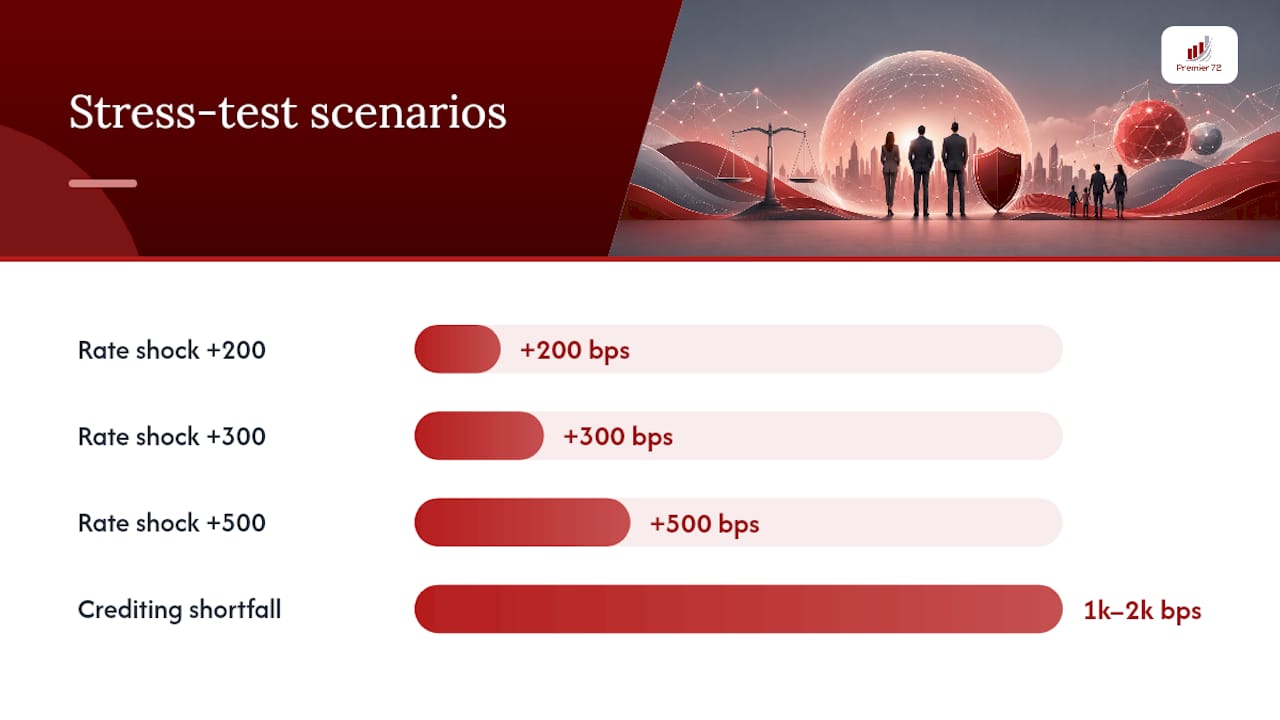
- Rate shock scenarios. Model the loan at +200, +300, and +500 basis points over the starting benchmark, held for at least three consecutive years.
- Crediting shortfalls. Test the policy at 1,000 to 2,000 basis points below the illustrated crediting rate over a multi-year window, not just a single bad year.
- Liquidity shock. If your outside collateral is tied to business cash flow, model a scenario where that business hits a downturn at the same time rates rise.
- Combined stress. Layer a rate shock and a crediting shortfall together, since the two often arrive in the same environment.
Analysis from Quantum Law Group identifies the core failure mode directly: loan rates reprice almost immediately with SOFR, while policy crediting lags behind by design. That mismatch is where collateral calls originate, and it is exactly what these stress tests are built to expose.
If the numbers get uncomfortable, you need real exits, not hypothetical ones. Options include refinancing with a new lender or better terms, posting additional collateral to buy time, repaying the loan outright with outside funds, converting the policy to paid-up or reduced paid-up status, pursuing a life settlement sale of the policy, or surrendering the policy as a last resort. Insurance Curator's analysis of failed deals walks through each of these paths and the tradeoffs attached to them. Document trustee authority to execute any of these moves in advance. Waiting for a crisis to ask an ILIT trustee for emergency approval is how manageable problems become forced liquidations.
Governance, Trust Structure, and a Case Template Worth Adapting
Premier72 approaches premium financing the way it approaches every business protection engagement: governance first, product second. The Retirement Bank Method™ was built on the idea that a plan only holds up if the paperwork, the trustees, and the stress tests were done properly before money moved. Premium financing is a case study in why that discipline matters. It concentrates risk on the borrower's balance sheet and the trustee's judgment simultaneously.
A workable engagement template for advisors and owners follows four steps: gather inputs (net worth, borrowing capacity, defined exit event, existing trust structure), run the stress scenarios described above, negotiate lender protections before signing anything, and document the exit path with named trustee authorities attached.
A trustee and ILIT governance checklist should include:
- Written trustee authority to approve additional collateral pledges without a full trust amendment.
- A pre-agreed valuation methodology for any collateral substitution.
- Annual review triggers tied to loan renewal dates, not just calendar year-end.
- A named backup liquidity source the trustee can access without insured cooperation.
Learn more about how insurance-funded planning supports business legacy goals and how these structures fit into broader wealth transfer planning.
What to Prepare Before You Approach a Lender
Getting from proposal to funded policy takes real preparation, and the timeline rewards owners who show up organized.
Gather these documents first:
- Personal and, if applicable, business financial statements from the last two to three years.
- Tax returns covering the same period.
- Current life insurance policy illustrations, if a policy already exists.
- A liquidity schedule showing borrowable capacity and unencumbered assets.
- Existing ILIT documents, or a plan to establish one before funding.
Ask prospective advisors and lenders directly how they handle collateral calls, what their cure periods look like, and whether they have managed clients through a full rate cycle. Based on typical underwriting timelines noted by WealthPoint, expect roughly several weeks to a few months from initial proposal to funding, depending on medical underwriting speed and document turnaround.
Stop the process early if you cannot identify a defined exit event, or if your outside collateral would be exhausted by a single rate shock scenario.
Legal and Regulatory Considerations You Cannot Skip
Premium financing sits at the intersection of insurance regulation, trust law, and lending law, and problems in any one area can unwind the whole structure. Insurable interest rules require the insured to have a genuine relationship to the policy at inception; structures designed primarily to profit an unrelated third party can draw regulatory scrutiny in several states.
STOLI (stranger-originated life insurance) concerns are the sharpest legal risk in this space. Regulators and insurers actively watch for financing arrangements that look like a disguised STOLI transaction, where the real economic interest belongs to an investor rather than the family or business the policy is meant to protect. A properly structured ILIT with a genuine insurable interest and a real family or business purpose avoids this exposure, but the documentation needs to make that purpose explicit.
Trust law adds another layer. The trustee has fiduciary duties to beneficiaries that can conflict with a lender's collateral demands during a stressed renewal. Litigation traced by BHSEC Law shows that disputes often arise not from the financing structure itself, but from ambiguity over who had authority to pledge collateral or approve a refinance under pressure.
Gift tax rules also apply to trust contributions used to service loan interest or post collateral, and getting the annual exclusion or Crummey notice mechanics wrong can trigger unexpected tax exposure. None of this is a reason to avoid the strategy. It is a reason to insist on counsel experienced specifically in premium finance transactions, not general estate planning counsel handling a first case.
Risk Mitigation Beyond the Lender's Term Sheet
Negotiating better lender terms solves part of the risk equation. The rest comes down to structural choices you control independently of any single bank.
Alternative collateral options reduce dependence on the policy's own cash value. Pledging a diversified brokerage account, a fractional interest in real estate, or a standby letter of credit gives you more flexibility than relying solely on policy cash value that a lender has already discounted. Some owners negotiate a blended collateral pool from the start, splitting exposure across two or three asset types so a decline in one does not trigger an immediate call.
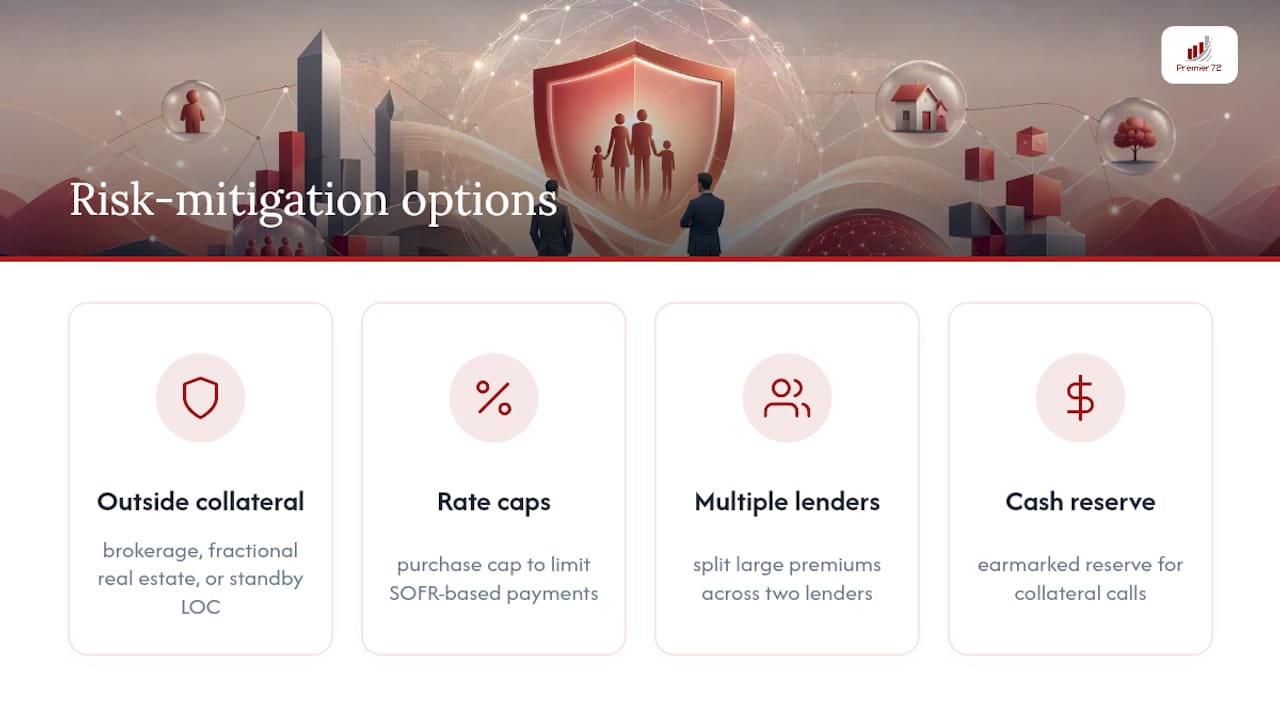
Interest rate hedging is underused in this space but worth exploring for larger loans. Interest rate caps, purchased through the lending bank or a third party, put a ceiling on how high your SOFR-based payment can climb, converting an open-ended rate risk into a known maximum cost. This is not free, but for a loan sized in the millions, the cap premium can be cheap insurance against the exact scenario that sinks most failed deals: a multi-year rate spike that outlasts the borrower's patience.
Diversifying across two lenders for very large premium commitments is another option some family offices use, avoiding concentration risk with a single institution's covenant terms and renewal appetite. Finally, building a dedicated cash reserve specifically earmarked for collateral calls, separate from general liquidity, keeps a temporary rate shock from turning into a forced-sale event elsewhere in the balance sheet. Combining even two of these approaches meaningfully changes the risk profile of a deal versus relying on lender terms alone.
Three Scenarios: How Premium Financing Plays Out Differently
Scenario one: the business owner with a defined exit. A manufacturing company owner in her late 50s plans to sell the business in six to eight years. She finances a $15 million death benefit through an ILIT, using a diversified investment portfolio as outside collateral. Rates rise 250 basis points two years in; she posts additional collateral from that portfolio without disruption, because the stress test anticipated exactly this. The eventual business sale retires the loan as planned.
Scenario two: the aggressive illustration, no cushion. A family relies on an illustration assuming a consistently high crediting rate and stable low borrowing costs, with minimal outside collateral beyond the policy itself. When crediting underperforms and rates climb simultaneously, the family faces a collateral call it cannot meet from outside assets. This is the exact failure pattern BHSEC Law's litigation analysis describes: optimistic assumptions plus insufficient outside collateral.
Scenario three: the negotiated safety net. A business owner negotiates capped spreads and a 90-day cure period before signing, rather than accepting the lender's standard terms. When a collateral shortfall arises three years in, that extended cure period gives the ILIT trustee time to arrange a collateral substitution rather than a forced sale. The loan terms themselves, negotiated up front, become the difference between a manageable adjustment and a crisis.
Why Governance Beats Optimism in Premium Financing
The biggest structural failure in premium financing is not a bad lender or a rogue market move. It is a plan built on an illustration that everyone quietly hoped would hold up, without anyone documenting what happens if it doesn't. I've seen the pattern repeat across the case studies and litigation analysis referenced throughout this piece: aggressive assumptions, thin outside collateral, and no trustee authority pre-approved for a crisis that eventually arrives.
Conservative modeling is not pessimism. It's the only honest way to evaluate whether a family or business can actually carry this strategy through a full rate cycle. Premier72 builds governance into these engagements from the start, coordinating trustee authority, lender negotiation, and stress testing before a single premium gets financed, because a strategy this powerful deserves exactly that level of scrutiny.
— Asa
How Premier72 Helps Qualified Clients Evaluate Premium Financing
Premier72 gives business owners something most financing proposals skip entirely: a governance-first review before any lender term sheet gets signed. Where a bank's premium finance desk is selling a loan, Premier72 evaluates whether the strategy fits your balance sheet, your trust structure, and your actual exit event, not just your net worth on paper.

That review includes a suitability assessment against the profile outlined earlier, support setting up or reviewing your ILIT structure, hands-on lender RFP coordination and term sheet negotiation, and the stress testing and trustee governance checklist that separates durable deals from the ones that unwind in year three. Premier72 also helps you think through how a financed policy fits alongside other wealth preservation strategies already in place.
This is not a fit for every household. It is built for owners and families who meet the profile: real outside collateral, a defined future exit, and the appetite to stress-test before committing capital. If that sounds like your situation, start a conversation with Premier72 about whether premium financing belongs in your plan.
This article is general information, not a substitute for advice from a qualified financial advisor. Consult a qualified financial professional about your own circumstances before acting on anything here.
Sources
- Life insurance premium financing: Is it right for you? — U.S. Bank
- Premium Financing — BHSEC Law (Jason Casco analysis)
- When premium financing backfires: Lessons from failed deals — Insurance Curator