

Reps and warranties insurance (RWI) shifts the financial risk of a breach in the seller's representations and warranties from the deal parties to an insurer. Buyers purchase most policies, and the primary payoff is a cleaner exit for sellers and a faster, less contentious path to closing for buyers. RWI has become a standard tool in middle-market deals above a certain transaction enterprise value threshold, priced through a premium, an underwriting fee, and a retention.
TL;DR:
- RWI primarily covers unknown breaches related to financial, IP, contract, tax, and asset representations, but excludes issues flagged during diligence or disclosed in schedules.
- Buy-side policies are most common, allowing direct claims against insurers, while sell-side policies mainly protect sellers and are less prevalent in practice.
- Overall costs include a 2.5% to 3.5% premium, non-refundable underwriting fees, and a retention of about 0.5% to 1% of deal enterprise value, totaling hundreds of thousands for large deals.
- Initiating RWI negotiations at the LOI stage and aligning baskets with retentions can significantly reduce last-minute exclusions and improve deal economics.
- Proper preparation, including clean financials and thorough disclosures, shortens underwriting timelines and minimizes coverage disputes during claims.
Table of Contents
- What Reps and Warranties Insurance Covers and How It Works
- Buy-Side vs. Sell-Side Policies: Who's Actually Insured
- Benefits for Buyers and Sellers in the Deal
- Coverage Scope and Common Exclusions in RWI Policies
- Reps and Warranties Insurance Cost: Premiums, Fees, and Retentions
- Underwriting Process and Timeline: From NBIL to Binder
- When RWI Makes Sense (and When It Doesn't)
- How RWI Changes the Negotiation: Escrow, Baskets, Caps
- Filing a Claim: Investigation and Subrogation Basics
- Premier72's Checklist for RWI-Ready Businesses
- Key Policy Terms Beyond Coverage and Exclusions
- Negotiation Traps in RWI Policy Wording
- RWI Compared to Holdbacks and Traditional Indemnities
- Market Trends Shaping RWI Availability and Pricing
- The Role of Brokers and Advisors in Placing RWI
- Typical Claims Scenarios and What They Teach Us
- Three Negotiation Habits That Separate Good Deals From Bad Ones
- Get Deal-Ready Before You Talk to an RWI Broker
- Sources
What Reps and Warranties Insurance Covers and How It Works
Reps and warranties insurance is a transactional policy that pays for losses tied to breaches of the seller's representations and warranties in the purchase agreement. It sits alongside the deal, not inside it. The insurer steps into the shoes of the seller (in a buy-side policy) or protects the seller directly (in a sell-side policy), covering losses that surface after closing from something nobody caught during diligence.
That last part matters more than most first-time buyers realize. RWI covers unknown breaches, not problems already flagged in the disclosure schedules or found during due diligence. If your quality of earnings report flagged a customer concentration issue, that issue is baked into underwriting and typically excluded from coverage.
Representations commonly insured include:
- Financial statement accuracy and undisclosed liabilities
- Intellectual property ownership and freedom from infringement claims
- Material contract validity and consent requirements
- Tax compliance and unpaid liabilities
- Title to assets and capitalization accuracy
Disclosure quality drives everything here. A thin or rushed disclosure schedule invites broader exclusions, while a thorough one narrows the gap between what the seller promised and what the insurer is willing to stand behind.
Buy-Side vs. Sell-Side Policies: Who's Actually Insured
Buy-side policies dominate the market. The buyer holds the policy and can claim directly against the insurer if a representation turns out to be false, without having to chase the seller or dip into an escrow account. Buy-side placements make up the vast majority of RWI transactions for good reason: they let buyers negotiate aggressively while giving sellers a reason to say yes.
Sell-side policies work differently. The seller buys the coverage and it protects the seller's own indemnification exposure under the purchase agreement.
- Sell-side policies suit private equity funds nearing the end of their life that need to distribute capital without holding large reserves.
- They also fit strategic sellers exiting a distribution relationship who want a clean break from ongoing liability.
- Sell-side coverage accelerates capital return for funds while capping what the seller might owe after the deal closes.
Most brokers will steer you toward a buy-side structure by default, since buyers usually drive the process and the market has built around that preference.
Benefits for Buyers and Sellers in the Deal
RWI reshapes the economics of a transaction for both sides, and the advantages compound once you see how they interact.
- Sellers collect more cash at closing. Instead of parking 10% to 15% of purchase price in escrow for 12 to 24 months, sellers with RWI in place often walk away with the bulk of proceeds immediately, since the escrow gets replaced or sharply reduced by the policy.
- Buyers get a direct claims path. Rather than pursuing a former owner (who may be uncooperative, judgment proof, or simply gone), the buyer files a claim with a rated insurance carrier.
- Business relationships survive the deal. Sellers who stay on as employees, consultants, or minority partners don't have to sue the people they now work alongside.
- Auction dynamics tilt in favor of RWI-backed bids. Sellers running a competitive process often favor buyers who propose RWI upfront, since it signals a smoother path to close with fewer post-closing fights over indemnity language.
Coverage Scope and Common Exclusions in RWI Policies
Every RWI policy insures a defined set of representations, but the exclusions are where deals get complicated. Underwriters won't touch a matter that diligence already surfaced, and they build carve-outs around a handful of categories almost every time.
Standard exclusions include:
- Known issues identified anywhere in the diligence process, whether formally disclosed or not
- Purchase price adjustments and working capital true-ups
- Forward-looking statements, projections, and budgets
- Underfunded pension liabilities in many industries
- Certain environmental exposures depending on the target's sector
Koley Jessen's comparison of RWI and traditional indemnity makes the point directly: RWI does not replace diligence, it insures the gaps diligence didn't catch. Skipping a thorough quality of earnings review or a legal deep dive to save time backfires, since underwriters will simply exclude whatever wasn't properly examined.
Insurers also typically require a No Claims Declaration (NCD) before binding coverage. This document, signed by deal team members, confirms nobody is aware of a breach or claim at the time the policy issues. A sloppy or rushed NCD process is one of the fastest ways to invite a coverage dispute later, since the insurer can point to it if a claim surfaces that someone plausibly should have flagged.
Pro Tip: Loop your RWI broker into the diligence process before it wraps up, not after. Underwriters read every diligence report closely, and a report that raises a question without resolving it almost always becomes an exclusion.
Reps and Warranties Insurance Cost: Premiums, Fees, and Retentions
Budgeting for RWI means understanding three separate cost components, and dealmakers who only ask about "the premium" usually get surprised later by the other two.
The rate-on-line premium typically runs 2.5% to 3.5% of the policy limit, non-refundable underwriting fees usually land in the low five figures, and retentions commonly sit between 0.5% and 1% of transaction enterprise value.
Run the math on a $50 million deal with a $10 million policy limit. Add an underwriting fee, plus applicable surplus lines taxes depending on the jurisdiction, and the all-in cost before a single dollar of claims coverage kicks in can reach $350,000 or more.
The underwriting fee gets paid whether or not the deal ultimately binds. Vanbridge's guidance is explicit that outside counsel and specialist review fees are charged upfront, so a deal that falls apart in the eleventh hour still leaves the buyer holding that bill. Retention structures also often vary by representation category: fundamental reps (title, capitalization, authority) and tax reps sometimes carry a lower or nil retention compared to general business reps, since insurers view breaches in those areas as more clear-cut and less prone to gray-area disputes.
Underwriting Process and Timeline: From NBIL to Binder
Getting an RWI policy bound follows a fairly predictable sequence, and knowing the order helps you avoid the two mistakes that cause the most delay: starting too late and submitting incomplete diligence materials.
- Submit the deal for a non-binding indication of interest (NBIL). This early-stage document gives you a preliminary premium range, retention estimate, and initial view on exclusions, typically at no cost.
- Underwriters begin "diligencing the diligence." Rather than redoing your legal, financial, and operational reviews from scratch, the insurer's team examines the buyer's own diligence reports for gaps, unresolved flags, or thin coverage areas.
- Pay the underwriting fee and move to full underwriting. This is when outside counsel and industry specialists dig into specific representation categories, often requesting a call with your deal counsel.
- Bind the policy, either at signing or at closing. Clean deals with thorough diligence can move through this entire process in roughly one to three weeks.
Pro Tip: Submit for an NBIL the moment you sign the LOI, not after you've finished diligence. Running the insurance process in parallel with diligence, instead of after it, is the single biggest lever for avoiding last-minute exclusions.
When RWI Makes Sense (and When It Doesn't)
RWI earns its cost on the right deal, but it's not automatic. Below a certain size, fixed underwriting fees eat too much of the value proposition.
- Deals above roughly $25 million in transaction enterprise value are the practical threshold where RWI economics work, since the fixed underwriting fee becomes a smaller percentage of overall cost.
- Deals with known, significant issues (active litigation, a pending tax audit, unresolved environmental liability) aren't good candidates, since insurers will simply carve those items out and you're left buying a policy that doesn't cover your actual risk.
- Certain industries, particularly ones with heavy regulatory exposure or underfunded pension obligations, often see narrower coverage or higher pricing regardless of deal size.
- For known risks that RWI won't touch, specific indemnity insurance products or targeted escrow arrangements remain the more appropriate tool.
If your deal falls below that threshold or carries a known problem the insurer won't insure around, a traditional indemnity structure with a modest escrow may simply be the more efficient path.
How RWI Changes the Negotiation: Escrow, Baskets, Caps
Once RWI enters the conversation, the entire indemnity negotiation shifts. Instead of arguing over how much cash sits in escrow for two years, the parties are negotiating how the insurance layer interacts with a much smaller retention.
- Escrow amounts often shrink from the traditional 10% to 15% of purchase price down to just the size of the retention, sometimes 0.5% to 1% of enterprise value.
- Baskets, the threshold of losses before indemnification kicks in, get restructured to align with the policy retention rather than sitting as a separate negotiated number.
- Caps on seller liability often drop close to the retention amount, since the insurer absorbs everything above it up to the policy limit.
- Sellers commonly agree to slightly broader representations in exchange for the buyer accepting a lower escrow, since the insurer, not the seller, bears most of the post-closing risk.
The net effect: sellers negotiate from a position of "we'll represent more broadly" while buyers negotiate from "we need less escrow because insurance backs us up." Both sides get something they actually want.
Filing a Claim: Investigation and Subrogation Basics
Filing an RWI claim starts with a written notice to the insurer describing the alleged breach and the resulting loss, typically as soon as you become aware of it. Insurers then request supporting documentation: the original representation language, financial records showing the loss, and often an independent damages calculation. Investigation timelines vary by complexity, but insurers usually coordinate closely with any remaining escrow funds still tied to the deal.
Subrogation rights let the insurer pursue the seller for reimbursement after paying a claim, though most policies waive subrogation against the seller except in cases of fraud. That fraud carve-out matters: it's the one scenario where a seller who knowingly misrepresented something can still face direct liability, even with RWI in place.
Premier72's Checklist for RWI-Ready Businesses
Owners who prepare early get better underwriting outcomes, plain and simple. A clean, organized data room with three years of reviewed financials, a complete disclosure schedule, and a documented history of prior insurance claims gives underwriters less reason to carve out coverage.
Premier72's exit-readiness work through The Retirement Bank Method™ addresses exactly this gap, tightening financial documentation, formalizing operational systems, and reducing owner dependence long before a term sheet is on the table. The overlap with RWI underwriting isn't a coincidence: insurers reward the same operational discipline that makes a business more sellable in the first place. Owners considering a sale in the next 12 to 24 months should start preparing their business for sale well before engaging an RWI broker, since clean documentation shortens underwriting and narrows exclusions.
Key Policy Terms Beyond Coverage and Exclusions
The coverage grid and exclusions list get the most attention, but the procedural terms buried deeper in the policy often determine whether a claim actually pays out smoothly.
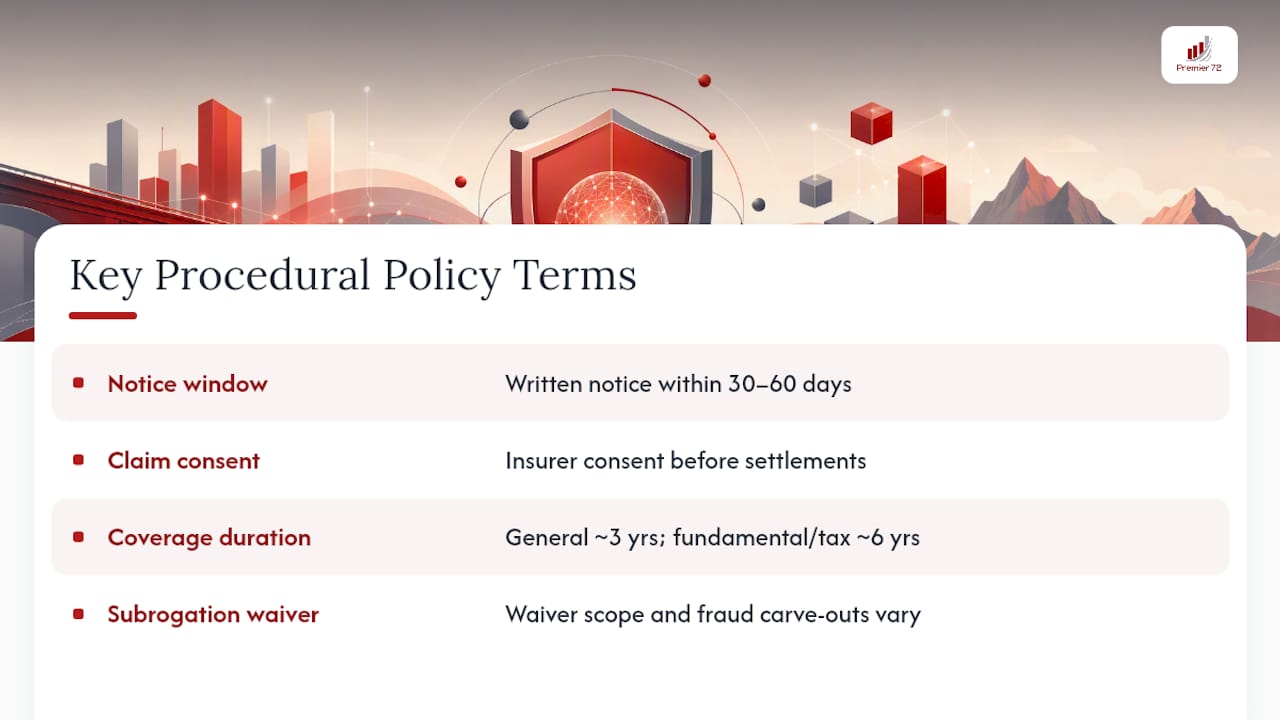
Notice requirements are the first trap. Most policies require written notice of a potential claim within a specific window, often 30 to 60 days, once the insured becomes aware of the underlying facts. Miss that window, even on a claim you'd otherwise win, and the insurer can deny coverage on procedural grounds alone.
Claim consent provisions matter just as much. Many policies require insurer consent before the insured settles a third-party claim or takes certain litigation steps, meaning your deal counsel can't just handle a dispute unilaterally once RWI is involved. Coordinate with the insurer's claims team early rather than presenting them with a settlement already agreed to.
Coverage duration terms deserve close attention too, since they're not uniform across representation types. General representations are commonly insured for around three years, while fundamental representations (title, authority, capitalization) and tax representations often extend to six years, matching statute of limitations exposure on tax matters. Buyers negotiating the policy should match these durations to their actual risk horizon rather than accepting the insurer's default terms.
Subrogation waivers, discussed above in the claims context, also appear here as a negotiated term rather than a fixed feature. Confirm the waiver's scope and its fraud carve-out language before binding, since insurers phrase this differently across carriers.
Negotiation Traps in RWI Policy Wording
The policy wording itself is where experienced deal teams earn their fee, and where first-timers get burned. A few traps show up again and again.
Retention "drop-down" language determines whether the retention decreases over time, often stepping down to a smaller amount after 12 months. Some policies include this automatically; others require you to negotiate for it. Skipping this point leaves money on the table for the buyer.
Definitions of "actual knowledge" for the seller's representations can quietly expand or narrow what counts as a known issue. Broad knowledge definitions (imputing knowledge across an entire management team) make it harder for a seller to claim ignorance, while narrow definitions protect sellers but frustrate buyers trying to establish a breach.
Interplay between the purchase agreement and the policy is a subtle but critical trap. If the indemnification provisions in the purchase agreement don't mirror the representations insured under the policy, gaps open up that neither document covers. Deal counsel and the insurance broker need to review both documents side by side, not in isolation.
Sandbagging provisions, which determine whether a buyer can claim for a breach it already knew about before closing, interact directly with RWI coverage and need careful alignment with the NCD process described earlier.
RWI Compared to Holdbacks and Traditional Indemnities
Escrow holdbacks and seller indemnities remain the default risk allocation tools in smaller deals, and they work fine when the deal size doesn't justify RWI's fixed costs. A holdback ties up seller cash, typically 10% to 15% of purchase price, for a set period, giving the buyer a pool to draw from if a breach surfaces. The seller bears the credit risk directly rather than an insurer standing behind the promise.
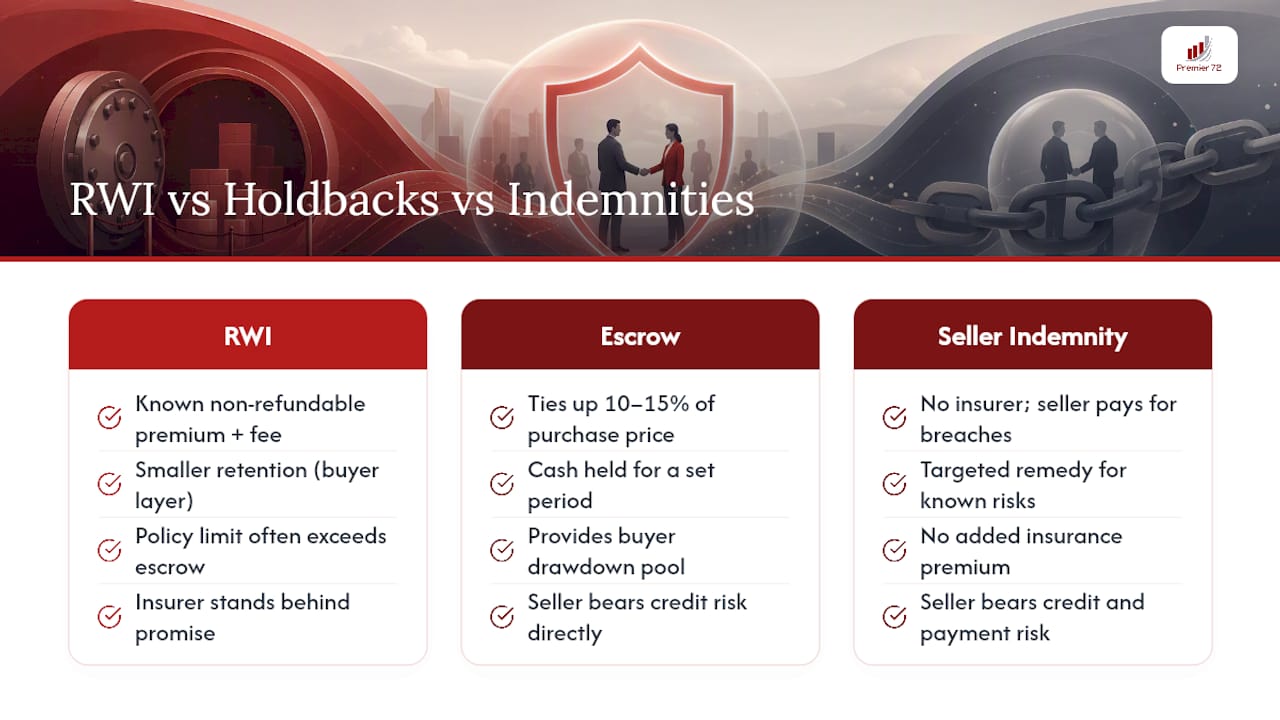
RWI trades a known, non-refundable cost (premium plus underwriting fee) for a smaller retention and a policy limit that often exceeds what any escrow would have held. The tradeoff favors RWI when the deal is large enough to spread that fixed cost thin, and it favors traditional indemnity when the deal is small or when a known risk needs a targeted solution instead of broad insurance. Some deals use both: a modest escrow to cover the retention layer, backed by an RWI policy above it, giving the buyer continuous protection from dollar one.
Market Trends Shaping RWI Availability and Pricing
RWI has matured from a niche product into something close to a standard feature of middle-market M&A, and that maturity has pushed pricing down. Market commentary from Weil's private equity practice notes that premiums and underwriting fees have trended lower as more insurers entered the space and competition increased.
That shift changes deal dynamics in a real way. RWI proposals that once signaled a sophisticated, well-advised buyer are now closer to table stakes in competitive auctions, particularly for private equity buyers who've built RWI into their standard playbook. Sellers running a process increasingly expect it, and buyers who don't offer it risk looking less prepared than the competition.
Capacity has also grown as more carriers and managing general underwriters entered the RWI market, giving deal teams more options when shopping a submission. That competition benefits buyers and sellers alike: more carriers bidding on a submission tends to produce tighter retentions and broader coverage than a market with only a handful of underwriters willing to write the risk.
The Role of Brokers and Advisors in Placing RWI
A specialized insurance broker does far more than shop your deal to a few carriers. Good RWI brokers manage the entire submission process: packaging diligence materials for underwriters, negotiating exclusions before they get baked into a binder, and coordinating between your deal counsel and the insurer's legal team on policy wording.
The broker's leverage comes from relationships and deal volume. A broker who places dozens of RWI policies a year knows which carriers are aggressive on a given industry, which underwriters push back hardest on tax rep coverage, and where there's room to negotiate a lower retention or broader definition of loss. That knowledge is difficult to replicate deal by deal without dedicated volume.
Deal counsel plays a complementary role, reviewing the interplay between the purchase agreement and the policy wording described earlier. The best outcomes happen when the broker, deal counsel, and the buyer's or seller's internal deal team coordinate from the LOI stage forward, rather than looping in the insurance broker only after the purchase agreement is nearly final.
Typical Claims Scenarios and What They Teach Us
Real RWI claims tend to cluster around a handful of representation categories, and each teaches a distinct lesson about preparation.
Undisclosed customer contract issues are common. A target represents that all material contracts are in good standing, but a key customer contract actually required consent to assign that nobody caught during diligence. The claim often turns on whether the buyer's diligence reasonably should have found the issue, which is exactly why thorough contract review matters before underwriting begins.
Financial statement misstatements show up frequently too, particularly around revenue recognition practices that don't match the target's stated accounting policies. These claims tend to resolve faster when the buyer's quality of earnings report already flagged the accounting methodology for underwriter review, since the policy language around that representation is usually clearer.
Tax liability surprises, often from a state or local tax authority pursuing unpaid obligations discovered after closing, illustrate why the extended coverage period for tax representations matters. A claim surfacing four years after closing would fall outside a three-year general rep period but inside a six-year tax rep period, underscoring why matching coverage duration to representation type isn't a minor drafting detail.
The consistent lesson: claims succeed or stall based on how well the underlying representation was diligenced and disclosed before the policy bound, not on clever claims-handling after the fact.
Three Negotiation Habits That Separate Good Deals From Bad Ones
Bring up RWI at the LOI stage, not after the purchase agreement is drafted. Waiting until the eleventh hour forces underwriting into the same tight window as closing, and that pressure produces broader exclusions, not narrower ones.
Align the basket amount with the retention deliberately, rather than negotiating them as separate line items. When they're mismatched, you end up with a gap where losses fall between the seller's indemnity obligation and the policy's payout threshold, and nobody covers that gap.
Document what the buyer's deal team actually knew, and when, with real care. The assumption that RWI will simply cover whatever due diligence found is the most expensive misconception in this entire process. It won't, and assuming otherwise is how deal teams end up disputing a claim they thought was a sure thing.
— Asa
Get Deal-Ready Before You Talk to an RWI Broker
Reps and warranties insurance rewards businesses that show up with clean books, complete disclosure schedules, and a documented operating history, and it penalizes ones that don't. Premier72 helps established business owners get to that point well before a term sheet exists, tightening financial reporting, reducing owner dependence, and organizing the documentation that underwriters and buyers both want to see.

That preparation work runs through The Retirement Bank Method™, Premier72's structured advisory approach to turning an owner-dependent company into a transferable asset. It pairs naturally with insurance-based planning for the transaction itself, whether that means funding a buy-sell agreement ahead of a partner exit or structuring broader business protection coverage around the deal. If you're eyeing a sale in the next one to three years, the smartest move is starting the readiness conversation now, not after your first term sheet lands. Schedule a consultation with Premier72 to walk through where your business stands today.
Sources
- Reps & Warranties Insurance — Vanbridge reference guide (2025)
- Representations and Warranties Insurance in M&A — DarrowEverett
- Representations and warranties insurance: fundamentals and practical considerations — Hunton practice note
This article is general information, not a substitute for advice from a qualified financial advisor. Consult a qualified financial professional about your own circumstances before acting on anything here.